Artificial Intelligence (AI) is transforming how people work, businesses operate, and societies use technology. From virtual assistants and recommendation systems to advanced data analysis and automated business processes, AI is becoming an important part of everyday life. Organizations across industries are exploring AI to improve efficiency, understand customer needs, develop innovative products, and make better decisions.
Artificial intelligence enables computer systems to perform tasks that typically require human intelligence, including recognizing patterns, understanding language, analyzing information, and generating content. Although AI can perform many tasks efficiently, it does not replace human judgment in every situation. Its effectiveness depends on the quality of its data, the design of its systems, and how people use it.
As AI technology continues to advance, understanding its applications, benefits, limitations, and potential risks is becoming increasingly important for businesses, professionals, students, and everyday users.
What Is Artificial Intelligence?
Artificial Intelligence is a field of computer science focused on developing systems that can perform tasks associated with human intelligence. These tasks may include learning from data, recognizing images, understanding spoken or written language, solving problems, and making predictions.
AI systems use different techniques depending on the task. Some follow predefined rules, while others use machine learning models trained on data to recognize patterns and generate outputs.
For example, an email service may use AI to identify spam, a navigation application may estimate travel times, and an online retailer may recommend products based on a customer's browsing activity.
AI is not a single technology. It includes several approaches, such as machine learning, deep learning, natural language processing, computer vision, and generative AI.
These technologies support different applications, from recognizing objects in images to helping businesses analyze large amounts of information.
How Does Artificial Intelligence Work?
Artificial intelligence systems generally process information, identify patterns, and produce an output based on their design and available data.
The exact process varies according to the technology, but many AI applications involve the following stages.
1. Data Collection
AI systems may use text, images, audio, numerical records, sensor readings, or other information. The data must be appropriate for the task and handled according to relevant privacy and security requirements.
2. Data Preparation
Information may need to be cleaned, organized, labeled, or transformed before it can be used effectively. Poor-quality data can reduce the reliability of an AI system.
3. Model Training or Configuration
Machine learning models learn statistical patterns from training data. Other AI systems may rely on rules, pretrained models, or combinations of different techniques.
4. Processing and Prediction
Once deployed, an AI system receives an input and produces an output. Depending on its purpose, this may be a prediction, classification, recommendation, summary, or generated response.
5. Evaluation and Improvement
Developers and organizations evaluate performance to identify errors, limitations, and opportunities for improvement. Some models can be retrained or updated when suitable data becomes available.
AI outputs are not automatically correct. Important results should be evaluated according to the risks and requirements of the task.
Main Types of Artificial Intelligence
Artificial intelligence can be categorized in different ways. The following categories help explain its capabilities and applications.
1. Narrow AI
Narrow AI, also known as specialized AI, is designed to perform particular tasks or a limited range of activities.
Examples include spam filters, voice assistants, recommendation engines, image recognition systems, and fraud detection tools.
Most AI applications currently used in everyday products and business systems fall into this category.
2. Machine Learning
Machine learning is a branch of AI that enables systems to learn patterns from data rather than relying exclusively on manually written rules.
It is used in fraud detection, demand forecasting, customer segmentation, predictive maintenance, and many other applications.
3. Deep Learning
Deep learning uses neural networks with multiple processing layers to identify complex patterns in large datasets.
It supports applications such as speech recognition, image analysis, language processing, and certain advanced prediction systems.
4. Natural Language Processing
Natural language processing, or NLP, helps computers analyze, interpret, and generate human language.
Applications include chatbots, translation tools, document classification, sentiment analysis, and automated text summarization.
5. Computer Vision
Computer vision enables systems to interpret visual information, including photographs, video, and images from cameras or sensors.
It is used in manufacturing inspections, medical image analysis, document processing, security monitoring, and autonomous systems.
6. Generative AI
Generative AI creates new content based on patterns learned from data. It can generate text, images, audio, video, software code, and other outputs.
Businesses and individuals use generative AI for brainstorming, drafting, content creation, research assistance, and software development.
Generated content still requires appropriate review for accuracy, originality, safety, and suitability.
7. Artificial General Intelligence
Artificial general intelligence, or AGI, refers to a proposed form of AI capable of performing a broad range of intellectual tasks at a general level comparable to human abilities.
AGI is a concept in ongoing research and discussion, not a capability that should be assumed to exist in current AI products.
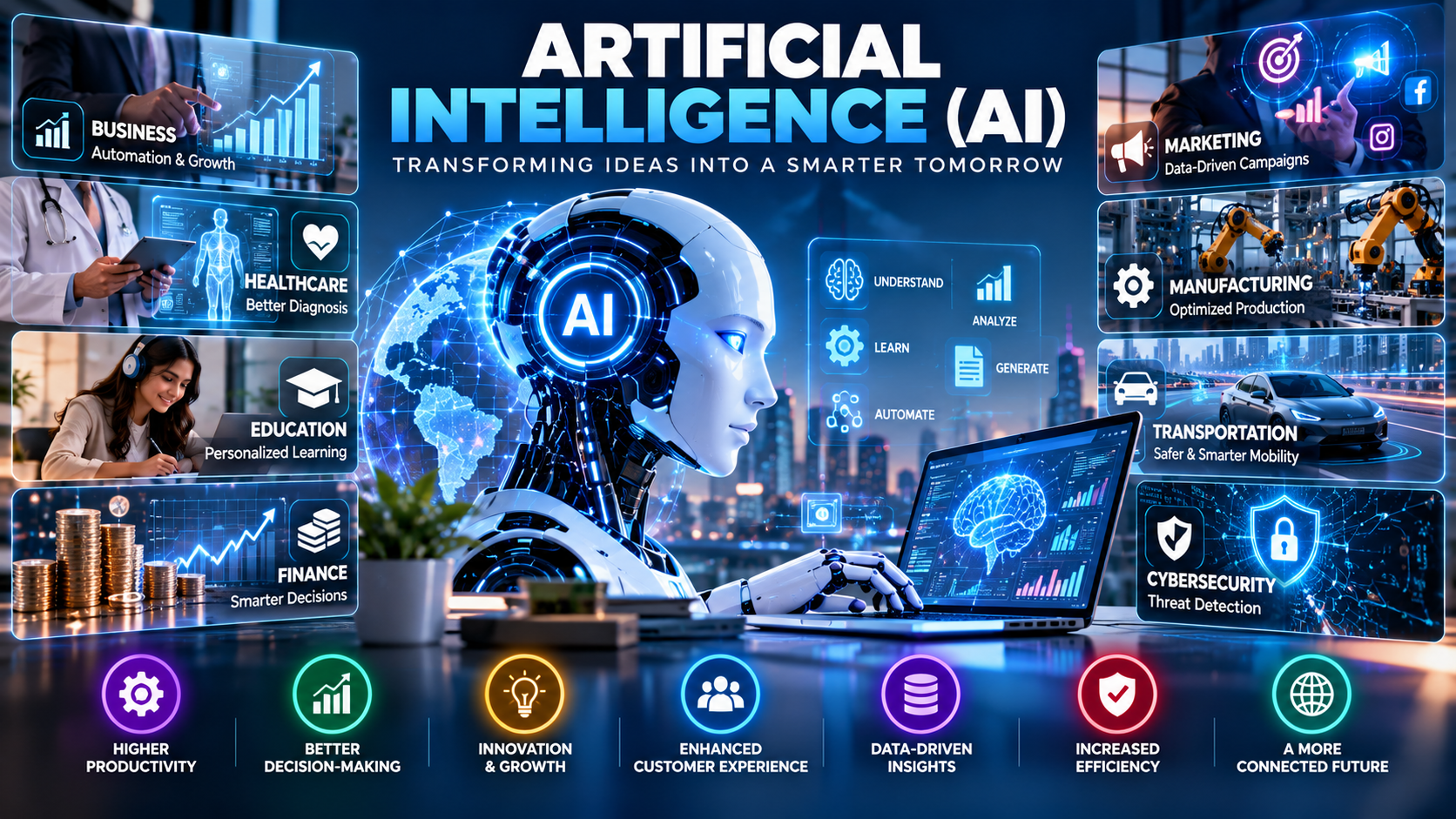
Applications of Artificial Intelligence in Different Industries
AI is being used across a growing range of industries. Its practical value depends on the specific problem, available data, and quality of implementation.
1. Artificial Intelligence in Business
Businesses use AI to analyze performance, automate routine work, support forecasting, and improve customer service.
Examples include preparing reports, organizing documents, analyzing sales trends, and assisting employees with internal information searches.
Enterprise AI can also connect AI capabilities with existing business systems to support workflows across multiple departments.
2. Artificial Intelligence in Healthcare
Healthcare organizations use AI to support medical image analysis, administrative workflows, research, and selected clinical decision-support tasks.
AI can help identify patterns in medical information, but healthcare decisions require appropriate clinical expertise, validation, and oversight.
Patient privacy and the reliability of medical systems are particularly important considerations.
3. Artificial Intelligence in Education
AI can support personalized practice, language learning, tutoring-style explanations, and educational content development.
Students may use AI to review difficult concepts, generate practice questions, or organize revision plans.
However, learners should verify important information and follow their institution's academic integrity policies.
4. Artificial Intelligence in Finance
Financial institutions use AI for fraud detection, transaction monitoring, risk analysis, customer support, and forecasting.
AI can identify unusual patterns across large datasets and help analysts prioritize transactions that require investigation.
Financial applications must account for accuracy, privacy, fairness, and regulatory requirements.
5. Artificial Intelligence in Marketing
Marketing teams use AI to analyze customer behavior, develop content drafts, segment audiences, and evaluate campaign performance.
AI can also support search engine optimization, advertising analysis, email personalization, and customer relationship management.
Human review remains important to ensure that marketing content is accurate, relevant, and consistent with brand values.
6. Artificial Intelligence in Manufacturing
Manufacturers can use AI to identify product defects, forecast maintenance needs, optimize production schedules, and monitor equipment performance.
These applications may improve quality control and reduce operational disruption when integrated with reliable data and appropriate engineering practices.
7. Artificial Intelligence in Transportation
AI supports route optimization, traffic prediction, fleet management, driver assistance, and research into autonomous vehicles.
Transportation applications must be evaluated carefully because errors can have significant safety consequences.
8. Artificial Intelligence in Cybersecurity
Cybersecurity teams use AI to analyze network activity, identify suspicious behavior, detect potential fraud, and prioritize security alerts.
AI can help improve threat visibility, but it should be combined with established security controls, employee training, and incident response procedures.
9. Artificial Intelligence in Retail and E-Commerce
Retail businesses use AI to recommend products, forecast demand, analyze customer preferences, and manage inventory.
Personalized recommendations may improve the shopping experience, while forecasting tools can help businesses make better purchasing decisions.
Organizations should handle customer data responsibly and avoid relying on unverified predictions.
Benefits of Artificial Intelligence
Artificial intelligence can provide meaningful advantages when applied to suitable tasks.
Improved Efficiency
AI can assist with repetitive activities such as sorting information, summarizing documents, processing requests, and preparing initial drafts.
This may allow employees to spend more time on tasks requiring judgment, creativity, and personal interaction.
Faster Data Analysis
AI can process large datasets and identify patterns that may be difficult to recognize through manual analysis alone.
These findings can help organizations explore trends and evaluate possible decisions.
Better Customer Experiences
AI-powered assistants and recommendation systems can help businesses respond to common questions, provide relevant information, and personalize certain services.
The quality of the experience depends on system reliability and the availability of human support when needed.
Support for Innovation
AI can help researchers, developers, and business teams explore ideas, test concepts, and accelerate selected stages of product development.
It may also help organizations identify new uses for existing data and technology.
Greater Accessibility
Speech recognition, text-to-speech, translation, and image description tools can make digital information more accessible to some people with disabilities or language barriers.
Predictive Insights
Machine learning models can use historical information to estimate future outcomes, such as product demand, equipment maintenance needs, or customer behavior.
Predictions should be treated as estimates rather than guarantees.
Challenges and Risks of Artificial Intelligence
Despite its benefits, AI presents important technical, social, and organizational challenges.
1. Inaccurate Information
AI systems can produce incorrect answers, misleading summaries, or unsupported claims. Generative AI may present inaccurate information confidently.
Users should verify important facts against reliable sources, especially when dealing with medical, financial, legal, or safety-related decisions.
2. Data Privacy
AI applications may process personal information, business records, customer communications, or confidential documents.
Organizations should understand how data is collected, stored, accessed, and used by AI providers.
Sensitive information should only be processed through tools and workflows that meet appropriate privacy and security requirements.
3. Bias and Fairness
AI models can reproduce or amplify patterns of bias present in their training data or design.
This may affect applications such as recruitment, lending, education, and access to services.
Organizations should test systems for unfair outcomes and establish procedures for reviewing important decisions.
4. Cybersecurity Threats
AI systems can introduce new security risks, while cybercriminals may use AI to create convincing phishing messages or automate certain attacks.
Businesses need secure system configurations, access controls, software updates, monitoring, and incident response planning.
5. Employment and Skills Changes
AI may automate some tasks, change job responsibilities, and create demand for new skills.
The effects will vary by occupation and industry. Workers can prepare by developing relevant technical knowledge, communication skills, problem-solving abilities, and adaptability.
6. Implementation Costs
AI adoption may require software, computing resources, integration, employee training, and ongoing maintenance.
Businesses should evaluate the total cost of ownership and identify clear objectives before investing in complex systems.
7. Copyright and Intellectual Property
AI-generated content can raise questions about training data, ownership, licensing, and the use of protected material.
Organizations should understand relevant laws, platform terms, and licensing requirements before using AI outputs commercially.
How Businesses Can Use AI Effectively
Successful AI adoption begins with a real business need rather than a desire to use the latest technology.
Identify a Specific Problem
Determine which process needs improvement. Examples include reducing document-processing time, improving customer support, or analyzing sales performance.
Assess Data Quality
Review whether the information needed for the application is accurate, relevant, accessible, and appropriately protected.
Choose the Right Tool
Compare available solutions based on their capabilities, integration options, privacy protections, reliability, cost, and support.
Start With a Small Project
Test the AI application on a limited task before deploying it across the organization. A pilot can reveal errors, workflow challenges, and training needs.
Train Employees
Help employees understand how to use AI tools, verify outputs, protect sensitive data, and recognize system limitations.
Maintain Human Oversight
Define which tasks can be automated and which require human review. Important decisions should have appropriate accountability and review procedures.
Measure Results
Track relevant indicators such as time saved, error rates, customer satisfaction, employee adoption, and total costs.
Expand successful applications when evidence shows that they provide meaningful value.
AI Skills and Career Opportunities
As AI becomes more common across industries, professionals may benefit from developing skills related to both AI technology and its practical applications.
Possible career paths include:
Machine learning engineer.
AI researcher.
Data scientist.
AI product manager.
Data analyst.
AI solutions architect.
Automation specialist.
AI governance and risk specialist.
Cybersecurity analyst working with AI tools.
AI application developer.
These roles have different requirements. Some require advanced mathematics, programming, or formal technical education, while others focus on business analysis, product management, operations, or responsible technology adoption.
People who do not intend to become AI specialists can still benefit from learning how to use AI tools effectively, assess their limitations, and apply them within their professional fields.
A practical learning path may include introductory AI concepts, data literacy, relevant software tools, hands-on projects, and continued professional development.
The Future of Artificial Intelligence
Artificial intelligence is likely to become increasingly integrated into software, business processes, research, and everyday digital services.
AI assistants may help people complete multi-step tasks, search organizational knowledge, develop software, and coordinate activities across approved applications.
Advances in multimodal AI may also improve systems that work with text, images, audio, and video together.
At the same time, organizations and governments will need to address questions involving privacy, security, transparency, accountability, fairness, and employment.
The long-term impact of AI will depend not only on technical progress but also on how people choose to design, deploy, regulate, and use these systems.
Businesses that combine innovation with responsible oversight and employee development may be better prepared to benefit from AI while managing its risks.
Conclusion
Artificial Intelligence is transforming technology, business operations, education, healthcare, finance, marketing, and many other fields. By analyzing data, recognizing patterns, generating content, and supporting selected tasks, AI can improve efficiency and help people explore new opportunities.
However, AI is not infallible. Inaccurate outputs, privacy risks, bias, cybersecurity concerns, and implementation costs must be managed carefully.
The most effective approach combines appropriate AI tools with reliable data, human expertise, clear governance, and measurable objectives.
Whether you are a business owner, student, professional, or technology enthusiast, understanding artificial intelligence can help you make more informed decisions and prepare for a world where AI plays an increasingly important role.
Frequently Asked Questions About Artificial Intelligence
What is artificial intelligence in simple words?
Artificial intelligence is technology that enables computer systems to perform tasks such as recognizing patterns, understanding language, making predictions, and generating content.
What are the main types of AI?
Common AI categories and approaches include narrow AI, machine learning, deep learning, natural language processing, computer vision, and generative AI. These categories overlap rather than representing entirely separate technologies.
How is AI used in everyday life?
AI is used in search engines, navigation applications, spam filters, translation tools, recommendation systems, voice assistants, and many digital customer service platforms.
What are the main benefits of AI?
AI can improve efficiency, analyze large datasets, support predictions, assist customer service, increase accessibility, and help organizations develop new products and services.
What are the risks of artificial intelligence?
Important risks include inaccurate information, privacy violations, biased outcomes, cybersecurity threats, intellectual property concerns, and changes to employment.
Can AI replace human workers?
AI can automate certain tasks and change job responsibilities, but its impact varies by occupation. Many roles continue to require human judgment, creativity, communication, accountability, and specialized expertise.
How can beginners learn AI?
Beginners can start with basic AI concepts, introductory online courses, practical exercises, data literacy, and responsible use of AI tools. More technical roles may require programming, mathematics, and machine learning experience.
What is the future of artificial intelligence?
AI is likely to become more integrated into business software, digital services, research, and everyday tools. Responsible development, security, human oversight, and effective governance will remain important as capabilities evolve.