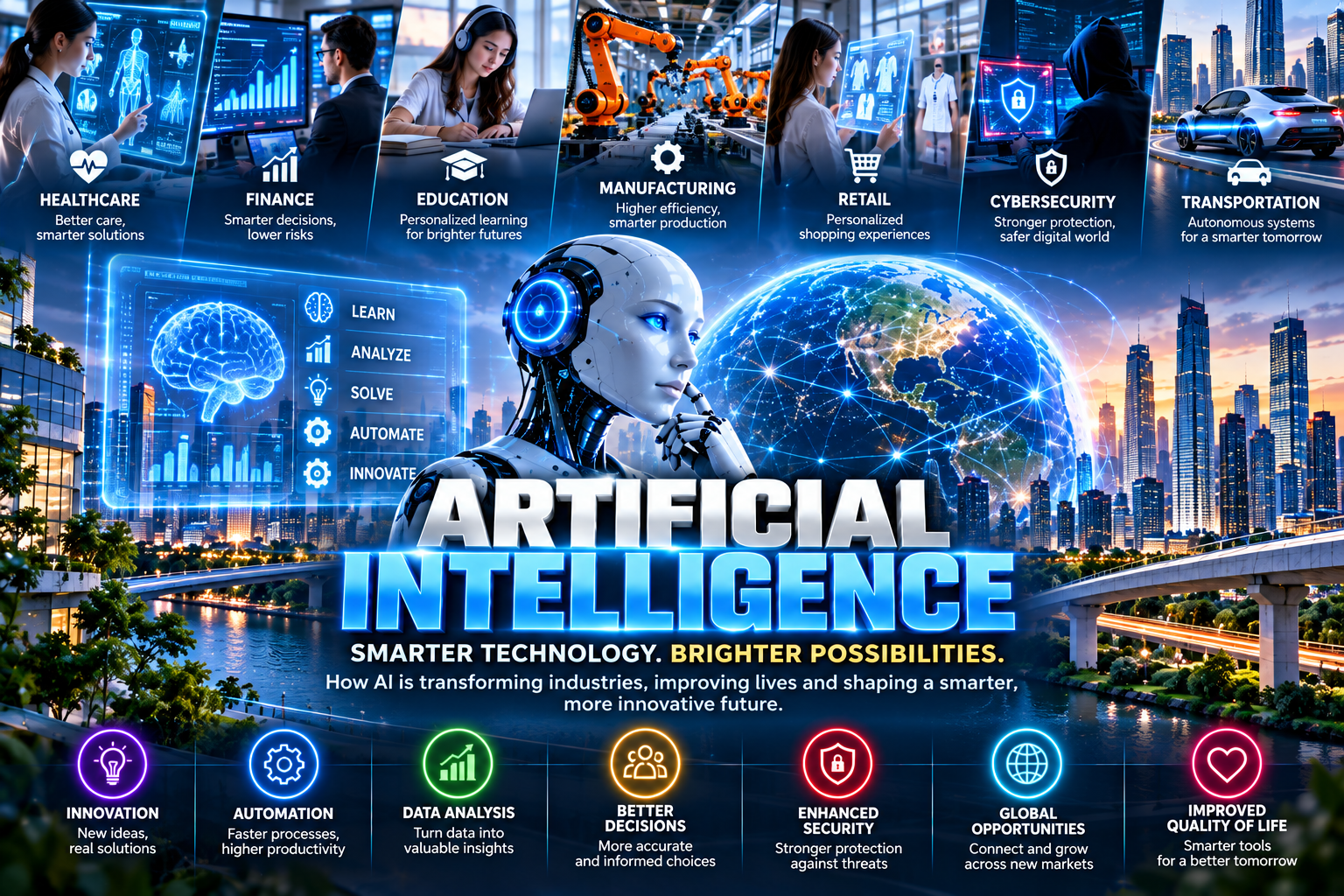
Artificial intelligence, commonly known as AI, has become one of the most important technologies shaping the modern world. From virtual assistants and recommendation systems to generative AI, autonomous machines, healthcare applications, cybersecurity, and business automation, AI is changing how people and organizations work with information.
AI is no longer limited to research laboratories. It is increasingly being integrated into businesses, schools, hospitals, financial institutions, manufacturing facilities, creative industries, and everyday digital products.
According to the OECD, 20.2% of firms across OECD countries reported using AI in 2025, compared with 14.2% in 2024 and 8.7% in 2023. Stanford's 2026 AI Index also reported that organizational AI adoption reached 88% in its surveyed organizations, demonstrating how quickly AI is moving into professional environments.
What Is Artificial Intelligence?
Artificial intelligence is a broad field of computing focused on creating systems that can perform tasks associated with human intelligence.
These tasks can include:
Learning from information
Recognizing patterns
Understanding language
Generating content
Making predictions
Solving problems
Processing images and video
Supporting decisions
Interacting with people
Operating digital or physical systems
AI does not necessarily work like the human brain. Different AI systems are designed for different purposes, and their capabilities depend on their architecture, data, training, tools, and operating environment.
How Does AI Work?
Modern AI systems often rely on algorithms and large datasets.
A machine-learning system can be trained using examples so that it learns statistical patterns within the data. Once trained, it can apply those patterns to new information.
Generative AI systems use large models trained on extensive datasets to generate outputs such as text, images, audio, video, and computer code.
More advanced systems can also use external tools, databases, software applications, and other information sources to perform multi-step tasks.
The quality of an AI system depends on factors including:
Data quality
Model architecture
Computing resources
Training methods
Evaluation
Human feedback
Security
System design
Major Types of AI
AI can be categorized in several ways.
Machine Learning
Machine learning allows systems to identify patterns in data and improve their performance without requiring every rule to be manually programmed.
Applications include fraud detection, recommendation systems, forecasting, image recognition, and predictive maintenance.
Deep Learning
Deep learning uses neural networks with multiple layers to process complex information.
It has contributed to major advances in areas such as computer vision, speech recognition, natural-language processing, and generative AI.
Generative AI
Generative AI produces new content based on instructions or other inputs.
It can generate:
Text
Images
Audio
Video
Code
Presentations
Summaries
Creative concepts
Generative AI has become one of the fastest-growing areas of AI adoption.
Computer Vision
Computer vision enables computers to analyze visual information.
It is used in areas such as medical imaging, manufacturing quality control, autonomous vehicles, security systems, agriculture, and retail.
Natural-Language Processing
Natural-language processing allows computers to process and generate human language.
It supports chatbots, translation, speech interfaces, document analysis, search systems, and AI assistants.
Robotics and AI
Robotics combines software intelligence with physical machines.
AI-powered robots can be used for manufacturing, logistics, healthcare, agriculture, warehouses, and research.
Generative AI and the New AI Era
Generative AI has significantly changed public and business interest in artificial intelligence.
Unlike traditional software that follows predetermined instructions, generative AI can produce new content based on natural-language instructions.
Organizations use generative AI for tasks such as:
Drafting documents
Summarizing information
Writing software
Analyzing text
Customer support
Marketing
Research
Translation
Data analysis
Stanford's 2026 AI Index reported that generative AI reached 53% adoption within three years, faster than the historical adoption of personal computers or the internet according to the report's comparison.
AI in Business
Businesses are among the major adopters of artificial intelligence.
Companies can use AI to automate repetitive tasks, analyze customer information, forecast demand, optimize operations, and support employees.
Common business applications include:
Customer service
Sales
Marketing
Finance
Human resources
Cybersecurity
Supply chains
Software development
Business analytics
Document processing
AI can potentially improve productivity, but successful adoption requires more than simply purchasing an AI tool.
Businesses need reliable data, appropriate infrastructure, employee training, security controls, and clear objectives.
AI in Enterprise Operations
Enterprise AI is increasingly moving from simple assistants toward systems capable of supporting more complex workflows.
AI agents can potentially retrieve information, interact with software, complete multiple steps, and assist employees with business processes.
The OECD reported that many organizations are experimenting with AI agents, although widespread deployment remains relatively early.
This could change how companies organize knowledge work.
For example, an AI system could potentially research information, prepare a report, update a business system, and send the result for human review.
AI in Healthcare
Healthcare is one of the most important areas for AI development.
Potential applications include:
Medical-image analysis
Drug discovery
Clinical research
Administrative automation
Patient communication
Medical documentation
Disease prediction
Personalized treatment support
Stanford's 2026 AI Index includes a dedicated chapter on AI in medicine, reflecting the growing role of AI in scientific discovery and healthcare applications.
Healthcare AI requires careful validation because inaccurate systems can have serious consequences.
Human expertise, clinical oversight, privacy protection, and regulatory requirements remain important.
AI in Education
AI is changing how students and teachers interact with educational technology.
Students can use AI systems to:
Explain difficult concepts
Practice languages
Generate study questions
Summarize material
Brainstorm ideas
Receive personalized explanations
Teachers can use AI to support lesson planning, administrative work, content creation, and educational analysis.
However, educational institutions also face questions involving academic integrity, student privacy, misinformation, and appropriate use of AI-generated work.
The OECD reported that three-quarters of students aged 16 and older across the OECD used generative AI tools in 2025.
AI in Finance
Financial institutions use AI for a wide range of activities.
Examples include:
Fraud detection
Risk assessment
Financial forecasting
Customer service
Document analysis
Trading research
Credit analysis
Compliance monitoring
AI can process large quantities of financial information quickly, but financial organizations need strong controls around data security, accuracy, transparency, and regulatory compliance.
AI in Cybersecurity
Cybersecurity is becoming increasingly connected to AI.
Security teams can use AI to analyze large volumes of network and system information, identify unusual behavior, prioritize alerts, detect potential threats, and support incident response.
At the same time, cybercriminals can also use AI.
This creates a technological race in which defenders and attackers can both benefit from increasingly capable systems.
Organizations therefore need to secure AI systems while also using AI as part of their broader cybersecurity strategy.
AI in Manufacturing
AI is transforming modern manufacturing through automation and predictive analytics.
Factories can use AI for:
Quality inspection
Predictive maintenance
Production optimization
Robotics
Demand forecasting
Inventory management
Supply-chain planning
Computer vision systems can inspect products for defects, while predictive models can identify signs that equipment may require maintenance.
AI and Autonomous Vehicles
AI plays an important role in autonomous and assisted-driving technologies.
Vehicles can use sensors, cameras, machine-learning systems, maps, and other technologies to understand their surroundings and make driving-related decisions.
AI is also being used in autonomous delivery systems, drones, logistics, and transportation planning.
Because transportation systems interact with the physical world, reliability and safety are particularly important.
AI and Creativity
AI has become increasingly involved in creative industries.
Generative systems can assist with:
Writing
Graphic design
Music
Video production
Animation
Photography
Advertising
Game development
AI can function as a creative assistant, helping people generate ideas, experiment with styles, and accelerate production.
However, AI-generated content also raises questions around copyright, ownership, attribution, originality, and the role of human creators.
AI and Scientific Research
AI is increasingly being used in scientific research.
Researchers can use AI to analyze large datasets, identify patterns, simulate systems, search scientific literature, and generate hypotheses.
Stanford's 2026 AI Index added a dedicated science chapter, reflecting the expanding use of AI across fields including biology, chemistry, physics, and astronomy.
AI may therefore become an increasingly important research tool alongside traditional scientific methods.
AI and the Economy
AI has significant economic implications.
The technology can increase productivity by helping workers complete certain tasks faster or by automating selected activities.
The OECD notes that early evidence suggests generative AI can improve performance on specific workplace tasks, although economy-wide and long-term effects remain uncertain.
Stanford's 2026 AI Index reported that global corporate AI investment more than doubled in 2025, while private investment grew particularly rapidly.
The economic impact of AI will depend on how widely the technology is adopted, how businesses reorganize around it, and how effectively workers and institutions adapt.
AI and Jobs
AI is changing the labor market, but the effects are complex.
AI can automate some tasks while creating new tasks and increasing productivity in others.
The OECD describes three major channels through which AI can affect employment:
Automation of existing tasks
Creation of new tasks and occupations
Productivity improvements
The balance between these effects will vary across industries and occupations.
Some workers may need to develop new skills as AI changes existing jobs.
Skills that can become increasingly valuable include:
Critical thinking
Communication
Problem-solving
Creativity
Data literacy
AI literacy
Technical skills
Adaptability
AI and Small Businesses
AI is not limited to large corporations.
Small businesses can use commercially available AI tools for:
Marketing
Customer service
Content creation
Bookkeeping support
Data analysis
Research
Scheduling
Translation
Business planning
However, the OECD reports that smaller businesses face barriers including costs, infrastructure limitations, skills shortages, and maintenance challenges.
Affordable and easy-to-use AI tools could therefore play an important role in narrowing technology gaps between businesses.
AI and Personal Productivity
Individuals can also use AI as a productivity tool.
AI assistants can help users:
Organize information
Draft emails
Summarize documents
Learn new topics
Brainstorm ideas
Translate languages
Write and debug code
Plan projects
Analyze information
The OECD reported that more than one-third of individuals across OECD countries used generative AI tools in 2025.
AI Risks and Challenges
Artificial intelligence offers significant opportunities, but it also creates challenges.
Accuracy
AI systems can generate incorrect or misleading information.
Bias
AI systems can reproduce or amplify biases present in their training data or design.
Privacy
AI applications may process sensitive personal or business information.
Cybersecurity
AI systems can become targets for attacks, while AI can also be used by attackers.
Employment Disruption
Some occupations and tasks may experience significant changes as automation expands.
Misinformation
Generative AI can make it easier to create realistic but misleading text, images, audio, and video.
Intellectual Property
The use of copyrighted or proprietary material in AI systems raises complex legal and policy questions.
Energy and Infrastructure
Advanced AI models require substantial computing infrastructure, including data centers, chips, electricity, and cooling systems.
Responsible AI
Responsible AI focuses on developing and using AI systems in ways that consider safety, fairness, transparency, privacy, security, and accountability.
Organizations should establish clear processes for:
Testing AI systems
Monitoring performance
Protecting sensitive information
Reviewing high-impact decisions
Managing risks
Documenting system behavior
Maintaining human oversight
Stanford's 2026 AI Index notes that AI capabilities are advancing faster than society's ability to measure and manage them, highlighting the importance of governance and evaluation.
The Future of Artificial Intelligence
The future of AI is likely to involve increasingly capable models, AI agents, robotics, scientific applications, personalized systems, and deeper integration with business software.
AI is also becoming more multimodal, allowing systems to work with combinations of text, images, audio, video, and other information.
Another major development is the movement toward agentic AI, where systems can perform multi-step tasks using tools and external information.
At the same time, AI infrastructure will continue to expand. Data centers, advanced processors, cloud computing, energy systems, and specialized hardware will remain important components of the AI ecosystem.
How Businesses Can Prepare for AI
Businesses that want to adopt AI can begin with a practical framework:
Identify business problems rather than starting with technology.
Select specific AI use cases with measurable benefits.
Evaluate data quality and security.
Train employees to work effectively with AI.
Establish governance and security controls.
Start with pilot projects.
Measure results.
Improve systems based on feedback.
Scale successful applications.
Continuously monitor risks and performance.
AI adoption should be treated as an ongoing organizational process rather than a one-time technology purchase.
Final Thoughts
Artificial intelligence is transforming technology, business, science, education, healthcare, finance, manufacturing, cybersecurity, and everyday life.
The technology is developing rapidly, and adoption is expanding across organizations and populations. Current evidence shows strong growth in AI use, investment, research, and commercial applications, while challenges involving skills, governance, security, privacy, employment, and responsible development remain important.
AI is therefore more than a single technology. It is becoming a broad technological platform that can influence how information is created, analyzed, distributed, and used.
The organizations and individuals that understand both the opportunities and limitations of AI will be better positioned to use it effectively as the technology continues to evolve.
FAQs About Artificial Intelligence
What is AI?
Artificial intelligence is a field of computing focused on creating systems capable of performing tasks that normally require forms of human intelligence, such as learning, reasoning, language processing, prediction, and pattern recognition.
What is generative AI?
Generative AI is a category of AI capable of producing new content such as text, images, audio, video, and computer code.
How is AI used in business?
Businesses use AI for customer service, marketing, sales, cybersecurity, financial analysis, automation, forecasting, software development, and many other activities.
Can AI replace humans?
AI can automate some tasks and change how jobs are performed, but its effects vary by occupation and industry. AI can also create new tasks and complement human workers.
What are the main risks of AI?
Major concerns include inaccurate outputs, bias, privacy, cybersecurity, misinformation, intellectual-property issues, employment disruption, and insufficient governance.
What is an AI agent?
An AI agent is a system designed to perform multi-step tasks using AI models, information, and potentially external tools or software.
Why is AI important?
AI can help people and organizations analyze information, automate tasks, improve productivity, develop new products, and solve complex problems.
What is the future of AI?
AI is likely to become increasingly integrated into business software, scientific research, healthcare, education, robotics, cybersecurity, and everyday digital services.