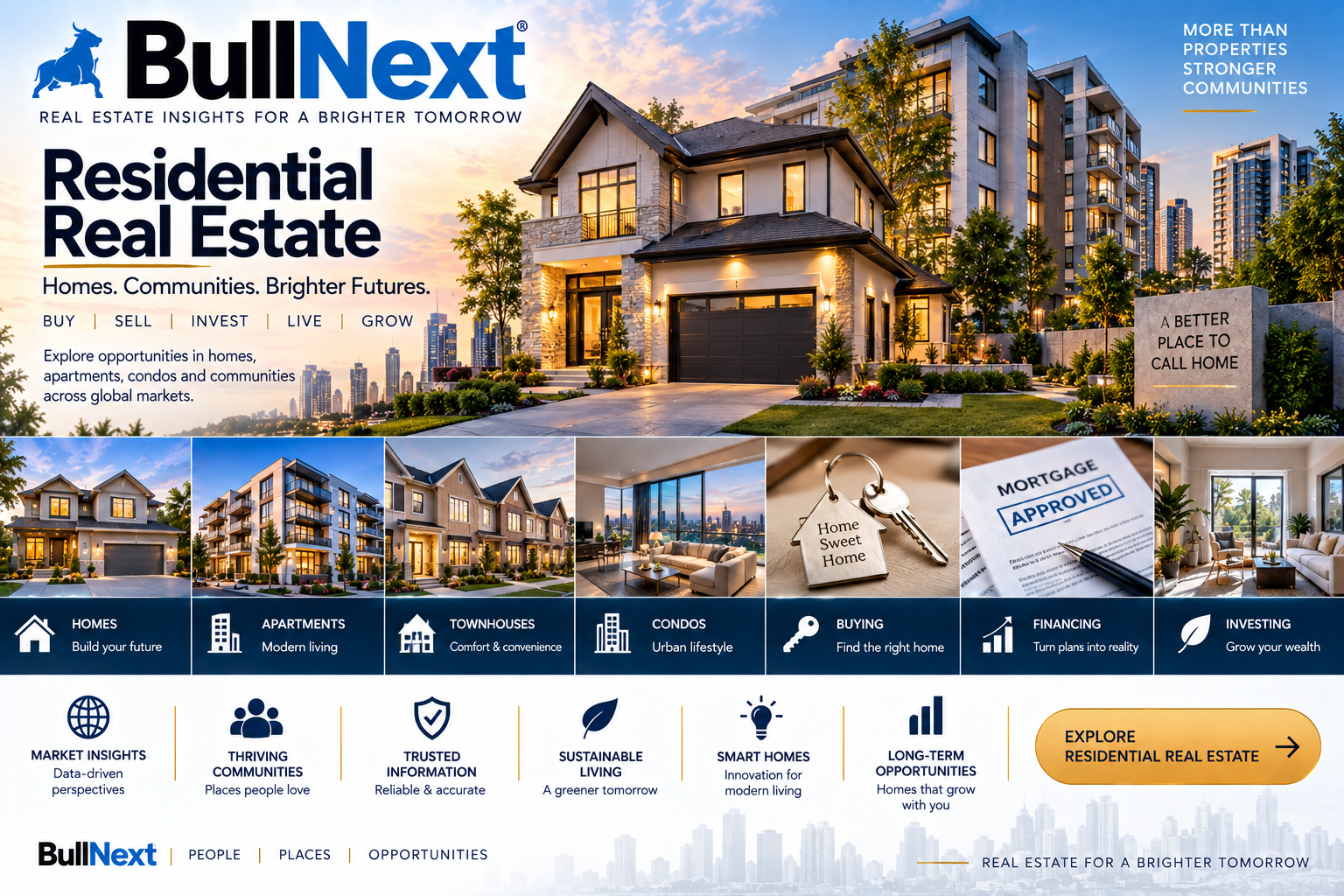
Residential real estate is one of the most important parts of the property industry. It includes the homes, apartments, condominiums, and residential communities where people live and build their daily lives.
The residential property market is influenced by many factors, including population growth, employment, household formation, mortgage rates, construction, local infrastructure, property supply, and buyer demand.
For buyers, understanding residential real estate can make it easier to evaluate properties, estimate costs, compare financing options, and prepare for homeownership. For sellers, understanding the market can help with pricing, preparation, marketing, and negotiations.
This guide explores the fundamentals of residential real estate, from property types and home buying to mortgages, inspections, technology, selling, and future housing trends.
What Is Residential Real Estate?
Residential real estate refers to property primarily designed for people to live in.
Common examples include:
Single-family homes
Apartments
Condominiums
Townhouses
Villas
Duplexes
Residential communities
Manufactured homes
Multi-unit residential buildings
Residential properties can range from small apartments to large luxury homes and master-planned communities.
The market can also differ considerably from one city or neighborhood to another. Factors such as employment, transportation, schools, amenities, construction, and population growth can influence local housing demand.
Why Residential Real Estate Matters
Housing is closely connected to the wider economy.
People need homes, while developers, builders, lenders, real estate professionals, insurers, property managers, and local governments all participate in the residential property ecosystem.
Changes in housing can affect:
Household finances
Construction activity
Employment
Consumer spending
Local businesses
Infrastructure development
Community growth
Because housing is both a basic need and a major financial asset for many households, residential real estate remains an important economic sector.
Major Types of Residential Property
Residential real estate includes several different property types.
Single-Family Homes
A single-family home is generally designed for one household and typically provides private living spaces and outdoor areas.
These properties are common in suburban, urban, and rural markets.
Condominiums
Condos are individual residential units within a larger building or community.
Owners generally own their individual unit while shared areas and facilities are managed collectively, often through a homeowners association or condominium association.
Townhouses
Townhouses typically share one or more walls with neighboring properties but have individual entrances and living spaces.
They can provide an alternative between detached houses and apartments.
Apartments
Apartments are individual residential units within larger buildings or communities.
Depending on the market, apartments may be rented or individually owned.
Multi-Family Properties
Multi-family residential properties contain multiple housing units.
Examples include duplexes, triplexes, four-unit buildings, and larger apartment buildings.
Location and Residential Real Estate
Location remains one of the most important factors in housing.
A home is part of a wider neighborhood and community, so buyers often consider more than the building itself.
Important factors may include:
Access to employment
Schools
Healthcare
Public transportation
Roads
Shopping
Restaurants
Parks
Recreation
Safety
Community services
A property with attractive features may still have different market characteristics depending on its location.
This is why residential property analysis should consider both the home and its surrounding environment.
Understanding Housing Affordability
Affordability involves more than the purchase price.
A buyer may need to consider:
Down payment
Mortgage payment
Property taxes
Homeowners insurance
Maintenance
Utilities
Association fees
Closing costs
Repairs
Freddie Mac recommends that prospective buyers understand their finances before beginning the home search and consider the full cost of homeownership.
A property that appears affordable based only on its listing price may have substantially different monthly costs once financing and ownership expenses are included.
Mortgage Financing
Many residential properties are purchased using mortgage financing.
A mortgage allows a buyer to borrow money to purchase a property and repay the loan over an agreed period, subject to the loan's terms.
Mortgage costs can include:
Principal
Interest
Property taxes
Insurance
Mortgage insurance where applicable
Lender fees
Other closing costs
Mortgage rates can also influence purchasing power.
As of September 17, 2026, Freddie Mac reported an average U.S. 30-year fixed mortgage rate of 6.95%, illustrating how borrowing costs can affect housing affordability and purchasing decisions.
Mortgage rates change over time, so buyers should use current lender offers rather than relying on historical rates.
Getting Pre-Approved
Mortgage pre-approval can help buyers understand their potential price range before they begin making offers.
Freddie Mac recommends comparing mortgage offerings from multiple lenders and obtaining pre-approval before seriously searching for a home. A pre-approval indicates how much a lender may be willing to lend based on information available at that stage; it is not a guarantee that the loan will ultimately close.
Pre-approval can also help buyers understand the financial limits of their search.
Choosing the Right Residential Property
The right property depends on the buyer's circumstances and priorities.
Important considerations can include:
Budget
Determine the total amount that can reasonably be spent on housing.
Location
Consider commuting, schools, transportation, services, and future development.
Property Size
Think about current and future space requirements.
Condition
Assess the age and condition of major systems and structural components.
Neighborhood
Research amenities, development plans, accessibility, and local conditions.
Future Needs
Consider whether the property will continue to meet household needs over time.
Home Inspection
A home inspection can provide important information about a property's physical condition.
The CFPB recommends arranging an independent home inspection as soon as possible after selecting a property, giving the buyer time to identify problems and address them before closing.
An inspection may examine areas such as:
Roof
Plumbing
Electrical systems
Heating and cooling
Windows
Foundation
Appliances
Attic
Floors
Visible structural components
A home inspection and appraisal serve different purposes. An inspection focuses on the property's physical condition, while an appraisal provides an opinion of value and is commonly used by lenders when evaluating financing.
Property Appraisal
An appraisal estimates the market value of a property.
Lenders commonly use appraisals when determining whether a property provides sufficient collateral for a mortgage.
The appraisal can consider factors such as:
Property characteristics
Location
Condition
Comparable properties
Local market conditions
An appraisal and the agreed purchase price are not necessarily the same thing.
If an appraisal comes in below the purchase price, the buyer may need to reconsider financing or negotiate with the seller, depending on the purchase contract and applicable terms.
Understanding Closing Costs
The purchase price is only one component of the total cost of buying a home.
Closing costs may include:
Loan-related fees
Appraisal fees
Title-related costs
Recording fees
Taxes
Insurance
Prepaid expenses
Other transaction costs
The exact costs vary by location, property, lender, and transaction.
Buyers should review their loan and closing documents carefully before signing.
Buying a Residential Property
The home-buying process generally involves several stages.
1. Assess Your Finances
Review income, savings, debts, credit, and monthly expenses.
2. Establish a Budget
Determine a housing budget that accounts for ownership costs beyond the mortgage.
3. Research Financing
Compare mortgage options and lenders.
4. Get Pre-Approved
Obtain an indication of potential borrowing capacity.
5. Search for Properties
Compare homes based on location, condition, size, price, and features.
6. Make an Offer
Submit an offer based on the property and applicable market conditions.
7. Conduct Due Diligence
Review inspections, appraisals, title information, disclosures, and other relevant documents.
8. Finalize Financing
Complete the mortgage process and satisfy lender requirements.
9. Close the Transaction
Sign the necessary documents and complete the transfer according to the applicable legal process.
10. Take Ownership
After closing and transfer requirements are completed, the buyer becomes the property's owner according to local law.
Selling Residential Real Estate
Selling a home also requires preparation.
A seller may need to consider:
Property condition
Pricing
Repairs
Presentation
Photography
Marketing
Buyer demand
Negotiations
Closing costs
Pricing is particularly important.
An excessively high asking price can reduce buyer interest, while an unnecessarily low price may not reflect the property's market position.
Professional market analysis can help sellers understand comparable properties and local conditions.
Preparing a Home for Sale
Small improvements can sometimes make a property easier to market.
Preparation may include:
Decluttering
Cleaning
Minor repairs
Improving curb appeal
Updating lighting
Addressing visible maintenance issues
Professional photography
Major renovations should be evaluated carefully because the cost of an improvement does not necessarily translate into an equal increase in selling price.
Residential Real Estate Investment
Residential property can also be used as an investment.
Examples include:
Long-term rental properties
Multi-family properties
Vacation rentals
Property development
Renovation projects
Potential financial outcomes can come from rental income, property appreciation, or both.
However, residential property investment also involves costs and risks.
These can include:
Vacancies
Maintenance
Property management
Taxes
Insurance
Financing costs
Repairs
Market changes
Property investors should evaluate the full financial picture rather than focusing only on expected rental income or price appreciation.
Rental Residential Property
Rental housing provides accommodation to tenants in exchange for rent.
Owners may need to manage:
Tenant screening
Lease agreements
Rent collection
Repairs
Maintenance
Insurance
Legal compliance
Property management
Local landlord-tenant laws can differ substantially, so property owners should understand the regulations applicable to their jurisdiction.
Residential Real Estate Technology
Technology has transformed the way people search for and manage homes.
Buyers can now use digital platforms to:
Search listings
Compare properties
View photographs
Take virtual tours
Research neighborhoods
Communicate with agents
Estimate mortgage payments
Property managers can use technology for:
Rent collection
Maintenance requests
Tenant communication
Digital documentation
Building access
Financial reporting
Technology can make the process more efficient, but buyers should still verify important property and legal information independently.
Smart Homes
Smart-home technology is becoming increasingly common in residential properties.
Examples include:
Smart thermostats
Security cameras
Smart locks
Connected lighting
Energy-monitoring systems
Automated appliances
Home assistants
Smart technology can improve convenience and potentially help homeowners monitor energy use and security.
However, buyers should also consider privacy, cybersecurity, compatibility, maintenance, and long-term costs.
Sustainability and Residential Real Estate
Energy efficiency and sustainable construction are becoming increasingly relevant in housing.
Residential sustainability can involve:
Energy-efficient windows
Insulation
Solar power
Efficient appliances
Water-saving fixtures
Sustainable materials
Energy-management systems
These features can influence operating costs, comfort, and long-term property considerations.
Climate and weather-related risks can also be relevant when evaluating housing. The CFPB specifically notes that climate risk should be considered in housing decisions.
Residential Real Estate and Changing Demographics
Population trends can influence housing demand.
Changes in:
Population size
Household formation
Migration
Age distribution
Employment
Income
Family structure
can affect the types of homes people need.
For example, an area attracting young professionals may experience demand for apartments and smaller homes, while growing families may seek larger properties with additional bedrooms and outdoor space.
The Role of Infrastructure
Infrastructure can have a major influence on residential development.
New roads, railways, public transportation, schools, hospitals, shopping centers, and employment districts can change the attractiveness of an area.
However, buyers should distinguish between existing infrastructure and projects that are only proposed.
Future development plans can change, so important claims should be verified through reliable local sources.
Residential Real Estate Market Trends
Residential markets can change as economic conditions evolve.
Factors that may influence housing markets include:
Mortgage rates
Employment
Household income
Housing supply
Construction activity
Population growth
Consumer confidence
Local regulations
Inventory
In the U.S., current conditions demonstrate why buyers and sellers need to pay attention to financing costs. In September 2026, Freddie Mac's average 30-year fixed mortgage rate was 6.95%, while Reuters reported that U.S. pending home sales were still 4.7% below the previous year despite a small monthly increase in August.
These figures describe the U.S. market at a specific point in time and should not be assumed to represent every country or local housing market.
Common Residential Real Estate Mistakes
Ignoring the Full Cost
Buyers should consider taxes, insurance, maintenance, financing, and other ownership expenses.
Skipping Due Diligence
Important property documents, inspections, appraisals, and legal information should be reviewed carefully.
Focusing Only on Appearance
A beautiful property can still have expensive underlying maintenance or structural problems.
Choosing a Location Without Research
The surrounding neighborhood can be just as important as the property itself.
Borrowing More Than Is Comfortable
Mortgage approval does not necessarily mean a particular payment is comfortable for a household's budget.
Assuming Prices Always Rise
Residential property values can increase or decrease depending on market conditions.
Ignoring Future Needs
A property should be evaluated according to both current and foreseeable household requirements.
How to Evaluate a Residential Property
A simple framework can make property research more organized:
Location → Condition → Cost → Financing → Market → Future Needs
Location
Study the neighborhood, transportation, services, employment, and infrastructure.
Condition
Review the physical condition through inspections and available documentation.
Cost
Calculate the purchase price plus taxes, insurance, maintenance, financing, and other expenses.
Financing
Compare mortgage options and understand the total cost of borrowing.
Market
Research comparable properties, supply, demand, and local market conditions.
Future Needs
Consider whether the property will remain suitable for the household or intended use.
The Future of Residential Real Estate
Residential real estate will continue to evolve alongside technology, demographics, economic conditions, and changing lifestyles.
Several themes are likely to remain important:
Smart-home technology
Energy efficiency
Sustainable construction
Digital property searches
Remote and flexible work
Urban development
Changing household structures
New housing construction
Digital property management
Technology may make property transactions faster and more convenient, while local conditions will continue to influence individual housing markets.
Final Thoughts
Residential real estate is much more than buying and selling houses.
It includes homes, apartments, communities, financing, construction, infrastructure, property management, technology, and the changing needs of households.
For buyers, careful planning can help clarify affordability, location preferences, financing options, property condition, and long-term needs.
For sellers, understanding local market conditions, preparing the property, pricing carefully, and presenting accurate information can support a more organized sales process.
For property investors, evaluating income, expenses, financing, vacancies, maintenance, and market conditions is essential.
The residential real estate market is constantly changing, but the fundamentals remain important: research the property, understand the costs, examine the location, verify the information, and make decisions based on your own financial circumstances and objectives.
Frequently Asked Questions
What is residential real estate?
Residential real estate refers to properties primarily designed for people to live in, including houses, apartments, condos, townhouses, villas, and multi-unit residential buildings.
What should I consider before buying a home?
Consider affordability, location, property condition, financing, taxes, insurance, maintenance, neighborhood characteristics, and future housing needs.
Why is a home inspection important?
An inspection can identify potential physical problems before closing and may provide information that can help buyers negotiate repairs or other terms, depending on the contract.
What is the difference between an appraisal and a home inspection?
An appraisal provides an opinion of a property's value, while an inspection focuses on its physical condition.
What are common residential property types?
Common types include single-family homes, apartments, condos, townhouses, villas, duplexes, and other multi-family properties.
Can residential real estate be an investment?
Yes. Residential properties can generate rental income and may appreciate in value, but they also involve expenses and market risks.
How do mortgage rates affect residential real estate?
Mortgage rates affect borrowing costs and monthly payments, which can influence affordability and purchasing power.
What makes a residential property attractive?
Factors can include location, condition, price, accessibility, amenities, infrastructure, neighborhood characteristics, and suitability for the buyer's needs.
How is technology changing residential real estate?
Technology supports online property searches, virtual tours, digital transactions, smart homes, property management, communication, and data analysis.