
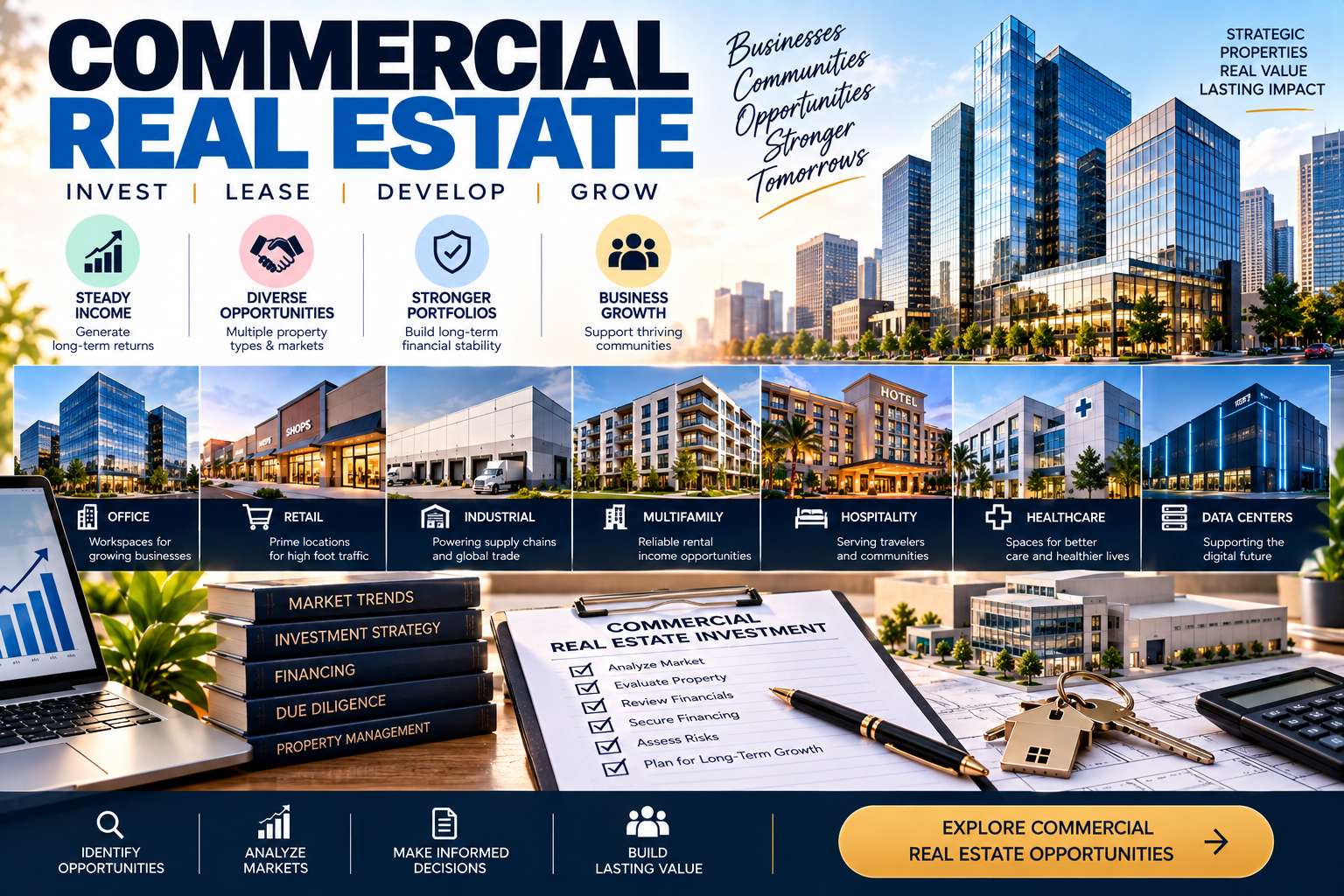
Commercial real estate, commonly known as CRE, is an important part of the property market and the broader economy. It includes properties used for business, commerce, housing, logistics, healthcare, hospitality, and other income-producing activities.
Unlike residential real estate, which is primarily associated with homes for individuals and families, commercial real estate is generally evaluated based on its ability to generate income, support business activity, attract tenants, and maintain long-term value.
Commercial real estate can include office buildings, retail centers, warehouses, apartment buildings, hotels, medical facilities, data centers, and specialized properties.
For investors, commercial property can provide rental income and potential appreciation. For businesses, it provides the physical space needed to operate, serve customers, manufacture products, store inventory, and employ workers.
Understanding how commercial real estate works is important before purchasing, investing in, developing, or leasing a property.
What Is Commercial Real Estate?
Commercial real estate refers to property primarily used for business or income-producing purposes.
Major categories include:
Office buildings
Retail properties
Industrial properties
Warehouses
Multifamily apartment buildings
Hotels
Healthcare properties
Data centers
Life sciences properties
Mixed-use developments
Land for commercial development
Each property type has different tenants, operating costs, financing structures, lease arrangements, and investment risks.
How Does Commercial Real Estate Work?
Commercial real estate typically involves owners, investors, developers, lenders, brokers, property managers, tenants, contractors, attorneys, appraisers, and other professionals.
An investor may purchase a commercial property and lease space to businesses. The rental income can help cover operating expenses, debt payments, and other costs.
A simplified commercial property investment process may look like this:
Identify a property or investment opportunity.
Analyze the local market.
Review the property's income and expenses.
Conduct due diligence.
Arrange financing if necessary.
Negotiate the purchase.
Complete the transaction.
Lease and manage the property.
Monitor income, expenses, occupancy, and market conditions.
Commercial real estate is therefore more than buying a building. Investors need to understand the property's financial performance and the factors that could affect future income.
Major Types of Commercial Real Estate
1. Office Real Estate
Office properties provide workspace for companies, professional services, government organizations, and other businesses.
Office buildings can range from small local properties to large skyscrapers in central business districts.
Important considerations include:
Location
Building quality
Tenant demand
Parking
Transit access
Amenities
Floor layouts
Lease terms
Vacancy
Operating expenses
The U.S. office market has been changing as businesses reassess their space requirements. CBRE's 2026 outlook reports that demand is increasingly concentrated in higher-quality office properties, while performance varies significantly between prime and lower-quality assets.
2. Retail Real Estate
Retail properties are designed for businesses that sell products or services directly to consumers.
Examples include:
Shopping centers
Grocery-anchored centers
Strip centers
Open-air retail centers
Shopping malls
Standalone stores
Location is particularly important because retailers depend on customer traffic, visibility, accessibility, demographics, and surrounding businesses.
CBRE's 2026 U.S. outlook indicates that retail supply remains limited in many markets, while grocery, discount, service-oriented, and other retailers continue to influence demand.
3. Industrial Real Estate
Industrial properties support manufacturing, logistics, storage, distribution, and other commercial activities.
Examples include:
Warehouses
Distribution centers
Manufacturing facilities
Logistics facilities
Flex industrial buildings
Industrial properties can be influenced by e-commerce, supply chains, transportation networks, manufacturing activity, labor availability, and infrastructure.
CBRE expects U.S. industrial leasing activity to increase in 2026, with demand supported by reshoring, third-party logistics, and businesses seeking higher-quality facilities.
4. Multifamily Real Estate
Multifamily properties contain multiple residential units and are often treated as commercial real estate when they reach certain sizes.
Examples include:
Apartment buildings
Large residential complexes
Student housing
Senior housing
Investors generally focus on rental income, occupancy, operating expenses, financing, property management, and local housing demand.
5. Hospitality Real Estate
Hospitality properties include:
Hotels
Resorts
Extended-stay properties
Lodging facilities
Hotel performance can depend on tourism, business travel, local events, room rates, occupancy, operating expenses, and economic conditions.
6. Healthcare Real Estate
Healthcare real estate includes properties such as:
Medical offices
Clinics
Outpatient facilities
Specialized healthcare buildings
Healthcare properties can have specialized building requirements and tenant needs, making location, infrastructure, tenant quality, and lease structure important considerations.
7. Data Centers
Data centers are specialized facilities designed to house computing infrastructure and support digital services.
Demand for data centers has become increasingly connected with cloud computing, artificial intelligence, digital services, and the need for large amounts of computing capacity.
CBRE's 2026 midyear outlook identifies data centers as one of the sectors experiencing particularly strong demand.
Why Invest in Commercial Real Estate?
Investors may consider commercial real estate for several reasons.
Rental Income
Commercial properties can generate rental income through leases with tenants.
Potential Appreciation
A property's value may increase if income rises, demand improves, the market strengthens, or the property is improved.
However, appreciation is never guaranteed.
Portfolio Diversification
Commercial property can provide exposure to a physical asset class alongside stocks, bonds, and other investments.
Business Demand
Commercial properties serve businesses and organizations that require physical space.
The strength of that demand can vary significantly by property type and location.
Understanding Commercial Property Income
One of the most important differences between residential and commercial real estate is the emphasis on property income.
Investors often analyze:
Gross rental income
Vacancy
Operating expenses
Net operating income
Debt service
Capital expenditures
Cash flow
A property with high rental revenue isn't necessarily a strong investment if expenses are also high.
What Is Net Operating Income?
Net operating income, commonly called NOI, is an important measure used in commercial real estate.
A simplified calculation is:
NOI = Property Income − Operating Expenses
Operating expenses may include:
Property management
Maintenance
Insurance
Property taxes
Utilities paid by the owner
Repairs
Other operating costs
NOI generally does not include mortgage principal and interest payments.
Investors use NOI to evaluate property performance and calculate other investment metrics.
What Is a Cap Rate?
The capitalization rate, or cap rate, is a common metric used in commercial real estate.
A simplified formula is:
Cap Rate = Net Operating Income ÷ Property Value
For example, if a property generates $500,000 in annual NOI and is valued at $10 million:
$500,000 ÷ $10,000,000 = 5% cap rate
Cap rates should not be viewed in isolation. JPMorgan notes that factors such as property type, location, property condition, tenant quality, expected rent growth, income, expenses, and interest rates can influence cap rates and property values.
What Is Commercial Real Estate Financing?
Commercial real estate financing provides capital for purchasing, refinancing, developing, or improving commercial properties.
Financing can come from:
Banks
Credit unions
Commercial mortgage lenders
Private lenders
Insurance companies
Real estate investment funds
Other institutional investors
Commercial loans can have different structures, terms, interest rates, collateral requirements, and repayment schedules.
Borrowers should compare the complete financing cost rather than focusing only on the advertised interest rate.
Commercial Real Estate vs. Residential Real Estate
Feature | Commercial Real Estate | Residential Real Estate |
|---|---|---|
Primary use | Business or income-producing activity | Housing |
Typical tenants | Businesses and organizations | Individuals or families |
Lease structure | Often more complex | Generally simpler |
Property analysis | Strong focus on income and expenses | Strong focus on affordability and comparable sales |
Financing | Commercial loans | Residential mortgages |
Management | Often professional property management | May be owner-managed |
Major sectors | Office, retail, industrial, multifamily | Single-family, condos, townhomes |
Valuation | Often heavily income-based | Often strongly influenced by comparable sales |
Commercial Real Estate Leases
Leases are central to commercial property investment.
A commercial lease determines the relationship between the landlord and tenant and can establish:
Rent
Lease duration
Renewal options
Maintenance responsibilities
Property taxes
Insurance responsibilities
Operating expenses
Tenant improvements
Rent increases
Security deposits
Other contractual obligations
Gross Lease
Under a gross lease, the landlord generally pays many property expenses while the tenant pays an agreed rent.
Net Lease
Under a net lease, the tenant may pay some property-related expenses in addition to base rent.
Triple-Net Lease
A triple-net, or NNN, lease generally requires the tenant to pay base rent plus specified property expenses such as taxes, insurance, and maintenance.
Lease structures can vary, so investors and tenants should carefully review the actual contract.
What Is Commercial Property Due Diligence?
Due diligence is the process of investigating a property before completing a transaction.
Commercial property due diligence may include reviewing:
Financial statements
Existing leases
Tenant payment history
Property condition
Environmental reports
Zoning
Building permits
Property taxes
Insurance
Title
Survey
Utilities
Maintenance records
Capital expenditure requirements
Local market conditions
Due diligence is particularly important because commercial properties can involve complex financial and legal arrangements.
CBRE's 2026 capital markets outlook specifically emphasizes asset selection, due diligence, and asset management as important factors for commercial real estate performance.
Location in Commercial Real Estate
Location can significantly affect commercial property performance.
Important factors may include:
Population growth
Employment
Transportation
Highway access
Public transit
Customer traffic
Nearby businesses
Labor availability
Zoning
Development plans
Local competition
Demographics
The ideal location depends on the property type.
A warehouse may prioritize highway access and logistics infrastructure, while a retail store may prioritize visibility and customer traffic.
An office property may place greater emphasis on transit, amenities, and proximity to employees and clients.
Tenant Quality Matters
Commercial real estate investors should examine not only the building but also the tenants.
Important considerations include:
Tenant financial strength
Lease duration
Rent payment history
Industry
Credit quality
Lease renewal probability
Tenant concentration
A property dependent on one tenant can have a different risk profile from a building with many diversified tenants.
Occupancy and Vacancy
Occupancy measures how much of a property is leased or occupied.
Vacancy represents available space.
High occupancy can support rental income, but investors should also consider the quality and duration of the leases.
A property with high occupancy but several leases expiring soon may face more uncertainty than a property with slightly lower occupancy but long-term leases.
Commercial Real Estate Development
Developers may purchase land or existing properties and develop new commercial projects.
Development can involve:
Site acquisition
Market research
Feasibility analysis
Financing
Zoning and approvals
Design
Construction
Leasing or sales
Property management
Development can offer significant potential returns but also introduces construction, financing, regulatory, market, and leasing risks.
Commercial Real Estate and Interest Rates
Interest rates can influence commercial real estate because borrowing costs affect property financing and investment returns.
When borrowing becomes more expensive, some buyers may reduce the amount they can finance.
Interest rates can also influence property valuations and investor demand.
CBRE's 2026 midyear outlook notes that benchmark rates and broader uncertainty are important factors affecting cap rates and investment activity.
2026 Commercial Real Estate Trends
The U.S. commercial real estate market continues to evolve across property sectors.
CBRE's 2026 outlook projects increased U.S. commercial real estate investment activity while emphasizing that performance differs considerably by asset type and location.
Office
Office markets are increasingly differentiated by property quality and location. Prime, high-quality properties have generally attracted stronger tenant interest than lower-quality space, according to CBRE's 2026 outlook.
Industrial
Industrial demand continues to be influenced by logistics, manufacturing, reshoring, and third-party logistics providers. CBRE forecasts industrial leasing activity to increase in 2026.
Retail
Retail availability remains relatively limited in many U.S. markets, while grocery, discount, and service retailers continue to support demand for selected locations.
Multifamily
Multifamily properties remain an important commercial real estate sector, although performance differs by market depending on employment, new supply, rents, and occupancy.
Data Centers
Data center demand continues to be supported by digital infrastructure and artificial intelligence-related computing needs.
Risks of Commercial Real Estate Investment
Commercial real estate can involve significant risks.
Potential risks include:
Vacancy
Tenant defaults
Falling property values
Rising interest rates
Refinancing risk
Construction delays
Higher operating costs
Regulatory changes
Economic downturns
Unexpected repairs
Environmental problems
Local oversupply
Investors should evaluate both potential income and downside scenarios before purchasing a property.
How to Analyze a Commercial Property
A basic commercial property analysis can include:
Step 1: Review the Purchase Price
Determine whether the asking price is reasonable compared with comparable properties and the property's income.
Step 2: Calculate NOI
Estimate annual income and operating expenses to determine net operating income.
Step 3: Calculate the Cap Rate
Use NOI and property value to calculate the capitalization rate.
Step 4: Review Existing Leases
Analyze tenant quality, rent levels, lease expirations, renewal options, and escalation clauses.
Step 5: Review Financing
Calculate the expected debt payment and financing costs.
Step 6: Evaluate Capital Expenditures
Identify major repairs or upgrades that may be required.
Step 7: Analyze the Local Market
Study vacancy, rents, development, employment, population, and competing properties.
Step 8: Stress-Test the Investment
Consider what could happen if:
Vacancy increases
Rents decline
Expenses rise
Interest rates increase
A major tenant leaves
Property values fall
This type of analysis can provide a more realistic view of potential performance.
Commercial Real Estate Brokers
Commercial real estate brokers help buyers, sellers, landlords, tenants, and investors navigate transactions.
A broker may assist with:
Property searches
Market research
Valuation analysis
Lease negotiations
Property marketing
Buyer and seller negotiations
Due diligence
Transaction coordination
Businesses and investors should understand how the broker is compensated and which party the broker represents.
Technology in Commercial Real Estate
Technology is changing the commercial real estate industry.
Modern tools can help investors and businesses:
Analyze property data
Track leases
Monitor building performance
Manage tenants
Conduct virtual property tours
Automate reporting
Evaluate markets
Manage maintenance
Analyze investment opportunities
Artificial intelligence and data analytics are also increasingly being used to analyze markets, operations, tenant demand, and property performance.
Is Commercial Real Estate a Good Investment?
Commercial real estate can provide rental income and potential appreciation, but investment performance depends on the property, financing, tenants, location, management, and market conditions.
There is no guarantee that a commercial property will increase in value or generate positive cash flow.
Investors should analyze the numbers carefully and consider professional legal, financial, tax, and real estate advice where appropriate.
Final Thoughts
Commercial real estate covers a broad range of properties, from office buildings and shopping centers to warehouses, apartment communities, hotels, healthcare facilities, and data centers.
For investors, understanding income, expenses, leases, financing, cap rates, occupancy, tenant quality, and market conditions is essential.
For businesses, choosing the right commercial property can affect operating costs, customer access, employee experience, and long-term growth.
The U.S. commercial real estate market in 2026 continues to show different trends across sectors. Current research from CBRE points to recovering investment activity, continued demand for high-quality assets, industrial growth, selective retail strength, and significant data-center demand.
Because commercial real estate transactions can involve substantial amounts of money and complex contracts, careful research and due diligence are essential before making an investment or signing a long-term lease.
FAQs About Commercial Real Estate
What is commercial real estate?
Commercial real estate refers to property primarily used for business, investment, or income-producing purposes. Examples include offices, retail centers, warehouses, hotels, and multifamily properties.
What are the main types of commercial real estate?
The major categories include office, retail, industrial, multifamily, hospitality, healthcare, data centers, and specialized properties.
How does commercial real estate make money?
Commercial properties can generate income through rent and may also appreciate in value. However, expenses, vacancies, financing costs, taxes, and maintenance can reduce actual returns.
What is NOI in commercial real estate?
NOI, or net operating income, is generally the property's income minus operating expenses before debt service and certain other costs.
What is a cap rate?
A capitalization rate is commonly calculated by dividing a property's net operating income by its value. It is one metric investors use to evaluate commercial properties.
What is a commercial real estate lease?
A commercial lease is a contract between a property owner and a business or other tenant that establishes rent, lease duration, responsibilities, and other terms.
What is a triple-net lease?
A triple-net lease, commonly called an NNN lease, generally requires the tenant to pay base rent plus specified property expenses such as taxes, insurance, and maintenance.
Is commercial real estate risky?
Commercial real estate carries risks including vacancy, tenant defaults, changing interest rates, property-value changes, unexpected expenses, refinancing risk, and economic conditions.
How do you finance commercial real estate?
Commercial properties can be financed through banks, commercial mortgage lenders, credit unions, private lenders, institutional investors, and other sources. Financing terms vary by property, borrower, market, and lender.
What should I check before buying commercial property?
Review the property's financial statements, leases, tenant quality, occupancy, expenses, physical condition, title, zoning, environmental information, financing requirements, and local market conditions.
What is due diligence in commercial real estate?
Due diligence is the process of investigating a commercial property and its financial, legal, physical, and market characteristics before completing a transaction.
What commercial real estate sectors are important in 2026?
Major sectors include office, industrial, retail, multifamily, healthcare, hospitality, and data centers. Current U.S. market conditions differ considerably by sector and location.
Can beginners invest in commercial real estate?
Beginners can gain exposure to commercial real estate through direct property ownership, partnerships, real estate funds, and REITs. Each approach has different risks, costs, liquidity, and management requirements.