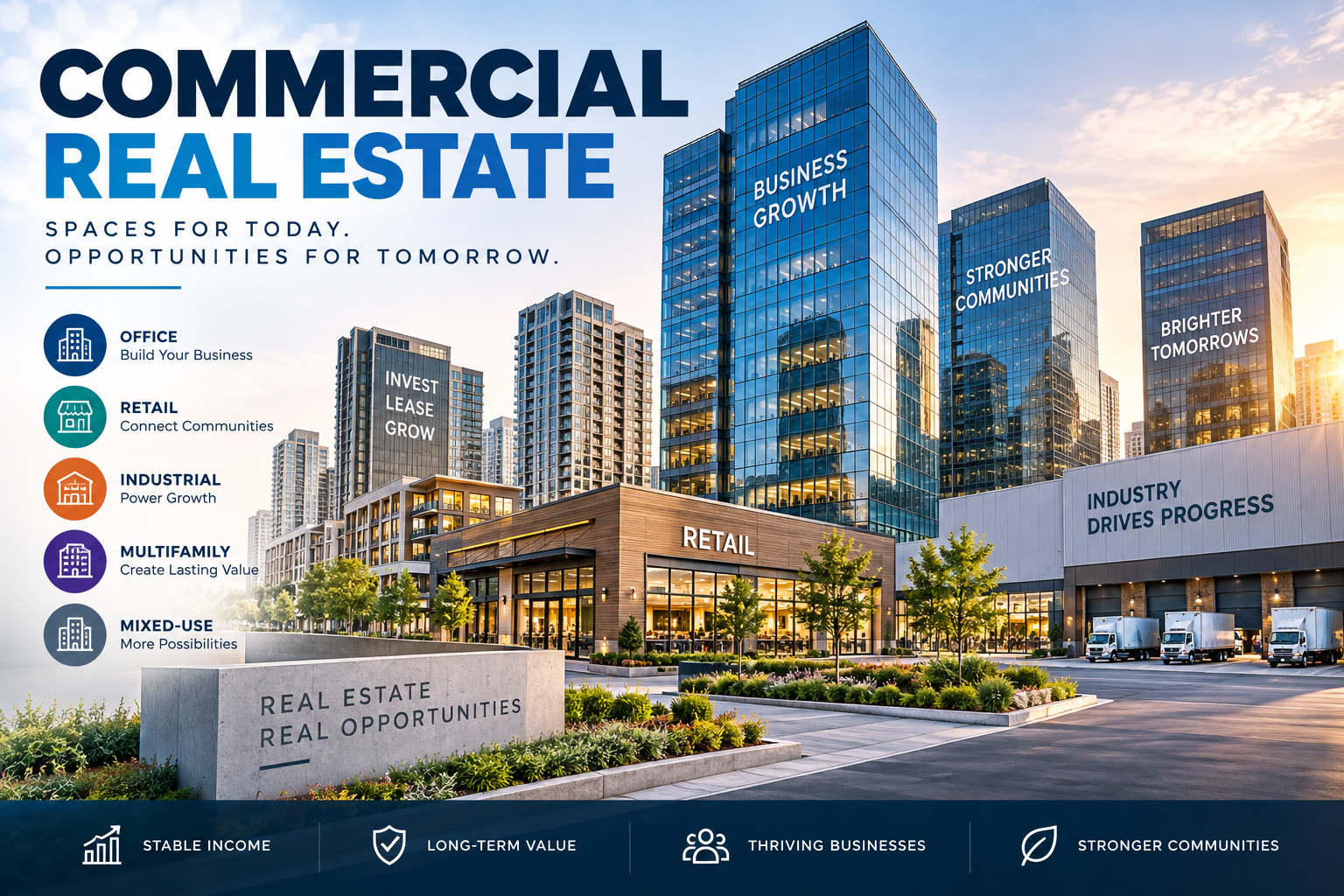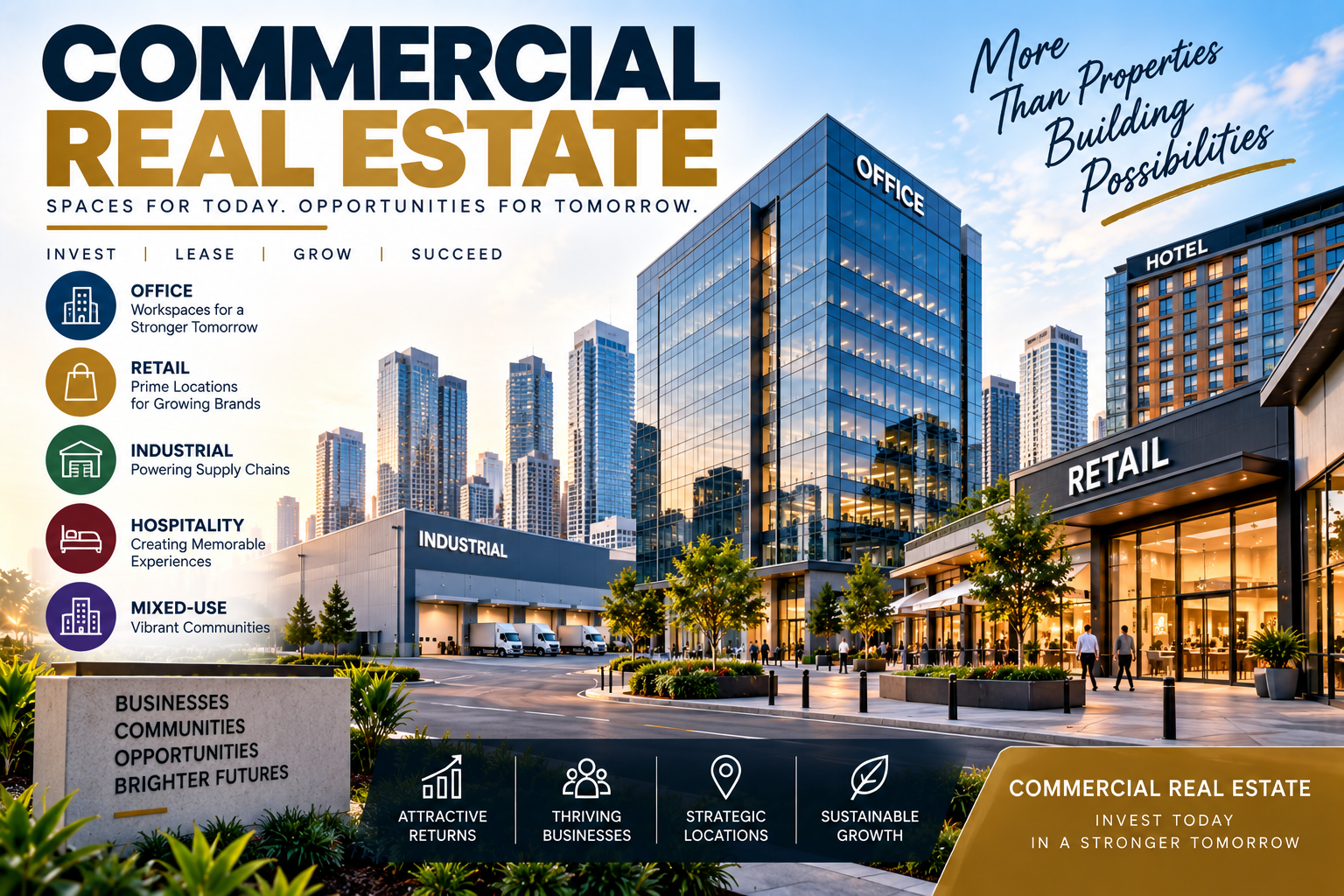
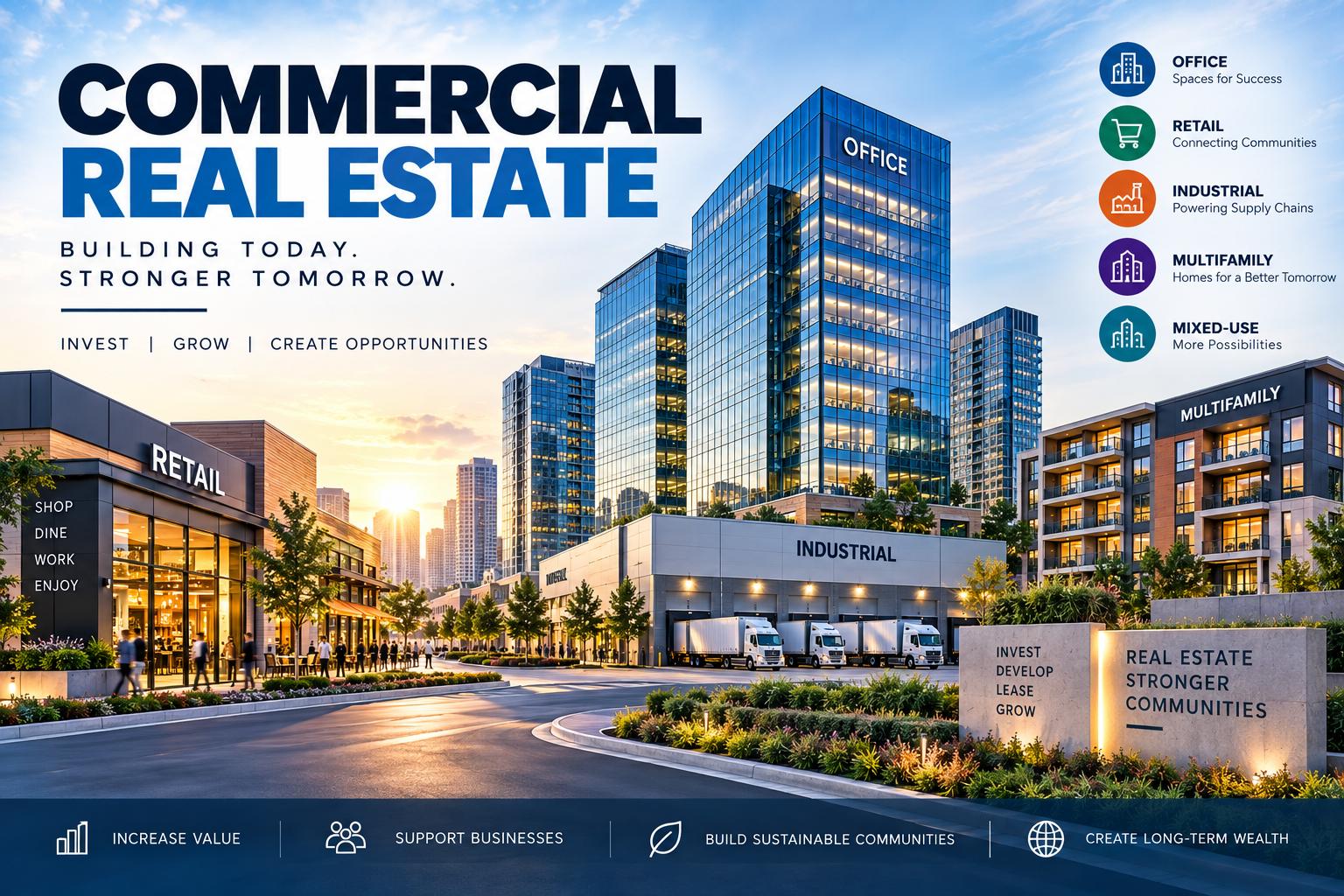
Commercial real estate plays a major role in the global economy by providing the physical spaces where businesses operate, products are stored, customers shop, and communities develop. From modern office buildings and retail centers to warehouses and mixed-use developments, commercial properties represent a broad range of investment and business opportunities.
As technology, consumer behavior, and workplace preferences continue to change, the commercial real estate industry is also evolving. For investors and business owners, understanding these changes is essential for identifying opportunities and managing potential risks.
What Is Commercial Real Estate?
Commercial real estate refers to properties primarily used for business activities or income generation. Owners may lease these properties to companies, retailers, manufacturers, service providers, or other organizations.
Unlike residential property, where the primary purpose is providing housing, commercial real estate is generally connected to business operations and investment returns.
Common examples include:
Office buildings
Retail stores and shopping centers
Warehouses
Manufacturing facilities
Distribution centers
Apartment buildings
Hotels
Mixed-use developments
Each property type has its own market characteristics, tenant requirements, operating costs, and investment considerations.
Why Is Commercial Real Estate Important?
Commercial real estate supports businesses of all sizes. A company needs an appropriate location to operate, while retailers require accessible spaces to serve customers. Manufacturers and distributors need warehouses and industrial facilities to move products efficiently.
Commercial development can also contribute to economic growth by creating jobs, attracting businesses, improving infrastructure, and supporting local communities.
For investors, commercial property can provide another potential source of income through rental payments and long-term property appreciation.
Major Types of Commercial Real Estate
Office Real Estate
Office properties are designed for professional and corporate activities. They range from small office buildings to large corporate campuses.
Demand for office space has changed as companies adopt hybrid and flexible working arrangements. Modern offices increasingly emphasize collaboration areas, technology, employee amenities, and flexible layouts.
Retail Real Estate
Retail properties include shopping centers, neighborhood stores, malls, restaurants, and standalone commercial units.
Location is particularly important for retail properties. Visibility, parking, accessibility, nearby businesses, population demographics, and customer traffic can all influence a property's performance.
Industrial Real Estate
Industrial properties include warehouses, manufacturing facilities, logistics centers, and distribution buildings.
The growth of online shopping and increasingly complex supply chains has increased demand for strategically located logistics facilities in many markets.
Multifamily Real Estate
Multifamily properties include apartment buildings and other residential developments containing multiple units. They are generally treated as commercial investments when operated as income-producing properties.
Investors often consider occupancy levels, rental rates, operating expenses, and local housing demand when evaluating multifamily opportunities.
Mixed-Use Developments
Mixed-use properties combine different functions within the same development. A project might include apartments, offices, restaurants, retail stores, and entertainment spaces.
These developments can create active communities where people can live, work, shop, and socialize in one location.
Key Factors That Influence Commercial Property Value
Several factors can affect the value and profitability of commercial real estate.
Location
Location remains one of the most important factors. Properties near transportation networks, business districts, residential communities, airports, highways, and other major facilities may attract stronger tenant demand.
Economic Conditions
Employment growth, business activity, interest rates, inflation, and consumer spending can influence commercial property markets.
A strong economy can encourage businesses to expand, while economic uncertainty may cause companies to reduce their property requirements.
Tenant Quality
The financial strength and reliability of tenants can have a significant impact on an investment. Long-term leases with financially stable tenants may provide greater income stability.
Property Condition
Well-maintained buildings can be more attractive to tenants and may require fewer unexpected capital expenditures. Investors should carefully evaluate the building's structure, systems, energy efficiency, parking, and other facilities.
Supply and Demand
A market with strong demand and limited availability may support higher rents and property values. Conversely, an oversupply of commercial space can increase competition between property owners.
Benefits of Commercial Real Estate Investment
Commercial real estate can offer several potential advantages.
Income generation: Properties can generate recurring rental income from tenants.
Long-term appreciation: Well-positioned properties may increase in value over time.
Portfolio diversification: Real estate can provide diversification from traditional financial assets.
Multiple investment strategies: Investors can pursue strategies such as buying and holding properties, developing new projects, renovating existing buildings, or leasing vacant space.
Potential for value creation: Improvements to a property, better management, stronger leasing, or redevelopment can potentially increase its value.
However, investors should remember that commercial real estate involves risks, including vacancies, market downturns, maintenance costs, financing expenses, and changes in tenant demand.
Commercial Real Estate Investment Strategies
Investors can approach commercial real estate in different ways depending on their financial goals and risk tolerance.
Buy and Hold
A buy-and-hold strategy involves purchasing a property and keeping it for an extended period while generating rental income and potentially benefiting from appreciation.
Value-Add Investment
Value-add investors purchase properties with opportunities for improvement. Renovations, better management, updated amenities, or improved leasing can potentially increase income and property value.
Development
Real estate development involves acquiring land and constructing new commercial properties. While development can offer significant potential returns, it also carries construction, financing, permitting, and market risks.
Property Repositioning
Some investors acquire properties that are underperforming or outdated and transform them into more attractive spaces for modern tenants.
The Role of Technology in Commercial Real Estate
Technology is transforming how commercial properties are developed, marketed, leased, and managed.
Property managers increasingly use digital platforms to communicate with tenants, track maintenance, monitor building performance, and analyze financial information.
Smart building technology can also improve energy management, security, lighting, heating, and cooling. Data analytics can help owners understand occupancy patterns and make better operational decisions.
Technology is therefore becoming an important part of creating efficient and competitive commercial properties.
Future Trends in Commercial Real Estate
The commercial real estate industry is expected to continue adapting to changing business and consumer needs.
Flexible office spaces, modern logistics facilities, mixed-use developments, sustainable buildings, and technology-enabled properties are likely to remain important areas of interest.
Sustainability is also becoming increasingly relevant. Energy-efficient buildings, renewable energy systems, water-saving technologies, and environmentally responsible construction can help reduce operating costs while meeting changing expectations from tenants and investors.
Tips for Investors and Business Owners
Before making a commercial real estate decision, consider the following:
Research the local market carefully.
Analyze current and future tenant demand.
Review rental rates and comparable properties.
Calculate operating expenses and potential cash flow.
Examine existing leases and tenant agreements.
Evaluate financing costs and loan conditions.
Inspect the property's physical condition.
Consider future development in the surrounding area.
Understand local zoning and regulatory requirements.
Develop a clear exit or long-term investment strategy.
Professional advice from real estate, legal, tax, and financial specialists can also be valuable when dealing with complex commercial transactions.
Conclusion
Commercial real estate provides opportunities for businesses, developers, landlords, and investors across a wide range of property types. From offices and retail centers to industrial facilities and mixed-use developments, each segment offers different opportunities and challenges.
Success in commercial real estate depends on more than simply purchasing a property. Investors need to understand location, market conditions, tenant demand, operating expenses, financing, and long-term trends.
As businesses and communities continue to evolve, commercial real estate will remain an important part of economic development and investment. Careful research, effective property management, and a well-defined strategy can help investors make more informed decisions in this constantly changing market.