
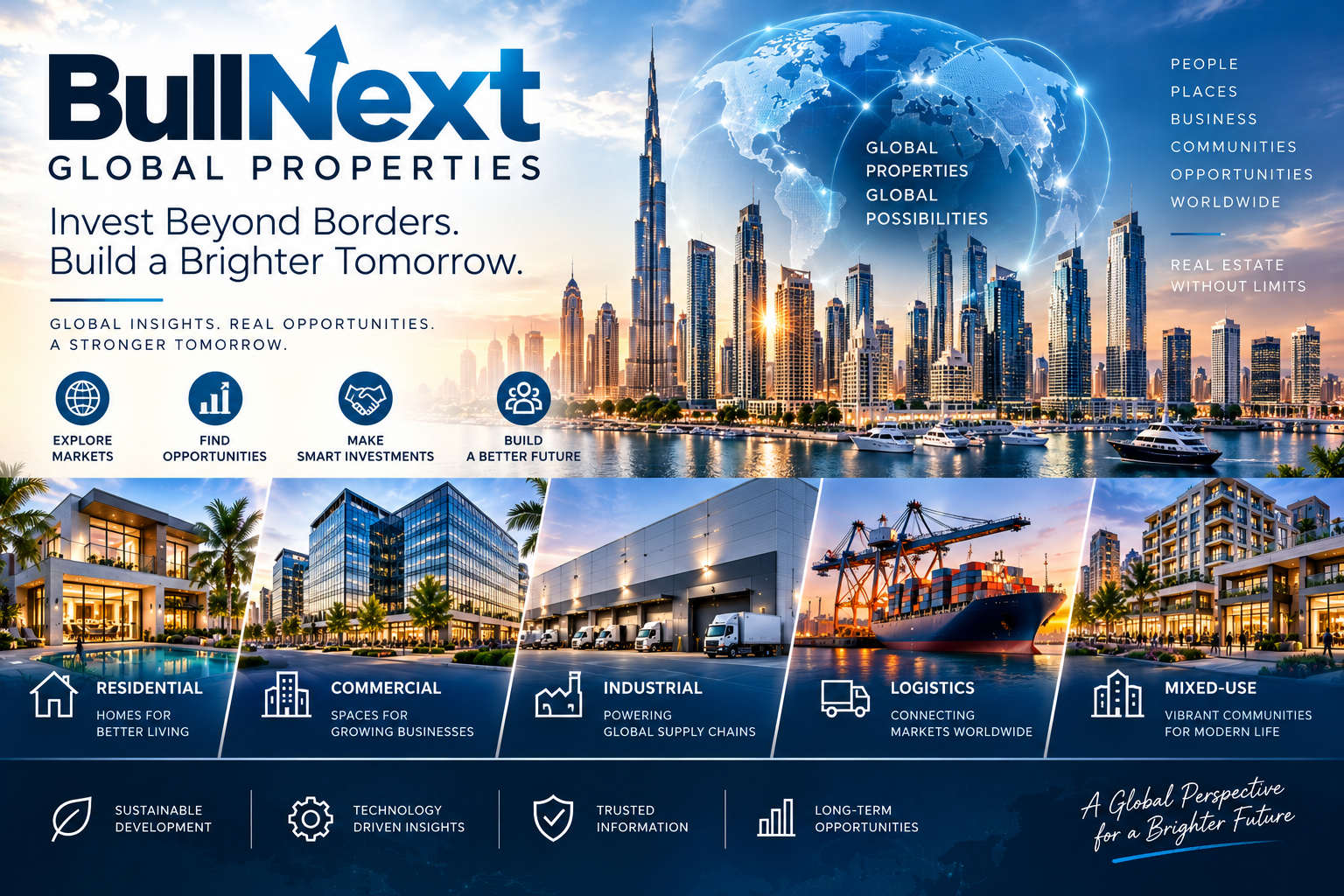
Real estate is becoming increasingly global. Investors, businesses, developers, and property professionals can now explore opportunities across cities and countries, comparing markets based on economic growth, infrastructure, demographics, technology, and long-term demand.
BullNext Global Properties provides a platform for exploring these international real estate themes, from residential and commercial property to industrial, logistics, and mixed-use developments. BullNext's Real Estate section currently includes Global Properties alongside Commercial Real Estate and Residential Real Estate.
The Changing Global Property Landscape
Real estate markets are influenced by the people, businesses, and economies surrounding them. As cities expand and international business becomes more connected, property demand can change rapidly.
A growing technology center may create demand for offices and housing. A manufacturing region may require industrial facilities and warehouses. A tourism destination may see opportunities in hotels, retail, and hospitality.
This means there is no single formula for evaluating global real estate. Every market needs to be considered according to its own economic and demographic conditions.
What Does Global Property Include?
Global properties cover a wide range of real estate assets, including:
Residential homes and apartments
Office buildings
Retail centers
Industrial facilities
Warehouses and logistics centers
Hotels and hospitality properties
Mixed-use developments
Land and development projects
Each category has different requirements and responds to different market forces.
For example, residential demand can be influenced by population growth and affordability, while industrial property may depend more heavily on transportation infrastructure and supply-chain activity.
Why Location Still Matters
Technology has made it easier to research property around the world, but location remains one of the most important fundamentals of real estate.
A property's potential can be influenced by its proximity to:
Major transportation networks
Employment centers
Business districts
Schools and universities
Healthcare facilities
Shopping and entertainment
Airports and ports
Highways and rail networks
Investors should look beyond the property itself and examine the development of the surrounding area.
A building located in an area with improving infrastructure, growing employment, and increasing business activity may have different long-term prospects from a similar property in a declining market.
Global Cities as Real Estate Hubs
Major cities continue to attract businesses, workers, students, tourists, and investment.
Financial centers can create demand for offices and luxury residential properties. Technology hubs may attract companies and highly skilled workers. Manufacturing centers can generate demand for industrial facilities and logistics infrastructure.
However, a large or famous city does not automatically represent a strong investment opportunity.
Investors should examine factors such as property prices, rental demand, supply, affordability, employment, infrastructure, regulations, and future development.
Residential Property Opportunities
Residential real estate remains one of the largest segments of the global property market.
Houses, apartments, condominiums, and residential communities can experience changing demand as populations grow and lifestyles evolve.
Modern residents may increasingly value:
Convenient transportation
Flexible living spaces
Energy efficiency
Digital connectivity
Nearby services
Community amenities
Access to employment centers
Developers and investors who understand these changing preferences may be better positioned to identify properties that match future demand.
Commercial Real Estate Across Borders
Commercial real estate provides the physical infrastructure businesses need to operate and expand.
International commercial property can include offices, retail centers, hotels, restaurants, and other business-focused developments.
Businesses evaluating a property may consider:
Customer accessibility
Employee convenience
Local economic activity
Rental costs
Infrastructure
Competition
Long-term growth potential
As working patterns continue to evolve, commercial properties may also need to become more flexible and technology-enabled.
Industrial and Logistics Real Estate
The global movement of goods has made logistics infrastructure an increasingly important part of the property industry.
Warehouses and distribution centers are often strategically located near ports, airports, highways, railways, and major population centers.
E-commerce, manufacturing, international trade, and supply-chain development can all influence demand for industrial real estate.
For investors, the location and connectivity of a logistics property can be particularly important because transportation efficiency directly affects business operations.
Mixed-Use Developments
Mixed-use developments combine different property types within one project.
A development may include:
Residential apartments
Offices
Retail stores
Restaurants
Entertainment spaces
Public areas
These developments can create communities where residents can live, work, shop, and socialize within a connected environment.
Mixed-use projects can also help developers respond to changing preferences for convenience and walkable communities.
Infrastructure and Property Growth
Infrastructure can influence where real estate development occurs.
New roads, airports, rail networks, public transportation systems, ports, and utilities can improve accessibility and encourage economic activity.
Digital infrastructure is also becoming increasingly important. Reliable internet connectivity and advanced communication networks can influence where businesses and professionals choose to locate.
When researching an international property market, it can therefore be useful to examine not only existing infrastructure but also planned infrastructure projects.
Technology Is Reshaping Real Estate
Technology has transformed the way people search for and manage property.
International buyers can use digital platforms to research markets, compare properties, view virtual tours, communicate with agents, and review property information without immediately traveling to the location.
Property owners and managers can also use technology for:
Tenant communication
Maintenance management
Financial reporting
Market analysis
Building monitoring
Digital marketing
Customer support
These tools can make international property management more efficient, although local expertise remains important for physical and regulatory matters.
Artificial Intelligence and Global Property
Artificial intelligence is becoming another important technology in real estate.
AI tools can help property professionals analyze large amounts of information, compare markets, identify patterns, automate administrative tasks, and improve customer communication.
For investors, AI can potentially make research faster by helping organize information about property prices, rental markets, demographics, infrastructure, and economic conditions.
However, technology should support—not replace—professional judgment. Real estate decisions involve legal, financial, physical, and local-market considerations that require careful evaluation.
Sustainability and Modern Properties
Sustainability is becoming a significant consideration in global property development.
Modern developments may incorporate:
Energy-efficient systems
Solar power
Water-saving technology
Sustainable construction materials
Efficient lighting
Waste-reduction systems
Smart building controls
Sustainable design can potentially reduce operating expenses while creating properties that better align with changing environmental expectations.
For investors and developers, sustainability can therefore be both an environmental consideration and a long-term property-management consideration.
Challenges of International Real Estate
Global property opportunities also come with additional risks.
Investors may need to consider:
Currency Risk
Changes in exchange rates can affect the value of an international investment when measured in the investor's home currency.
Regulatory Differences
Property ownership, taxes, zoning, rental rules, and foreign investment requirements vary between countries.
Market Risk
Economic conditions can change property prices, rental demand, vacancy rates, and development activity.
Management Challenges
Managing a property from another country can make maintenance, tenant communication, inspections, and repairs more complicated.
Financing
Mortgage availability, interest rates, lending requirements, and financing structures can differ significantly between markets.
Understanding these risks is essential before making an international property decision.
The Importance of Due Diligence
International property decisions require careful research.
Before purchasing a property, buyers should consider verifying:
Ownership: Confirm the legal ownership and title information.
Property condition: Inspect the building and identify potential maintenance or structural issues.
Market demand: Research rental demand, buyer activity, vacancy, and competing properties.
Legal requirements: Understand ownership restrictions, zoning, taxes, and other regulations.
Financial costs: Calculate purchase expenses, financing, insurance, maintenance, taxes, and management costs.
Exit strategy: Consider how the property could potentially be sold or transferred in the future.
Professional legal, tax, financial, and property advice can be especially valuable when entering an unfamiliar market.
Global Real Estate and Business Expansion
Real estate can play an important role when companies expand internationally.
A business entering a new market may need offices, retail locations, warehouses, manufacturing facilities, or distribution centers.
The right property can support:
Employees
Customers
Suppliers
Transportation
Operations
Business growth
Property decisions should therefore be connected to the company's broader expansion strategy rather than considered separately.
What Could Shape the Future?
Several forces are likely to continue influencing global property markets.
Urbanization may increase demand for housing, offices, transportation, and mixed-use developments.
Technology may make property research and management increasingly digital.
Artificial intelligence may improve data analysis and operational efficiency.
Sustainability may influence construction standards and property preferences.
E-commerce may continue affecting warehouses and logistics facilities.
Changing lifestyles may reshape demand for residential and mixed-use communities.
Infrastructure investment may create new development opportunities in emerging areas.
These trends do not guarantee investment success, but they can provide useful context when analyzing future property markets.
A Smart Approach to Global Property Research
A simple framework can help investors and businesses approach international real estate:
Research → Compare → Verify → Calculate → Consult → Decide
Research
Understand the economy, demographics, infrastructure, regulations, and property market.
Compare
Look at multiple cities, neighborhoods, property types, and investment opportunities.
Verify
Check ownership, documentation, property condition, regulations, and development plans.
Calculate
Estimate the complete financial picture, including purchase costs, taxes, financing, maintenance, management, and potential income.
Consult
Seek advice from qualified local professionals who understand the market.
Decide
Choose an opportunity that matches your objectives, budget, time horizon, and risk tolerance.
Conclusion
BullNext Global Properties reflects the increasingly international nature of the real estate industry. Property opportunities now extend across residential, commercial, industrial, logistics, hospitality, and mixed-use markets around the world.
However, successful global property decisions require more than finding an attractive location. Investors and businesses need to understand infrastructure, demographics, economic conditions, regulations, financing, currency, technology, sustainability, and long-term demand.
The combination of global research and local expertise can provide a stronger foundation for evaluating international property opportunities.
As cities grow, businesses expand, technology advances, and communities evolve, global real estate will continue to play an important role in economic development and investment.
For readers interested in understanding these changes, BullNext Global Properties provides a useful focus for exploring the opportunities, trends, and challenges shaping real estate beyond local markets.