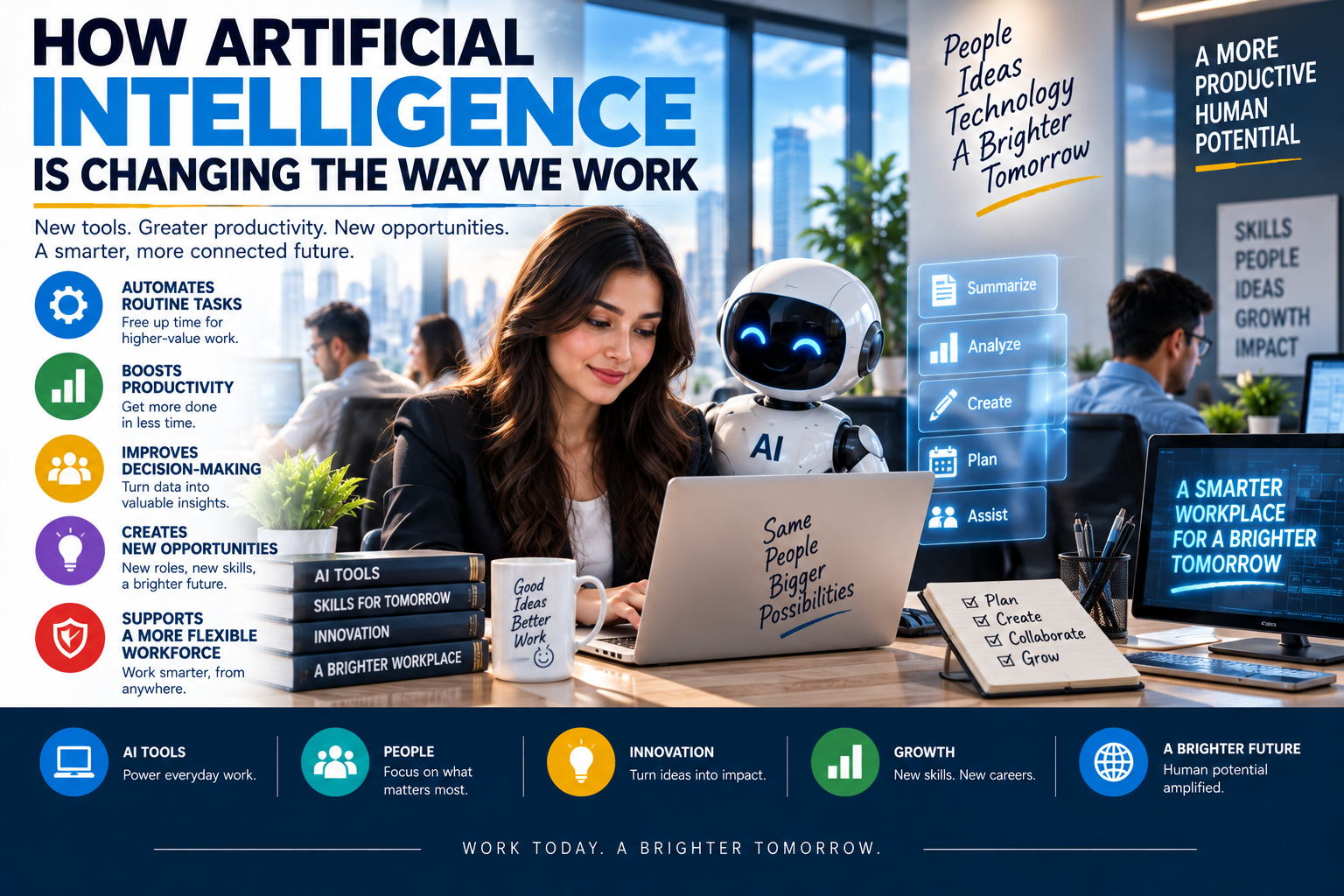
Artificial intelligence is changing the way people and businesses work. From automating repetitive tasks to helping professionals analyze information, communicate with customers, create content, and make decisions, AI is becoming part of everyday workplace operations.
The impact of artificial intelligence is not limited to technology companies. Businesses in healthcare, finance, education, manufacturing, retail, marketing, logistics, professional services, and many other industries are exploring ways to use AI.
For employees, this transformation can create new opportunities while also changing the skills required for many jobs. Some tasks that once required significant amounts of manual effort can now be completed more quickly with AI-powered tools. At the same time, workers increasingly need skills such as critical thinking, communication, creativity, problem-solving, and the ability to work effectively with technology.
The future of work is therefore not simply about humans versus machines. In many cases, it is about humans working with machines to accomplish more.
Understanding how AI is changing the workplace can help employees, business leaders, and organizations prepare for the opportunities and challenges ahead.
What Is Artificial Intelligence?
Artificial intelligence refers to technologies designed to perform tasks that traditionally require aspects of human intelligence.
Depending on the system, AI can help with:
Understanding language
Recognizing patterns
Analyzing information
Generating text
Creating images
Processing large datasets
Making predictions
Automating workflows
Answering questions
Supporting decisions
Modern AI systems can process enormous amounts of information and perform specific tasks at impressive speed.
However, AI systems do not replace human judgment in every situation. They can produce incorrect, incomplete, or misleading results, making human oversight important.
Why AI Is Becoming Important in the Workplace
Businesses are under constant pressure to improve efficiency, reduce unnecessary costs, serve customers better, and adapt to changing markets.
AI can help organizations achieve some of these objectives by automating routine processes and assisting employees with information-intensive tasks.
For example, a company might use AI to summarize documents, analyze customer feedback, identify patterns in business data, draft routine communications, or assist employees with research.
Instead of spending hours on repetitive work, employees may be able to devote more time to tasks requiring judgment and creativity.
This is one of the major reasons organizations are exploring AI.
AI Can Automate Repetitive Tasks
One of the clearest workplace applications of AI is automation.
Many jobs involve repetitive activities such as:
Data entry
Scheduling
Document processing
Basic reporting
Email classification
Customer inquiries
Information extraction
Routine administrative work
When these tasks can be automated, employees may have more time for higher-value responsibilities.
Automation does not necessarily mean that an entire job disappears.
In many cases, only certain tasks within a job are automated.
This distinction is important because most jobs consist of multiple responsibilities.
AI may change how a job is performed without completely eliminating the role.
AI and Productivity
AI can improve productivity by helping employees complete certain tasks more quickly.
For example, an employee could use an AI assistant to:
Summarize a lengthy report
Organize information
Generate a first draft
Create a checklist
Brainstorm ideas
Analyze a dataset
Prepare questions for a meeting
The employee can then review, correct, and improve the output.
This creates a workflow in which AI handles some of the initial work while the human remains responsible for judgment and final decisions.
Productivity gains, however, depend on how AI is implemented.
Simply adding AI tools to a workplace does not guarantee better results.
Organizations need appropriate processes, training, data, security controls, and human oversight.
AI Is Changing Administrative Work
Administrative professionals often manage large amounts of information and repetitive communication.
AI can assist with:
Meeting summaries
Calendar organization
Document drafting
Email categorization
Report preparation
Data organization
Research
Internal communications
These capabilities can reduce the time spent on routine tasks.
The human role remains important because administrative work often involves context, priorities, relationships, confidentiality, and judgment.
AI can assist with the process, but employees still need to determine what matters and how information should be used.
AI in Customer Service
Customer service is another area where AI is rapidly changing workflows.
AI-powered systems can help businesses answer common questions, organize support requests, summarize customer interactions, and identify frequently reported problems.
For simple requests, automated systems may provide immediate assistance.
More complicated situations can be transferred to human representatives.
This creates a hybrid model in which AI handles routine interactions while employees focus on cases that require empathy, negotiation, judgment, or specialized knowledge.
AI and Marketing
Marketing teams can use AI to support many activities.
These can include:
Content brainstorming
Audience analysis
Campaign planning
Customer segmentation
Market research
Copy drafting
Data analysis
Personalization
Performance reporting
AI can help marketers process large amounts of information and identify patterns that might otherwise take significant time to discover.
However, effective marketing still requires creativity, brand understanding, strategy, and human insight.
AI-generated content also needs careful review to ensure accuracy, originality, consistency, and alignment with the organization's voice.
AI Is Changing Software Development
Software development is another area where AI tools can assist professionals.
AI can help developers:
Generate code
Explain code
Find potential errors
Write tests
Create documentation
Understand unfamiliar code
Suggest solutions
Automate repetitive programming tasks
These tools can improve productivity, especially for routine development work.
However, generated code still needs to be reviewed and tested.
Software engineers must understand security, architecture, performance, reliability, and business requirements.
AI can assist with programming, but professional judgment remains essential.
AI in Data Analysis
Businesses generate huge amounts of data.
AI can help organizations process this information more efficiently.
Applications include:
Identifying trends
Detecting unusual patterns
Forecasting
Customer analysis
Sales analysis
Operational reporting
Risk analysis
Performance measurement
Instead of manually examining every piece of information, employees can use AI to identify areas that deserve closer attention.
The quality of the result still depends on the quality of the underlying data.
Poor data can lead to poor conclusions.
AI and Decision-Making
AI can provide information that supports business decisions.
For example, a company could use AI to analyze:
Customer behavior
Sales performance
Inventory
Market conditions
Operational costs
Employee workflows
Financial information
AI can identify patterns and provide recommendations.
But business decisions often involve factors that cannot be captured entirely in a dataset.
Leadership, ethics, experience, organizational culture, and long-term strategy all matter.
AI should therefore be viewed as a decision-support tool rather than an automatic replacement for responsible leadership.
AI and Remote Work
Remote and hybrid workplaces can also benefit from AI.
AI tools can help teams organize information across different locations and time zones.
Possible applications include:
Meeting summaries
Task management
Knowledge management
Automated reminders
Document search
Collaboration support
Translation
Communication assistance
These capabilities can reduce some of the friction associated with distributed teams.
However, technology cannot solve every challenge associated with remote work.
Strong communication, trust, accountability, and clear expectations remain essential.
AI Is Changing Workplace Skills
As AI becomes more common, the skills employers value may also change.
Technical skills remain important, but human-centered abilities can become increasingly valuable.
These include:
Critical thinking
Communication
Creativity
Leadership
Problem-solving
Collaboration
Adaptability
Emotional intelligence
Strategic thinking
Employees who can combine domain expertise with AI literacy may be better positioned to take advantage of emerging opportunities.
What Is AI Literacy?
AI literacy means understanding how AI systems work at a practical level and knowing how to use them responsibly.
An AI-literate employee should understand:
What AI can do
What AI cannot reliably do
How to verify AI-generated information
How to protect sensitive information
How to write effective instructions
When human judgment is required
How AI can introduce errors or bias
AI literacy does not necessarily mean becoming a computer scientist.
It means being able to use AI tools intelligently and responsibly within a particular role.
AI and Job Transformation
One of the biggest questions surrounding AI is how it will affect employment.
The answer is likely to vary significantly by industry, occupation, organization, and individual role.
Some jobs may experience substantial automation of routine tasks.
Others may change gradually as AI becomes another tool used by employees.
New roles may also emerge around AI implementation, governance, security, data management, training, and specialized applications.
Rather than thinking only in terms of jobs disappearing, it can be useful to think about jobs changing.
A profession that exists today may require a different combination of skills in the future.
AI Can Create New Career Opportunities
Technological change can create new types of work.
Organizations adopting AI may need people who can:
Implement AI systems
Manage AI projects
Evaluate AI outputs
Develop AI applications
Protect AI systems
Govern AI usage
Train employees
Manage data
Integrate AI with existing software
Some emerging opportunities may require highly technical expertise, while others may combine AI knowledge with existing professional skills.
For example, a marketing professional does not necessarily need to become an AI engineer to benefit from AI.
Learning how to use AI effectively within marketing may be enough to create a valuable new skill set.
AI and Employee Training
Organizations adopting AI should invest in employee training.
Employees need to understand not only how to use new tools but also when not to use them.
Training can cover:
AI fundamentals
Tool selection
Prompting and instructions
Data privacy
Security
Fact-checking
Bias awareness
Human review
Workplace policies
Without proper training, employees may use AI inconsistently or create unnecessary risks.
The Importance of Human Oversight
AI systems can produce impressive results, but they can also make mistakes.
An AI system may:
Misinterpret a question
Produce inaccurate information
Miss important context
Reflect biases in data
Generate confident-sounding errors
Misunderstand a business requirement
For high-impact decisions, human review is particularly important.
Employees should understand the limitations of the systems they use and know when additional verification is necessary.
AI and Creativity
There is a common assumption that creativity is exclusively human.
In practice, AI can now assist with many creative activities.
It can help people brainstorm:
Headlines
Product concepts
Marketing ideas
Story concepts
Design directions
Presentation structures
Campaign themes
However, creativity is more than generating possibilities.
Human creativity involves understanding people, culture, emotions, context, goals, and meaning.
AI can generate options, but humans often determine which ideas are valuable and how they should be developed.
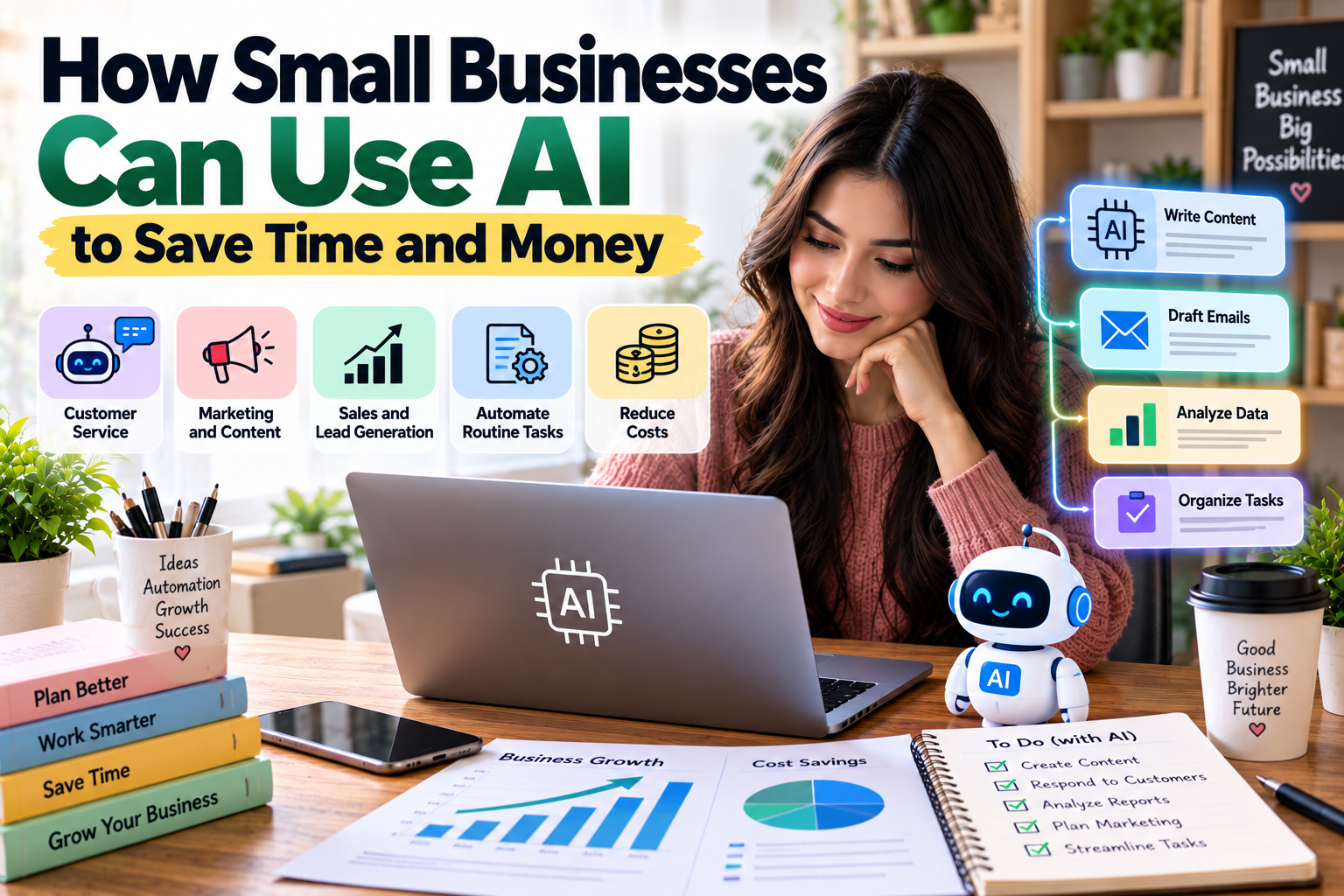
AI Can Help Small Businesses
AI is not only useful for large corporations.
Small businesses can use AI to support areas such as:
Customer service
Marketing
Bookkeeping assistance
Content creation
Research
Scheduling
Inventory planning
Administrative tasks
This can allow smaller organizations to access capabilities that previously required larger teams.
However, small businesses should choose tools based on actual business needs rather than adopting AI simply because it is popular.
AI and Workplace Efficiency
AI can help identify inefficiencies in business processes.
For example, an organization might examine how long employees spend:
Searching for documents
Responding to routine questions
Creating reports
Entering data
Processing requests
Reviewing repetitive information
AI automation may reduce unnecessary steps.
But businesses should first understand the process they are trying to improve.
Automating a poorly designed process can simply make a bad process faster.
AI and Workplace Communication
AI can assist employees with written communication.
It may help draft:
Emails
Reports
Proposals
Meeting summaries
Internal announcements
Customer responses
Presentations
Employees should still review AI-generated communication before sending it.
Tone, accuracy, confidentiality, and context matter.
An AI-generated message that sounds professional may still be inappropriate for a particular customer, colleague, or situation.
AI and Workplace Privacy
AI adoption also creates privacy considerations.
Employees may be tempted to place confidential information into AI tools without understanding how the information is processed or stored.
Organizations should establish clear policies covering:
Customer information
Employee data
Financial information
Intellectual property
Business strategy
Passwords and credentials
Confidential documents
Employees should never assume that an AI tool is appropriate for sensitive information simply because it is easy to use.
AI and Cybersecurity
AI has implications for both cybersecurity defenses and cyber risks.
Organizations can use AI to help identify unusual activity, analyze security information, and support threat detection.
At the same time, malicious actors can use AI to create more sophisticated scams and attacks.
This makes cybersecurity awareness increasingly important for employees.
Businesses need security policies that address both the opportunities and risks associated with AI.
AI and Workplace Ethics
The use of AI raises important ethical questions.
Organizations may need to consider:
Transparency
Privacy
Fairness
Bias
Accountability
Human oversight
Intellectual property
Employment impacts
For example, if AI contributes to an important business decision, organizations should understand who is responsible for the final outcome.
Technology should not become an excuse for avoiding accountability.
AI and Leadership
Business leaders play an important role in responsible AI adoption.
Leaders should ask:
What problem are we trying to solve?
Can AI actually improve this process?
What risks could it introduce?
What data will it require?
Who will review the results?
How will success be measured?
What training will employees need?
A successful AI strategy should be connected to business objectives.
AI adoption for its own sake is unlikely to create lasting value.
How Employees Can Prepare for an AI-Driven Workplace
Employees do not need to predict exactly which technologies will dominate the future.
Instead, they can build adaptable skills.
Learn the AI Tools Relevant to Your Work
Focus on tools that can actually improve your current responsibilities.
Strengthen Human Skills
Develop communication, critical thinking, creativity, leadership, and problem-solving.
Learn to Verify Information
Do not automatically assume that AI-generated information is correct.
Understand Your Industry
AI skills become more valuable when combined with knowledge of a specific field.
Stay Adaptable
Technology will continue to change.
The ability to learn new tools may be more valuable than mastering one tool permanently.
How Businesses Can Prepare
Businesses can take a structured approach to AI adoption.
Identify High-Value Use Cases
Start with processes where AI could realistically save time, improve quality, or support better decisions.
Establish Policies
Create clear rules for privacy, security, acceptable use, and human oversight.
Train Employees
Make sure workers understand both the capabilities and limitations of AI.
Measure Results
Track whether AI is actually improving productivity, quality, customer experience, or another meaningful business outcome.
Scale Gradually
Successful pilot projects can be expanded once the organization understands their benefits and risks.
The Future of Human-AI Collaboration
The workplace of the future is likely to involve increasing collaboration between humans and intelligent software.
AI may handle more routine information-processing tasks while people focus on areas requiring:
Judgment
Relationships
Creativity
Leadership
Strategy
Complex problem-solving
Accountability
The exact balance will vary across industries.
The most successful organizations may not be those that automate everything.
They may be those that understand where technology provides the greatest value and where human expertise remains essential.
AI Does Not Eliminate the Need to Learn
Technology can make certain tasks easier, but learning remains essential.
As AI changes job responsibilities, workers may need to continuously develop their skills.
Lifelong learning can include:
Online courses
Professional certifications
Workshops
Industry events
Practical experimentation
Mentoring
Reading
Hands-on projects
The goal is not to compete with AI at everything.
The goal is to understand how technology can extend human capabilities.
Common Mistakes Businesses Make With AI
Adopting AI Without a Clear Purpose
Using AI simply because competitors are doing so can waste resources.
Ignoring Data Quality
AI systems depend heavily on the information they receive.
Failing to Train Employees
A powerful tool can produce limited results if employees do not understand how to use it.
Removing Human Oversight
Important decisions should not automatically be delegated to AI.
Ignoring Security
Sensitive business information requires appropriate safeguards.
Expecting Immediate Transformation
AI implementation can require experimentation, process redesign, and organizational learning.
A Practical AI Adoption Framework
Businesses can use a simple framework when considering an AI project.
Step 1: Identify the Problem
Define the business problem before choosing a technology.
Step 2: Evaluate the Opportunity
Estimate potential time savings, quality improvements, or financial benefits.
Step 3: Assess the Risks
Consider privacy, security, accuracy, bias, compliance, and operational risks.
Step 4: Test the Solution
Start with a limited pilot where results can be measured.
Step 5: Train Employees
Provide clear guidance on responsible use.
Step 6: Measure Performance
Compare results against the original objectives.
Step 7: Improve the Process
Use feedback to refine the workflow.
Step 8: Scale Carefully
Expand successful applications while maintaining appropriate controls.
The Bottom Line
Artificial intelligence is changing the way work gets done.
It can automate repetitive tasks, assist with research, improve data analysis, support customer service, accelerate content creation, help developers write software, and give businesses new ways to understand information.
But AI is not simply a replacement for human workers.
In many workplaces, its greatest value may come from helping people work more effectively.
Employees who combine AI literacy with communication, critical thinking, creativity, leadership, and industry knowledge can be better prepared for changing workplace demands.
Businesses, meanwhile, need to adopt AI strategically rather than simply following technology trends. Clear objectives, employee training, data protection, human oversight, and responsible governance are essential.
The future of work will continue to evolve as AI becomes more capable.
The most important question is not whether AI will change work—it already is.
The more useful question is how employees and organizations can use AI responsibly to create better, more productive, and more adaptable workplaces.
Frequently Asked Questions About AI and the Future of Work
1. How is artificial intelligence changing the way we work?
AI is changing work by automating repetitive tasks, assisting with research and analysis, supporting communication, improving workflows, and helping employees make better use of information.
2. Will AI replace human workers?
AI may automate certain tasks and change some occupations, but many jobs involve responsibilities requiring judgment, communication, creativity, relationships, and accountability. The impact will vary by industry and role.
3. What jobs are most affected by AI?
Jobs involving large amounts of repetitive, predictable, or information-processing tasks may experience significant changes. However, the impact depends on the specific tasks within each occupation.
4. How can employees prepare for AI?
Employees can learn relevant AI tools, strengthen digital literacy, develop critical thinking and communication skills, understand their industry, and remain adaptable as technology changes.
5. What is AI literacy?
AI literacy is the ability to understand AI's capabilities and limitations and use AI tools effectively, responsibly, and safely.
6. Can AI improve workplace productivity?
Yes. AI can help automate repetitive work, summarize information, analyze data, generate drafts, organize workflows, and support other activities. Productivity gains depend on effective implementation.
7. Can small businesses use AI?
Yes. Small businesses can use AI for customer service, marketing, research, administrative tasks, content creation, data analysis, and other activities.
8. How is AI changing customer service?
AI can answer routine questions, categorize support requests, summarize interactions, and help employees identify customer issues. Complex cases can remain with human representatives.
9. How is AI changing marketing?
AI can support content creation, customer analysis, market research, personalization, campaign planning, and performance analysis.
10. Can AI replace creativity?
AI can assist with brainstorming and generating creative possibilities, but human creativity remains important for understanding context, emotions, culture, strategy, and audience needs.
11. Is AI-generated information always accurate?
No. AI systems can produce incorrect or incomplete information. Important information should be reviewed and verified.
12. Why is human oversight important when using AI?
Human oversight helps identify errors, evaluate context, address ethical concerns, and ensure that important decisions remain accountable.
13. How does AI affect remote work?
AI can support remote teams through meeting summaries, document organization, information search, task management, translation, and collaboration tools.
14. What skills will become important in an AI-driven workplace?
Critical thinking, communication, creativity, problem-solving, adaptability, leadership, collaboration, industry knowledge, and AI literacy are likely to remain valuable.
15. How can businesses introduce AI responsibly?
Businesses should identify clear use cases, assess risks, establish policies, train employees, protect sensitive information, test AI systems, and measure results.
16. Can AI help with business decision-making?
AI can analyze large amounts of data and identify patterns that support decision-making. However, human judgment should remain important for complex or high-impact decisions.
17. What are the risks of using AI at work?
Potential risks include inaccurate information, privacy problems, cybersecurity threats, bias, intellectual property concerns, inappropriate automation, and overreliance on AI-generated results.
18. Does every business need an AI strategy?
Businesses do not necessarily need to adopt every AI technology. They should evaluate whether specific AI applications can solve meaningful problems or create measurable value.
19. Will new jobs be created because of AI?
AI adoption can create demand for roles related to AI development, implementation, governance, security, data management, training, and specialized applications.
20. What is the future of AI in the workplace?
AI is likely to become increasingly integrated into everyday workflows. Many employees may use AI as a productivity and decision-support tool while continuing to provide human judgment, creativity, communication, and accountability.