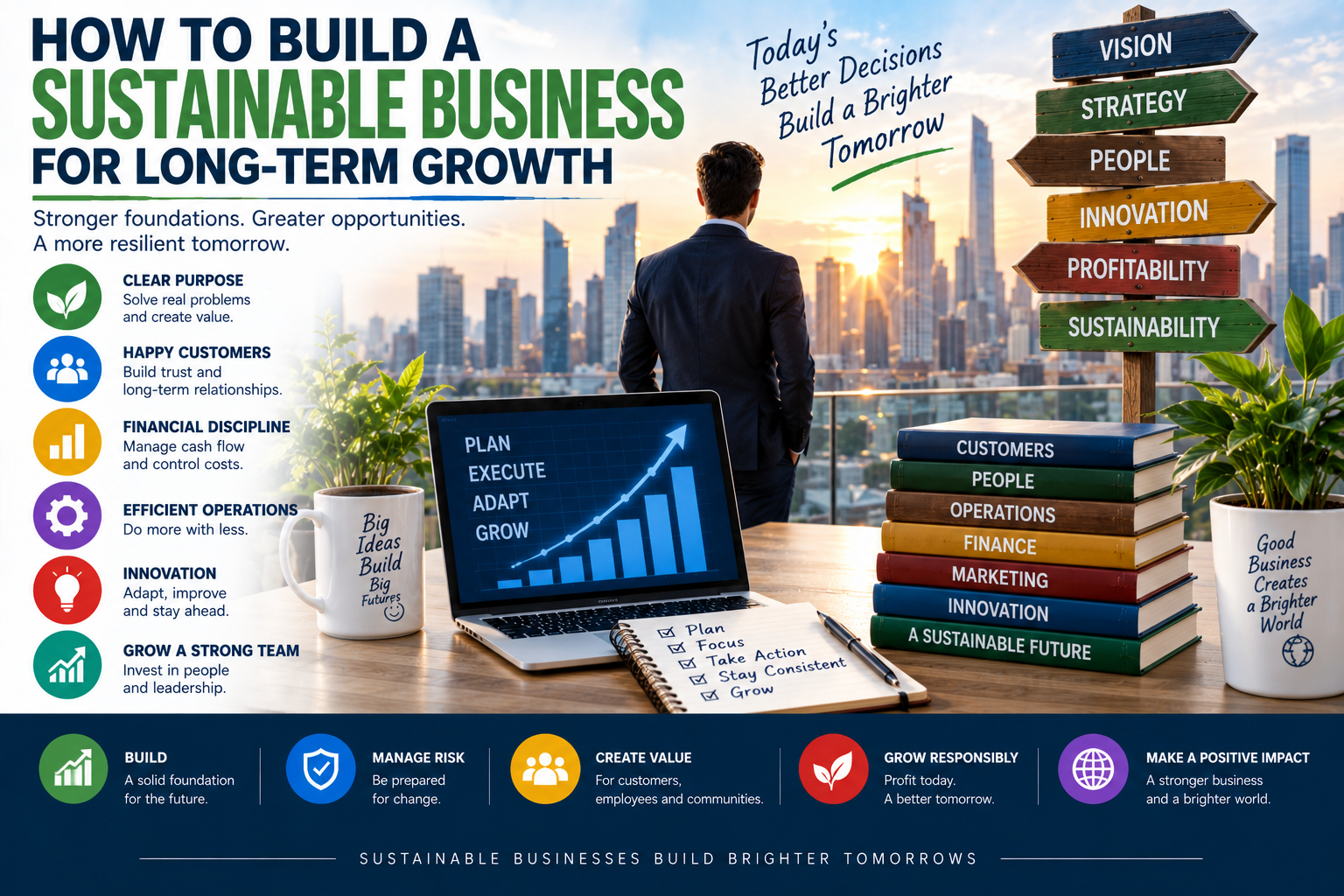
Building a business is one thing. Building a business that can survive challenges, adapt to change, serve customers consistently, and grow for many years is something much more difficult.
Sustainable business growth is not simply about increasing sales as quickly as possible. It involves creating a strong foundation that allows a company to remain financially healthy, maintain customer trust, develop its employees, improve its products or services, and respond to changes in the market.
A business can experience rapid growth and still become unstable if expenses rise too quickly, cash flow is poorly managed, customers are dissatisfied, or the organization becomes dependent on a single product, employee, supplier, or market.
Long-term growth requires a broader perspective.
Business leaders need to think about profitability, operational efficiency, innovation, customer relationships, talent, technology, risk management, and responsible decision-making at the same time.
The strongest businesses are often those that create value consistently rather than chasing short-term opportunities at the expense of long-term stability.
What Is a Sustainable Business?
A sustainable business is an organization designed to create value over the long term while maintaining financial, operational, and organizational stability.
Sustainability in business can involve several areas:
Financial sustainability
Customer sustainability
Operational sustainability
Employee development
Innovation
Risk management
Responsible resource use
Strong leadership
Adaptability
A sustainable business should be capable of handling setbacks without losing its ability to serve customers or continue operating effectively.
This does not mean that a sustainable company will never experience difficulties.
Instead, it means the company has systems and strategies that help it respond to challenges.
Why Long-Term Growth Matters
Short-term growth can be exciting, but growth without a strong foundation can create problems.
A company might increase sales rapidly while also experiencing:
Higher operating costs
Cash-flow pressure
Employee burnout
Customer service problems
Supply-chain issues
Quality-control problems
Management challenges
Long-term growth focuses on expanding in a way the organization can actually support.
The objective is to create a business that becomes stronger as it grows rather than one that becomes increasingly difficult to manage.
Start With a Clear Business Purpose
A sustainable business begins with a clear understanding of why it exists.
A business purpose should answer questions such as:
What problem does the company solve?
Who does it serve?
Why should customers choose it?
What value does it provide?
What makes the company different?
A clear purpose can help guide strategic decisions.
When leaders understand the company's core purpose, it becomes easier to determine which opportunities fit the business and which ones may distract from its long-term direction.
Understand Your Target Customers
No business can build sustainable growth without understanding its customers.
Customer research can help businesses identify:
Needs
Preferences
Pain points
Buying behavior
Budget considerations
Expectations
Common complaints
Unmet needs
Businesses should not assume they know what customers want.
Customer expectations can change over time.
Regular feedback can help companies identify areas where products, services, communication, or customer experiences need improvement.
Create a Strong Value Proposition
A value proposition explains why customers should choose your business.
It should communicate the specific value customers receive.
A strong value proposition may be based on:
Quality
Convenience
Price
Reliability
Expertise
Customer service
Innovation
Speed
Customization
Experience
The goal is not to appeal to everyone.
A business should clearly understand which customers it serves best and what meaningful advantage it provides.
Focus on Customer Satisfaction
Customer acquisition is important, but customer retention can be equally valuable for long-term growth.
Satisfied customers may:
Return more frequently
Purchase additional products
Recommend the company
Leave positive reviews
Build long-term relationships
Businesses should therefore measure customer satisfaction and pay attention to complaints.
A complaint is not necessarily just a problem.
It can reveal an opportunity to improve a product or process.
Build a Reliable Business Model
A business model explains how a company creates, delivers, and captures value.
Before pursuing aggressive growth, business leaders should understand:
Revenue sources
Pricing
Customer acquisition costs
Operating expenses
Gross margins
Profit margins
Cash flow
Supplier costs
Employee costs
A business can generate significant revenue and still struggle financially.
Revenue is not the same as profit.
And profit is not the same as cash flow.
Understanding these differences is essential for sustainable growth.
Prioritize Healthy Cash Flow
Cash flow is one of the most important elements of business survival.
A profitable company can still face financial difficulties if cash is tied up in inventory, unpaid invoices, or other obligations.
Businesses should monitor:
Money coming in
Money going out
Accounts receivable
Accounts payable
Inventory
Debt payments
Operating expenses
Capital expenditures
Maintaining sufficient liquidity can give businesses greater flexibility during difficult periods.
Keep Expenses Under Control
Sustainable growth does not mean eliminating every expense.
Instead, businesses should distinguish between expenses that create value and expenses that do not.
Before increasing spending, ask:
What business outcome will this expense produce?
Some investments can support growth, such as:
Employee training
Technology
Marketing
Product development
Customer support
Infrastructure
Other expenses may grow without producing meaningful benefits.
Regularly reviewing costs can help businesses maintain healthy margins.
Price Products and Services Strategically
Pricing has a direct effect on business sustainability.
A company that consistently underprices its products may struggle to cover rising costs or invest in future growth.
At the same time, pricing too high without delivering sufficient value can reduce demand.
Businesses should consider:
Production costs
Operating expenses
Customer willingness to pay
Competitor pricing
Product differentiation
Perceived value
Market conditions
Pricing should be reviewed periodically because costs and customer expectations can change.
Don't Depend on One Revenue Source
Revenue concentration can create risk.
A business that depends heavily on one customer, product, platform, supplier, or market may become vulnerable if conditions change.
For example, losing one major customer could create serious financial pressure.
Businesses can reduce concentration risk by gradually developing:
Multiple products
Multiple customer segments
Multiple sales channels
Diverse supplier relationships
Different geographic markets
Diversification should be strategic rather than random.
Invest in Product and Service Quality
Quality is central to long-term customer relationships.
Businesses that prioritize quality can build stronger reputations and reduce problems such as:
Returns
Complaints
Refunds
Rework
Negative reviews
Customer churn
Quality does not necessarily mean offering the most expensive product.
It means consistently delivering what customers reasonably expect.
Companies should establish clear quality standards and measure performance against them.
Build Efficient Operations
Operational efficiency allows a company to produce and deliver value without unnecessary waste.
Businesses can improve efficiency by examining:
Workflows
Inventory
Procurement
Staffing
Technology
Communication
Customer service
Production
Delivery
A useful approach is to identify bottlenecks.
Where does work slow down?
Where are errors happening?
Where are employees spending too much time on repetitive tasks?
Where are customers experiencing delays?
Solving these problems can improve both productivity and customer satisfaction.
Use Technology Strategically
Technology can support sustainable business growth when it solves real problems.
Businesses may use technology for:
Accounting
Customer relationship management
Marketing
Data analysis
Inventory management
Communication
Project management
Cybersecurity
Automation
Customer support
However, businesses should avoid adopting technology simply because it is fashionable.
The best technology investment is one that improves a measurable business outcome.
Use Data to Make Better Decisions
Data can help business leaders understand what is working and what is not.
Businesses can track:
Revenue
Profit margins
Customer acquisition
Customer retention
Conversion rates
Website activity
Inventory turnover
Employee productivity
Customer satisfaction
Data does not automatically create good decisions.
Leaders still need to interpret information correctly and consider context.
But reliable data can reduce dependence on assumptions.
Develop a Strong Brand
A strong brand can help a business stand out in a competitive market.
Brand building involves more than a logo.
It can include:
Reputation
Customer experience
Communication
Product quality
Company values
Visual identity
Reliability
Consistency
A business should aim to create a consistent experience across its website, social channels, products, customer service, and other interactions.
Trust takes time to build and can be lost quickly.
Build a Strong Online Presence
For many businesses, an online presence is essential.
A professional digital presence can include:
A clear website
Search-friendly content
Social media
Email communication
Online reviews
Helpful educational resources
Digital customer support
Businesses should focus on providing useful information rather than simply promoting products.
Educational content can demonstrate expertise and help potential customers make informed decisions.
Invest in Employees
Employees are one of the most important resources in a business.
A company cannot achieve sustainable growth if its workforce lacks the skills, support, and motivation required to perform effectively.
Businesses can invest in employees through:
Training
Mentoring
Career development
Clear responsibilities
Performance feedback
Recognition
Leadership development
Employee development can also help businesses build internal talent instead of relying entirely on external hiring.
Create a Healthy Workplace Culture
Company culture influences how employees communicate, collaborate, solve problems, and treat customers.
A healthy workplace culture can encourage:
Accountability
Respect
Collaboration
Learning
Transparency
Innovation
Responsibility
Culture is not created only through policies.
It is strongly influenced by leadership behavior.
Employees often pay attention to what leaders actually do rather than what company documents say.
Develop Future Leaders
Sustainable businesses need leadership beyond the founder or current executive team.
Companies should identify employees with leadership potential and provide opportunities to develop.
Leadership development can include:
Mentoring
Training
Project ownership
Decision-making responsibilities
Cross-functional experience
Coaching
Developing future leaders can make an organization more resilient as it grows.
Encourage Innovation
Markets change.
Customer expectations change.
Technology changes.
Competitors change.
A business that never improves can eventually lose relevance.
Innovation does not always mean creating a revolutionary new product.
It can involve:
Improving an existing product
Simplifying a process
Finding a better distribution method
Improving customer service
Reducing costs
Creating a new business model
Using technology more effectively
Small improvements can produce significant results over time.
Listen to the Market
Businesses should continuously monitor their environment.
Pay attention to:
Customer behavior
Competitors
Industry developments
New technologies
Economic conditions
Regulatory changes
Supplier conditions
Market awareness allows businesses to identify potential opportunities and risks before they become urgent problems.
Build Strong Supplier Relationships
Suppliers can have a major influence on business operations.
A company may depend on suppliers for:
Raw materials
Inventory
Packaging
Technology
Equipment
Transportation
Professional services
Businesses should evaluate supplier reliability, quality, pricing, delivery times, and financial stability.
Where appropriate, companies should avoid excessive dependence on a single supplier.
Manage Business Risk
Every business faces risk.
Common risks include:
Financial risk
Market risk
Operational risk
Cybersecurity risk
Supply-chain risk
Legal risk
Reputation risk
Technology risk
Employee risk
Business leaders should identify major risks and consider how they would respond if those risks materialized.
Risk management is not about predicting every possible problem.
It is about preparing for important problems before they occur.
Protect Business Data
As businesses become increasingly digital, data protection becomes essential.
Companies may hold:
Customer information
Payment information
Employee records
Business plans
Financial information
Intellectual property
Businesses should implement appropriate security measures and establish clear procedures for handling sensitive information.
Cybersecurity should be viewed as a business responsibility rather than only a technology issue.
Build Financial Reserves
Strong financial reserves can help businesses survive periods of uncertainty.
Unexpected events can include:
Sales declines
Equipment failures
Supply disruptions
Major repairs
Customer losses
Economic downturns
A financial buffer can provide time to respond instead of forcing leaders to make rushed decisions.
The appropriate level of reserves depends on the company's industry, size, revenue stability, expenses, and risk profile.
Grow at a Sustainable Pace
Fast growth can create opportunities, but uncontrolled growth can create serious problems.
A business should ask:
Can our operations handle more customers?
Do we have enough employees?
Can suppliers meet demand?
Can our technology handle increased activity?
Do we have sufficient working capital?
Can customer service maintain quality?
If the answer is no, growth may need to happen more gradually.
Sustainable growth means expanding at a pace the organization can support.
Measure the Right Metrics
Businesses should establish key performance indicators that reflect their goals.
Possible metrics include:
Revenue growth
Gross margin
Net profit margin
Cash flow
Customer retention
Customer acquisition cost
Customer lifetime value
Conversion rate
Employee turnover
Productivity
Inventory turnover
The exact metrics depend on the business model.
Leaders should avoid measuring everything simply because data is available.
Focus on metrics that support important decisions.
Don't Sacrifice Profitability for Growth
Revenue growth can look impressive, but growth that consistently loses money may not be sustainable.
Businesses should understand whether new sales actually contribute to profitability.
For example, acquiring a large number of customers through expensive marketing may increase revenue while producing weak margins.
Growth should therefore be evaluated in relation to:
Profitability
Cash flow
Customer retention
Operating capacity
Long-term customer value
Healthy growth is usually more valuable than growth at any cost.
Build Customer Loyalty
Customer loyalty can provide stability.
Businesses can encourage loyalty by offering:
Consistent quality
Responsive support
Reliable delivery
Personalized experiences
Fair pricing
Loyalty programs
Helpful communication
Customers are more likely to remain loyal when they trust that a business will consistently deliver value.
Adapt to Changing Customer Expectations
Customer expectations rarely remain fixed.
Customers may become more interested in:
Convenience
Speed
Personalization
Transparency
Digital experiences
Sustainability
Customer support
Businesses should monitor these changes rather than assuming yesterday's strategy will work indefinitely.
Adaptation can help companies remain relevant.
Build a Scalable Business Model
A scalable business can increase revenue without increasing costs at exactly the same rate.
Scalability can come from:
Technology
Automation
Standardized processes
Digital products
Efficient distribution
Strong supplier relationships
Repeatable sales systems
Not every business needs to scale rapidly.
However, companies should understand which parts of their operations become more difficult or expensive as they grow.
Create Repeatable Processes
Businesses often depend too heavily on individual employees because processes exist only in people's heads.
Documenting important procedures can make the company more consistent.
Create clear processes for:
Hiring
Customer service
Sales
Purchasing
Accounting
Quality control
Marketing
Product delivery
Documented processes also make it easier to train new employees.
Maintain Business Agility
A sustainable business should be stable without becoming rigid.
Agility means being able to adjust when conditions change.
Businesses may need to respond to:
New competitors
Changing customer needs
Economic conditions
Technology
Supply problems
Regulatory developments
A company with excessive bureaucracy may struggle to respond quickly.
Leaders should create systems that provide both accountability and flexibility.
Think Long Term About Marketing
Marketing should not be based entirely on short-term promotions.
Long-term marketing can build:
Brand recognition
Customer trust
Organic visibility
Community
Expertise
Customer loyalty
Content marketing, educational resources, search visibility, social media, email marketing, partnerships, and referrals can all contribute to long-term customer relationships.
The right mix depends on the business and its audience.
Build Strong Business Relationships
Partnerships can create new opportunities.
Businesses may collaborate with:
Suppliers
Distributors
Technology providers
Professional organizations
Industry experts
Complementary businesses
Strong relationships can provide access to knowledge, customers, resources, and new markets.
However, partnerships should be evaluated carefully and structured around clearly defined expectations.
Responsible Business Practices
Sustainability increasingly involves how a company treats its employees, customers, suppliers, communities, and resources.
Responsible business practices can include:
Honest communication
Fair treatment of employees
Responsible sourcing
Appropriate environmental practices
Customer privacy
Ethical marketing
Transparent policies
Responsible practices can strengthen trust and reduce long-term reputational risk.
Businesses should avoid making sustainability claims that they cannot support.
Prepare for Economic Downturns
Economic conditions change.
A business that performs well during strong economic periods may face challenges when customers reduce spending.
Preparation can include:
Maintaining financial reserves
Controlling fixed costs
Diversifying revenue
Protecting customer relationships
Monitoring cash flow
Avoiding excessive debt
Maintaining operational flexibility
Businesses that prepare during good times may have more options during difficult periods.
Don't Ignore Business Debt
Debt can help finance expansion, equipment, inventory, or other investments.
But excessive debt can create financial pressure.
Before taking on debt, businesses should consider:
Interest costs
Repayment schedules
Cash-flow requirements
Variable-rate exposure
Collateral
Business conditions
Borrowing should support a clear business purpose rather than simply covering persistent operational problems.
Create a Long-Term Strategic Plan
A strategic plan gives the business a framework for future decisions.
It can define:
Long-term goals
Target customers
Competitive advantages
Growth priorities
Investment needs
Key risks
Performance metrics
A strategy does not need to predict the future perfectly.
Its purpose is to establish direction while allowing the company to adapt as conditions change.
Review the Business Regularly
Businesses should periodically step back from daily operations and evaluate the bigger picture.
Ask:
What is working?
What is not working?
Which products are most profitable?
Which customers are most valuable?
Where are costs increasing?
Which processes are inefficient?
What risks are growing?
What opportunities are emerging?
What should we stop doing?
Regular reviews can prevent small problems from becoming major ones.
Common Mistakes That Can Hurt Long-Term Growth
Chasing Every Opportunity
Not every opportunity fits the company's strategy.
Growing Too Quickly
Rapid growth can overwhelm operations and cash flow.
Ignoring Customers
A business cannot remain sustainable without understanding customer needs.
Underinvesting in Employees
Poor training and high turnover can damage productivity and customer experience.
Focusing Only on Revenue
Profitability and cash flow are equally important.
Ignoring Technology
Businesses that refuse to adapt can lose efficiency and competitiveness.
Taking Excessive Debt
High financial obligations can reduce flexibility during downturns.
Depending on One Customer
Losing a major customer can create significant financial problems.
Failing to Plan for Risk
Unexpected events are easier to manage when preparation happens in advance.
A Step-by-Step Framework for Sustainable Business Growth
Businesses can use a practical framework to build long-term stability.
Step 1: Define Your Purpose
Identify the problem you solve and the customers you serve.
Step 2: Understand Your Market
Research customers, competitors, industry trends, and changing demand.
Step 3: Strengthen Your Business Model
Review pricing, revenue sources, expenses, margins, and cash flow.
Step 4: Improve Customer Experience
Use feedback to strengthen products, services, and support.
Step 5: Build Efficient Operations
Remove unnecessary processes and improve productivity.
Step 6: Invest in People
Train employees and develop future leaders.
Step 7: Use Technology Carefully
Adopt tools that solve meaningful problems and produce measurable value.
Step 8: Manage Risk
Identify vulnerabilities and create contingency plans.
Step 9: Diversify Carefully
Reduce excessive dependence on one customer, supplier, product, or market.
Step 10: Measure Performance
Track the metrics that matter most to the business.
Step 11: Innovate
Continuously look for ways to improve products, services, and processes.
Step 12: Grow at the Right Pace
Expand only as quickly as the organization's finances and operations can support.
The Role of Leadership in Sustainable Growth
Leadership ultimately determines many of the decisions that shape a company's future.
Strong leaders should balance short-term responsibilities with long-term thinking.
They should be willing to:
Make difficult decisions
Invest before returns are obvious
Listen to employees
Respond to customer feedback
Admit mistakes
Adapt strategy
Protect company values
Manage risk
Develop other leaders
Sustainable growth requires discipline.
Leaders need to resist the temptation to prioritize immediate results when doing so could damage the company's long-term position.
The Bottom Line
Building a sustainable business requires much more than increasing sales.
Long-term success depends on creating a strong business model, understanding customers, maintaining healthy cash flow, controlling costs, developing employees, improving operations, adopting useful technology, managing risks, and adapting to market changes.
A sustainable business does not need to grow at the fastest possible speed.
It needs to grow in a way that the organization can support.
The strongest businesses continuously create value for customers while maintaining financial and operational discipline.
They understand that reputation takes time to build, customer relationships require consistent attention, employees need opportunities to grow, and markets will continue to change.
For entrepreneurs and business leaders, the goal should therefore be more than building a company that performs well today.
The goal should be to build an organization capable of creating value, adapting to change, managing risk, and growing responsibly for years to come.
Frequently Asked Questions About Sustainable Business Growth
1. What is a sustainable business?
A sustainable business is a company designed to create long-term value while maintaining financial stability, strong operations, customer trust, employee development, and the ability to adapt to change.
2. Why is sustainable business growth important?
Sustainable growth helps businesses expand without creating excessive financial, operational, or organizational problems.
3. How can a small business achieve long-term growth?
Small businesses can focus on customer satisfaction, healthy cash flow, efficient operations, employee development, strong branding, strategic marketing, and gradual expansion.
4. What is the difference between growth and sustainable growth?
Growth generally refers to increasing business activity, revenue, customers, or market share. Sustainable growth means achieving that expansion at a pace the business can financially and operationally support.
5. Why is cash flow important for a business?
Cash flow determines whether a business has enough available money to meet ongoing obligations such as payroll, suppliers, rent, debt payments, and other expenses.
6. Can a profitable business still fail?
Yes. A company can report accounting profits while experiencing cash-flow problems that prevent it from meeting immediate financial obligations.
7. How does customer satisfaction support sustainable growth?
Satisfied customers are more likely to return, recommend a business, and develop long-term relationships, which can support more stable revenue.
8. Why should businesses diversify their revenue?
Diversification can reduce dependence on a single customer, product, market, or sales channel and potentially make the business more resilient.
9. How can technology support business growth?
Technology can improve efficiency, automate repetitive processes, analyze data, support customer service, manage operations, and improve communication.
10. Should every business use artificial intelligence?
Not necessarily. Businesses should adopt AI or other technologies when they solve meaningful problems or create measurable value rather than simply following trends.
11. Why are employees important to sustainable business growth?
Skilled and engaged employees contribute to productivity, customer service, innovation, leadership development, and organizational stability.
12. How can businesses manage risk?
Businesses can identify major risks, assess their potential impact, diversify where appropriate, maintain financial reserves, establish contingency plans, and regularly review vulnerabilities.
13. How important is business innovation?
Innovation helps businesses adapt to changing customer expectations, technology, competition, and market conditions.
14. How fast should a business grow?
There is no universal growth rate. A business should generally grow at a pace that its finances, employees, suppliers, technology, and operations can support.
15. What business metrics should leaders monitor?
Depending on the business model, important metrics may include revenue, margins, cash flow, customer retention, acquisition costs, customer satisfaction, employee turnover, productivity, and inventory performance.
16. How can a business prepare for an economic downturn?
Businesses can strengthen cash reserves, manage expenses, diversify revenue, protect customer relationships, avoid excessive debt, and maintain operational flexibility.
17. Why is a strong brand important?
A strong brand can differentiate a business, build customer recognition, support trust, and contribute to long-term customer relationships.
18. What is a scalable business model?
A scalable business model allows a company to increase revenue and customers without increasing costs at exactly the same rate.
19. How can businesses build customer loyalty?
Businesses can build loyalty through consistent quality, reliable service, responsive communication, fair pricing, personalization, and consistently delivering customer value.
20. What is the most important principle of sustainable business growth?
The central principle is to create lasting value while maintaining financial discipline, operational strength, customer trust, employee capability, and the flexibility to adapt to change.