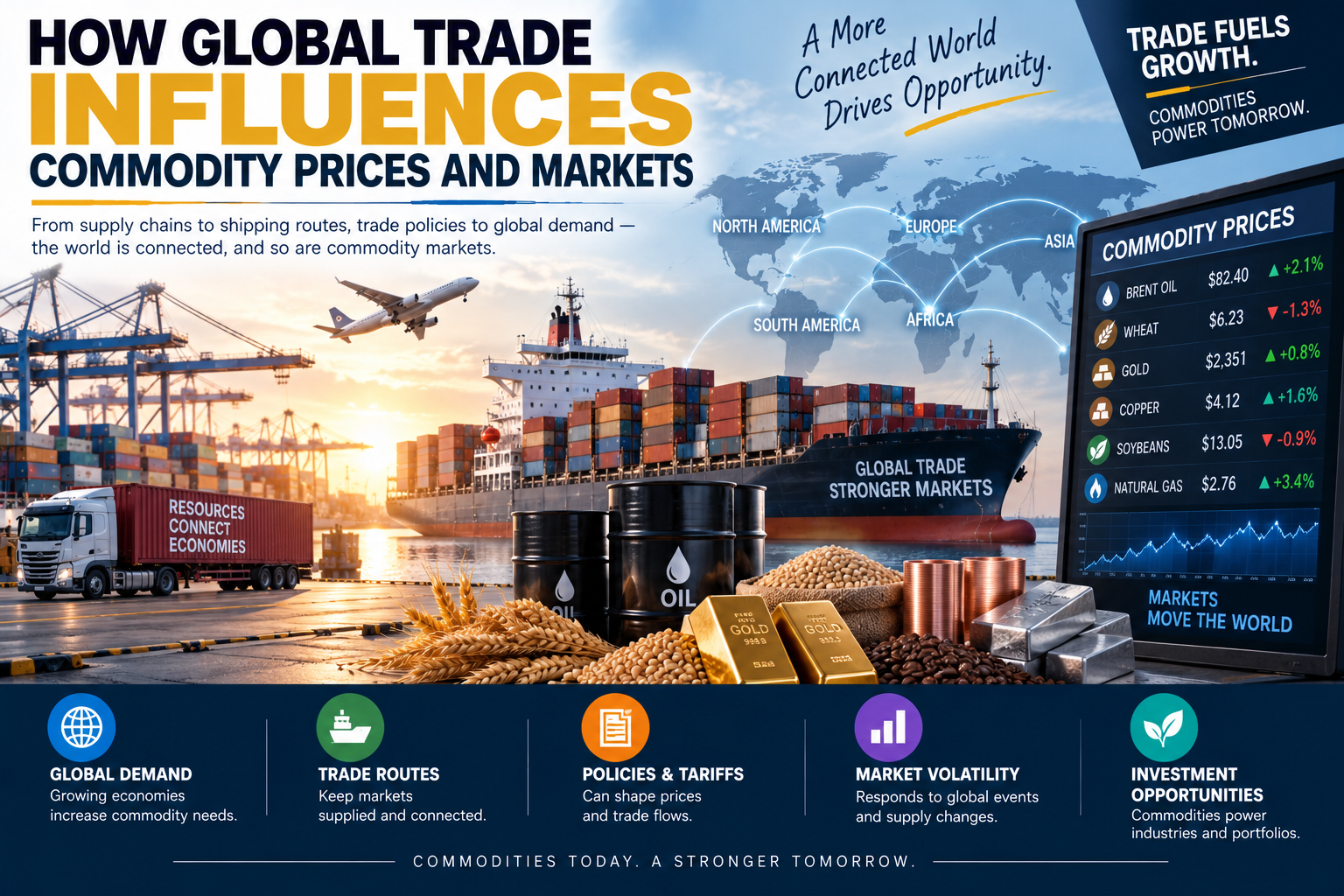
Global trade connects producers, manufacturers, consumers, and investors across countries and continents. Every day, commodities such as oil, natural gas, metals, grains, coffee, cotton, and other raw materials move through international markets to support industries and households around the world.
Because commodities are traded across borders, changes in global trade can have a significant influence on their prices. A disruption at a major port, a new trade agreement, a change in tariffs, a geopolitical conflict, or a shift in demand from a major economy can affect commodity markets far beyond the country where the event occurs.
Understanding this relationship is important for investors, businesses, policymakers, and consumers.
Commodity prices do not move because of one factor alone. They are influenced by supply, demand, inventories, transportation, currency movements, weather, government policies, geopolitical conditions, economic growth, and expectations about the future.
Global trade brings many of these factors together.
What Are Commodities?
Commodities are basic raw materials or primary agricultural products that can be bought and sold in markets.
They are often grouped into several major categories.
Energy Commodities
Energy commodities include:
Crude oil
Natural gas
Coal
Refined petroleum products
Energy is essential for transportation, manufacturing, electricity generation, and many other economic activities.
Metals
Metals can include:
Gold
Silver
Copper
Aluminum
Nickel
Zinc
Iron ore
Some metals are primarily used for industrial purposes, while others also have important investment or monetary roles.
Agricultural Commodities
Agricultural commodities include:
Wheat
Corn
Soybeans
Rice
Coffee
Cocoa
Sugar
Cotton
Agricultural commodities are particularly sensitive to weather, harvest conditions, disease, transportation, and changes in global consumption.
Why Global Trade Matters for Commodity Markets
Commodities are rarely produced and consumed entirely within one country.
One country may have abundant natural resources but limited domestic demand. Another may have large industrial or consumer demand but insufficient domestic production.
International trade allows these economies to exchange resources.
For example, an energy-producing country may export oil to countries that rely heavily on imported energy.
Similarly, agricultural producers may export crops to countries where domestic production is insufficient.
This creates a global network in which commodity prices are influenced by developments in multiple markets simultaneously.
Supply and Demand Drive Commodity Prices
The fundamental force behind commodity prices is supply and demand.
When demand increases while supply remains limited, prices can rise.
When supply increases faster than demand, prices can decline.
Global trade affects both sides of this equation.
Trade allows commodities to move from areas with excess supply to areas with stronger demand.
When trade flows smoothly, international markets can help balance shortages and surpluses.
When trade becomes restricted, that balancing mechanism can weaken.
The Role of Major Commodity Producers
Some countries play particularly important roles in specific commodity markets because they produce large quantities of certain resources.
When production changes in a major exporting country, global prices can respond.
For example, a significant disruption in oil production can affect energy prices internationally.
Likewise, a poor agricultural harvest in a major exporting region can influence global food prices.
The larger a country's share of global production or exports, the more important its trade policies and production conditions can become for international markets.
Major Importers Also Matter
Commodity markets are not influenced only by producers.
Large importing economies can have enormous influence because of their purchasing power.
When a major economy increases imports of energy, metals, or agricultural products, global demand can rise.
If that economy reduces purchases because of weaker growth, changing policies, or lower industrial activity, commodity demand may decline.
This is why investors frequently pay attention to economic developments in major commodity-consuming countries.
Trade Agreements and Commodity Markets
Trade agreements can make international commerce easier by reducing barriers between countries.
They may affect:
Tariffs
Import quotas
Customs procedures
Market access
Transportation rules
Agricultural trade
Investment conditions
When trade barriers are reduced, commodity flows may increase.
When barriers are introduced, trade can become more expensive or less efficient.
These changes can influence prices and create new opportunities or risks for producers and consumers.
How Tariffs Can Affect Commodity Prices
Tariffs are taxes or duties imposed on certain imported goods.
When a tariff increases the cost of importing a commodity or a commodity-related product, the effects can spread through the supply chain.
For example, higher tariffs on imported raw materials may increase production costs for manufacturers.
Companies may then pass some of those costs to customers.
However, the actual impact depends on factors such as:
The size of the tariff
Availability of alternative suppliers
Currency movements
Domestic production
Consumer demand
Market competition
Tariffs can therefore affect commodity markets directly and indirectly.
Trade Restrictions and Export Controls
Governments may restrict exports for economic, strategic, political, or national-security reasons.
Export controls can reduce the amount of a commodity available to international buyers.
If global demand remains strong while export supply falls, prices may increase.
However, buyers may search for alternative suppliers, which can change trade patterns.
Over time, these changes can encourage companies and countries to diversify their supply chains.
Geopolitical Events Can Disrupt Trade
Geopolitical developments can have a major impact on commodity markets.
Conflicts, sanctions, diplomatic disputes, border restrictions, and political instability can interrupt production or transportation.
Energy markets are particularly sensitive because oil and gas production and transportation are concentrated in certain regions.
Agricultural and industrial commodity markets can also be affected when shipping routes or major trading relationships are disrupted.
The market impact often depends on the scale and expected duration of the disruption.
Shipping Routes Are Critical
Commodities need to be transported from producers to consumers.
Major shipping routes, ports, pipelines, rail networks, highways, and other infrastructure are therefore essential to global commodity markets.
A disruption to a major transportation route can create delays and increase costs.
Even when sufficient commodities exist globally, transportation problems can temporarily prevent them from reaching buyers.
This can cause regional price differences and increase volatility.
Freight Costs Affect Commodity Prices
The cost of transporting commodities can influence their final price.
Higher freight costs may result from:
Fuel prices
Port congestion
Shipping shortages
Insurance costs
Labor disruptions
Geopolitical risks
Longer shipping routes
When transportation becomes more expensive, buyers may have to pay more to obtain imported commodities.
Businesses may then pass higher costs through their supply chains.
Supply Chains Connect Commodity Markets
Modern supply chains are highly interconnected.
A commodity may be produced in one country, processed in another, manufactured into a product somewhere else, and eventually sold to consumers in another market.
This means a disruption at one stage can affect businesses and consumers much farther away.
For example, a shortage of a particular industrial metal can affect manufacturers that depend on it for components.
Higher input costs can then influence the prices of finished products.
Currency Movements Matter
Most major international commodities are priced in widely used currencies, particularly the U.S. dollar.
Currency movements can therefore influence commodity demand and prices.
When the dollar strengthens, commodities priced in dollars can become more expensive for buyers using other currencies.
When the dollar weakens, commodities may become relatively cheaper for international buyers.
Currency effects are only one factor, but they can influence global commodity demand.
Inflation and Commodity Prices
Commodity prices can contribute to inflation.
Energy, food, metals, and other raw materials are inputs into many goods and services.
When commodity prices rise significantly, businesses may face higher production and transportation costs.
Some of these costs may eventually be passed on to consumers.
At the same time, inflation itself can influence commodity markets by affecting demand, interest rates, currencies, and investor expectations.
This creates a two-way relationship between commodities and inflation.
Economic Growth and Commodity Demand
Economic growth can influence demand for commodities.
During periods of strong industrial activity, businesses may require more:
Energy
Metals
Construction materials
Transportation fuels
Agricultural products
When economic growth slows, demand for some commodities may weaken.
Industrial commodities such as copper and iron ore can be particularly sensitive to changes in construction and manufacturing activity.
Energy demand can also change depending on transportation and industrial production.
China's Role in Commodity Markets
Large economies can have a significant impact on global commodity demand.
China is particularly important across several commodity markets because of its large industrial base, manufacturing activity, construction sector, energy consumption, and consumer market.
Changes in Chinese economic activity can therefore influence international demand for metals, energy, agricultural products, and other commodities.
Investors often watch indicators related to industrial production, construction, infrastructure spending, imports, and manufacturing activity when assessing commodity demand.
Weather and Agricultural Trade
Agricultural commodities are strongly affected by weather.
Droughts, floods, extreme temperatures, storms, and other weather events can reduce crop yields.
A major production shortfall in one region may increase the need for imports from other countries.
This can tighten global supply and increase prices.
Conversely, strong harvests can increase available supply and put downward pressure on prices.
Because agricultural production is seasonal, traders and businesses often pay close attention to planting conditions, crop development, harvest expectations, and weather forecasts.
Inventories and Commodity Prices
Inventories provide an important buffer between supply and demand.
When inventories are high, markets may be better able to absorb temporary supply disruptions.
When inventories are low, even a relatively small disruption can have a larger impact on prices.
For this reason, investors and commodity analysts often monitor inventory levels alongside production and consumption data.
The Difference Between Spot and Futures Markets
Commodity markets can involve both spot and futures transactions.
A spot price generally refers to the price for immediate or near-immediate delivery.
A futures contract is an agreement involving the purchase or sale of a commodity at a specified price for delivery at a future date.
Futures markets allow producers, consumers, and investors to manage price exposure or take positions based on expectations.
Futures prices can be influenced by:
Expected future supply
Expected demand
Storage costs
Interest rates
Transportation
Market sentiment
Geopolitical developments
Hedging Against Commodity Price Risk
Businesses that depend on commodities often face significant price uncertainty.
For example, an airline is exposed to fuel costs.
A food manufacturer may be exposed to agricultural commodity prices.
A mining company may be exposed to metal prices.
Hedging can allow businesses to reduce the financial impact of unfavorable price movements.
Depending on the situation, companies may use futures, options, swaps, or other financial instruments.
Hedging does not eliminate risk entirely, but it can make financial planning more predictable.
Commodity Trading and Speculation
Not every participant in commodity markets is a producer or consumer.
Financial investors and traders also participate.
Some investors seek to benefit from expected price changes.
Their activity can contribute to market liquidity, but speculative trading can also increase short-term price volatility.
Commodity prices can therefore move because of both fundamental changes and shifts in investor expectations.
Global Trade and Commodity Market Volatility
Commodity markets can be more volatile than some other markets because supply and demand can change quickly.
A sudden production problem can remove significant supply.
A sudden increase in demand can create shortages.
A change in trade policy can redirect global flows.
A geopolitical event can alter transportation routes.
These factors can cause commodity prices to move sharply.
How Businesses Can Manage Commodity Risks
Businesses exposed to commodity prices can take several steps to manage risk.
Diversify Suppliers
Depending on a single supplier or country can create significant vulnerability.
Multiple suppliers can provide greater flexibility.
Maintain Appropriate Inventories
Strategic inventory management can help companies handle temporary supply disruptions.
Use Long-Term Contracts
Longer-term agreements can provide greater price and supply visibility.
Hedge Price Exposure
Financial hedging can help reduce the impact of major price fluctuations.
Monitor Global Developments
Businesses should track trade policies, transportation risks, currency movements, weather, and geopolitical developments.
How Investors Can Approach Commodity Markets
Investors interested in commodities should understand that commodity exposure can involve significant volatility.
Before investing, consider:
Investment objectives
Risk tolerance
Time horizon
Commodity fundamentals
Market structure
Currency effects
Trading costs
Diversification
Liquidity
Investors can gain commodity exposure through different structures, depending on the market and jurisdiction.
These can include direct physical exposure, futures-based investments, commodity funds, shares of commodity-producing companies, and other investment vehicles.
Each approach has different risks and characteristics.
The Importance of Diversification
Commodities can sometimes behave differently from stocks and bonds.
This can make them potentially useful as part of a diversified portfolio.
However, diversification does not guarantee profits or eliminate losses.
Investors should avoid placing too much capital into a single commodity based on a short-term market forecast.
A balanced investment strategy should reflect overall financial goals and risk tolerance.
Sustainability and the Future of Commodity Trade
Global commodity markets are also being influenced by changes in energy systems, technology, environmental policies, and consumer preferences.
The transition toward lower-carbon energy sources may influence demand for traditional fossil fuels while increasing demand for certain minerals used in batteries, renewable energy systems, electric vehicles, and power infrastructure.
At the same time, agricultural markets may be influenced by changing climate conditions, resource availability, technology, and sustainable farming practices.
These developments could reshape global commodity trade over the long term.
Technology Is Changing Commodity Markets
Technology is making commodity markets more interconnected and data-driven.
Businesses and investors can increasingly use:
Satellite imagery
Artificial intelligence
Supply-chain tracking
Automated trading systems
Weather analytics
Digital logistics platforms
Real-time market data
These technologies can improve forecasting and supply-chain visibility.
However, better information does not eliminate uncertainty.
Unexpected events can still produce major market movements.
What Consumers Should Know
Consumers may not trade commodities directly, but they are affected by commodity prices.
Higher energy prices can increase transportation and utility costs.
Higher agricultural prices can influence food prices.
Higher metals prices can increase the cost of manufactured goods, construction, and infrastructure.
Understanding commodity markets can therefore help consumers understand why prices for everyday products sometimes change.
What Investors Should Watch
Investors following global commodity markets can monitor several key indicators.
Supply
Is production increasing or decreasing?
Demand
Are consumers and businesses purchasing more or less?
Inventories
Are stockpiles rising or falling?
Trade Policies
Are tariffs, sanctions, quotas, or export restrictions changing?
Transportation
Are shipping routes and logistics operating normally?
Currency
Is the U.S. dollar strengthening or weakening?
Interest Rates
Are borrowing costs changing?
Economic Growth
Are major economies expanding or slowing?
Weather
Are agricultural production conditions changing?
Geopolitical Developments
Could conflicts or political decisions disrupt production or trade?
Looking at these factors together provides a more complete picture than focusing on a single headline.
Common Misconceptions About Commodity Markets
Myth 1: Commodity Prices Are Controlled by One Country
Global commodity prices are usually influenced by multiple producers, consumers, traders, and market conditions.
Myth 2: Higher Commodity Prices Always Benefit Producers
Higher prices may increase revenue, but producers can also face higher costs and reduced demand.
Myth 3: Lower Prices Are Always Good for Consumers
Lower commodity prices can reduce some costs, but they may also reflect weak economic demand or problems for producers.
Myth 4: Commodity Prices Are Impossible to Understand
Commodity markets can be complex, but understanding supply, demand, inventories, trade, and economic conditions provides a useful foundation.
Myth 5: Commodities Always Rise During Inflation
Commodities can respond differently depending on economic conditions, supply, demand, currencies, and interest rates.
A Practical Framework for Understanding Commodity Markets
When analyzing a commodity, consider five basic questions:
1. Who produces it?
Identify the major producing countries and companies.
2. Who consumes it?
Understand the largest markets and industries that depend on the commodity.
3. How is it transported?
Examine shipping routes, pipelines, ports, railways, and other infrastructure.
4. What could disrupt supply or demand?
Consider weather, geopolitical risks, trade policies, economic growth, and technological changes.
5. What are market expectations?
Commodity prices reflect not only current conditions but also expectations about future supply and demand.
This framework can help investors and businesses organize information before making decisions.
The Bottom Line
Global trade plays a central role in commodity markets.
Oil, natural gas, metals, agricultural products, and other raw materials move across borders to connect producers with consumers. As a result, changes in trade policies, transportation networks, geopolitical conditions, currencies, economic growth, weather, and supply chains can influence commodity prices around the world.
For businesses, understanding these relationships can improve supply-chain planning and risk management.
For investors, studying global commodity markets can provide insight into economic trends, inflation, industrial activity, and potential portfolio opportunities.
For consumers, commodity markets help explain why the prices of fuel, food, transportation, construction materials, and other everyday products can change.
The most important lesson is that commodity prices are interconnected with the broader global economy.
Rather than viewing each price movement in isolation, investors and businesses can gain a clearer understanding by looking at the complete picture: supply, demand, trade, transportation, currencies, inventories, policy, technology, and global economic conditions.
Frequently Asked Questions About Global Trade and Commodity Markets
1. What are commodities?
Commodities are basic raw materials or agricultural products that can be bought and sold in markets, including oil, natural gas, metals, grains, coffee, and other resources.
2. How does global trade affect commodity prices?
Global trade allows commodities to move between producers and consumers. Changes in trade flows, tariffs, restrictions, transportation, and demand can therefore influence prices.
3. What determines commodity prices?
Commodity prices are primarily influenced by supply and demand, but inventories, trade policies, weather, currencies, interest rates, transportation, geopolitical events, and investor expectations also matter.
4. Why are commodity prices volatile?
Commodity supply can be disrupted quickly, while demand can also change rapidly. Weather, geopolitical events, trade restrictions, and economic conditions can cause significant price movements.
5. How do tariffs affect commodities?
Tariffs can increase the cost of imported commodities or related products, potentially changing demand, supply chains, and prices.
6. How do trade restrictions affect commodity markets?
Export restrictions or import restrictions can reduce the availability of commodities in certain markets and potentially increase prices if alternative supplies are limited.
7. How does weather affect commodities?
Weather can significantly affect agricultural production. Droughts, floods, storms, and extreme temperatures can reduce supply and influence prices.
8. Why are shipping routes important to commodity markets?
Shipping routes connect producers and consumers. Disruptions can delay deliveries, increase transportation costs, and create temporary shortages.
9. How does the U.S. dollar affect commodities?
Many internationally traded commodities are priced in U.S. dollars. Changes in the dollar's value can influence the purchasing power of international buyers and commodity demand.
10. How does inflation affect commodity prices?
Commodity prices can contribute to inflation because raw materials and energy are important inputs for many goods and services. Inflation can also affect commodity markets through changes in interest rates, currencies, and demand.
11. What is a commodity futures contract?
A commodity futures contract is an agreement involving the purchase or sale of a commodity at a specified price for delivery at a future date.
12. What is commodity hedging?
Commodity hedging involves using financial or contractual strategies to reduce the impact of unfavorable commodity price movements.
13. Can investors make money from commodities?
Commodity investments can potentially generate returns, but they also involve significant risks, including price volatility, market risk, currency effects, and changes in supply and demand.
14. Are commodities a good investment?
Commodities may play a role in some diversified portfolios, but whether they are appropriate depends on an investor's goals, risk tolerance, time horizon, and overall strategy.
15. What is the difference between spot and futures prices?
A spot price generally reflects the price for immediate or near-immediate delivery, while a futures price relates to a contract for delivery at a future date.
16. Why do commodity inventories matter?
Inventories provide a buffer between supply and demand. Low inventories can make markets more vulnerable to supply disruptions, while high inventories can provide greater flexibility.
17. How does economic growth affect commodities?
Strong economic activity can increase demand for energy, metals, transportation, and industrial materials. Slower economic growth can reduce demand for some commodities.
18. Why is China important to commodity markets?
China is a major global economy with significant industrial, manufacturing, construction, and consumer demand, making its economic activity important to many commodity markets.
19. Can commodities help diversify an investment portfolio?
Commodity exposure can sometimes provide diversification because commodities may behave differently from other asset classes. However, diversification does not eliminate investment risk.
20. What should investors monitor when analyzing commodities?
Investors can monitor production, consumption, inventories, trade policies, transportation, currencies, interest rates, weather, economic growth, geopolitical developments, and future market expectations.