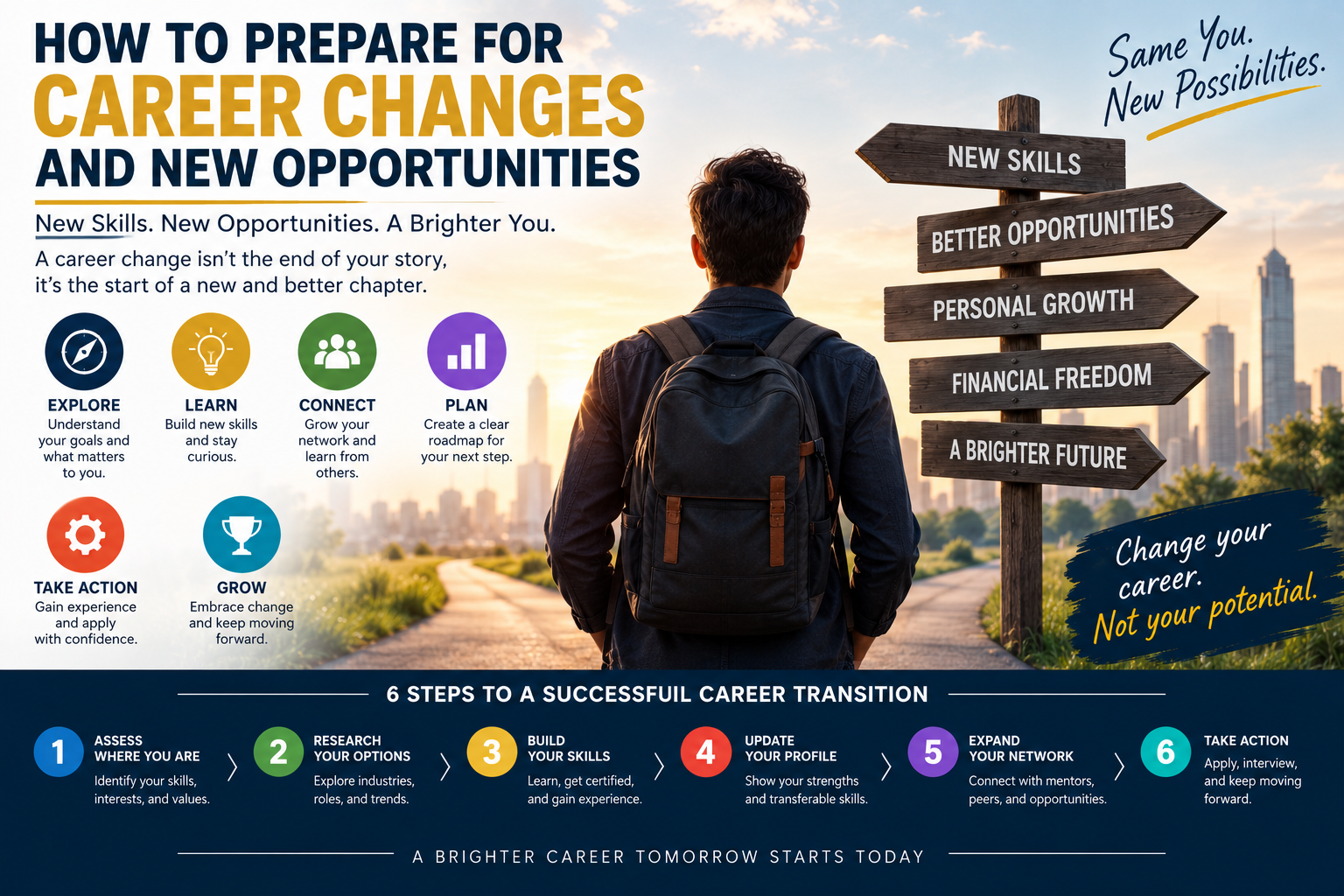
Career paths are rarely as predictable as they once appeared.
People change jobs, industries evolve, businesses adopt new technologies, and new roles emerge. Employees may decide to pursue a different profession, return to work after a break, move into management, start a business, or develop new skills for an opportunity that did not exist earlier in their careers.
A career change can be exciting, but it can also create uncertainty.
Questions naturally arise:
What skills will I need?
Will my experience transfer to a different role?
How should I prepare?
Should I leave my current position?
How can I compete with people who already have experience in the new field?
The good news is that career changes do not have to happen without preparation.
By understanding your strengths, researching opportunities, developing relevant skills, building professional relationships, and creating a realistic plan, you can make career transitions more manageable.
Preparing for career change is not only useful when you are unhappy with your current job. It is also a valuable long-term habit that can help you remain adaptable as industries and workplaces evolve.
Why Career Changes Are Becoming More Common
Modern careers can involve several different roles, employers, industries, and areas of specialization.
Technology has changed how many organizations operate, while businesses increasingly need people who can adapt to new tools, processes, and customer expectations.
At the same time, individuals have more opportunities to learn independently and explore different career paths.
A person who starts their career in one field may eventually discover that their skills are useful somewhere completely different.
For example, someone with experience in customer service may move into sales, account management, or customer success.
A teacher may transition into training, instructional design, content development, or education technology.
A marketing professional may develop expertise in analytics, digital strategy, or product marketing.
Career changes are therefore not necessarily a complete restart.
Often, they are a process of transferring existing strengths into a new environment.
What Is a Career Change?
A career change can mean different things.
It might involve:
Moving to a new company
Changing job roles
Entering a new industry
Switching professions
Moving into management
Returning to work after a career break
Becoming self-employed
Starting a business
Developing a new specialization
Moving from traditional work to remote or flexible work
Some career changes are gradual.
Others happen quickly because of organizational changes, economic conditions, personal circumstances, or new opportunities.
Regardless of the reason, preparation can reduce uncertainty.
Start by Understanding Why You Want a Change
Before making a major career decision, identify the reason behind it.
Ask yourself:
What do I want to change?
What do I enjoy about my current career?
What do I dislike?
Am I looking for better growth opportunities?
Do I want to develop new skills?
Am I seeking greater responsibility?
Do I want a different work environment?
Am I interested in another industry?
Is the problem temporary or long-term?
Understanding your motivation can prevent you from making a major change for the wrong reason.
For example, someone who is simply experiencing temporary stress may not need a completely new career.
They may need a different role, better boundaries, improved management, or a period of rest.
Evaluate Your Current Skills
Before deciding what you want to do next, take inventory of what you already know.
List your:
Technical skills
Communication skills
Management abilities
Industry knowledge
Problem-solving skills
Analytical abilities
Project experience
Customer experience
Leadership experience
Digital skills
Do not focus only on your job title.
Your job title may describe your position, but your actual skills are often much broader.
For example, a person working as an office administrator may have experience in scheduling, communication, organization, customer service, documentation, problem-solving, and software systems.
Those skills can be valuable in many different roles.
Identify Your Transferable Skills
Transferable skills are abilities that can be useful across different jobs and industries.
Common examples include:
Communication
Teamwork
Leadership
Time management
Organization
Problem-solving
Research
Project management
Customer service
Negotiation
Writing
Analytical thinking
Adaptability
Transferable skills can make career changes easier because you are not necessarily starting from zero.
Your challenge is to demonstrate how your existing experience applies to the new opportunity.
Identify Your Skill Gaps
After identifying your strengths, determine what you still need to learn.
Suppose you want to move into a role that requires data analysis.
You may already have strong communication and business knowledge, but you might need to develop technical skills involving spreadsheets, databases, visualization, or analytics tools.
Create two lists:
Skills I already have
Skills I need to develop
Then prioritize the second list.
You do not necessarily need to learn everything before applying for a new role.
Focus on the skills that are most important to the opportunities you want.
Research the Career You Want
Do not choose a new career based solely on assumptions.
Research it carefully.
Look at:
Typical responsibilities
Required skills
Common qualifications
Career progression
Working conditions
Industry trends
Entry-level opportunities
Salary ranges
Common challenges
Employer expectations
Read job descriptions even if you are not ready to apply.
Job listings can reveal what employers actually want.
If the same skills repeatedly appear across multiple listings, those skills may deserve higher priority in your learning plan.
Talk to People in the Field
Research can provide useful information, but conversations with people who already work in the field can provide valuable practical insight.
Consider connecting with professionals through:
Professional networking platforms
Industry events
Conferences
Alumni communities
Online communities
Workshops
Training programs
Ask thoughtful questions about their experience.
You might ask:
What does a typical day look like?
Which skills are most important?
What do employers look for?
What challenges should beginners expect?
Which skills helped you progress?
What would you recommend someone learn first?
You do not need to ask someone for a job.
At this stage, the goal is learning.
Build a Career Transition Plan
A career change becomes easier to manage when it is divided into smaller steps.
Your plan might look like this:
Step 1: Identify the target career.
Step 2: Research required skills.
Step 3: Identify your skill gaps.
Step 4: Choose learning resources.
Step 5: Build practical experience.
Step 6: Update your professional profile.
Step 7: Expand your network.
Step 8: Begin applying for suitable opportunities.
Step 9: Prepare for interviews.
Step 10: Continue learning after the transition.
A plan does not need to be perfect.
It needs to be realistic enough to follow.
Update Your Resume
A career change may require you to rethink your resume.
Instead of focusing only on previous job titles, emphasize skills and achievements that relate to your target role.
For example, if you are moving into project management, highlight experience involving:
Coordinating teams
Managing deadlines
Organizing resources
Communicating with stakeholders
Solving operational problems
Tracking project progress
Your previous experience may be more relevant than it initially appears.
The key is presenting it in a way that connects to the new role.
Focus on Achievements, Not Just Responsibilities
A resume that says:
“Responsible for managing customer accounts”
does not communicate much about your impact.
A stronger approach is to explain what you accomplished.
For example:
“Managed a portfolio of customer accounts while improving communication processes and resolving service issues.”
Whenever possible, explain:
What did you do?
What changed because of your work?
What problem did you solve?
This makes your experience easier for employers to understand.
Build a Portfolio
A portfolio can be especially valuable when entering a new field.
It provides evidence of your capabilities.
Depending on the career, a portfolio might include:
Projects
Writing samples
Designs
Presentations
Research
Data analysis
Marketing campaigns
Business plans
Case studies
Software projects
You do not necessarily need professional clients to create a portfolio.
You can develop sample projects specifically to demonstrate your abilities.
A strong portfolio can help bridge the gap between “I am interested in this field” and “I can demonstrate relevant skills.”
Gain Practical Experience
Learning theory is useful, but practical experience can make your transition stronger.
Look for opportunities such as:
Freelance projects
Volunteer work
Internships
Personal projects
Part-time work
Temporary assignments
Cross-functional projects
Community projects
Practical experience gives you something concrete to discuss during interviews.
It also helps you discover whether you actually enjoy the work.
Use Your Current Job as a Training Ground
If you are currently employed, you may not need to leave immediately.
Look for opportunities to develop relevant skills where you already work.
For example, you might:
Join another project
Volunteer for a new responsibility
Work with a different department
Learn a new software system
Assist with research
Take responsibility for a presentation
Help improve a process
These experiences can provide evidence of your ability to perform tasks related to your desired career.
Develop a Learning Strategy
Career development does not always require returning to full-time education.
Depending on the field, you may learn through:
Online courses
Professional certifications
Workshops
Books
Industry publications
Tutorials
Mentorship
Practical projects
Professional communities
The best learning method depends on the skill.
Some abilities require formal qualifications.
Others can be demonstrated through practical work.
Research the expectations of your target industry before investing significant time or money in a particular program.
Learn Continuously, Not All at Once
One common mistake is trying to learn everything before taking action.
This can delay progress.
Instead, create a manageable learning schedule.
For example, you might dedicate several focused hours each week to developing one priority skill.
As your knowledge grows, apply it through projects and practical exercises.
Learning becomes more effective when it is connected to real problems.
Strengthen Your Digital Skills
Digital skills are increasingly useful across many careers.
Depending on your field, relevant skills might include:
Productivity software
Data analysis
Digital communication
Collaboration tools
Online research
Artificial intelligence
Cybersecurity awareness
Digital project management
Content creation
Basic data visualization
You do not need to master every technology.
Focus on the tools that are relevant to your desired role.
Learn How AI May Affect Your Career
Artificial intelligence is changing how many organizations approach repetitive tasks, research, content creation, data analysis, customer service, and other areas.
Rather than viewing technology only as a threat, consider how it could become part of your skill set.
Ask:
Which tasks in my field can be automated?
Which tasks still require human judgment?
How can AI improve my productivity?
What AI-related skills are becoming useful?
How can I use technology without compromising quality?
Professionals who understand both their field and relevant technology may be better positioned to adapt.
Build Your Professional Network Before You Need It
Networking should not begin only when you need a new job.
Build professional relationships throughout your career.
Connect with:
Former colleagues
Current colleagues
Industry professionals
Mentors
Recruiters
Alumni
Business owners
Professional communities
Stay in touch.
Share useful information.
Congratulate people on achievements.
Participate in relevant conversations.
A strong network can provide information about opportunities that may never appear in public job listings.
Create a Professional Online Presence
Your online presence can influence how potential employers, clients, and professional contacts perceive you.
Review your:
Professional profiles
Portfolio
Personal website
Published work
Public social media content
Make sure your professional information is current.
Your profile should clearly communicate:
What you do
What skills you have
What you are interested in
What type of opportunity you are pursuing
Consistency helps create a clearer professional identity.
Develop Your Personal Brand
A career transition can be an opportunity to reposition your professional identity.
Suppose you previously worked in traditional marketing and are moving toward digital strategy.
You can begin publishing content about:
Digital marketing
Customer behavior
Content strategy
Analytics
Technology
Industry trends
Over time, this can help demonstrate your interest and developing expertise.
Your personal brand should be based on genuine knowledge and continuous learning.
Prepare Financially
Career changes can sometimes involve temporary income uncertainty.
Before making a major move, review your finances.
Consider:
Current income
Monthly expenses
Savings
Debt obligations
Education costs
Transportation costs
Potential income changes
A financial buffer can provide greater flexibility during a transition.
This does not mean every career change requires significant savings.
The appropriate level of preparation depends on the circumstances.
The important point is to understand the financial implications before making a major decision.
Do Not Underestimate the Emotional Side of Career Change
Career changes are not purely financial or professional decisions.
They can affect confidence, identity, routines, relationships, and expectations.
You may experience:
Excitement
Doubt
Frustration
Uncertainty
Motivation
Impatience
These feelings are normal.
Changing careers can mean temporarily becoming a beginner again.
That can feel uncomfortable even when the decision is right.
Give yourself time to learn.
Be Prepared to Start at a Different Level
A career change may involve accepting a position that is different from your previous level of seniority.
That does not necessarily mean your previous experience has been wasted.
Your previous skills can still provide an advantage.
For example, someone moving into a new industry may enter at a different level but bring years of experience in leadership, communication, customer management, or operations.
Think about the transition as building a bridge between your previous experience and your new direction.
Learn How to Explain Your Career Change
Interviewers may ask:
“Why are you changing careers?”
Prepare a clear and positive answer.
Avoid focusing entirely on what you disliked about your previous career.
Instead, explain:
What you learned
What interests you about the new field
Which transferable skills you bring
What you have done to prepare
Why the new direction makes sense
A career change can demonstrate initiative and adaptability when explained effectively.
Prepare for Interviews
Career-change interviews may require additional preparation because employers could question your lack of direct experience.
Prepare examples that demonstrate:
Problem-solving
Leadership
Communication
Adaptability
Learning ability
Relevant achievements
Transferable skills
Research the company and role carefully.
Be prepared to explain why your background is valuable even if your previous job title was different.
Use the STAR Method
The STAR framework can help organize interview answers.
Situation: Explain the context.
Task: Describe what needed to be accomplished.
Action: Explain what you did.
Result: Describe the outcome.
This approach helps turn vague statements into specific examples.
Instead of saying:
“I am good at problem-solving.”
You can describe a real situation in which you identified a problem, took action, and produced a positive result.
Consider a Gradual Career Transition
You do not always have to make a sudden change.
A gradual transition can involve:
Learning while employed
Building a portfolio in your free time
Freelancing
Taking part-time projects
Networking with people in the target industry
Applying selectively
Developing certifications
This approach can reduce financial and professional uncertainty.
It may also help you test whether the new career actually suits you.
Avoid Making Decisions Based Only on Trends
A career can become popular because of a temporary trend.
That does not mean it is automatically right for you.
Before changing direction, consider:
Your interests
Your strengths
Your values
Long-term opportunities
Required skills
Working conditions
Potential challenges
A career should fit more than the current market conversation.
Keep Your Options Open
You may begin a career transition with one specific destination in mind and discover another opportunity along the way.
Stay open to related roles.
For example, someone interested in marketing may discover that their strengths are better suited to market research, content strategy, sales enablement, or product marketing.
The goal is not necessarily to follow a rigid plan.
The goal is to move toward a career that fits your skills and goals.
Learn From Rejection
Career transitions can involve rejection.
You may apply for positions and receive no response.
You may reach interviews but not receive offers.
You may discover that employers want skills you have not yet developed.
Do not automatically interpret rejection as proof that you cannot succeed.
Instead, look for useful feedback.
Ask:
Was my resume relevant?
Did I demonstrate the required skills?
Was my portfolio strong enough?
Did I explain my career change clearly?
Do I need more practical experience?
Use each experience to improve the next application.
Keep Building Your Confidence
Confidence often comes from evidence.
Instead of trying to convince yourself that you are ready, create evidence that you are progressing.
Complete a project.
Learn a skill.
Solve a real problem.
Publish useful work.
Receive feedback.
Help someone.
Build a portfolio.
Every completed step can strengthen your confidence.
Create a 90-Day Career Transition Plan
A simple 90-day plan can provide structure.
Days 1–30: Research and Assessment
Define your career goal
Identify transferable skills
Research target roles
Identify skill gaps
Speak with professionals
Choose learning priorities
Days 31–60: Skill Development
Begin structured learning
Complete practical projects
Improve your resume
Build or update your portfolio
Strengthen your professional profile
Days 61–90: Opportunity Building
Expand your network
Apply for suitable roles
Contact relevant professionals
Practice interviews
Request feedback
Continue developing skills
After 90 days, review your progress and adjust your plan.
Career Change Is a Process, Not a Single Decision
One of the most important things to remember is that career change rarely happens through one dramatic decision.
It is usually a series of smaller decisions.
You learn something.
You meet someone.
You complete a project.
You discover a new opportunity.
You improve your resume.
You apply.
You receive feedback.
You adjust.
Then you continue.
This approach makes career development more manageable and less intimidating.
Final Thoughts
Preparing for career changes and new opportunities is an ongoing process.
You do not have to wait until your job disappears, your industry changes, or you become unhappy before developing new skills.
The strongest career strategy is often proactive.
Understand your strengths. Identify transferable skills. Research opportunities. Develop relevant abilities. Build relationships. Create evidence of your capabilities. Keep your professional presence current. And remain open to learning.
A career change may involve uncertainty, but uncertainty does not have to mean being unprepared.
The more clearly you understand your skills, goals, finances, and opportunities, the more confidently you can make decisions.
Your previous experience does not disappear when you change direction.
It becomes part of the foundation for what comes next.
In a changing workplace, the ability to learn, adapt, and recognize new opportunities can become one of the most valuable career advantages you have.
Frequently Asked Questions
1. What is the best way to prepare for a career change?
Start by identifying why you want a change, evaluating your current skills, researching the target career, identifying skill gaps, developing relevant abilities, and building practical experience.
2. Should I quit my job before changing careers?
Not necessarily. Depending on your circumstances, you may be able to develop skills, build a portfolio, and explore opportunities while remaining employed.
3. What are transferable skills?
Transferable skills are abilities that can be useful across different jobs and industries, such as communication, leadership, organization, problem-solving, teamwork, and project management.
4. How do I know which skills I need to learn?
Research job descriptions for the roles you want and identify skills that appear repeatedly. You can then compare those requirements with your current abilities.
5. Can I change careers without going back to university?
In some fields, formal education may be necessary. In others, practical experience, certifications, portfolios, courses, and demonstrated skills may be sufficient. Requirements vary by profession.
6. How can I gain experience in a new field?
Consider personal projects, freelance work, volunteering, internships, part-time work, cross-functional projects, or other opportunities that allow you to demonstrate relevant abilities.
7. How can I explain a career change in an interview?
Explain what you learned from your previous career, why you are interested in the new field, what transferable skills you bring, and how you have prepared for the transition.
8. Is it too late to change careers?
There is no universal age at which a career change becomes impossible. The practical considerations may change over time, but people can continue learning and pursuing new professional directions throughout their working lives.
9. How important is networking during a career change?
Networking can provide industry knowledge, advice, referrals, mentorship, and information about opportunities that may not be publicly advertised.
10. Should I build a personal brand during a career transition?
It can be useful. Sharing relevant knowledge, projects, and professional interests can help demonstrate your developing expertise and make your career direction clearer.
11. Can AI help with career development?
AI tools can assist with tasks such as brainstorming career options, organizing learning plans, improving drafts, preparing interview questions, and researching areas to explore. Important information should still be independently verified.
12. How long does a career change take?
There is no fixed timeline. The transition can take weeks, months, or longer depending on the profession, required qualifications, existing skills, financial circumstances, and available opportunities.
13. What if I do not know which career I want?
Start by exploring your interests, strengths, values, and preferred working conditions. Research several related career options and speak with people who work in those fields.
14. Should I accept a lower position when changing careers?
Sometimes a different level of seniority can be a practical entry point into a new field. However, evaluate the role based on its learning potential, future opportunities, compensation, and fit with your long-term goals.
15. How can I make my resume suitable for a career change?
Emphasize transferable skills, relevant achievements, projects, certifications, and experience that connect to the target role rather than focusing exclusively on previous job titles.
16. How can I build a portfolio if I have no experience?
Create relevant sample projects, personal projects, volunteer work, case studies, or practical exercises that demonstrate your abilities.
17. What should I do if I keep getting rejected?
Review your resume, portfolio, skills, applications, and interview performance. Identify patterns in the feedback and use them to improve your approach.
18. Is career planning only important when changing jobs?
No. Career planning is useful even when you are satisfied with your current role because it helps you identify future opportunities and prepare for changes.
19. Why is continuous learning important for careers?
Industries and workplaces evolve. Continuous learning helps professionals keep their skills relevant and adapt to changing expectations.
20. What is the most important skill during a career change?
Adaptability is especially valuable because career transitions require people to learn, adjust, handle uncertainty, and apply existing skills in new situations.