
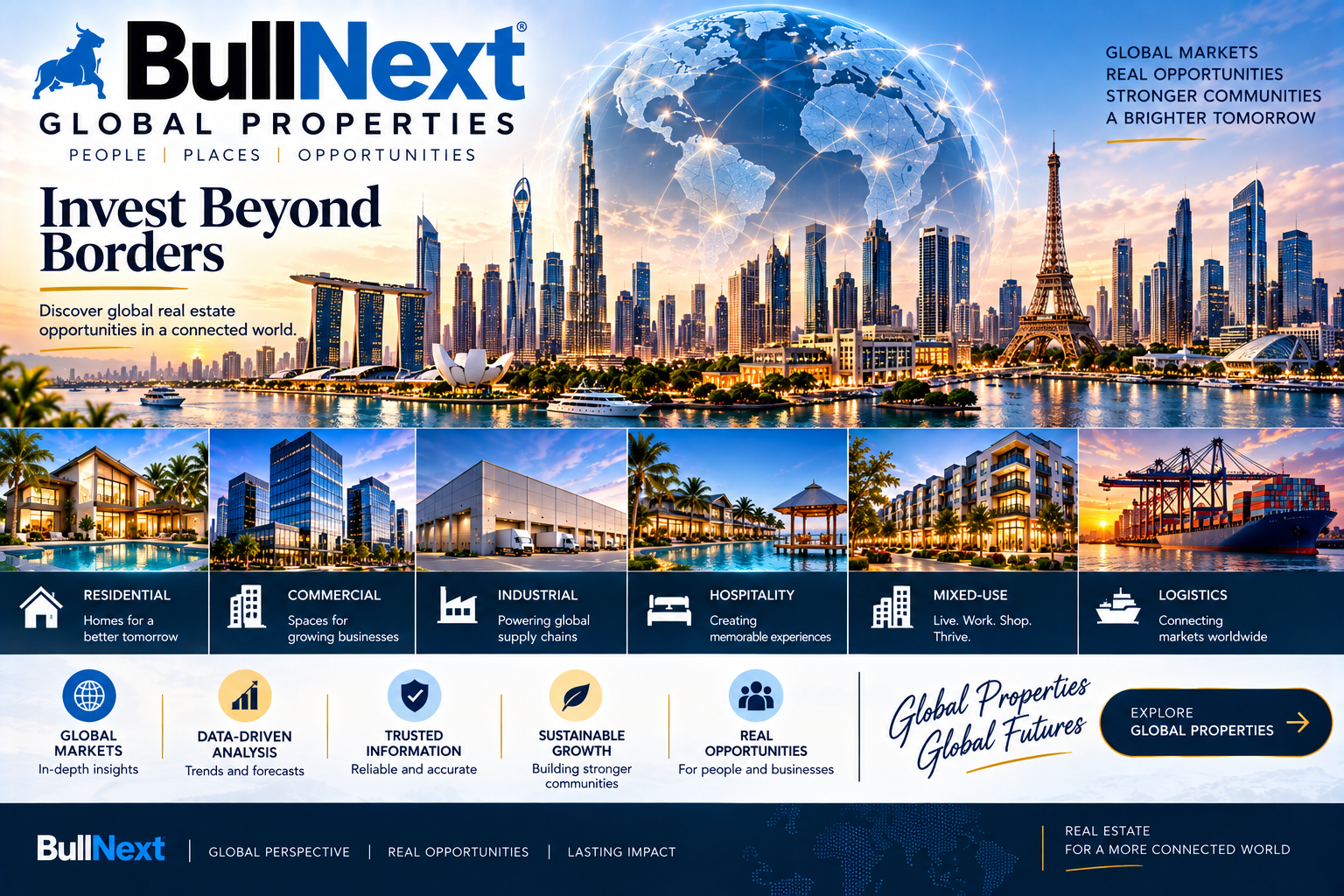
Real estate is becoming increasingly connected across borders. Businesses are expanding into new markets, populations are shifting toward growing cities, infrastructure is improving in emerging regions, and technology is changing how properties are researched and managed.
BullNext Global Properties provides a broader perspective on these developments by looking at international residential, commercial, industrial, logistics, hospitality, and mixed-use real estate. BullNext's Real Estate coverage includes Global Properties alongside Commercial Real Estate and Residential Real Estate.
For buyers, businesses, developers, investors, and property professionals, understanding global real estate requires more than comparing property prices. Location, infrastructure, demographics, regulations, economic activity, financing, technology, sustainability, and local demand can all influence a property market.
What Are BullNext Global Properties?
BullNext Global Properties focuses on real estate opportunities and developments across international markets.
Global properties can include:
Residential homes and apartments
Commercial buildings
Office properties
Retail developments
Industrial facilities
Warehouses
Logistics centers
Hotels and resorts
Mixed-use developments
Land and development projects
Each property type serves a different purpose and responds to different market conditions.
For example, residential markets can be influenced by population growth and housing affordability, while logistics properties may depend heavily on transportation networks, trade activity, and proximity to major distribution centers.
Why International Real Estate Matters
Property markets are not identical around the world.
A technology-focused city may experience demand for offices, apartments, and supporting services. A manufacturing region may require industrial buildings and warehouses. A major tourism destination may create demand for hotels, restaurants, retail centers, and holiday properties.
This diversity makes global real estate a broad and constantly changing industry.
International property research can help businesses and property professionals understand how different economies, cities, and communities are developing.
Location Is Still the Foundation
Technology may make international property research easier, but location remains one of the fundamental considerations in real estate.
A property's surrounding environment can influence its usefulness and demand.
Important factors may include:
Transportation
Employment
Population
Schools
Healthcare
Retail
Business districts
Airports
Ports
Highways
Public infrastructure
The importance of each factor depends on the property type.
A warehouse may require excellent highway and port access, while a residential development may benefit from schools, public transportation, shopping, and employment centers.
The Rise of Global Property Hubs
Some cities develop into important international property hubs because they combine economic activity, infrastructure, business opportunities, and population growth.
Financial centers may support office and luxury residential markets.
Technology centers can attract companies and highly skilled workers.
Manufacturing hubs may create demand for industrial facilities.
Tourism destinations can support hospitality and retail properties.
However, the reputation of a city alone does not determine the characteristics of its property market. Buyers and businesses should also examine supply, demand, affordability, infrastructure, regulations, employment, and future development.
Residential Properties Across Markets
Residential real estate is one of the largest areas of the global property industry.
It includes:
Houses
Apartments
Condominiums
Villas
Residential communities
Build-to-rent developments
Residential demand can change as populations grow, people migrate, employment patterns shift, and household preferences evolve.
Modern residents may also consider factors such as:
Digital connectivity
Energy efficiency
Transportation
Security
Community amenities
Access to healthcare
Proximity to employment
Recreation and entertainment
Developers therefore need to understand not only current housing demand but also how residents may live in the future.
Commercial Real Estate and Business Expansion
Commercial property provides physical space for companies and organizations.
Global commercial real estate can include offices, retail properties, hotels, restaurants, business parks, and other commercial developments.
When a company enters a new country, its property requirements may become part of its wider expansion strategy.
The business may need:
Offices
Retail locations
Warehouses
Manufacturing facilities
Distribution centers
Research facilities
Property decisions can therefore be closely connected to employees, customers, suppliers, transportation, operating costs, and local regulations.
Industrial and Logistics Properties
International trade depends on physical infrastructure.
Warehouses, distribution centers, manufacturing facilities, and logistics parks help businesses move products between manufacturers, suppliers, retailers, and customers.
Location is especially important for industrial and logistics properties.
Factors can include:
Highway access
Rail connections
Airports
Ports
Distribution networks
Labor availability
Manufacturing activity
Population centers
As supply chains continue to evolve, logistics infrastructure remains an important part of global real estate.
Hospitality and Tourism Property
Hotels, resorts, serviced apartments, and other hospitality properties are closely connected to travel and tourism.
A hospitality market can be influenced by:
International visitors
Domestic tourism
Business travel
Events
Transportation
Local attractions
Seasonal demand
Consumer spending
Tourism can also influence surrounding real estate by creating demand for restaurants, retail, entertainment, transportation, and mixed-use developments.
Mixed-Use Developments
Mixed-use developments combine multiple property functions in one location.
A project may include:
Residential apartments
Offices
Retail stores
Restaurants
Hotels
Entertainment
Public spaces
The concept can help create environments where people can live, work, shop, and access services within the same broader development.
As cities become more densely developed, mixed-use projects can play an important role in urban planning and property development.
Infrastructure Can Reshape Property Markets
Infrastructure is one of the major forces that can influence real estate development.
New roads, rail systems, airports, ports, public transportation, utilities, and digital networks can improve connectivity and support economic activity.
Infrastructure development can also change the attractiveness of areas that previously had limited access.
For this reason, global property research should consider not only existing infrastructure but also major planned projects.
Understanding future infrastructure can provide additional context when studying a city's development pattern.
Technology Is Transforming Global Property
Technology has made international property research significantly more accessible.
People can now use digital platforms to:
Research markets
View properties
Take virtual tours
Compare locations
Communicate with agents
Review documents
Monitor property management
Analyze market information
For property managers, technology can also support maintenance requests, tenant communication, financial reporting, security, and building monitoring.
Digital tools can improve efficiency, but they do not eliminate the need for local knowledge.
Artificial Intelligence in Real Estate
Artificial intelligence is becoming increasingly relevant to the property industry.
AI tools can assist with:
Data analysis
Market research
Property comparisons
Customer service
Document processing
Property descriptions
Administrative tasks
Pattern identification
For global property research, AI can help organize large amounts of information across multiple cities and markets.
However, AI-generated information should be independently verified when decisions involve ownership, taxes, financing, regulations, contracts, or significant financial commitments.
Smart Buildings and Connected Properties
Buildings are becoming increasingly connected through digital systems.
Smart-building technology can help monitor:
Energy consumption
Lighting
Temperature
Security
Building access
Equipment
Maintenance requirements
For commercial and mixed-use developments, connected systems can provide property owners and managers with more information about building performance.
Smart technology can also support energy management and operational efficiency.
Sustainability in Global Real Estate
Sustainability is becoming an increasingly important part of property development.
Developers and owners may consider:
Energy-efficient construction
Renewable energy
Water conservation
Sustainable materials
Waste reduction
Efficient heating and cooling
Green building systems
Sustainable development can affect operating costs, building performance, tenant expectations, and regulatory requirements.
The importance of sustainability can also vary between countries and property sectors.
International Property Regulations
One of the biggest differences between domestic and international property is regulation.
Each country can have different rules regarding ownership, development, taxation, rental activity, zoning, and financing.
Before entering a foreign property market, it can be important to understand:
Foreign ownership rules
Property taxes
Zoning requirements
Building permits
Rental regulations
Financing restrictions
Reporting obligations
Development regulations
Qualified local legal and tax professionals can help explain requirements specific to the relevant jurisdiction.
Currency and Cross-Border Property
Currency is another factor that can affect international real estate.
When property transactions, rental income, financing, or expenses involve different currencies, exchange-rate movements can affect the overall financial outcome.
A complete property analysis should therefore consider more than the advertised purchase price.
Potential costs may include:
Taxes
Legal fees
Financing
Insurance
Maintenance
Property management
Currency conversion
Transaction costs
Understanding the complete financial picture can provide a clearer view of the property.
Managing Property From Another Country
International property ownership can create practical management challenges.
Owners may need local assistance with:
Maintenance
Repairs
Inspections
Tenant communication
Rent collection
Vendor management
Property marketing
Legal compliance
Digital communication can make remote management easier, but physical properties still require local attention.
Reliable property-management support can therefore be an important consideration when evaluating an overseas property.
Global Real Estate and Diversification
International real estate can be considered within broader diversification strategies.
Different markets can have different economic cycles, property structures, regulations, and demand drivers.
However, owning properties across multiple countries does not remove risk.
International property can still be affected by:
Economic changes
Currency movements
Regulatory changes
Financing costs
Vacancy
Construction issues
Property-management problems
Liquidity constraints
Diversification should therefore be based on research and an understanding of the risks associated with each market.
How to Research a Global Property Market
A structured research process can make international property analysis easier.
Step 1: Understand the Economy
Review major industries, employment, business activity, economic development, and population trends.
Step 2: Study Demographics
Examine population growth, migration, household formation, income levels, and changing consumer preferences.
Step 3: Review Infrastructure
Study roads, railways, airports, ports, public transportation, utilities, and digital connectivity.
Step 4: Analyze Property Supply
Look at existing properties, new construction, development pipelines, vacancy, and competing projects.
Step 5: Examine Demand
Research buyers, tenants, employment, tourism, business expansion, and population changes.
Step 6: Review Regulations
Understand property ownership, taxation, zoning, permits, rental rules, and foreign-investment requirements.
Step 7: Calculate Total Costs
Consider the purchase price together with financing, taxes, insurance, maintenance, management, and transaction expenses.
A Practical BullNext Global Properties Framework
A simple framework for evaluating international real estate is:
Research → Compare → Verify → Calculate → Consult → Decide
Research
Study the market, economy, demographics, infrastructure, and property sector.
Compare
Compare different cities, neighborhoods, property types, and costs.
Verify
Check ownership records, legal documents, property condition, regulations, and development plans.
Calculate
Estimate the complete financial requirements and ongoing expenses.
Consult
Seek appropriate local property, legal, tax, and financial expertise.
Decide
Consider whether the property matches the intended purpose, budget, timeframe, and risk tolerance.
Future Trends in Global Properties
Several long-term forces may continue to influence international real estate.
Urban Development
Growing cities can create demand for housing, offices, retail, transportation, and mixed-use communities.
Digital Transformation
Technology is likely to remain important for property research, marketing, management, and building operations.
Artificial Intelligence
AI may increasingly support property analysis, customer service, automation, and data management.
Sustainable Development
Energy efficiency and environmentally responsible construction may become increasingly relevant to property owners and developers.
Logistics Growth
Global trade and changing supply chains can continue influencing demand for warehouses and distribution facilities.
Changing Lifestyles
Remote work, flexible living arrangements, urban preferences, and changing demographics can influence residential and commercial property requirements.
Key Risks to Consider
Global property opportunities also come with challenges.
Potential risks include:
Economic downturns
Currency fluctuations
Regulatory changes
Financing costs
Property vacancies
Unexpected repairs
Construction delays
Local market changes
Management difficulties
Limited liquidity
Understanding these risks is an essential part of responsible property research.
The Future of BullNext Global Properties
The international real estate industry will continue to evolve alongside cities, businesses, technology, infrastructure, and demographics.
BullNext Global Properties provides a useful lens for examining these changes across different property sectors and markets. Its broader Real Estate coverage places Global Properties alongside Commercial Real Estate and Residential Real Estate.
The global perspective is particularly relevant because real estate is connected to many other parts of the economy.
Housing is connected to population growth.
Commercial property is connected to business activity.
Industrial property is connected to manufacturing and supply chains.
Hospitality is connected to tourism.
Logistics property is connected to global trade.
Infrastructure is connected to urban development.
Technology is connected to how buildings are designed, managed, and used.
Final Thoughts
BullNext Global Properties offers a way to understand real estate beyond individual cities and domestic markets.
International property includes a wide range of opportunities, from residential communities and commercial buildings to industrial facilities, logistics centers, hotels, and mixed-use developments.
But global real estate requires careful research.
Location, infrastructure, demographics, supply and demand, regulations, financing, currency, sustainability, technology, and local expertise can all influence the characteristics of a property market.
The strongest research process is therefore not simply about finding a property in another country. It is about understanding the market surrounding that property and evaluating how economic, social, technological, and infrastructure changes may affect it.
As cities grow and economies become more connected, global properties will remain an important part of the international real estate landscape.
Frequently Asked Questions
What does BullNext Global Properties cover?
BullNext Global Properties focuses on international real estate, including residential, commercial, industrial, logistics, hospitality, and mixed-use properties.
What factors are important when researching global property?
Location, infrastructure, demographics, economic activity, property supply and demand, regulations, financing, currency, technology, and sustainability are important factors.
Why is location important in international real estate?
Location affects accessibility, employment, transportation, services, business activity, and potential demand. The most relevant factors depend on the property's intended use.
What types of global properties can businesses use?
Businesses may require offices, retail locations, warehouses, manufacturing facilities, logistics centers, research facilities, or hospitality properties.
Can technology help with international property research?
Yes. Digital platforms, virtual tours, data-analysis tools, property-management systems, and AI applications can support research and management.
What are the main risks of international real estate?
Potential risks include economic changes, currency fluctuations, regulatory changes, financing costs, vacancy, maintenance, construction issues, management challenges, and limited liquidity.
Why is local expertise important?
Local professionals can provide information about regulations, property documentation, neighborhoods, market conditions, construction standards, taxes, and local practices.
How should someone evaluate an international property?
A practical process is to research the market, compare alternatives, verify the property and legal information, calculate total costs, consult relevant professionals, and then make a decision based on the intended objectives and risk tolerance.