
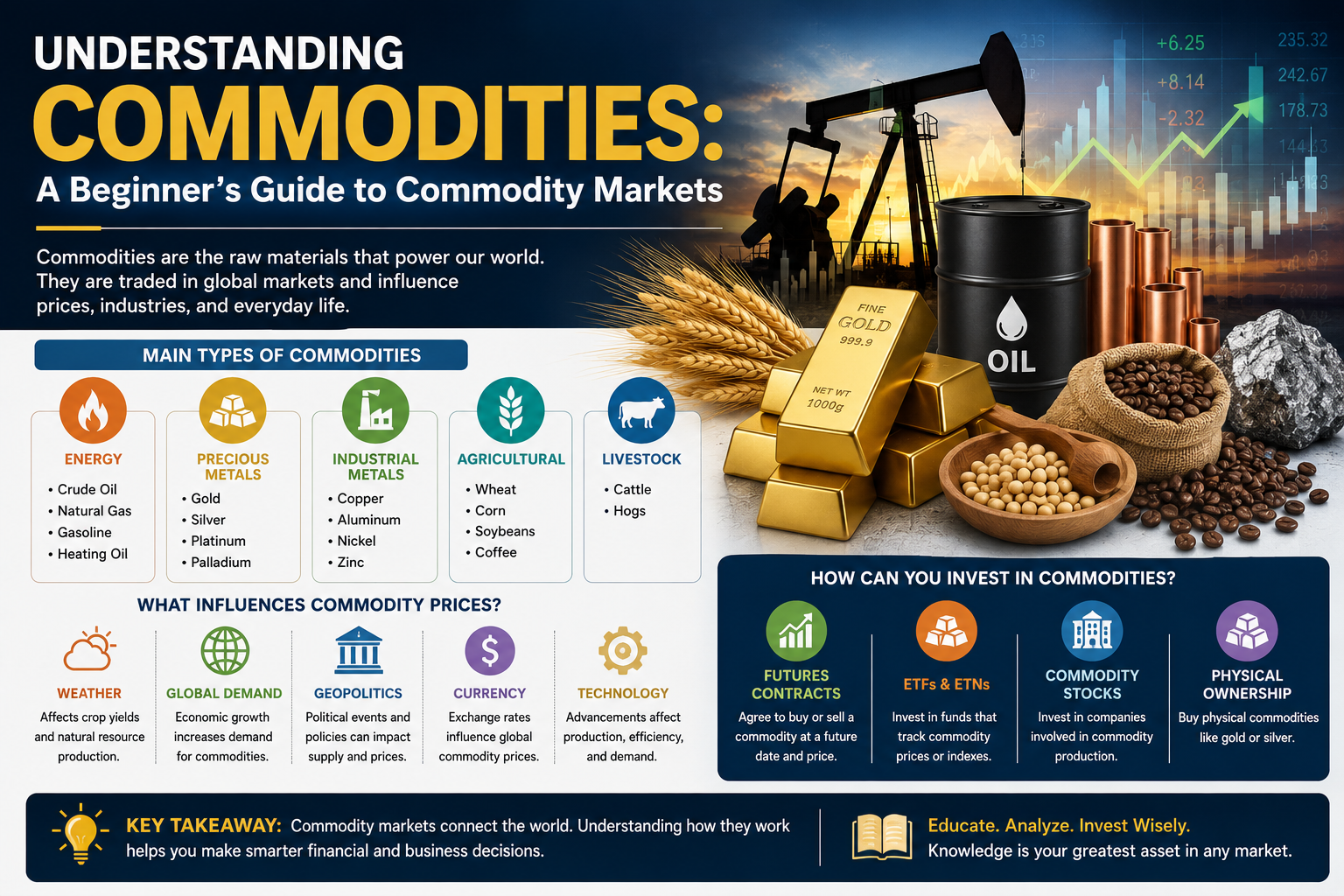
Commodity markets play an important role in the global economy. From the oil used to transport goods and power industries to the wheat, coffee, and metals used in everyday products, commodities are part of nearly every aspect of modern life.
For beginners, however, commodity markets can seem complicated. Terms such as futures, spot prices, supply and demand, hedging, and commodity exchanges may make the subject difficult to understand at first.
The good news is that the basic idea behind commodity markets is relatively simple.
A commodity is a basic physical good that can be bought and sold, usually in standardized quantities and qualities. Commodities are generally divided into categories such as energy, metals, agriculture, and livestock.
Understanding how these markets work can help investors, businesses, and everyday readers better understand why prices of fuel, food, metals, and other essential goods rise and fall.
This beginner's guide explains what commodities are, how commodity markets work, the major types of commodities, what influences prices, and some of the common ways people gain exposure to commodity markets.
What Are Commodities?
Commodities are raw materials or basic goods that can be traded in markets. Unlike finished products, commodities are generally interchangeable when they meet specific quality standards.
For example, one standardized quantity of a particular grade of crude oil can generally be exchanged for another equivalent quantity meeting the same specifications.
Common commodities include:
Gold
Silver
Crude oil
Natural gas
Copper
Wheat
Corn
Coffee
Sugar
Soybeans
Cotton
Livestock
These goods are produced in different parts of the world and are used by consumers and businesses globally.
Commodities can therefore be influenced by events occurring thousands of miles away. A drought in a major agricultural region, a disruption in oil production, or increased demand for industrial metals can affect prices across international markets.
Why Are Commodity Markets Important?
Commodity markets help connect producers, consumers, businesses, traders, and investors.
A farmer may produce wheat months before knowing exactly what the market price will be when the crop is ready for sale. An airline may need large amounts of fuel and may want greater certainty about future fuel costs. A manufacturer may need copper or aluminum for production.
Commodity markets provide mechanisms that allow these participants to manage price uncertainty.
They also help establish market prices based on available information about supply and demand.
Because commodities are fundamental inputs for businesses and households, their prices can have a wider economic impact. Changes in energy prices, for example, can affect transportation costs, manufacturing expenses, and household budgets.
The Main Types of Commodities
Commodity markets are commonly divided into several major categories.
1. Energy Commodities
Energy commodities include resources used to produce energy or fuel economic activity.
Major examples include:
Crude oil
Natural gas
Gasoline
Heating oil
Other refined energy products
Crude oil is one of the world's most actively followed commodities because it is used in transportation, manufacturing, chemicals, and numerous other industries.
Energy prices can be affected by production levels, inventories, weather, geopolitical developments, economic activity, and changes in consumer demand.
2. Precious Metals
Precious metals include:
Gold
Silver
Platinum
Palladium
Gold receives particularly strong attention from investors. It is used in jewelry and industry and is also commonly viewed as a store of value.
Silver has applications in jewelry, electronics, industrial products, and other areas.
Because precious metals have both industrial and financial uses, their prices can respond to several different forces at the same time.
3. Industrial Metals
Industrial metals are widely used in construction, manufacturing, infrastructure, transportation, and technology.
Examples include:
Copper
Aluminum
Nickel
Zinc
Lead
Copper is especially important because it is used in electrical wiring, construction, machinery, and various technologies.
Demand for industrial metals can increase when economies expand and businesses invest in buildings, factories, infrastructure, and equipment.
4. Agricultural Commodities
Agricultural commodities include crops and other farm products.
Examples include:
Wheat
Corn
Soybeans
Coffee
Sugar
Cotton
Cocoa
Agricultural commodities can be particularly sensitive to weather and growing conditions.
A drought, flood, frost, plant disease, or other agricultural problem can reduce supply and potentially influence prices.
At the same time, changes in consumer preferences, population, income levels, and international trade can influence demand.
5. Livestock
Livestock commodities include animals and animal products traded through organized markets.
Examples include:
Cattle
Hogs
Prices can be affected by feed costs, weather, disease concerns, consumer demand, production levels, and broader economic conditions.
How Do Commodity Markets Work?
Commodity markets bring buyers and sellers together.
Some commodities are traded in physical markets, where the underlying goods are actually bought and sold. Others are traded through financial contracts that allow participants to gain exposure to changes in commodity prices without necessarily taking physical delivery.
One of the most important instruments in commodity markets is the futures contract.
What Are Commodity Futures?
A futures contract is an agreement to buy or sell a specified quantity of a commodity at a predetermined price for delivery at a future date.
Futures markets are widely used by businesses and financial market participants.
For example, a producer may use futures contracts to reduce uncertainty about the price it will receive for a commodity. A company that needs a commodity may use them to help manage the risk of rising prices.
Traders may also use futures contracts to speculate on whether commodity prices will rise or fall.
Futures markets can therefore serve several purposes, including price discovery, risk management, and trading.
What Is a Spot Market?
The spot market involves transactions based on current market prices, generally for relatively immediate delivery.
The spot price represents what buyers and sellers are willing to pay and accept for a commodity under current market conditions.
The futures price, by comparison, relates to a contract for a future period.
The relationship between spot and futures prices can provide information about market expectations, inventories, financing costs, and other factors.
Supply and Demand: The Foundation of Commodity Prices
The most important concept for understanding commodity markets is supply and demand.
When demand rises while supply remains limited, prices may increase.
When supply increases while demand remains weak, prices may decline.
However, commodity markets can be more complicated because supply and demand can change for many different reasons.
For example, crude oil supply can be affected by production decisions and disruptions. Agricultural supply can change because of weather. Metal demand can change with construction and industrial activity.
This makes commodity prices particularly sensitive to changes in the real economy.
Factors That Influence Commodity Prices
Several factors can influence commodity prices.
Weather
Weather can have a major impact on agricultural commodities.
A drought can reduce crop production, while favorable growing conditions can increase supply.
Weather can also affect energy markets. Extremely hot or cold conditions can change demand for electricity, natural gas, heating fuels, or other energy products.
Global Economic Growth
Economic growth can increase demand for commodities.
When businesses expand production and consumers purchase more goods, demand for energy, metals, transportation, and agricultural products may rise.
During economic slowdowns, demand for certain commodities may weaken.
Geopolitical Developments
Political and geopolitical developments can affect commodity markets, particularly energy and metals.
Supply disruptions, trade restrictions, sanctions, conflicts, or changes in international relationships can affect the availability and movement of commodities.
Because many commodities are traded globally, developments in one major producing or consuming region can influence prices elsewhere.
Currency Movements
Many internationally traded commodities are priced in U.S. dollars.
As a result, changes in the value of the dollar can influence commodity prices and purchasing power for international buyers.
Currency movements are therefore another factor market participants may watch when analyzing commodities.
Government Policies
Government policies can influence commodity markets through taxes, regulations, subsidies, trade rules, environmental policies, energy policies, and agricultural programs.
Changes in policy can affect production costs, consumption, investment, and international trade.
Technological Change
Technology can change both commodity supply and demand.
Improved extraction methods can increase energy production. Advances in renewable energy can affect demand for certain traditional energy sources while increasing demand for specific industrial metals and materials.
Technology can also improve agricultural productivity and influence long-term demand for raw materials.
Why Commodity Prices Can Be Volatile
Commodity markets can experience significant price movements because physical supply and demand can change quickly while production often takes considerable time to adjust.
Imagine a major agricultural crop suffers from severe weather. Supply could fall substantially, but consumers and businesses may still need the product.
Similarly, if a sudden disruption reduces energy production, buyers may compete for a smaller available supply.
This difference between available supply and demand can cause prices to move sharply.
Commodity markets can therefore be more volatile than some other types of investments.
How Businesses Use Commodity Markets
Commodity markets are not only for investors and traders.
Businesses frequently use them to manage price risk.
Consider a food manufacturer that depends heavily on wheat. If wheat prices rise sharply, the company's production costs could increase.
A business may use commodity contracts as part of a risk-management strategy to reduce the financial impact of unfavorable price movements.
Similarly, airlines and transportation companies can be highly exposed to fuel prices.
Mining companies, manufacturers, farmers, energy producers, and food businesses may all have reasons to manage commodity price risk.
This practice is commonly known as hedging.
What Is Hedging?
Hedging means taking a position designed to reduce the financial impact of an unfavorable price movement.
For example, a producer concerned that the price of its commodity could fall may use financial contracts to help manage that risk.
A business concerned about rising input costs may similarly use contracts to provide greater price certainty.
Hedging does not necessarily eliminate all risk, and it can involve costs and other trade-offs. Its primary purpose is usually risk management rather than maximizing trading profits.
How Can Investors Gain Exposure to Commodities?
Investors can gain exposure to commodities through several approaches.
Direct Physical Ownership
Some commodities can be physically purchased and stored.
Gold and silver are common examples.
However, physical ownership can involve storage, insurance, security, transaction costs, and other considerations.
Commodity Futures
Futures contracts provide direct financial exposure to commodity prices, but they are more complex than simply buying a physical asset.
Futures involve contract specifications, expiration dates, margin requirements, and potentially significant gains or losses.
They are generally more suitable for people who understand how futures markets work.
Exchange-Traded Products
Some exchange-traded funds and other products are designed to provide exposure to particular commodities or groups of commodities.
These products can offer a more convenient way to obtain commodity exposure, but investors should understand how each product is structured.
Some may hold physical commodities, while others may use futures contracts or other financial instruments.
Commodity-Related Companies
Another approach is investing in companies involved in commodity industries.
Examples include:
Mining companies
Oil and gas producers
Agricultural businesses
Commodity processors
Equipment manufacturers
However, investing in a commodity-related company is not the same as investing directly in the commodity.
A company's share price can be influenced by management decisions, debt, operating costs, competition, and broader stock-market conditions.
Commodities vs. Stocks
Stocks represent ownership in companies, while commodities represent physical goods or exposure to their prices.
The factors influencing the two markets can therefore be different.
A company's stock price may depend on revenue, profits, business strategy, competition, interest rates, and investor expectations.
Commodity prices are often more directly connected to physical supply and demand.
This difference means commodities may behave differently from stocks under certain market conditions.
Commodities vs. Bonds
Bonds represent debt issued by governments, companies, or other organizations.
Investors generally receive interest payments and repayment of principal according to the terms of the bond.
Commodities do not work this way. A commodity does not generate interest simply because it is owned.
Instead, the potential return generally depends on changes in its market value and, depending on the investment structure, other factors.
The Role of Commodities in a Diversified Portfolio
Some investors consider commodities as one component of a diversified portfolio.
Diversification means spreading investments across different assets rather than relying entirely on one investment or market.
Commodities can sometimes respond differently to economic conditions than stocks or bonds.
For example, commodity prices may benefit from strong demand or supply constraints during periods when other assets are facing different pressures.
However, diversification does not guarantee profits or eliminate investment losses.
Commodities can be volatile, and investors should consider their objectives, time horizon, risk tolerance, and understanding of the market before investing.
Common Mistakes Beginners Should Avoid
Commodity markets can be attractive, but beginners should approach them carefully.
Following Prices Without Understanding the Market
A commodity price may rise or fall for many reasons. Simply seeing a price increase does not explain whether the movement is likely to continue.
Understanding supply, demand, inventories, production, and market conditions is more useful than relying on price movements alone.
Using Excessive Leverage
Some commodity instruments, particularly futures, can involve leverage.
Leverage can increase potential gains, but it can also magnify losses.
Beginners should understand the risks before using leveraged products.
Confusing a Commodity With a Commodity Company
Buying shares of a mining or energy company does not provide exactly the same exposure as buying the underlying commodity.
Company-specific factors can significantly affect the investment.
Ignoring Global Events
Commodity markets are global. Weather, economic developments, policy decisions, trade changes, and supply disruptions can all affect prices.
Ignoring these factors can lead to poor decisions.
Treating Commodities as a Guaranteed Hedge
Commodities can sometimes provide diversification benefits, but they do not automatically protect a portfolio from losses.
Their performance can vary significantly depending on market conditions.
How Beginners Can Start Learning About Commodity Markets
The best way to understand commodities is to start with the fundamentals.
First, learn the major commodity categories and understand what each commodity is used for.
Next, study supply and demand.
Then, learn how futures markets, spot markets, exchanges, and commodity-related investment products work.
It can also be useful to follow a small number of commodities rather than trying to track everything at once.
For example, a beginner might choose gold, crude oil, or copper and study the major factors that influence its price.
Over time, this approach can make complex market movements easier to understand.
A Simple Example of Commodity Price Movement
Consider coffee.
Coffee production depends heavily on growing conditions in producing regions. If weather problems reduce the expected harvest, the available supply may decline.
If consumer demand remains strong, buyers may compete for a smaller supply.
That can put upward pressure on prices.
On the other hand, if production is strong and supplies increase while demand remains stable, prices may come under downward pressure.
This simple example demonstrates why understanding physical supply and demand is so important when studying commodity markets.
The Future of Commodity Markets
Commodity markets will continue to evolve as economies, technologies, industries, and consumer preferences change.
The global transition toward different energy sources may influence traditional energy commodities while increasing demand for certain metals and materials.
Growing populations and changing food consumption patterns may influence agricultural markets.
At the same time, technological innovation can change how commodities are produced, transported, processed, and consumed.
For investors and businesses, understanding these long-term trends can be valuable. However, commodity markets will continue to be influenced by short-term factors as well, including weather, inventories, economic activity, and unexpected supply disruptions.
Final Thoughts
Commodity markets are an important part of the global financial system and the real economy.
From energy and metals to agricultural products and livestock, commodities provide the raw materials that support industries and everyday life.
For beginners, the most important concepts to understand are supply and demand, commodity categories, spot prices, futures contracts, hedging, and price volatility.
Commodity investing can provide opportunities, but it also carries risks. Prices can change rapidly, and some commodity instruments involve considerable complexity and leverage.
The best starting point is education. By learning how commodity markets work and understanding the factors that influence individual commodities, beginners can develop a stronger foundation for evaluating this important part of the global economy.
Frequently Asked Questions
1. What are commodities?
Commodities are basic physical goods or raw materials that can be bought and sold in markets. Examples include gold, oil, natural gas, wheat, coffee, copper, and livestock.
2. What are the main types of commodities?
The major categories include energy commodities, precious metals, industrial metals, agricultural commodities, and livestock.
3. How do commodity markets work?
Commodity markets connect buyers and sellers and help establish prices based on supply, demand, expectations, and other market factors. Commodities can be traded physically or through financial contracts.
4. What is commodity trading?
Commodity trading involves buying and selling commodities or financial contracts linked to commodity prices. Traders may attempt to profit from price movements, while businesses may trade commodities to manage price risk.
5. What are commodity futures?
Commodity futures are contracts to buy or sell a specified amount of a commodity at an agreed price for a future date. They are commonly used for both hedging and trading.
6. Why do commodity prices change?
Commodity prices can change because of shifts in supply and demand, weather, economic growth, geopolitical developments, currency movements, government policies, inventories, and technological changes.
7. Is gold a commodity?
Yes. Gold is a precious-metal commodity that has applications in jewelry, industry, and investment.
8. Is crude oil a commodity?
Yes. Crude oil is one of the world's most important energy commodities and is widely traded in international markets.
9. Are commodities risky investments?
Commodities can be volatile and therefore carry investment risk. Some commodity products, particularly leveraged instruments, can expose investors to substantial losses.
10. Can beginners invest in commodities?
Beginners can learn about and potentially gain exposure to commodities, but they should first understand the risks and the structure of the investment product they are considering.
11. What is hedging in commodity markets?
Hedging is a risk-management strategy designed to reduce the financial impact of unfavorable commodity price movements.
12. What is the difference between spot and futures prices?
A spot price generally represents the current market price for a commodity, while a futures price relates to a contract for a specified future date.
13. Why are agricultural commodities affected by weather?
Weather influences crop production. Droughts, floods, frost, and other conditions can reduce or increase agricultural supply and affect prices.
14. What are industrial metals?
Industrial metals are metals widely used in construction, manufacturing, infrastructure, and technology. Copper, aluminum, nickel, zinc, and lead are examples.
15. Can commodities help diversify an investment portfolio?
Commodities may provide diversification because they can respond differently to certain economic and market conditions than stocks or bonds. However, diversification does not guarantee profits or prevent losses.
16. What is the difference between investing in a commodity and a commodity company?
Investing in a commodity provides exposure to the price of the underlying raw material, while investing in a commodity-related company also exposes the investor to company-specific factors such as management, costs, debt, and competition.
17. What is supply and demand in commodity markets?
Supply refers to how much of a commodity is available, while demand refers to how much buyers want. Changes in either can influence commodity prices.
18. What commodities are commonly traded?
Commonly traded commodities include crude oil, natural gas, gold, silver, copper, wheat, corn, soybeans, coffee, sugar, and livestock.
19. What should beginners learn before trading commodities?
Beginners should understand commodity fundamentals, supply and demand, futures contracts, leverage, market volatility, risk management, and the specific product they intend to trade.
20. Why are commodity markets important to the global economy?
Commodities provide essential raw materials for energy, food, manufacturing, transportation, construction, and many other industries. Their prices can therefore influence businesses, consumers, and economies around the world.