
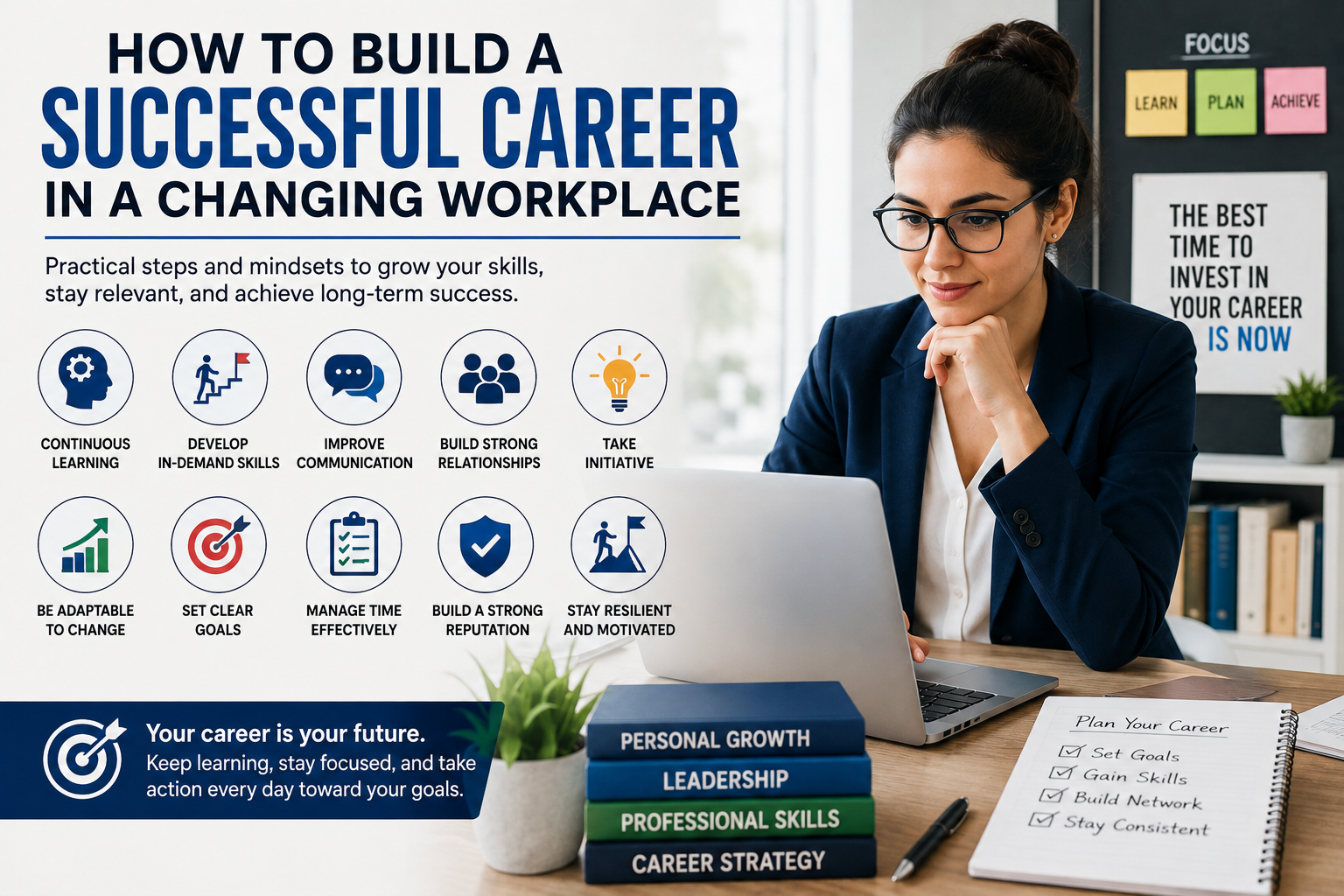
Building a successful career has never been about following one fixed path. People change jobs, develop new skills, move between industries, take on new responsibilities, and discover new professional interests throughout their working lives.
At the same time, workplaces continue to evolve. Technology changes how people communicate and complete tasks, organizations introduce new processes, and employers increasingly value a combination of technical knowledge and human skills.
For professionals, this means career development is an ongoing process rather than a one-time achievement.
A successful career does not necessarily mean reaching the highest possible position or earning the largest salary. Career success can also mean finding meaningful work, developing valuable skills, maintaining professional relationships, having opportunities to grow, and creating a career path that fits your long-term goals.
The good news is that many of the principles behind career development remain useful regardless of industry or job title.
Understand What Career Success Means to You
Before deciding how to advance your career, it is useful to define what success actually means to you.
Different people have different priorities.
One person may want to become a senior executive. Another may prefer to become an expert in a particular field. Someone else may value flexibility, meaningful work, independence, or a better balance between professional and personal responsibilities.
Without a clear idea of what you want, it can be difficult to decide which opportunities are worth pursuing.
Consider questions such as:
What type of work do I enjoy?
What skills do I want to develop?
What kind of responsibilities interest me?
Where would I like my career to be in several years?
Do I prefer leadership or specialized expertise?
What type of workplace environment suits me?
Which values are important to me professionally?
Your answers do not need to remain the same forever. Career goals can change as you gain experience.
The purpose of defining them is to give your current decisions some direction.
1. Develop Skills That Remain Valuable
A strong career foundation comes from developing skills that can be applied in different situations.
Technical skills are important, but employers also value broader abilities such as communication, problem-solving, teamwork, adaptability, organization, and critical thinking.
For example, a professional may become highly skilled at a particular software platform. That expertise can be useful, but the ability to learn new tools can be even more valuable over a long career.
Consider building a combination of:
Technical skills
Communication skills
Problem-solving abilities
Leadership skills
Time-management skills
Collaboration skills
Analytical thinking
Digital literacy
Adaptability
Professional writing
The ideal combination depends on your industry and career goals.
The important point is to avoid relying entirely on one narrow skill.
2. Become a Lifelong Learner
Learning should not stop after completing formal education.
Industries evolve, new tools appear, and professional expectations change. People who continue learning can become more comfortable with new responsibilities and unfamiliar situations.
Lifelong learning does not necessarily mean earning another degree.
You can learn through:
Professional courses
Books
Workshops
Online education
Mentorship
Workplace training
Industry publications
Conferences
Practical projects
Professional communities
Choose learning activities that connect to your goals.
For example, if you want to become a manager, studying leadership, communication, delegation, and decision-making may be useful. If you want to move into a technical field, you may need to develop specific technical skills.
The goal is not to learn everything. It is to keep developing skills that are relevant to where you want to go.
3. Improve Your Communication
Communication is one of the most transferable career skills.
Professionals communicate through meetings, emails, presentations, reports, messages, conversations, and increasingly through digital collaboration platforms.
Being technically capable is valuable, but if you cannot explain your ideas clearly, your expertise may be difficult for others to recognize or use.
Strong workplace communication involves both speaking and listening.
To improve communication:
Organize your thoughts before important conversations.
Keep professional messages clear and concise.
Ask questions when expectations are unclear.
Listen before responding.
Avoid unnecessary jargon.
Adapt your communication to your audience.
Confirm important details in writing.
Learn how to give and receive constructive feedback.
Good communication can also help prevent misunderstandings and improve collaboration.
4. Build a Strong Professional Reputation
Your professional reputation develops through repeated interactions.
People remember whether you meet deadlines, communicate reliably, treat colleagues respectfully, solve problems, and take responsibility for your work.
A strong reputation does not require trying to impress everyone.
Instead, focus on being dependable.
If you commit to completing something by a particular time, make a reasonable effort to meet that commitment. If a problem may affect a deadline, communicate it early rather than waiting until the last moment.
Over time, consistent behavior can create trust.
Your reputation can become particularly valuable when you apply for new opportunities, seek recommendations, or take on greater responsibility.
5. Learn From Feedback
Feedback can reveal areas for improvement that you may not notice yourself.
Some people avoid feedback because criticism can feel uncomfortable. However, useful feedback can become an important source of professional growth.
When receiving feedback, try to understand the specific behavior or outcome being discussed.
Instead of immediately becoming defensive, consider asking:
What could I have done differently?
Which part of my approach created the problem?
What would a better result have looked like?
Is there a specific skill I should develop?
Not every piece of feedback will be equally useful. Some feedback may reflect personal preferences rather than genuine performance issues.
Your responsibility is to listen carefully, identify useful information, and decide how to apply it.
6. Develop Adaptability
Adaptability is increasingly important because professional environments can change.
Employees may be asked to work with new systems, take on unfamiliar responsibilities, collaborate with different teams, or adjust to new processes.
Adaptability does not mean agreeing with every change.
It means being willing to understand new circumstances and learn what is necessary to operate effectively within them.
A practical way to become more adaptable is to regularly step outside your comfort zone.
Volunteer for a new project. Learn an unfamiliar tool. Work with people from another department. Take responsibility for something you have not done before.
These experiences can gradually increase your comfort with uncertainty.
7. Learn How to Work With Technology
Technology has become part of almost every modern workplace, even in roles that are not traditionally considered technical.
Professionals may use digital communication platforms, project-management systems, spreadsheets, databases, automation tools, artificial intelligence applications, or industry-specific software.
You do not need to become an expert in every technology.
Instead, develop the ability to understand which tools are relevant to your work and learn how to use them effectively.
Digital literacy can also involve understanding basic cybersecurity practices, protecting sensitive information, evaluating online information, and using workplace technology responsibly.
The ability to learn new tools may be more valuable than memorizing how to use one specific platform.
8. Build Meaningful Professional Relationships
Career development is not only about skills and qualifications. Relationships also matter.
Professional relationships can provide knowledge, advice, collaboration opportunities, mentorship, and exposure to different perspectives.
Networking does not have to mean attending formal events and collecting business cards.
It can be as simple as:
Staying in touch with former colleagues
Helping people when appropriate
Participating in professional communities
Attending industry events
Connecting with experienced professionals
Sharing useful knowledge
Asking thoughtful questions
Maintaining relationships over time
Effective networking should be based on genuine professional relationships rather than immediately asking people for favors.
9. Find Mentors and Learn From Experienced People
A mentor can provide perspective that is difficult to gain from books alone.
An experienced professional may help you understand workplace expectations, identify potential mistakes, evaluate career decisions, or recognize opportunities you had not considered.
A mentor does not have to be someone in the same organization.
They can be an experienced colleague, former manager, industry professional, teacher, or another person whose career experience is relevant to your goals.
When approaching someone for mentorship, be specific about what you want to learn.
Instead of asking someone to "teach me everything about your career," consider asking about a particular challenge or skill.
This makes the relationship more practical and focused.
10. Learn to Manage Your Time
Career growth becomes difficult when important responsibilities consistently compete for attention.
Time management is not simply about working faster. It is about deciding what deserves attention and organizing your work accordingly.
Start by identifying your highest-priority tasks.
A simple system can divide responsibilities into:
Urgent and important
Important but not urgent
Routine tasks
Tasks that can be delegated or postponed
Avoid filling every available minute with work.
Regular breaks, planning time, and reasonable boundaries can help maintain sustainable performance.
Productivity should support long-term effectiveness rather than create constant exhaustion.
11. Take Initiative
People who consistently wait to be told what to do may have fewer opportunities to demonstrate their capabilities.
Taking initiative means identifying opportunities or problems and taking appropriate action.
For example, you might notice that a repeated process wastes time. Instead of simply complaining about it, you could research a possible improvement and discuss it with your manager.
Initiative does not mean making major decisions without authorization.
It means showing that you can recognize problems, think about solutions, and take responsible action within your role.
12. Become a Problem Solver
Organizations value people who can help solve problems.
When you encounter an issue, try to move beyond simply identifying what is wrong.
Ask:
What happened?
Why did it happen?
What information do we need?
What solutions are possible?
What are the risks of each option?
What should happen next?
This approach can make you more useful in almost any professional environment.
Even when you cannot solve a problem yourself, presenting the issue clearly and suggesting possible next steps can demonstrate initiative.
13. Develop Leadership Skills Before Becoming a Manager
You do not need a management title to develop leadership abilities.
Leadership can begin with everyday behaviors such as helping colleagues, taking responsibility, communicating clearly, organizing projects, and supporting team goals.
If you eventually want a management position, developing these skills early can make the transition easier.
Focus on:
Communication
Accountability
Decision-making
Delegation
Conflict management
Emotional intelligence
Coaching
Strategic thinking
Leadership is not simply about authority. It is about helping people and organizations move toward meaningful objectives.
14. Learn to Handle Workplace Conflict
Disagreements are a normal part of professional life.
People may disagree about priorities, responsibilities, deadlines, strategies, or how a problem should be solved.
Avoiding every conflict is not always possible or useful.
When disagreements occur, focus on the issue rather than the person.
Listen to the other perspective, clarify facts, identify areas of agreement, and discuss possible solutions.
Avoid turning professional disagreements into personal attacks.
A calm approach can help preserve relationships while still addressing the underlying problem.
15. Ask for Opportunities to Grow
Career development often requires communicating your ambitions.
If you want to take on more responsibility, develop a particular skill, or move toward a different role, discuss your goals with appropriate people.
You might ask your manager:
What skills would I need for the next level?
Which areas should I improve?
Are there projects where I could take more responsibility?
What experience would prepare me for a future role?
These conversations can provide useful information about what is expected.
They also demonstrate that you are thinking intentionally about your development.
16. Create a Career Development Plan
A career plan does not need to be complicated.
Start by identifying where you are now and where you would like to go.
Then identify the gap between the two.
For example:
Current position: Marketing assistant
Desired direction: Marketing manager
Skills to develop: Leadership, analytics, budgeting, strategy
Experience needed: Project ownership and team coordination
Learning plan: Complete relevant training and practice through real projects
Review period: Reassess progress regularly
This approach turns a vague ambition into practical steps.
Your plan should remain flexible because career opportunities and interests can change.
17. Build a Portfolio of Your Achievements
Do not rely entirely on your memory when discussing your professional accomplishments.
Keep a record of meaningful projects, responsibilities, improvements, certifications, presentations, successful outcomes, and other achievements.
This can help when updating your résumé, preparing for interviews, discussing promotions, or reviewing your career progress.
Whenever possible, describe achievements in terms of outcomes.
For example, instead of saying:
"I worked on a customer service project."
You might describe the specific responsibility you had and the result it produced.
A record of achievements can also remind you how much you have developed over time.
18. Learn How to Present Yourself Professionally
Your professional profile should accurately communicate your skills and experience.
This includes your résumé, professional online profiles, portfolio, email communication, and interview skills.
Avoid exaggerating qualifications.
Instead, focus on presenting genuine strengths clearly.
A strong professional profile should make it easy for others to understand:
What you do
What skills you have
What experience you bring
What type of opportunities interest you
What results you have achieved
Professional presentation is not about creating a false image. It is about communicating your real value effectively.
19. Become Comfortable With Change in Career Direction
Not every career plan works exactly as expected.
You may discover that a profession you once wanted does not suit you. An industry may change. A company may restructure. Personal priorities may shift.
Changing direction does not automatically mean failure.
Career development is often an evolving process.
If your interests change, evaluate your transferable skills and consider how they could apply elsewhere.
For example, communication, project management, research, customer service, analysis, and leadership skills can often be used across different industries.
Your previous experience may therefore become a foundation for something new.
20. Protect Your Professional Well-Being
Career success should be sustainable.
Constantly working without adequate rest can eventually affect concentration, motivation, relationships, and overall well-being.
Develop reasonable boundaries where possible.
Take breaks, use time away from work to recover, and recognize when workload problems need to be discussed.
Professional ambition and personal well-being do not have to be opposites.
A sustainable career is one that allows you to continue performing effectively over the long term.
21. Learn From Setbacks
Career setbacks happen.
You may not receive a promotion, lose an opportunity, make a mistake, or discover that a project did not produce the expected result.
It is natural to feel disappointed.
However, setbacks can also provide useful information.
Ask:
What was within my control?
What was outside my control?
What could I have prepared for better?
What skills should I strengthen?
What can I do differently next time?
One unsuccessful outcome does not define an entire career.
The ability to learn and continue moving forward can be more valuable than avoiding every setback.
22. Review Your Career Regularly
Career development should not happen only when you are looking for a new job.
Set aside time periodically to evaluate your progress.
Consider:
What have I learned?
Which responsibilities have increased?
Which skills have improved?
What kind of work do I enjoy most?
What opportunities do I want next?
What is currently limiting my growth?
What should I learn next?
A regular review can help prevent your career from becoming purely reactive.
Instead of simply responding to whatever opportunity appears, you can make more deliberate decisions.
23. Focus on Long-Term Growth
Career growth rarely happens overnight.
Some skills take years to develop. Professional relationships take time to build. Leadership experience comes from repeated responsibility.
Avoid comparing your progress too closely with someone else's timeline.
A person who receives a promotion quickly may have different circumstances, experience, goals, or opportunities.
Focus on building a strong foundation.
Develop useful skills, maintain professional relationships, learn from experience, and make thoughtful decisions.
Over time, these habits can create opportunities for advancement.
A Simple Career Growth Framework
If you want a straightforward approach, use this five-step framework:
Learn
Identify the knowledge and skills you need.
Practice
Use those skills regularly rather than only studying them.
Apply
Look for real projects or responsibilities where you can use what you have learned.
Reflect
Review what worked, what did not, and what you can improve.
Adapt
Adjust your career plan as your goals and circumstances change.
This cycle can continue throughout your professional life.
Final Thoughts
Building a successful career in a changing workplace requires more than collecting qualifications or waiting for promotions.
Long-term career growth comes from continuously developing useful skills, communicating effectively, building professional relationships, taking initiative, adapting to change, and learning from experience.
Your career path does not have to be perfectly predictable.
What matters is developing the ability to make thoughtful decisions as circumstances change.
Start by identifying one skill that could improve your professional future. Create a practical plan, look for opportunities to apply it, and review your progress regularly.
A successful career is rarely built through one major decision. It is usually the result of many smaller decisions, habits, relationships, and learning experiences accumulated over time.
Frequently Asked Questions
1. How can I build a successful career?
Focus on developing valuable skills, gaining practical experience, communicating effectively, building professional relationships, learning continuously, and taking responsibility for your career development.
2. What skills are most important for career growth?
Communication, problem-solving, adaptability, teamwork, leadership, time management, critical thinking, digital literacy, and continuous learning are broadly useful across many careers.
3. Why is adaptability important in the workplace?
Workplaces can change because of new technologies, processes, organizational priorities, and market conditions. Adaptability helps professionals learn new approaches and remain effective when circumstances change.
4. How can I advance my career without changing jobs?
Look for opportunities to take on additional responsibilities, lead projects, develop new skills, mentor colleagues, improve processes, and discuss your professional development goals with your manager.
5. How can I improve my career if I have limited experience?
Start by developing relevant skills and gaining practical experience through projects, internships, volunteer opportunities, training, or entry-level responsibilities. Focus on building evidence of what you can do.
6. Is networking important for career development?
Yes. Professional relationships can provide knowledge, mentorship, collaboration opportunities, recommendations, and exposure to new career possibilities. Effective networking is based on genuine relationships rather than simply collecting contacts.
7. How can I find a good mentor?
Look for someone whose experience or skills align with your goals. This could be a manager, colleague, teacher, industry professional, or experienced person in your network. Be clear about what you hope to learn.
8. How often should I review my career goals?
There is no fixed schedule, but reviewing your goals periodically can help you stay focused and make adjustments when your interests or circumstances change.
9. What should I do if I feel stuck in my career?
Identify what is causing the feeling of being stuck. You may need a new skill, greater responsibility, a different role, additional education, or simply a clearer goal. Talking with a trusted mentor or professional can also provide another perspective.
10. Can changing careers be part of professional growth?
Yes. Career changes can happen for many reasons, including changing interests, new opportunities, industry shifts, or personal priorities. Transferable skills can help make a transition easier.
11. How can I make my résumé more effective?
Focus on relevant skills, responsibilities, experience, and measurable achievements. Keep the information clear and tailored to the type of role you are pursuing.
12. How can I demonstrate leadership without being a manager?
Take initiative, support colleagues, solve problems, organize projects, communicate clearly, accept responsibility, and help the team achieve shared goals. Leadership can be demonstrated at many levels.
13. Why is continuous learning important for career development?
Continuous learning helps professionals maintain and develop relevant knowledge and skills. It can also make it easier to adapt when responsibilities, technologies, or career goals change.
14. How can I become more confident at work?
Confidence often develops through preparation and experience. Learn the skills required for your role, take on manageable challenges, seek constructive feedback, and recognize your progress.
15. What is the most important thing for long-term career success?
There is no single formula, but continuous learning, adaptability, strong communication, professional relationships, reliability, and a willingness to take responsibility can provide a strong foundation for long-term career development.