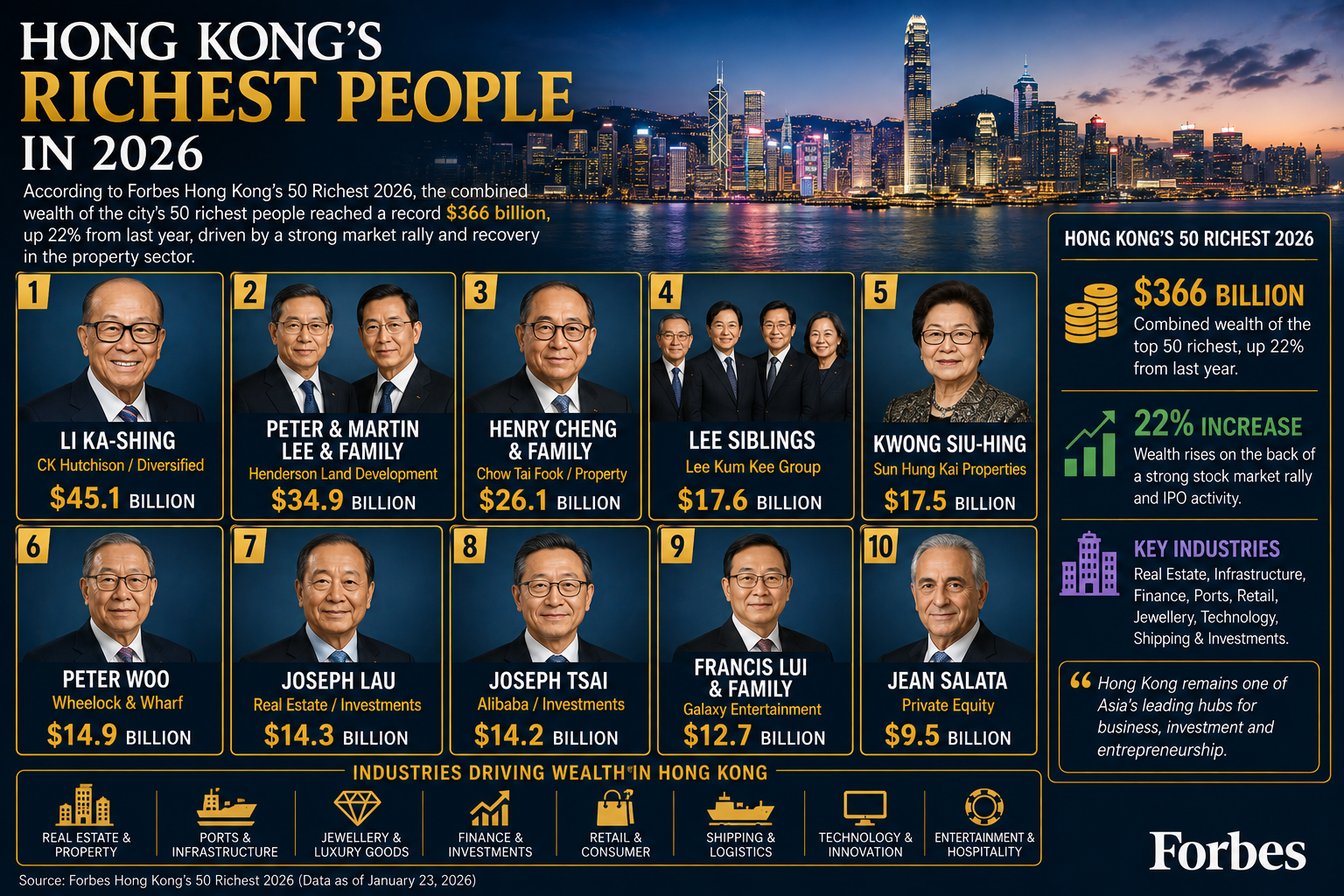
Hong Kong remains one of Asia’s most important centers for finance, property, trade and global business. The city is home to some of the world’s most influential billionaires, many of whom built their fortunes through real estate, infrastructure, ports, retail, finance, jewelry, technology and international investments.
In 2026, Hong Kong’s wealthiest business leaders benefited from a strong rebound in financial markets and signs of recovery in the property sector.
According to Forbes’ Hong Kong’s 50 Richest 2026, the combined wealth of the city’s 50 richest people reached an all-time high of approximately $366 billion, up from $301 billion the previous year. That represents an increase of about 22%.
The benchmark Hang Seng Index had rallied nearly 30% since Forbes’ previous wealth measurement, while a wave of initial public offerings and improving sentiment toward Hong Kong property helped lift billionaire fortunes.
At the top of the ranking was veteran business magnate Li Ka-shing, who retained his position as Hong Kong’s richest person with a fortune of $45.1 billion.
Top 10 Richest People in Hong Kong in 2026
Rank | Billionaire / Family | Main Business | Net Worth |
|---|---|---|---|
1 | Li Ka-shing | CK Hutchison / Diversified | $45.1B |
2 | Peter & Martin Lee & Family | Henderson Land Development | $34.9B |
3 | Henry Cheng & Family | Chow Tai Fook / Property | $26.1B |
4 | Lee Siblings | Lee Kum Kee Group | $17.6B |
5 | Kwong Siu-hing | Sun Hung Kai Properties | $17.5B |
6 | Peter Woo | Wheelock & Wharf | $14.9B |
7 | Joseph Lau | Real Estate / Investments | $14.3B |
8 | Joseph Tsai | Alibaba / Investments | $14.2B |
9 | Francis Lui & Family | Galaxy Entertainment | $12.7B |
10 | Jean Salata | Private Equity | $9.5B |
These figures are from Forbes’ 2026 Hong Kong’s 50 Richest ranking and are based on stock prices and exchange rates as of January 23, 2026. Forbes notes that real-time fortunes can differ as market values change.
1. Li Ka-shing — $45.1 Billion
Li Ka-shing remained Hong Kong’s richest person in 2026 with an estimated fortune of $45.1 billion.
Known for decades as one of Asia’s most influential businessmen, Li built a diversified business empire spanning ports, telecommunications, infrastructure, retail, utilities and investments.
He is the senior adviser of CK Hutchison Holdings, while his son Victor Li leads the conglomerate.
Li originally built his fortune through manufacturing and property before expanding into a much broader international business empire.
Forbes reported that his fortune increased by $7.8 billion over the previous year, making him the biggest dollar gainer on the 2026 Hong Kong list.
CK Hutchison has operations in more than 50 countries and employs hundreds of thousands of people.
Li Ka-shing’s major businesses
Ports
Telecommunications
Infrastructure
Retail
Utilities
Property
Investments
One of the major stories surrounding Li in 2026 was CK Hutchison’s proposed sale of stakes in 43 ports across 23 countries to a consortium led by BlackRock.
The multibillion-dollar transaction faced scrutiny and uncertainty, including attention from Beijing and legal developments surrounding port operations in Panama.
Despite these challenges, Li remained firmly at the top of Hong Kong’s wealth ranking.
From modest beginnings to billionaire status
Li's journey is particularly notable because he started with limited resources.
He founded Cheung Kong Plastics in 1950 at the age of 21 using savings and loans from relatives.
Over the following decades, he expanded from manufacturing into property and then into a multinational conglomerate.
His story remains one of Hong Kong's most famous examples of long-term entrepreneurship.
2. Peter & Martin Lee & Family — $34.9 Billion
Brothers Peter and Martin Lee made their debut at No. 2 in the 2026 Forbes ranking with a combined family fortune of approximately $34.9 billion.
They are the sons of the late property billionaire Lee Shau Kee, founder of Henderson Land Development.
Lee Shau Kee died in 2025 at the age of 97 after building one of Hong Kong’s largest property empires.
Peter and Martin now serve as co-chairmen of Henderson Land.
Their fortune demonstrates the continuing importance of real estate in Hong Kong.
Henderson Land has major interests in:
Residential property
Commercial buildings
Hotels
Infrastructure
Property investment
Development
The company has also been expanding its presence in Hong Kong's Central business district.
One major project is Central Yards, an approximately $8.1 billion mixed-use development overlooking Victoria Harbour.
The project is expected to open in phases beginning in 2027.
A new generation takes control
The rise of Peter and Martin Lee highlights an important trend among Hong Kong's richest families.
The next generation is increasingly taking control of businesses created by earlier generations while attempting to modernize and diversify those empires.
3. Henry Cheng & Family — $26.1 Billion
Henry Cheng and his family rank third with an estimated fortune of $26.1 billion.
Cheng is chairman of the family's major businesses, including Chow Tai Fook Jewellery Group and interests connected to New World Development.
His family fortune increased by approximately $6.6 billion during the year measured by Forbes.
One of the biggest drivers was the strong performance of Chow Tai Fook Jewellery Group.
The company's shares nearly doubled as rising gold prices supported demand for gold-related products.
The Cheng family empire
The family's businesses extend across:
Jewelry
Property
Hotels
Infrastructure
Retail
Investments
Hospitality
However, the family's property business has faced challenges.
New World Development has struggled with debt pressures, and the company has considered strategic options including a potential stake sale.
This creates an interesting contrast: the family's jewelry business benefited from higher gold prices while its property operations faced financial challenges.
4. Lee Siblings — $17.6 Billion
The Lee siblings rank fourth with a combined fortune of approximately $17.6 billion.
The family controls the Lee Kum Kee Group, one of the world's best-known Asian food companies.
The company was founded in 1888, when Lee Kum Sheung began producing oyster sauce.
More than a century later, Lee Kum Kee has become a global food brand.
The company's products are sold internationally, and the group has expanded beyond sauces into healthcare, property and venture capital.
The five siblings—Charlie, Sammy, Eddy, David and Elizabeth—are the children of the late Lee Man Tat.
Sammy Lee became executive chairman of the family group in 2022.
Lee Kum Kee's global reach
The company's oyster sauce is sold in more than 100 countries and the business employs thousands of people worldwide.
The Lee family's fortune demonstrates how a traditional consumer product can become a global brand when successfully passed through multiple generations.
5. Kwong Siu-hing — $17.5 Billion
Kwong Siu-hing ranks fifth with an estimated fortune of $17.5 billion.
Her wealth is closely connected to Sun Hung Kai Properties, one of Hong Kong's largest property developers.
She is the widow of the late property magnate Kwok Tak-seng, who co-founded Sun Hung Kai Properties with his brothers.
The company became one of Hong Kong's most powerful real estate groups.
Its business interests include:
Residential property
Office buildings
Shopping centers
Hotels
Infrastructure
Property investment
Kwong's position demonstrates how family ownership remains a defining characteristic of Hong Kong's billionaire economy.
6. Peter Woo — $14.9 Billion
Peter Woo ranks sixth with a fortune of approximately $14.9 billion.
Woo previously served as chairman of Wheelock & Company and its main subsidiary, Wharf Holdings.
Although he stepped down from the chairmanship in 2015, his family remains deeply connected to the business.
His son Douglas Woo now chairs Wheelock, which was taken private in 2020.
The family empire has interests in:
Property
Retail
Telecommunications
Ports
Hotels
Investments
One of the family's best-known consumer businesses is luxury department-store chain Lane Crawford.
Woo's career illustrates the combination of property, retail and international investment that has historically characterized Hong Kong's wealthiest families.
7. Joseph Lau — $14.3 Billion
Joseph Lau ranks seventh with an estimated fortune of $14.3 billion.
Lau built much of his wealth through Hong Kong property investments and is one of the city's best-known real estate billionaires.
Property has historically been the foundation of his fortune.
His business activities have included major commercial and residential properties, while his family remains active in managing the family's investments.
Lau's fortune also highlights the importance of Hong Kong's luxury property market.
Even during periods of broader property weakness, premium land and high-value real estate remain important components of the city's wealth economy.
8. Joseph Tsai — $14.2 Billion
Joseph Tsai ranks eighth with an estimated fortune of $14.2 billion.
Tsai is a cofounder of Alibaba Group and remains one of the company's largest individual shareholders.
He became Alibaba's chairman in 2023 after previously serving as executive vice chairman.
Tsai's business interests extend well beyond Alibaba.
He is also the owner of the Brooklyn Nets and has invested heavily in sports, technology and venture capital.
Forbes notes that Tsai sold a 15% stake in the parent company of the Brooklyn Nets in 2024 to Julia Koch and her family for nearly $700 million.
Joseph Tsai's sources of wealth
Alibaba
Technology
E-commerce
Investments
Sports
Venture capital
Tsai represents a newer generation of Hong Kong billionaire whose wealth is closely tied to global technology rather than traditional property alone.
9. Francis Lui & Family — $12.7 Billion
Francis Lui and his family rank ninth with approximately $12.7 billion.
Lui is vice chairman of Galaxy Entertainment Group, a major casino and resort operator in Macau.
The company operates major gaming and hospitality properties in Macau, one of the world's largest casino markets.
His fortune therefore connects Hong Kong's wealth rankings to the broader Greater Bay Area economy.
Galaxy Entertainment's operations include:
Casinos
Hotels
Restaurants
Entertainment
Luxury retail
Resorts
The recovery of tourism and gaming activity in Macau has remained an important factor for the business.
10. Jean Salata — $9.5 Billion
Jean Salata rounds out the top 10 with an estimated fortune of $9.5 billion.
Unlike most of the people near the top of the Hong Kong ranking, Salata built his fortune primarily through private equity.
He was the founder of Baring Private Equity Asia, which became one of Asia's major private-equity firms.
The business invested in companies throughout the Asia-Pacific region.
Salata's inclusion demonstrates the importance of financial markets and private investment in Hong Kong's billionaire economy.
His fortune represents a different path to extreme wealth compared with property development or inherited family businesses.
Why Hong Kong's Richest People Became Wealthier in 2026
The biggest story behind Hong Kong's 2026 billionaire rankings was the recovery of financial markets.
Forbes reported that the Hang Seng Index rose nearly 30% from the previous wealth measurement.
A wave of IPOs also helped increase market activity and investor confidence.
At the same time, Hong Kong's property market showed signs of stabilization after several difficult years.
These developments helped push the combined wealth of the city's 50 richest people to a record $366 billion.
Hong Kong's 50 Richest Reach $366 Billion
The combined fortune of Hong Kong's 50 richest people increased from approximately $301 billion to $366 billion.
That represents a gain of around 22% in just one year.
The improvement was broad.
Forbes reported that 36 members of the list increased their wealth.
This is particularly significant because Hong Kong's billionaire class had faced considerable pressure from weak property markets and uncertainty surrounding the Chinese economy in previous years.
The Minimum Fortune Reaches $1.6 Billion
Becoming one of Hong Kong's 50 richest people has become increasingly difficult.
The minimum fortune required to enter the 2026 ranking reached a record $1.6 billion, up from $1.4 billion the previous year.
This means that an individual can be a billionaire and still not qualify for the city's top 50.
The rising entry threshold reflects both market growth and the concentration of wealth among Hong Kong's most successful business owners.
Real Estate Still Dominates Hong Kong's Wealth
Property remains one of the most important sources of billionaire wealth in Hong Kong.
The city has extremely limited land availability, and major developers have built enormous fortunes through residential, commercial and mixed-use developments.
The Lee family, Cheng family, Kwong Siu-hing and Peter Woo all have major property connections.
Even as Hong Kong attempts to diversify its economy, real estate remains a central pillar of its billionaire landscape.
Ports and Infrastructure Create Global Fortunes
Li Ka-shing represents another major source of wealth: infrastructure.
CK Hutchison operates ports around the world, giving Li exposure to global trade rather than only Hong Kong's domestic economy.
The proposed transaction involving stakes in 43 ports across 23 countries shows how large Hong Kong's business empires have become.
Hong Kong's location at the center of Asian trade has historically helped local entrepreneurs build global logistics businesses.
Jewelry and Gold Become Increasingly Important
Henry Cheng's family demonstrates the importance of luxury goods.
Chow Tai Fook Jewellery Group benefited from rising gold prices during the period covered by Forbes' ranking.
Gold jewelry remains deeply connected to Asian consumer culture, wealth preservation and gifting traditions.
The strong performance of the company's shares helped push Cheng's family fortune higher despite difficulties in property.
Technology Is Becoming More Important
Hong Kong's billionaire rankings have historically been dominated by property and traditional businesses.
However, technology is becoming increasingly visible.
Joseph Tsai represents one of the clearest examples.
His fortune was created through Alibaba, one of China's most important technology and e-commerce companies.
Other Hong Kong billionaires have also invested in:
Technology
Artificial intelligence
Digital assets
Venture capital
Fintech
Data infrastructure
The city's role as a financial center could make it an important gateway for technology investment across Asia.
Shipping Remains a Major Source of Wealth
Hong Kong has a long history as a global shipping and logistics center.
The debut of the Sohmen-Pao family in the 2026 Forbes ranking highlights the continuing importance of shipping.
The family, heirs of shipping magnate Helmut Sohmen, entered the list with a fortune of approximately $5.7 billion.
Their appearance demonstrates that global transportation remains an important source of wealth even as Hong Kong's economy becomes more technology-oriented.
The Rise of the Next Generation
Several of Hong Kong's richest families are undergoing generational transitions.
The sons of Lee Shau Kee now lead Henderson Land.
The children of established business families increasingly hold executive positions and are responsible for expanding their parents' companies.
This transition is important because Hong Kong has many multigenerational family businesses.
The next generation is increasingly combining traditional industries with:
Technology
Green energy
Digital investments
International expansion
Venture capital
New Billionaires and Rising Fortunes
The 2026 ranking included several notable changes.
The Sohmen-Pao family entered the list following the death of shipping magnate Helmut Sohmen.
The Keswick family also experienced a dramatic increase in wealth, with its fortune rising nearly 90% to approximately $4.6 billion.
Their fortune benefited from a series of mergers and acquisitions involving Jardine Matheson and Mandarin Oriental International.
Meanwhile, Allan Wong, chairman and CEO of VTech Holdings, returned to the list after a one-year absence.
Hong Kong's Wealthiest People Are Increasingly Global
One of the most important characteristics of Hong Kong's billionaire class is international diversification.
Many of the city's richest people own businesses operating across:
Mainland China
Southeast Asia
Europe
North America
Australia
Global financial markets
Li Ka-shing's businesses span more than 50 countries.
Joseph Tsai's Alibaba investments connect Hong Kong with China's technology economy.
The Cheng family has international jewelry and hospitality interests.
This global exposure helps Hong Kong billionaires reduce their dependence on the city's relatively small domestic market.
Hong Kong's Billionaire Economy and China
Hong Kong's wealth ranking cannot be separated entirely from China's economy.
Many Hong Kong companies operate throughout mainland China, while Hong Kong itself remains an important financial gateway.
However, economic challenges in mainland China and property-market weakness have affected some billionaire fortunes.
At the same time, China's technology sector, financial markets and consumer economy continue to provide opportunities.
The future of Hong Kong's billionaire class will therefore depend partly on how the city balances its traditional role as an international financial center with its increasingly close integration with the Greater Bay Area.
What Could Change Hong Kong's Richest-People Ranking?
The biggest factor will likely remain financial-market performance.
Because many billionaire fortunes are tied to listed companies, changes in share prices can quickly move individuals up or down the ranking.
Property prices are another major factor.
Interest rates, Chinese economic growth, consumer spending, tourism and global trade can all influence the fortunes of Hong Kong's wealthiest people.
Technology is also likely to become more important.
If AI, fintech and digital assets continue to attract investment, new technology fortunes could challenge traditional property dynasties.
Who Is the Richest Person in Hong Kong?
According to Forbes' Hong Kong's 50 Richest 2026, Li Ka-shing is the richest person in Hong Kong with an estimated fortune of $45.1 billion.
His wealth is primarily associated with CK Hutchison and its diversified global businesses.
Forbes' annual figure was calculated using market data as of January 23, 2026.
However, Forbes' real-time estimate can be different.
As of September 1, 2026, Forbes' real-time profile valued Li Ka-shing at approximately $49.4 billion, illustrating how billionaire fortunes can change with market prices.
Final Thoughts
Hong Kong's richest people in 2026 reflect the city's unique combination of property, finance, infrastructure, retail, luxury goods, technology and global investment.
Li Ka-shing remains at the top with $45.1 billion, followed by Peter and Martin Lee and their family with $34.9 billion and Henry Cheng and his family with $26.1 billion.
The overall wealth of Hong Kong's 50 richest people reached a record $366 billion, showing a powerful recovery from the previous year's $301 billion.
While property remains the foundation of many fortunes, the city's billionaire economy is becoming increasingly diversified.
Technology entrepreneurs such as Joseph Tsai demonstrate the growing importance of digital businesses, while infrastructure, shipping, jewelry, gaming and private equity continue to create enormous fortunes.
The biggest question for the future is whether Hong Kong's traditional property and family-business dynasties will remain dominant—or whether technology, finance and new forms of investment will create the next generation of billionaires.
For now, however, Hong Kong remains one of Asia's most concentrated and influential centers of private wealth.
Source and Methodology
This article is primarily based on Forbes' Hong Kong's 50 Richest 2026 ranking. Forbes calculated the annual fortunes using information from individuals, analysts, government agencies, stock exchanges and other sources. Public-company valuations were based on stock prices and exchange rates as of the close of markets on January 23, 2026. Private companies were valued using financial ratios and comparisons with similar publicly traded companies. The ranking includes both individual and family fortunes and may include foreign citizens with significant business, residential or other ties to Hong Kong. Forbes' real-time net worth figures may differ from the annual ranking because market values change continuously.