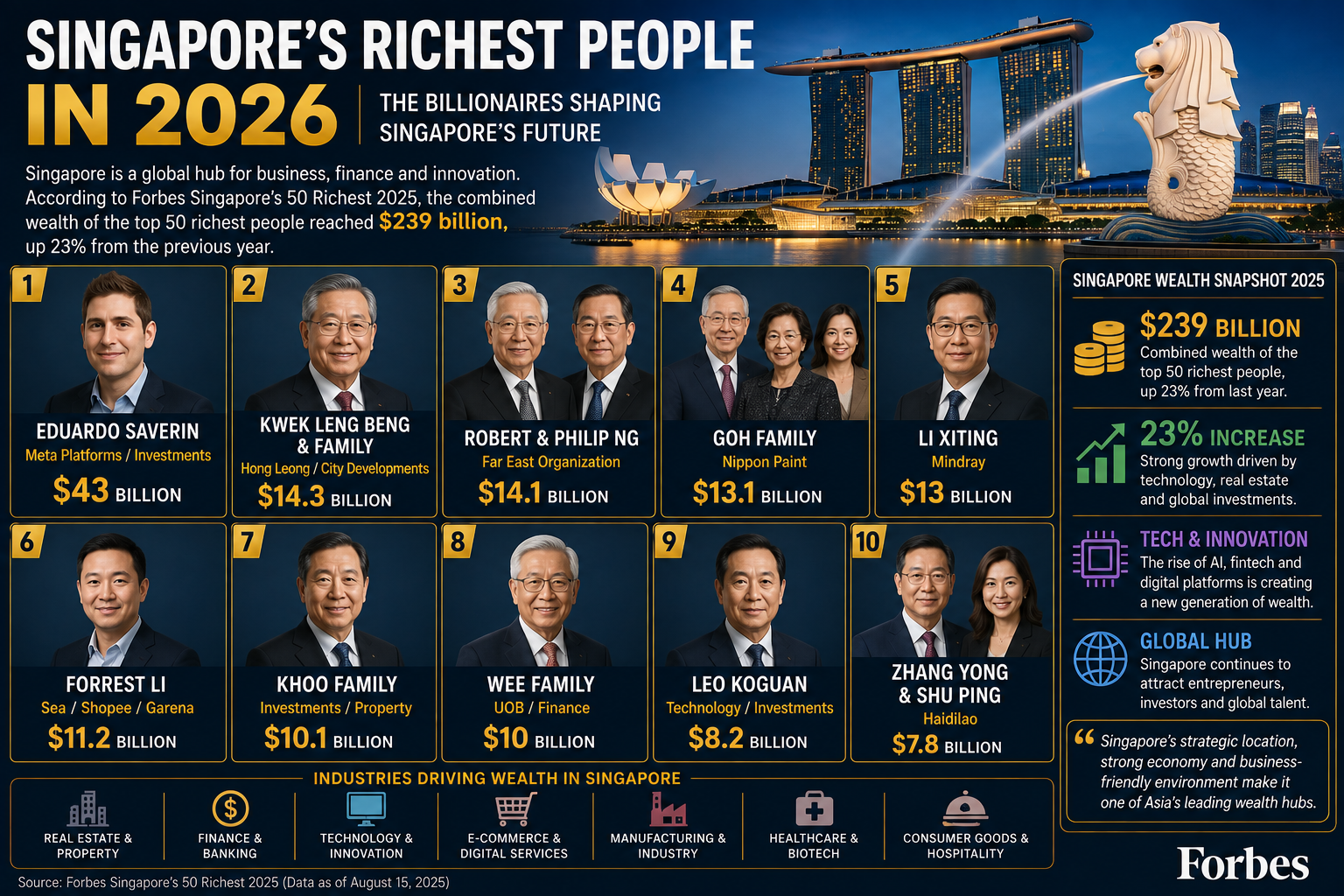
Singapore is one of Asia’s most important financial and business centers, attracting entrepreneurs, investors and wealthy families from around the world. The city-state has become a major hub for technology, finance, real estate, manufacturing, healthcare and consumer businesses.
Singapore’s billionaire landscape is particularly diverse. Some fortunes were built through generations of property development and banking, while newer fortunes have emerged from technology, e-commerce, digital entertainment and global investments.
According to the latest Forbes Singapore’s 50 Richest annual ranking, published in September 2025, the combined wealth of Singapore’s 50 richest people reached approximately $239 billion, up 23% from $195 billion the previous year. The minimum fortune required to make the list also reached a record $1 billion.
The latest annual ranking was led by Eduardo Saverin, cofounder of Meta Platforms, while property and finance families occupied many of the remaining top positions.
Top 10 Richest People in Singapore
Rank | Billionaire / Family | Main Business | Net Worth |
|---|---|---|---|
1 | Eduardo Saverin | Meta Platforms / Investments | $43B |
2 | Kwek Leng Beng & Family | Hong Leong / City Developments | $14.3B |
3 | Robert & Philip Ng | Far East Organization | $14.1B |
4 | Goh Family | Nippon Paint | $13.1B |
5 | Li Xiting | Mindray | $13B |
6 | Forrest Li | Sea / Shopee / Garena | $11.2B |
7 | Khoo Family | Investments / Property | $10.1B |
8 | Wee Family | UOB / Finance | $10B |
9 | Leo KoGuan | Technology / Investments | $8.2B |
10 | Zhang Yong & Shu Ping | Haidilao | $7.8B |
These figures are from Forbes’ latest annual Singapore ranking, with wealth measured using stock prices and exchange rates as of August 15, 2025.
1. Eduardo Saverin — $43 Billion
Eduardo Saverin was the richest person associated with Singapore in Forbes’ latest annual ranking, with a fortune of approximately $43 billion.
Saverin is best known as a cofounder of Meta Platforms, formerly Facebook. He cofounded Facebook with Mark Zuckerberg and other Harvard classmates in 2004.
His wealth primarily comes from his stake in Meta, whose shares benefited from strong advertising growth and the broader artificial intelligence boom.
Forbes reported that Saverin added approximately $14 billion to his fortune in the year leading up to the 2025 Singapore ranking, making him the biggest dollar gainer on the list.
Saverin later became a venture capitalist and cofounded B Capital, an investment firm focused on technology companies.
Saverin’s main sources of wealth
Meta Platforms
Technology investments
Venture capital
Artificial intelligence
Digital advertising
Although he was born in Brazil, Saverin is a long-time Singapore resident and has built much of his investment activity from the city-state.
As of September 1, 2026, Forbes' real-time tracker valued Saverin at approximately $32.3 billion, illustrating how billionaire fortunes can move significantly between annual rankings.
2. Kwek Leng Beng & Family — $14.3 Billion
Kwek Leng Beng and his family ranked second on Forbes’ latest Singapore list with approximately $14.3 billion.
Kwek is executive chairman of Hong Leong Group and City Developments Limited (CDL).
His family has built a major business empire spanning property, hotels, finance and investments.
City Developments owns and operates properties in Singapore and international markets, while the family's Hong Leong interests extend across financial services and other industries.
Forbes reported that the family’s fortune increased by 24% in the year leading up to the 2025 ranking, partly because of newly disclosed information about the family's holdings.
Kwek’s business empire demonstrates the enormous importance of real estate and property development to Singapore's billionaire economy.
3. Robert & Philip Ng — $14.1 Billion
Brothers Robert and Philip Ng ranked third with a combined fortune of approximately $14.1 billion.
They control Far East Organization, Singapore's largest private property developer and landlord.
The brothers inherited their business interests from their father, Ng Teng Fong, who built a major property empire in Singapore.
Far East Organization has extensive interests in residential, commercial, hospitality and property development projects.
The brothers' wealth declined slightly in the latest annual ranking, partly because of weakness in the Hong Kong property market, which affected their wider business interests.
Real estate remains one of the most important sources of billionaire wealth in Singapore.
4. Goh Family — $13.1 Billion
The Goh family entered Forbes’ Singapore 50 Richest ranking at No. 4 with approximately $13.1 billion.
The family fortune is associated with Nippon Paint Holdings, one of the world's major paint and coatings manufacturers.
The family entered the list following the death of patriarch Goh Cheng Liang, who died in August 2025 at the age of 98.
Nippon Paint shares increased significantly following the company's acquisition of U.S.-based specialty chemicals maker AOC.
The Goh family's fortune demonstrates that Singapore's wealth is not limited to property and technology. Manufacturing and industrial businesses continue to create major fortunes.
5. Li Xiting — $13 Billion
Li Xiting ranked fifth with a fortune of approximately $13 billion.
He is chairman of Shenzhen Mindray Bio-Medical Electronics, a major medical-equipment company.
Mindray develops medical technologies and equipment used by hospitals and healthcare providers.
Li's fortune represents the growing importance of healthcare and medical technology in Asia.
Although Mindray is headquartered in China, Li's Singapore residence has placed him among the city-state's wealthiest residents in Forbes' ranking.
His business interests highlight Singapore's role as a regional base for wealthy entrepreneurs with investments across Asia.
6. Forrest Li — $11.2 Billion
Technology entrepreneur Forrest Li ranked sixth with an estimated fortune of $11.2 billion.
Li is chairman and CEO of Sea Limited, the Singapore-based technology company behind Shopee, Garena and digital financial-services businesses.
Sea has become one of Southeast Asia's most important internet companies.
Its businesses cover:
E-commerce
Online gaming
Digital payments
Financial services
Mobile technology
Forrest Li's fortune increased strongly as Sea's business performance improved.
Forbes reported that Sea's second-quarter earnings surged dramatically, helping Li rise from ninth to sixth place in the Singapore ranking.
However, Forbes' real-time profile showed his wealth at approximately $7.2 billion on September 1, 2026, demonstrating the difference between annual and current market-based estimates.
7. Khoo Family — $10.1 Billion
The Khoo family ranked seventh with approximately $10.1 billion.
The family's fortune originated with the late banker and hotelier Khoo Teck Puat.
Over the years, the family has maintained substantial interests in property, investments and other assets.
The Khoo family's position among Singapore's richest families is another example of how wealth built over generations can remain influential in the modern economy.
8. Wee Family — $10 Billion
The Wee family ranked eighth with approximately $10 billion.
Their wealth is closely associated with United Overseas Bank (UOB) and Singapore's financial sector.
The family fortune was built around the banking empire established by the late Wee Cho Yaw, one of Singapore's most influential banking figures.
UOB has become one of Southeast Asia's major banks, with operations extending throughout Singapore and the wider region.
The Wee family's position highlights Singapore's status as a global financial center.
9. Leo KoGuan — $8.2 Billion
Leo KoGuan ranked ninth with an estimated fortune of $8.2 billion.
The Indonesia-born, Singapore-based billionaire is known for his investments in technology and public companies.
He was previously known as a major Tesla shareholder, although he has reduced his exposure over time.
KoGuan's fortune illustrates another path to billionaire status: strategic investing rather than building a large operating company from scratch.
His business activities have made him one of the more unconventional figures among Singapore's wealthiest people.
10. Zhang Yong & Shu Ping — $7.8 Billion
Zhang Yong and Shu Ping, the husband-and-wife founders of Haidilao, rounded out the top 10.
Their combined fortune was approximately $7.8 billion in Forbes' 2025 Singapore ranking.
Haidilao became one of the world's best-known hot-pot restaurant chains, expanding from China into international markets.
The couple's success shows how consumer businesses and restaurant brands can grow into global enterprises.
Their wealth also reflects Singapore's importance as a regional headquarters and investment destination for entrepreneurs operating throughout Asia.
Why Singapore Is a Billionaire Hub
Singapore's billionaire economy is different from many other Asian countries.
Rather than being dominated by one industry, the city-state has developed a combination of:
Finance
Real estate
Technology
Manufacturing
Healthcare
Food and beverages
Investments
E-commerce
This diversification has helped Singapore attract wealthy entrepreneurs from across Asia and beyond.
Real Estate Remains One of Singapore's Biggest Sources of Wealth
Property has historically been one of the strongest sources of billionaire wealth in Singapore.
Kwek Leng Beng, Robert and Philip Ng, the Khoo family and several other wealthy families have substantial property interests.
Singapore's limited land area, strong infrastructure and position as a global financial center have supported long-term demand for high-quality commercial and residential property.
Property development has therefore remained a major pillar of Singapore's billionaire economy.
Technology Is Creating New Billionaires
Technology is becoming increasingly important.
Eduardo Saverin's fortune demonstrates the enormous wealth that can be created through global technology companies.
Forrest Li represents another major technology success story through Sea Limited and Shopee.
Singapore's technology ecosystem also includes gaming, fintech, e-commerce, software and artificial intelligence.
Razer founder Min-Liang Tan, for example, was ranked 33rd on Forbes' 2025 list with $1.7 billion. Forbes noted that Razer was preparing AI tools aimed at game developers and players.
Singapore's Wealth Is Becoming More Global
One of the defining characteristics of Singapore's richest people is that many operate businesses far beyond the city-state.
Singapore provides an attractive base for entrepreneurs because of its:
Strategic location
Strong financial system
International connectivity
Business-friendly environment
Regional access to Southeast Asia
Developed infrastructure
As a result, a billionaire listed in Singapore may generate most of their wealth from businesses operating across several countries.
Singapore's 50 Richest Reach $239 Billion
The combined wealth of Singapore's 50 richest people reached $239 billion in the latest Forbes annual ranking.
That represented a 23% increase from approximately $195 billion the previous year.
The increase occurred as Singapore's economy performed strongly and technology-related businesses benefited from the global AI boom.
The minimum wealth required to enter the top 50 also increased to $1 billion, compared with $870 million the previous year.
That means Singapore's billionaire class has become increasingly wealthy and competitive.
AI Is Changing Singapore's Wealth Landscape
Artificial intelligence has become an important force behind some of Singapore's newest fortunes.
The AI boom has helped technology companies increase their valuations while also creating demand for:
Data centers
Cloud computing
Semiconductor infrastructure
Digital advertising
Gaming technology
Financial technology
Singapore's strategic location and advanced infrastructure make it particularly attractive for companies building data centers and regional technology operations.
This could lead to a greater number of technology billionaires appearing in future rankings.
Current Billionaire Wealth Can Change Quickly
It is important to distinguish between Forbes' annual country rankings and real-time billionaire estimates.
For example, Forbes' current profile for Eduardo Saverin showed approximately $32.3 billion on September 1, 2026, compared with the $43 billion used in the 2025 Singapore 50 Richest ranking.
Similarly, Robert Ng's Forbes real-time profile showed approximately $6.9 billion on September 2, 2026, compared with the $14.1 billion combined fortune he shared with Philip Ng in the 2025 country ranking.
These differences occur because public-company share prices, exchange rates and ownership valuations change continuously.
For this reason, an annual Forbes ranking should be treated as a snapshot rather than a permanent ranking.
Singapore's Next Generation of Billionaires
The next generation of Singapore's wealthiest people may look very different from previous generations.
Traditional sectors such as property and banking remain powerful, but technology, artificial intelligence, fintech and digital commerce are expanding rapidly.
Entrepreneurs who build global technology platforms can now create fortunes at a speed that would have been difficult to imagine several decades ago.
At the same time, Singapore's established family businesses continue to invest internationally and diversify into new industries.
Final Thoughts
Singapore's richest people represent a unique combination of technology entrepreneurs, property dynasties, investors, bankers and global business families.
Eduardo Saverin led the latest Forbes annual ranking with $43 billion, followed by Kwek Leng Beng and his family with $14.3 billion and Robert and Philip Ng with $14.1 billion.
Forrest Li, Li Xiting and the founders of Haidilao demonstrate the growing diversity of Singapore's billionaire economy, while families such as the Kweks, Ngs, Khoos and Wees highlight the continuing strength of property and finance.
With the latest Forbes annual list putting the combined wealth of Singapore's 50 richest at $239 billion, the city-state remains one of Asia's most important wealth centers.
As artificial intelligence, technology, fintech and digital commerce continue to expand, Singapore's billionaire landscape could become even more technology-driven in the years ahead.
Source and Methodology
This article primarily uses Forbes' Singapore's 50 Richest 2025, the latest official annual Singapore country ranking available as of September 2, 2026. Forbes' 2025 figures were based on stock prices and exchange rates as of August 15, 2025. Current billionaire fortunes can differ because Forbes' real-time ranking updates publicly traded holdings as markets move.