Taiwan has become one of the most important technology and semiconductor hubs in the world. The island is home to some of Asia’s wealthiest entrepreneurs, investors and business families, with fortunes spanning semiconductors, electronics, finance, AI infrastructure, manufacturing and technology.
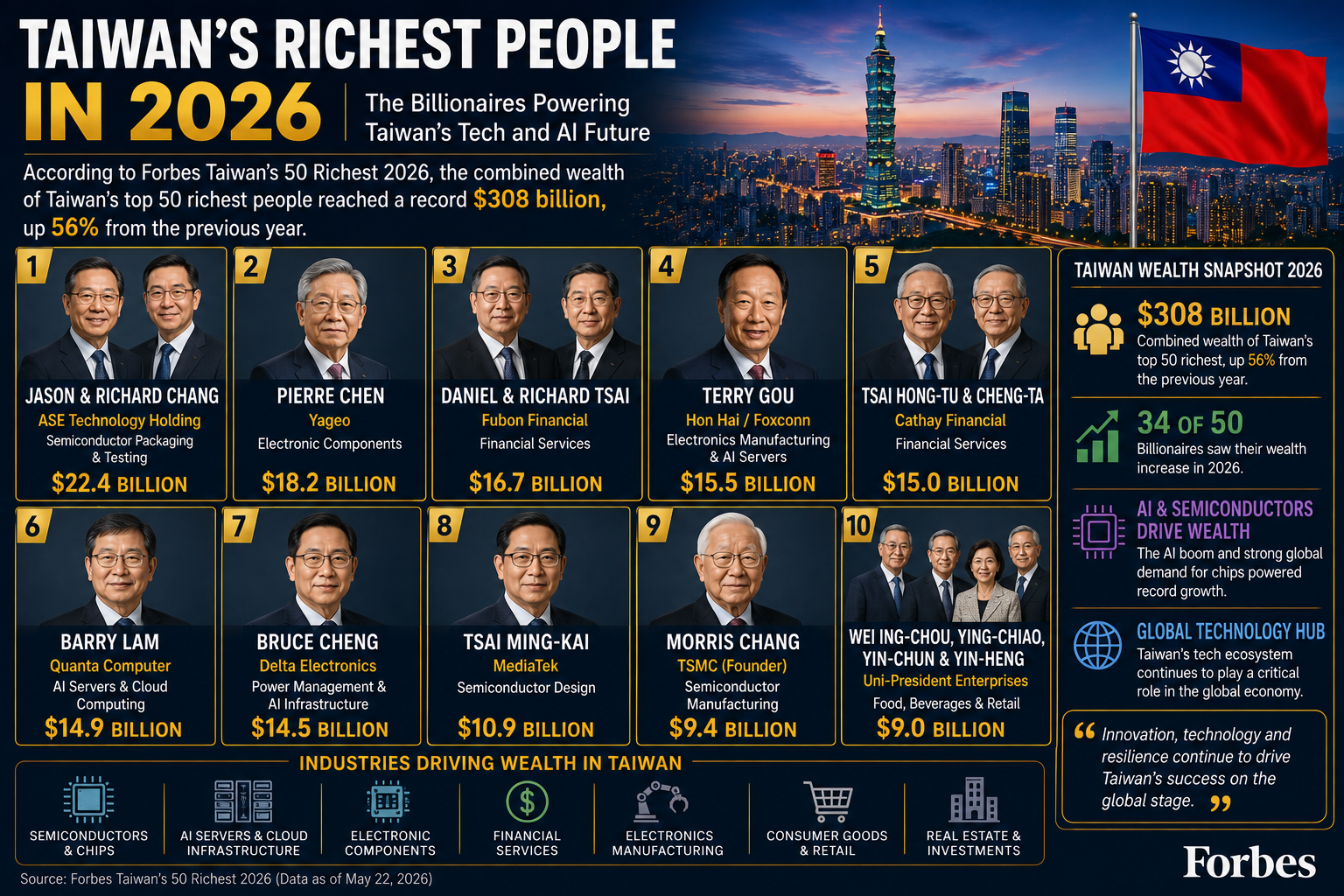
In 2026, Taiwan’s billionaire economy reached a remarkable milestone. According to Forbes’ Taiwan’s 50 Richest 2026, the combined wealth of the country’s 50 richest people climbed to a record $308 billion, up from $197 billion the previous year. That represents an increase of approximately 56%.
The dramatic increase was fueled by Taiwan’s powerful semiconductor industry and the global artificial intelligence boom. Taiwan’s economy grew 8.7% in 2025, its fastest pace in 15 years, while the benchmark Taiex more than doubled over the relevant period.
At the top of the ranking are brothers Jason and Richard Chang, whose wealth is closely connected to ASE Technology Holding and the semiconductor packaging and testing industry.
Top 10 Richest People in Taiwan in 2026
Rank | Billionaire / Family | Main Business | Net Worth |
|---|---|---|---|
1 | Jason & Richard Chang | ASE Technology Holding | $22.4B |
2 | Pierre Chen | Yageo | $18.2B |
3 | Daniel & Richard Tsai | Fubon Financial | $16.7B |
4 | Terry Gou | Hon Hai / Foxconn | $15.5B |
5 | Tsai Hong-tu & Cheng-ta | Cathay Financial | $15.0B |
6 | Barry Lam | Quanta Computer | $14.9B |
7 | Bruce Cheng | Delta Electronics | $14.5B |
8 | Tsai Ming-kai | MediaTek | $10.9B |
9 | Morris Chang | TSMC | $9.4B |
10 | Wei Ing-Chou, Ying-Chiao, Yin-Chun & Yin-Heng | Uni-President Enterprises | $9.0B |
These are Forbes’ 2026 annual Taiwan ranking figures, based on stock prices and exchange rates as of May 22, 2026. Forbes’ real-time wealth estimates can differ as markets move.
1. Jason & Richard Chang — $22.4 Billion
Brothers Jason Chang and Richard Chang became Taiwan’s richest people in 2026 for the first time.
Together, the brothers were worth approximately $22.4 billion, according to Forbes. Their combined fortune increased by $14.5 billion from the previous year, making them the biggest dollar gainers on the Taiwan list.
Jason Chang serves as chairman and Richard Chang as vice chairman of ASE Technology Holding, one of the world's leading semiconductor packaging, assembly and testing companies.
ASE plays an important role in the global semiconductor supply chain. As artificial intelligence systems require increasingly advanced chips, demand for semiconductor packaging and testing has increased.
The brothers' rise demonstrates how the AI boom is creating wealth not only for chip designers and manufacturers but also for companies that support the semiconductor ecosystem.
Main sources of wealth
Semiconductor packaging
Chip assembly and testing
Electronics manufacturing
Technology investments
Real estate
The Chang family's business history also extends beyond technology, with interests in real estate.
2. Pierre Chen — $18.2 Billion
Pierre Chen, founder and chairman of Yageo, ranks second among Taiwan's richest people.
Forbes estimated his fortune at $18.2 billion, an increase of $12.1 billion from the previous year.
Yageo manufactures electronic components used in products ranging from smartphones and computers to automobiles.
Chen founded Yageo in 1977 and took the company public 16 years later.
His strategy has increasingly focused on building Yageo into a major global supplier of electronic components.
In January 2026, Yageo completed its acquisition of Japanese thermistor manufacturer Shibaura Electronics for roughly $700 million, further expanding its international operations.
Pierre Chen's wealth is connected to
Electronic components
Semiconductors
Automotive electronics
Industrial technology
International acquisitions
The growth of AI infrastructure has increased demand for many of the components produced by companies throughout Taiwan's electronics ecosystem.
3. Daniel & Richard Tsai — $16.7 Billion
Brothers Daniel and Richard Tsai rank third with a combined fortune of approximately $16.7 billion.
Their wealth is closely connected to Fubon Financial Holding, one of Taiwan's major financial groups.
Although the brothers lost the No. 1 position in 2026, their fortune still increased by approximately $2.8 billion. Forbes reported that Fubon Financial's shares gained 26% during the relevant period, supported by strong investment returns.
Their position highlights that Taiwan's billionaire economy extends well beyond semiconductors.
Financial services, banking and investment management remain major sources of wealth.
4. Terry Gou — $15.5 Billion
Terry Gou, founder of Hon Hai Precision Industry, better known globally as Foxconn, ranks fourth.
Forbes estimated Gou's fortune at approximately $15.5 billion in 2026.
Gou founded Hon Hai in 1974 with just $7,500 and transformed it into the world's largest electronics contract manufacturer.
Foxconn is a critical part of the global electronics supply chain and counts some of the world's biggest technology companies among its customers.
The company has also become increasingly important in AI infrastructure, producing AI server systems for major cloud-service providers.
Foxconn's shares rose approximately 70% during the period used for Forbes' ranking, helping lift Gou's fortune.
Terry Gou's business empire
Electronics manufacturing
AI servers
Consumer electronics
Technology hardware
Global supply chains
Gou's rise from a small manufacturing operation to a global electronics giant remains one of Taiwan's most notable entrepreneurial stories.
5. Tsai Hong-tu & Cheng-ta — $15 Billion
Brothers Tsai Hong-tu and Cheng-ta rank fifth with a combined fortune of approximately $15 billion.
Their wealth is associated with Cathay Financial Holdings, one of Taiwan's largest financial groups.
Their fortune increased substantially from approximately $10.9 billion the previous year.
The family's success illustrates the importance of financial services within Taiwan's billionaire economy.
While technology dominates the headlines, banking, insurance and investment businesses continue to generate enormous fortunes.
6. Barry Lam — $14.9 Billion
Barry Lam, founder and chairman of Quanta Computer, ranks sixth with an estimated fortune of $14.9 billion.
Quanta is one of the world's major manufacturers of notebook computers, servers and other electronics.
The company has increasingly benefited from the rapid expansion of AI infrastructure.
As technology companies and cloud providers invest billions in data centers, demand for high-performance servers and computing systems has surged.
Lam's fortune therefore represents another example of how Taiwan's manufacturing capabilities are benefiting from the global AI revolution.
Quanta's key areas
AI servers
Cloud computing hardware
Computers
Electronics manufacturing
Data-center infrastructure
7. Bruce Cheng — $14.5 Billion
Bruce Cheng, founder of Delta Electronics, experienced one of the biggest jumps on Taiwan's 2026 wealth ranking.
His fortune reached approximately $14.5 billion, nearly five times the previous year's figure. He jumped 16 places to rank seventh.
Delta Electronics produces power-management components and systems used in a wide range of technologies.
The company supplies power components for AI GPUs to major technology companies including Nvidia and Google.
This makes Cheng one of the clearest examples of an entrepreneur benefiting directly from the AI infrastructure boom.
Delta Electronics operates across
Power electronics
AI infrastructure
Data centers
Electric vehicles
Industrial automation
Energy efficiency
As AI computing requires enormous amounts of electricity and sophisticated power-management systems, Delta's role in the technology supply chain has become increasingly valuable.
8. Tsai Ming-kai — $10.9 Billion
Tsai Ming-kai, chairman of MediaTek, ranks eighth with a fortune of approximately $10.9 billion.
MediaTek is one of the world's leading semiconductor design companies.
Its chips are used in smartphones, smart televisions, wireless communications devices and other consumer electronics.
The company's position in the global semiconductor industry makes Tsai another major beneficiary of Taiwan's technology ecosystem.
Taiwan's chip-design capabilities have become increasingly important as demand grows for advanced computing and connected devices.
9. Morris Chang — $9.4 Billion
Morris Chang, founder of Taiwan Semiconductor Manufacturing Company, or TSMC, ranks ninth with approximately $9.4 billion.
TSMC is arguably the most strategically important semiconductor manufacturer in the world.
The company manufactures advanced chips designed by some of the world's leading technology companies.
Although Chang stepped away from TSMC's leadership years ago, his fortune remains connected to his ownership stake.
His legacy is enormous.
The creation of TSMC helped establish Taiwan as a global semiconductor powerhouse and fundamentally changed the way advanced chips are manufactured.
Morris Chang's legacy
Founded TSMC
Helped pioneer the semiconductor foundry model
Built Taiwan into a global chip-manufacturing hub
Influenced the modern technology supply chain
TSMC's importance has only increased as artificial intelligence has created unprecedented demand for advanced chips.
10. Wei Ing-Chou, Ying-Chiao, Yin-Chun & Yin-Heng — $9 Billion
The tenth position is held by members of the Wei family, with a combined fortune of approximately $9 billion.
Their wealth is associated with Uni-President Enterprises, one of Taiwan's largest consumer and food companies.
The company has interests spanning food production, beverages, retail and other consumer businesses.
Their inclusion in the top 10 demonstrates that Taiwan's wealthiest families are not exclusively technology entrepreneurs.
Traditional consumer businesses remain an important part of the country's corporate economy.
Why Taiwan's Billionaires Became So Much Richer in 2026
The most important story behind Taiwan's wealth boom is artificial intelligence.
Global technology companies have been investing enormous amounts of money into AI chips, servers, data centers and supporting infrastructure.
Taiwan is positioned at the center of this ecosystem.
Companies involved in semiconductor manufacturing, packaging, electronics components, power management and server production have all benefited from rising demand.
Forbes reported that eight newcomers joined Taiwan's 50 Richest list in 2026, and all came from semiconductor or AI-related businesses.
That is a strong indication of how dramatically AI is reshaping Taiwan's wealth landscape.
Taiwan's Semiconductor Industry Is the Key
Taiwan's semiconductor industry is one of the country's greatest economic advantages.
From chip manufacturing to packaging, testing, components and equipment, Taiwanese companies participate in almost every stage of the technology supply chain.
This has helped Taiwan become indispensable to global technology companies.
The fortunes of Jason and Richard Chang, Pierre Chen, Bruce Cheng, Tsai Ming-kai and Morris Chang all have strong connections to this technology ecosystem.
AI Is Creating a New Generation of Taiwanese Billionaires
Artificial intelligence is not only benefiting traditional semiconductor companies.
It is also creating opportunities in:
AI server manufacturing
Data centers
Power management
Semiconductor testing
Electronic components
Cloud infrastructure
Advanced computing
Bruce Cheng's Delta Electronics is a clear example.
Its power-management technologies are important for AI infrastructure, while Quanta Computer's server business has also benefited from the growing demand for AI computing.
Taiwan's 50 Richest Reach $308 Billion
The combined wealth of Taiwan's 50 richest people reached a record $308 billion in 2026.
That was up from $197 billion in 2025, representing a roughly 56% increase.
Taiwan's strong economic performance also played a role.
The economy expanded by 8.7% in 2025, its fastest growth rate in 15 years.
Meanwhile, the Taiex stock-market index more than doubled from the previous year, pushing the total market capitalization of Taiwan's stock market to approximately $4.4 trillion.
These conditions created an exceptional environment for billionaire wealth creation.
The Wealth Gap at the Top Is Growing
The minimum fortune required to enter Taiwan's 50 Richest ranking reached a record $2.2 billion in 2026.
That compares with $1.3 billion in 2025.
In other words, simply being a billionaire is no longer enough to guarantee a place among Taiwan's 50 wealthiest people.
Forbes reported that 34 listees became wealthier during the relevant period.
The dramatic increase in the entry threshold demonstrates how quickly fortunes have grown in Taiwan's technology-driven economy.
New Billionaires Are Coming From AI and Semiconductors
The 2026 ranking welcomed eight newcomers, all connected to semiconductor or AI-related businesses.
The wealthiest newcomer was Hsieh Wen-Ta, chairman of AI chip-testing equipment maker Hon. Precision.
He entered the list at No. 12 with an estimated fortune of $7.1 billion after the company's shares more than doubled following its November IPO.
Another notable development was the return of data-storage tycoon Peter Shu, whose company Transcend Information benefited from the AI-driven technology boom.
These newcomers show that Taiwan's next generation of billionaires may increasingly come from highly specialized technology businesses.
Taiwan's Global Technology Importance
Taiwan's wealth story cannot be separated from its position in the global technology industry.
The island is home to companies responsible for manufacturing, designing, assembling, packaging and supplying components for some of the world's most advanced technologies.
As AI continues to expand, demand for these products is expected to remain strong.
That means Taiwan's billionaire rankings could become even more technology-focused in the coming years.
What Could Change Taiwan's Richest-People Ranking?
Although the outlook is strong, Taiwan's billionaires also face risks.
Technology stocks can be highly volatile, and semiconductor demand moves in cycles.
Geopolitical tensions can also influence Taiwan's technology industry and global supply chains.
Currency movements can affect billionaire rankings because Forbes converts fortunes into U.S. dollars.
And as AI investment matures, competition among semiconductor and electronics companies could intensify.
For these reasons, today's ranking may look very different several years from now.
Final Thoughts
Taiwan's richest people in 2026 demonstrate the extraordinary economic power of semiconductors, artificial intelligence and advanced electronics.
Jason and Richard Chang lead the Forbes ranking with $22.4 billion, followed by Pierre Chen with $18.2 billion and Daniel and Richard Tsai with $16.7 billion.
Terry Gou, Barry Lam and Bruce Cheng further demonstrate how Taiwan's electronics and AI supply chains are creating enormous fortunes.
At the same time, financial groups such as Fubon and Cathay and consumer businesses such as Uni-President show that Taiwan's billionaire economy remains diversified.
With the combined wealth of Taiwan's 50 richest reaching a record $308 billion, the country enters 2026 as one of the world's most important centers of technology-driven wealth creation.
The biggest question for the future is whether the AI boom will continue to lift Taiwan's semiconductor fortunes—or whether a new generation of entrepreneurs will emerge from the next wave of technological innovation.
Source and Methodology
This article is based primarily on Forbes' Taiwan's 50 Richest 2026 ranking. Forbes' annual figures use information from individuals, analysts, government agencies, stock exchanges and other databases. Public-company fortunes are based on stock prices and exchange rates as of the close of markets on May 22, 2026. Private companies are valued using financial ratios and comparisons with similar publicly traded businesses. Forbes notes that its real-time billionaire figures may differ from the annual ranking as market values change.