Malaysia is home to some of Southeast Asia’s most successful entrepreneurs, investors and business families. From palm oil and banking to aluminum, retail, property, telecommunications and infrastructure, the country’s wealthiest people have built large business empires that extend well beyond Malaysia.
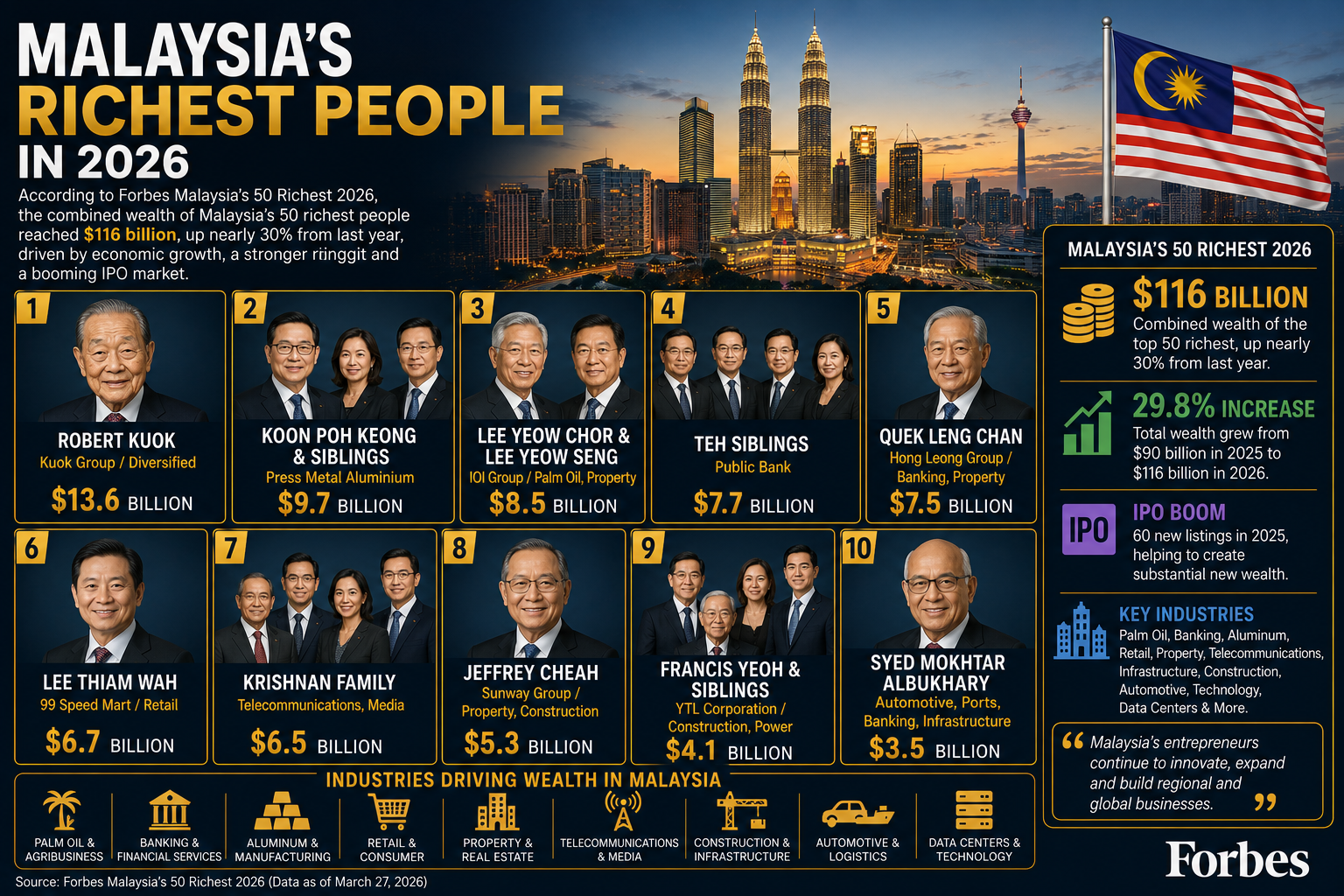
In 2026, Malaysia’s richest people became significantly wealthier. According to Forbes’ Malaysia’s 50 Richest 2026, the combined wealth of the country’s top 50 tycoons increased by nearly 30% to $116 billion, compared with $90 billion a year earlier.
The increase was supported by Malaysia’s economic growth, a stronger ringgit and a particularly active initial public offering (IPO) market.
At the top of the ranking once again is veteran business magnate Robert Kuok, whose fortune reached $13.6 billion.
Top 10 Richest People in Malaysia in 2026
Rank | Name | Net Worth | Main Business |
|---|---|---|---|
1 | Robert Kuok | $13.6 billion | Diversified, agribusiness, property |
2 | Koon Poh Keong & siblings | $9.7 billion | Aluminum |
3 | Lee Yeow Chor & Lee Yeow Seng | $8.5 billion | Palm oil, property |
4 | Teh siblings | $7.7 billion | Banking |
5 | Quek Leng Chan | $7.5 billion | Banking, property |
6 | Lee Thiam Wah | $6.7 billion | Retail |
7 | Krishnan family | $6.5 billion | Telecommunications, media |
8 | Jeffrey Cheah | $5.3 billion | Property, construction |
9 | Francis Yeoh & siblings | $4.1 billion | Construction, power |
10 | Syed Mokhtar Albukhary | $3.5 billion | Automotive, ports, banking |
The ranking is based on Forbes’ 2026 Malaysia list, with wealth calculated using stock prices and exchange rates as of March 27, 2026. Forbes includes both individual and family fortunes in this country ranking.
1. Robert Kuok — $13.6 Billion
Robert Kuok remains Malaysia’s richest person in 2026, with an estimated fortune of $13.6 billion.
At 102 years old, Kuok continues to represent one of Malaysia’s most remarkable business success stories. His business empire, the Kuok Group, has interests across numerous industries and countries.
His businesses and investments span:
Agribusiness
Palm oil
Sugar
Shipping
Property
Hotels
Food
Logistics
Data centers
Kuok's fortune increased by approximately 19% in 2026. His diversified business interests have helped keep him at the top of Malaysia's wealth rankings for many years.
The Kuok business empire
The Kuok Group has developed into a multinational organization with investments throughout Asia and other parts of the world.
One of its best-known businesses is Shangri-La Hotels, while the wider group also has major interests in commodities and property.
An increasingly important area is data-center infrastructure, reflecting the growing demand for artificial intelligence and cloud computing across Southeast Asia.
Kuok's wealth illustrates how diversification can allow a family business to remain relevant across generations.
2. Koon Poh Keong & Siblings — $9.7 Billion
The Koon Poh Keong family moved into second place in Malaysia's 2026 wealth ranking with a combined fortune of $9.7 billion.
Their wealth is closely connected to Press Metal Aluminium Holdings, one of Southeast Asia's largest integrated aluminum producers.
The family's fortune increased by an extraordinary 80% during the period measured by Forbes, making the Koons the biggest dollar gainers on the 2026 list.
A major factor was the strong performance of Press Metal's shares, which rose around 73% over the year.
Why aluminum matters
Aluminum is increasingly important to several fast-growing industries, including:
Electric vehicles
Renewable energy
Construction
Electronics
Artificial intelligence infrastructure
Data centers
The growing demand for aluminum therefore provided an important boost to the family's fortune.
The Koons' rise to second place is one of the biggest changes in Malaysia's billionaire rankings in 2026.
3. Lee Yeow Chor & Lee Yeow Seng — $8.5 Billion
Brothers Lee Yeow Chor and Lee Yeow Seng rank third with a combined fortune of approximately $8.5 billion.
The brothers are associated with IOI Group, one of Malaysia's major palm oil and property groups.
Their wealth increased substantially during the year, helping them move up three positions in the ranking.
Palm oil and property
IOI's core business remains palm oil, but the brothers have also developed significant property interests.
This combination gives the family exposure to two major areas of Malaysia's economy:
Agriculture and commodities: Palm oil remains one of Malaysia's most important exports.
Property: The family has accumulated a large portfolio of real estate assets in Malaysia and Singapore.
Plans for real estate investment trust listings could potentially unlock additional value from some of the group's property assets.
4. Teh Siblings — $7.7 Billion
The Teh siblings rank fourth with a combined fortune of $7.7 billion.
Their wealth comes primarily from their family's significant interest in Public Bank, one of Malaysia's largest financial institutions.
The fortune was inherited by the four children of the late banking tycoon Teh Hong Piow, who founded Public Bank.
Banking has historically been one of Malaysia's most important sources of billionaire wealth, and the Teh family remains one of the country's most prominent financial dynasties.
The importance of Public Bank
Public Bank has a major presence in:
Consumer banking
Corporate banking
Wealth management
Insurance
Financial services
The Teh family's position shows how ownership of a major financial institution can create and preserve enormous wealth across generations.
5. Quek Leng Chan — $7.5 Billion
Quek Leng Chan ranks fifth among Malaysia's richest people in 2026, with an estimated fortune of $7.5 billion.
He is the executive chairman of the Hong Leong Group, a diversified business empire with interests across banking, property, financial services and other industries.
Quek has long been one of Malaysia's most influential business leaders.
His major business interests include:
Banking
Financial services
Property
Investments
Healthcare
Although his fortune declined compared with the previous year, Quek remains firmly among Malaysia's wealthiest business figures.
His ranking also illustrates how quickly billionaire positions can change when share prices and market valuations move.
6. Lee Thiam Wah — $6.7 Billion
One of the most notable entrepreneurial stories on Malaysia's 2026 rich list is Lee Thiam Wah, founder and CEO of 99 Speed Mart Retail Holdings.
His fortune nearly doubled to approximately $6.7 billion, making him Malaysia's sixth-richest person.
The company added 259 stores during 2025, taking its total to more than 3,000 stores nationwide.
From one shop to a retail empire
Lee built his business from a small sundry shop into Malaysia's largest minimarket chain.
The company's rapid expansion demonstrates the enormous potential of Malaysia's consumer and retail market.
99 Speed Mart focuses on everyday products and convenience, allowing it to serve customers across urban and suburban areas.
Its success is a powerful example of how a simple retail concept can become a multibillion-dollar business when combined with efficient distribution and nationwide expansion.
7. Krishnan Family — $6.5 Billion
The Krishnan family ranks seventh with an estimated fortune of $6.5 billion.
The family's wealth is associated with businesses and investments spanning telecommunications, media and other sectors.
The family has historically been connected with major Malaysian companies including Maxis and Astro, while its broader investment interests extend through private holdings.
The Krishnan family fortune demonstrates another important feature of Malaysia's wealth landscape: large business empires are often spread across multiple industries rather than being dependent on a single company.
8. Jeffrey Cheah — $5.3 Billion
Jeffrey Cheah, founder of Sunway Group, ranks eighth with approximately $5.3 billion.
His fortune increased by a remarkable 76% according to Forbes.
Sunway has interests across:
Property
Construction
Healthcare
Education
Hospitality
Retail
Infrastructure
One of the major developments in 2026 was the listing of Sunway Healthcare, which raised approximately $732 million and became Malaysia's largest IPO in almost a decade.
Building a diversified Malaysian conglomerate
Cheah's success comes from building a business ecosystem rather than relying on a single industry.
Sunway has developed major integrated townships combining residential properties, shopping centers, universities, hospitals and entertainment facilities.
This strategy has helped turn Sunway into one of Malaysia's best-known corporate groups.
9. Francis Yeoh & Siblings — $4.1 Billion
Francis Yeoh and his siblings rank ninth with a combined fortune of approximately $4.1 billion.
The family is associated with YTL Corporation, a major Malaysian conglomerate.
YTL has interests across areas such as:
Construction
Utilities
Power generation
Property
Hotels
Telecommunications
Infrastructure
The family has expanded its business activities beyond Malaysia, giving it exposure to international markets.
YTL's diversified approach is similar to several other Malaysian business dynasties that have built wealth through long-term ownership of infrastructure and essential services.
10. Syed Mokhtar Albukhary — $3.5 Billion
Syed Mokhtar Albukhary rounds out the top 10 with an estimated fortune of $3.5 billion.
His business interests cover several strategic areas of Malaysia's economy.
They include:
Automotive
Ports
Banking
Infrastructure
Logistics
Property
Syed Mokhtar is particularly well known for building businesses in sectors connected to trade and infrastructure.
His diversified holdings demonstrate the importance of logistics, transportation and financial services in Malaysia's economy.
Malaysia's Richest People Became Nearly 30% Wealthier
One of the biggest stories of Malaysia's 2026 billionaire ranking is the sharp increase in collective wealth.
The combined fortune of Malaysia's 50 richest people reached approximately $116 billion, compared with $90 billion in 2025. That's an increase of nearly 30%.
The improvement was supported by several economic factors.
1. Economic growth
Malaysia's economy expanded by 5.2% in 2025, providing a stronger environment for businesses and investors.
2. Stronger ringgit
The Malaysian ringgit appreciated, helping increase the U.S.-dollar value of local fortunes.
3. IPO boom
Malaysia experienced a strong IPO market, with 60 new listings during 2025.
The increased activity in the stock market helped create substantial paper wealth for entrepreneurs and shareholders.
Malaysia's Billionaire Economy Is Becoming More Diverse
Malaysia's richest people come from a wide range of industries.
Agriculture and commodities
Palm oil remains a major source of wealth, with families such as the Kuoks and Lees having substantial interests in agriculture and related businesses.
Banking
The Teh and Quek families demonstrate the enormous wealth-generating potential of Malaysia's banking sector.
Aluminum
The Koon family's dramatic rise highlights the growing importance of industrial metals.
Retail
Lee Thiam Wah's rise shows how Malaysia's consumer economy can produce new billionaire fortunes.
Property
Jeffrey Cheah and other major Malaysian tycoons have built enormous wealth through property development.
Infrastructure
Ports, power generation, construction and transportation remain important sources of wealth for several Malaysian business families.
The Rise of Malaysia's IPO Market
The 2026 ranking also highlights how Malaysia's IPO market can transform private business wealth.
A company going public can provide founders and major shareholders with:
Greater liquidity
Public market valuations
Access to capital
Increased visibility
Opportunities for expansion
Lee Kar Whatt, cofounder and managing director of Eco-Shop Marketing, is a notable example.
He entered Forbes' 2026 list at No. 18 with an estimated fortune of $1.5 billion after Eco-Shop went public in May 2025.
The company operates more than 400 outlets across Malaysia.
Malaysia's New Billionaires
The 2026 Forbes ranking also included new entrants.
Lee Kar Whatt debuted at No. 18 with $1.5 billion.
The Tiong family entered at No. 42 with approximately $655 million. The family inherited interests associated with palm oil, property and media following the death of businessman Tiong Hiew King.
There was also a notable returnee.
Chu Jenn Weng, cofounder of semiconductor inspection equipment maker ViTrox, returned to the list after the company's shares rallied strongly amid increased demand connected to AI-related products.
AI Is Creating New Opportunities for Malaysian Billionaires
Artificial intelligence is becoming an increasingly important theme in Malaysia's economy.
AI requires enormous amounts of computing infrastructure, electricity, semiconductors and data-center capacity.
That creates opportunities for businesses involved in:
Data centers
Electricity
Aluminum
Semiconductor equipment
Construction
Property
Telecommunications
The connection between AI and Malaysia's industrial economy is already visible in the fortunes of some of the country's richest people.
Press Metal, for example, benefited from demand for aluminum linked to areas including AI data centers and electric vehicles.
Meanwhile, ViTrox benefited from demand for semiconductor inspection equipment.
Data Centers Are Becoming a Major Investment Theme
Malaysia has become an increasingly important destination for data-center investment in Southeast Asia.
Johor, in particular, has attracted major investment because of its proximity to Singapore.
The growth of artificial intelligence and cloud computing means data-center operators require large amounts of:
Electricity
Land
Cooling infrastructure
Construction
Fiber connectivity
Industrial equipment
This could create new billionaire fortunes in Malaysia over the coming decade.
Traditional business families are increasingly looking toward digital infrastructure as another way to diversify their wealth.
How Malaysia's Richest People Built Their Fortunes
The country's billionaire stories generally fall into several categories.
Building from scratch
Entrepreneurs such as Lee Thiam Wah demonstrate how a business can grow from a small operation into a national company.
Family businesses
The Kuok, Teh, Lee and other families demonstrate the power of multigenerational ownership.
Industrial expansion
The Koon family built its fortune through the expansion of Press Metal and Malaysia's aluminum industry.
Property development
Business leaders such as Jeffrey Cheah created wealth by combining construction, property and related services.
Financial ownership
Banking remains an important source of long-term family wealth.
Who Is the Richest Person in Malaysia in 2026?
According to Forbes Malaysia's 50 Richest 2026, Robert Kuok is Malaysia's richest person with a fortune of approximately $13.6 billion.
His fortune comes from the diversified Kuok Group, which has interests in agribusiness, food, hospitality, property, shipping and emerging areas such as data centers.
Kuok's position at the top is particularly remarkable because he is more than a century old and has remained one of Asia's most prominent business figures for decades.
Who Are the Richest Families in Malaysia?
Several family groups dominate Malaysia's billionaire landscape.
Among the most prominent are:
Kuok family
Koon family
Lee family
Teh family
Quek family
Krishnan family
Yeoh family
These families control or hold significant interests in companies across banking, property, agriculture, manufacturing, retail and infrastructure.
Their fortunes are often shared among multiple family members, which is why Forbes' country ranking can differ from its individual global billionaire rankings.
What Could Happen to Malaysia's Richest People Next?
Malaysia's billionaire ranking could change significantly in the coming years.
Several industries could play an important role.
Artificial intelligence
AI could drive demand for data centers, electricity, semiconductors and industrial materials.
Technology
Malaysia's technology ecosystem continues to develop, creating opportunities for new entrepreneurs.
Data centers
Johor and other regions could benefit from continued investment in digital infrastructure.
Consumer retail
Malaysia's growing middle class could create additional opportunities for retailers.
Renewable energy
The transition toward cleaner energy could create new fortunes in power generation and infrastructure.
Property
Real estate is likely to remain an important component of family wealth.
Final Thoughts
Malaysia's richest people in 2026 demonstrate the strength and diversity of the country's business economy.
Robert Kuok remains at the top with $13.6 billion, followed by Koon Poh Keong and his siblings with $9.7 billion and Lee Yeow Chor and Lee Yeow Seng with $8.5 billion.
But the most interesting story is not simply who ranks first.
The combined wealth of Malaysia's 50 richest people jumped nearly 30% to $116 billion, reflecting stronger economic growth, an appreciating ringgit and a booming IPO market.
At the same time, new industries are changing the country's wealth landscape.
Retail entrepreneurs, technology companies, semiconductor businesses, data centers and AI infrastructure are becoming increasingly important alongside traditional industries such as palm oil, banking and property.
Malaysia's billionaire economy is therefore entering an interesting period. The country's established business families remain extremely powerful, but the next generation of wealth could increasingly come from technology, digital infrastructure and companies serving the rapidly expanding Southeast Asian economy.
Source and Methodology
This article is based primarily on Forbes' Malaysia's 50 Richest 2026 ranking. Forbes calculated the fortunes using shareholding and financial information from individuals and families, stock exchanges, annual reports, analysts, government agencies and other sources. Net worth figures were based on stock prices and exchange rates as of the close of markets on March 27, 2026. Private companies were valued using comparisons with similar publicly traded companies. Forbes' Malaysia ranking includes both individual and family fortunes and can therefore differ from its global individual billionaire rankings.