Japan is home to some of Asia’s most influential entrepreneurs, investors and business families. From technology and artificial intelligence to fashion, retail, manufacturing and beverages, Japan’s wealthiest individuals have built businesses with a global reach.
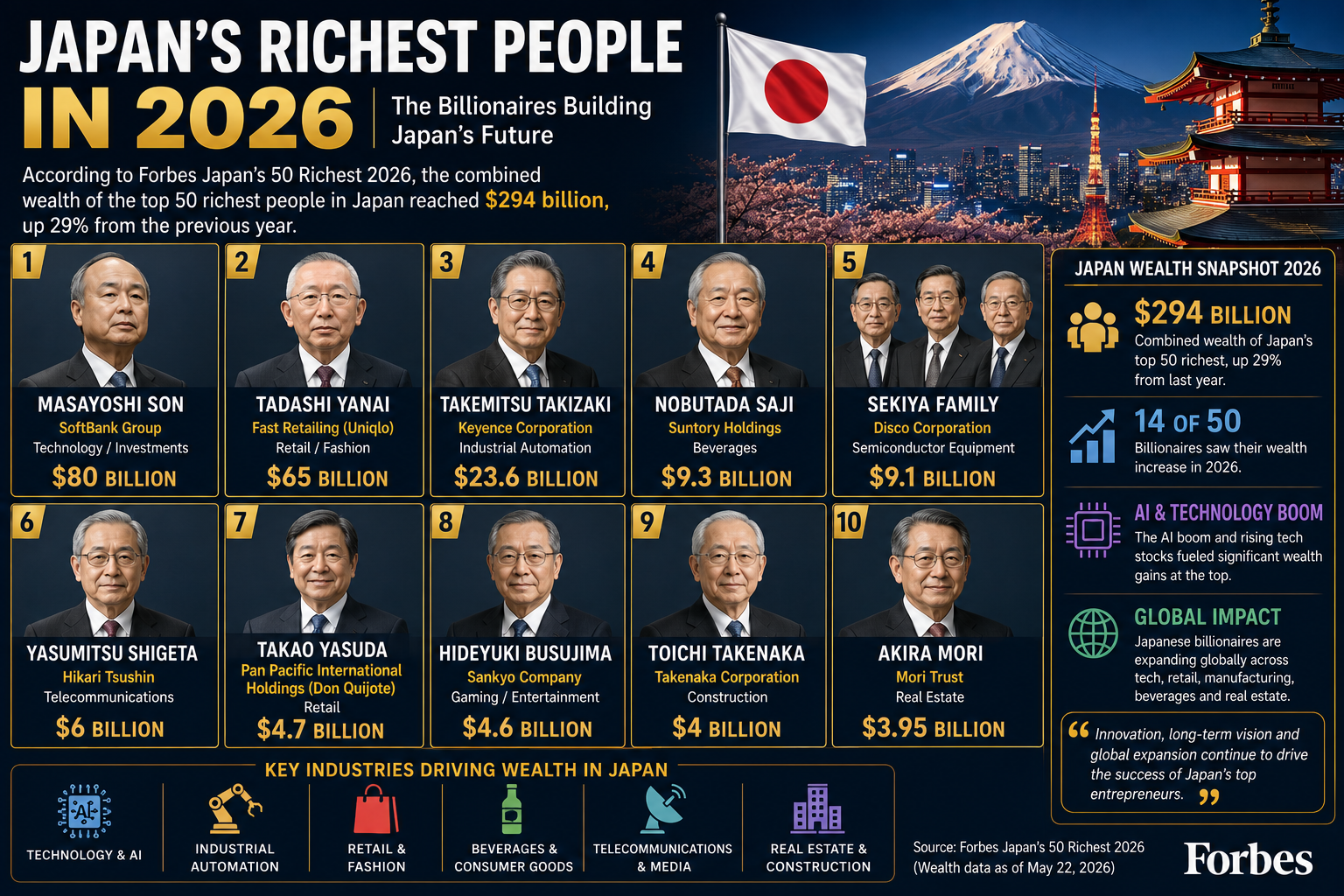
According to Forbes’ Japan’s 50 Richest 2026, the combined wealth of the country’s 50 richest people reached approximately $294 billion, a 29% increase from the previous year. The rise was supported by a strong Japanese stock market and the global artificial intelligence boom.
At the top of the ranking is Masayoshi Son, founder of SoftBank Group, whose fortune reached $80 billion in Forbes’ 2026 ranking. He reclaimed the No. 1 position after last holding it in 2021.
Top 10 Richest People in Japan in 2026
Rank | Billionaire / Family | Main Company or Business | Net Worth |
|---|---|---|---|
1 | Masayoshi Son | SoftBank Group | $80B |
2 | Tadashi Yanai | Fast Retailing / Uniqlo | $65B |
3 | Takemitsu Takizaki | Keyence | $23.6B |
4 | Nobutada Saji | Suntory Holdings | $9.3B |
5 | Sekiya Family | Disco | $9.1B |
6 | Yasumitsu Shigeta | Hikari Tsushin | $6B |
7 | Takao Yasuda | Pan Pacific International Holdings | $4.7B |
8 | Hideyuki Busujima | Sankyo | $4.6B |
9 | Toichi Takenaka | Takenaka Corporation | $4B |
10 | Akira Mori | Mori Trust | $3.95B |
The figures are from Forbes’ 2026 Japan ranking, which uses stock prices and exchange rates as of May 22, 2026.
1. Masayoshi Son — $80 Billion
Masayoshi Son is Japan’s richest person in 2026 and the founder of SoftBank Group.
His estimated fortune reached $80 billion, an enormous increase of $51.8 billion, or 184%, from the previous year. Forbes identifies him as the biggest gainer on the 2026 Japan list in both dollar and percentage terms.
Son’s wealth is closely connected to SoftBank’s investment strategy, particularly its aggressive focus on artificial intelligence.
SoftBank reported a record annual net profit of roughly ¥5 trillion for the year ended March 31, 2026. The company has also made multibillion-dollar investments connected to OpenAI and continues to pursue large-scale AI infrastructure projects.
Son has increasingly positioned SoftBank as an AI-focused investment and technology powerhouse. His investments through SoftBank and its Vision Funds have covered hundreds of companies across technology, transportation, e-commerce and other sectors.
Why Masayoshi Son is so wealthy
His fortune has benefited from:
SoftBank's rising valuation
Artificial intelligence investments
OpenAI-related investments
Technology and telecommunications
SoftBank Vision Fund investments
AI infrastructure
His return to the top demonstrates just how strongly AI has influenced Japan’s wealth rankings.
2. Tadashi Yanai — $65 Billion
Tadashi Yanai, founder of Fast Retailing and the force behind Uniqlo, ranks second among Japan’s richest people in 2026.
Forbes estimates his fortune at $65 billion. Although he dropped from first to second place, his wealth still increased by more than one-third from the previous year.
Yanai built Fast Retailing into one of the world's most recognizable apparel companies.
Its flagship brand, Uniqlo, has expanded far beyond Japan and operates thousands of stores internationally. Fast Retailing also owns brands including GU, Theory, Helmut Lang and J Brand.
The company reported strong revenue and profit growth, helping boost Yanai’s fortune.
Tadashi Yanai's business empire
His wealth is primarily associated with:
Uniqlo
Fast Retailing
Global retail
Clothing and fashion
International expansion
Yanai has repeatedly expressed ambitions for Fast Retailing to become the world's largest clothing retailer.
3. Takemitsu Takizaki — $23.6 Billion
Takemitsu Takizaki, founder of Keyence, ranks third with an estimated fortune of $23.6 billion.
Keyence is a major supplier of sensors, electronic components and factory automation technologies.
The company serves customers across industries including automobiles, electronics and food packaging. Approximately two-thirds of its revenue comes from customers outside Japan, according to Forbes.
Takizaki stepped down as chairman in 2015 but remains associated with the company as an honorary chairman and board member.
Keyence and industrial technology
Takizaki's fortune highlights the importance of Japan's industrial technology sector.
Keyence benefits from long-term demand for:
Factory automation
Sensors
Robotics
Electronic components
Manufacturing technology
Industrial automation
Japan's strength in advanced manufacturing continues to create enormous fortunes even outside the consumer technology sector.
4. Nobutada Saji — $9.3 Billion
Nobutada Saji, associated with Suntory Holdings, ranks fourth with an estimated fortune of $9.3 billion.
Suntory is one of Japan’s best-known beverage companies, with businesses spanning alcoholic beverages, soft drinks and other consumer products.
The Saji family has played a major role in building Suntory into a global beverage group.
Suntory represents a different path to wealth compared with the technology fortunes dominating many global billionaire rankings.
Its business empire is built around:
Beverages
Whisky
Food products
Consumer brands
International expansion
5. Sekiya Family — $9.1 Billion
The Sekiya family ranks fifth on Japan’s 2026 richest list with an estimated fortune of $9.1 billion.
Their wealth is linked to Disco, a company specializing in semiconductor manufacturing equipment.
The family's fortune increased significantly as demand for semiconductor-related products surged.
Forbes reports that Disco's shares more than doubled amid strong demand for products associated with the AI boom.
This makes the Sekiya family's rise another example of how artificial intelligence is indirectly creating wealth throughout the semiconductor supply chain.
6. Yasumitsu Shigeta — $6 Billion
Yasumitsu Shigeta ranks sixth with an estimated fortune of $6 billion.
His wealth is associated with Hikari Tsushin, a Japanese telecommunications and business-services company.
Unlike some of the newer technology fortunes, Shigeta's wealth demonstrates the continuing importance of established Japanese corporate businesses and investment holdings.
7. Takao Yasuda — $4.7 Billion
Takao Yasuda ranks seventh with an estimated fortune of $4.7 billion.
He is associated with Pan Pacific International Holdings, the parent company of the popular Japanese discount retailer Don Quijote.
The company has expanded its retail operations in Japan and internationally, making discount retail another significant source of billionaire wealth in Japan.
Yasuda's fortune demonstrates the strength of consumer spending and retail businesses in the Japanese economy.
8. Hideyuki Busujima — $4.6 Billion
Hideyuki Busujima ranks eighth with an estimated fortune of $4.6 billion.
His wealth is connected to Sankyo, a Japanese company known for its gaming and entertainment-machine business.
The Busujima family's wealth has remained closely connected with Sankyo's business operations, demonstrating the continuing importance of Japan's entertainment and gaming industries.
9. Toichi Takenaka — $4 Billion
Toichi Takenaka ranks ninth on the 2026 list with approximately $4 billion.
His wealth is associated with Takenaka Corporation, one of Japan's major construction companies.
Construction and real estate have historically been important sources of wealth in Japan, and the Takenaka family represents one of the country's prominent business dynasties.
10. Akira Mori — $3.95 Billion
Akira Mori, chairman of Mori Trust, rounds out the top 10 with an estimated fortune of $3.95 billion.
Mori Trust is involved in real estate and property development, including major commercial and hospitality projects.
His position on the list demonstrates the continuing importance of Japanese real estate alongside technology, retail and manufacturing.
What Is Driving Japan's Billionaire Wealth in 2026?
Japan's billionaire economy is becoming increasingly diverse, but several industries stand out.
Artificial Intelligence and Technology
AI is one of the biggest forces influencing Japan's wealth rankings.
The global AI boom has lifted technology stocks and increased demand for semiconductors, automation equipment and computing infrastructure.
Masayoshi Son's SoftBank is perhaps the clearest example. His enormous increase in wealth was closely connected to SoftBank's investments in AI and OpenAI.
Meanwhile, the Sekiya family's wealth benefited from growing demand for semiconductor equipment.
Semiconductors and Factory Automation
Japan remains a major player in advanced industrial technology.
Companies such as Keyence and Disco benefit from demand for sophisticated manufacturing equipment, sensors and semiconductor-related technologies.
The fortunes of Takemitsu Takizaki and the Sekiya family demonstrate how industrial technology can produce enormous personal wealth.
Fashion and Retail
Tadashi Yanai's $65 billion fortune demonstrates the global power of Japanese retail.
Uniqlo has transformed from a Japanese clothing retailer into a global brand. Fast Retailing continues to expand internationally while maintaining its position as one of Japan's most valuable consumer companies.
Retail also features prominently through Takao Yasuda and Pan Pacific International Holdings.
Beverages and Consumer Products
Japan's wealthiest business families also include major beverage and consumer-product owners.
The Saji family's connection to Suntory illustrates how generations of business development can turn a domestic company into an international consumer brand.
Real Estate and Construction
Real estate continues to play a significant role in Japanese wealth.
Akira Mori's Mori Trust and Toichi Takenaka's connection to Takenaka Corporation show how property development and construction remain important sources of wealth.
Japan's 50 Richest Become $294 Billion Strong
The overall wealth of Japan's 50 richest people reached $294 billion in 2026, up from approximately $228 billion the previous year. That represents a 29% increase.
The rise occurred during a powerful stock-market rally. Forbes noted that the Nikkei 225 had risen nearly 70% since the previous wealth measurement, although the weaker Japanese yen reduced some of the impact when fortunes were converted into U.S. dollars.
However, the gains were not evenly distributed.
Forbes reported that only 14 fortunes on the list increased, while 27 declined. The minimum fortune required to make the list also edged down to approximately $1.1 billion, compared with $1.2 billion the previous year.
This shows that Japan's billionaire economy is experiencing significant changes beneath the headline growth.
How Japan Compares With Previous Years
The 2026 ranking brought a major change at the top.
Tadashi Yanai, who had previously held the No. 1 position, moved to second place despite increasing his fortune.
Masayoshi Son returned to the top after a four-year absence, powered largely by the extraordinary performance of SoftBank and the company's AI investment strategy.
The change reflects a broader shift in Japan's wealth landscape—from traditional retail and consumer businesses toward technology, AI and semiconductor-related industries.
At the same time, established sectors such as beverages, construction, real estate and retail continue to produce some of Japan's wealthiest families.
New Billionaires and Changing Fortunes
Japan's 2026 list also saw new entrants.
Forbes reported six newcomers, including Masakazu Idemitsu, who shares a $1.15 billion family fortune connected to Idemitsu Kosan, and Fumio Sakiya, founder of semiconductor-equipment maker Rorze, with a $1.55 billion fortune.
Ryuji Arai, founder of electronics retailer Bic Camera, also returned to the list.
At the same time, some fortunes declined substantially, showing how sensitive billionaire wealth can be to stock-market movements and corporate performance.
The Future of Japan's Richest People
Japan's billionaire rankings could continue to change as the country's economy responds to global technological and demographic trends.
Artificial intelligence is likely to remain an important driver of wealth. Companies involved in semiconductors, automation, data infrastructure and advanced electronics could benefit from growing global investment in AI.
At the same time, consumer brands such as Uniqlo and Suntory will continue pursuing international growth.
Japan's established industrial and real-estate companies are also likely to remain important components of the country's billionaire economy.
The biggest question is whether technology and AI will continue to reshape the top of the Japanese wealth rankings—or whether established business empires will regain the advantage.
Final Thoughts
Japan's richest people in 2026 represent a fascinating mix of technology entrepreneurs, retail billionaires, industrialists and powerful business families.
Masayoshi Son leads the ranking with $80 billion, followed by Tadashi Yanai with $65 billion and Takemitsu Takizaki with $23.6 billion.
Together, these fortunes illustrate the breadth of Japan's economy. AI and technology are creating new opportunities, while retail, manufacturing, beverages, construction and real estate continue to support some of the country's oldest and most powerful fortunes.
With Japan's 50 richest people collectively worth about $294 billion, the country's billionaire landscape remains one of the most significant in Asia.
Source and Methodology
The rankings and wealth figures in this article are based on Forbes’ Japan’s 50 Richest 2026. Forbes calculates fortunes using shareholding and financial information from individuals and families, stock exchanges, annual reports and analysts. Private companies are valued using comparisons with publicly traded companies. Wealth estimates for the 2026 ranking are based on stock prices and exchange rates as of May 22, 2026.