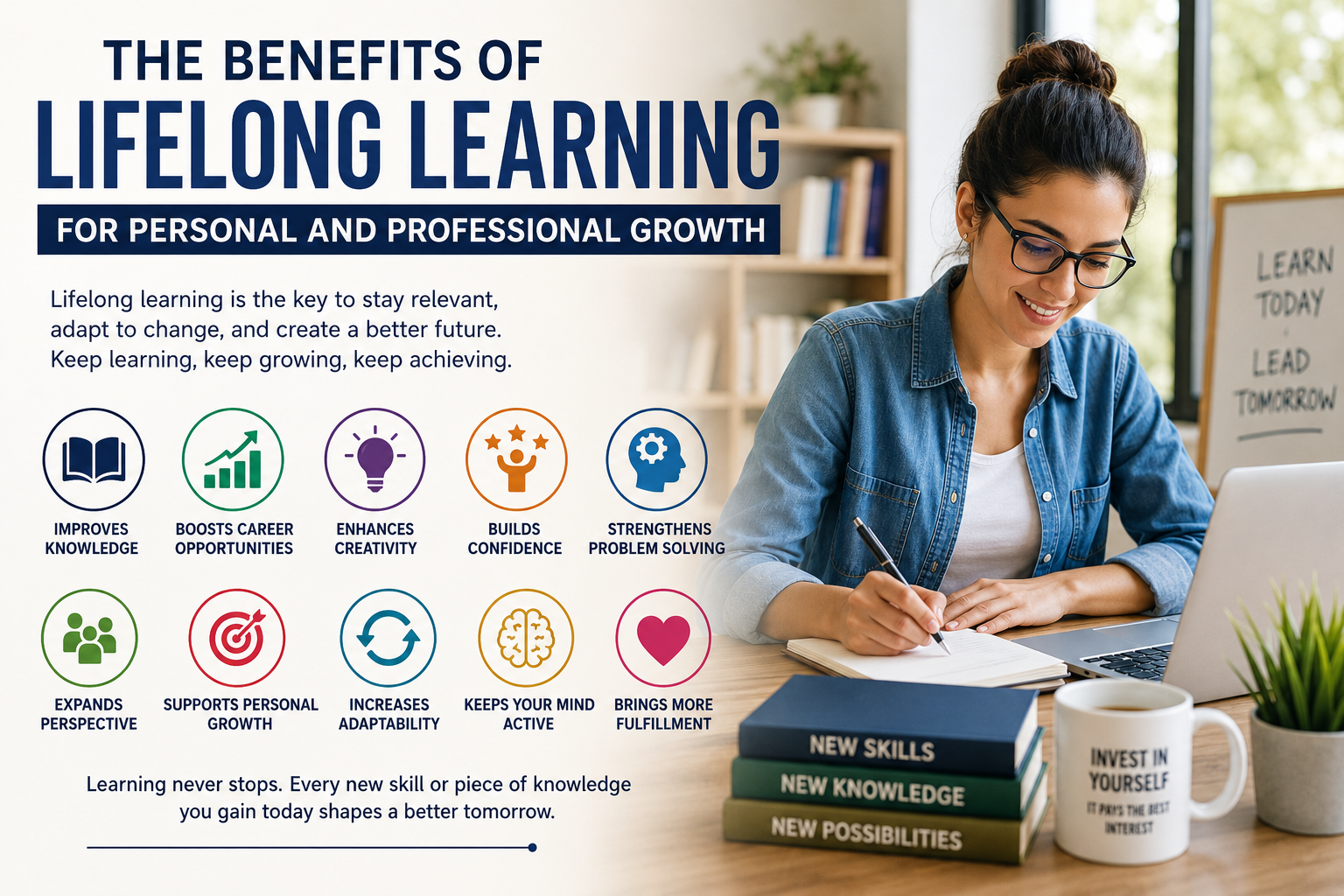
Learning does not have to end when school or university is finished. In fact, some of the most valuable learning can happen long after formal education has ended.
Lifelong learning is the ongoing process of developing knowledge, skills, interests, and abilities throughout different stages of life. It can involve taking a professional course, reading a book, learning a new language, developing a practical skill, attending a workshop, learning from colleagues, or exploring a subject independently.
The idea is simple: instead of viewing education as something that belongs only to childhood and early adulthood, lifelong learning treats learning as a continuous part of life.
This approach can support both personal development and professional growth. It can help people remain adaptable, discover new interests, improve existing abilities, and respond more confidently when circumstances change. The OECD describes lifelong learning as extending across the life course and including formal, non-formal, and informal learning.
What Is Lifelong Learning?
Lifelong learning is the continuous pursuit of knowledge and skills throughout a person's life.
It does not necessarily mean returning to university or earning another formal qualification. Learning can take many different forms.
For example, someone might learn through:
Online courses
Books and educational articles
Professional training
Workshops and seminars
Mentoring
Workplace experience
Personal projects
Community activities
Conversations with experienced people
Hobbies and creative activities
Self-directed study
Informal learning is particularly important because people develop skills through everyday experiences as well. The OECD notes that skills can be developed through work, social interaction, and self-directed learning, not only through formal education.
This makes lifelong learning accessible to people with very different backgrounds and circumstances.
Why Lifelong Learning Matters
The world of work and everyday life continues to change. Technology, business practices, industries, and professional expectations can evolve over time.
As a result, knowledge that was useful at one point in a person's career may not be enough forever.
Continuous learning provides a way to keep developing.
The OECD has emphasized the importance of lifelong learning as people adapt to changing labor markets and evolving skill requirements.
However, the value of lifelong learning extends beyond employment.
Learning can also help people become more curious, confident, independent, and engaged with the world around them.
1. Lifelong Learning Supports Career Development
One of the most obvious benefits of continuous learning is professional development.
Employees may eventually encounter new responsibilities, technologies, processes, or career opportunities. Developing relevant skills can make it easier to respond to these changes.
For example, someone working in marketing might learn data analysis. A manager might improve their communication and leadership skills. A designer might learn a new software application. A teacher might explore new instructional approaches.
The specific subject will vary, but the underlying principle remains the same: continuing to develop useful skills can strengthen professional capabilities.
Career development itself is a lifelong process, and continuing education can help people navigate transitions between different stages of work.
2. It Helps You Adapt to Change
Change can be uncomfortable when people feel unprepared for it.
Learning can provide a sense of control because it gives people opportunities to understand new situations and develop the skills needed to respond.
This is particularly important when professional responsibilities change or when new technologies become part of everyday work.
Lifelong learning does not mean predicting every future development. Instead, it helps people become more comfortable with the process of learning something unfamiliar.
A person who has developed a habit of learning may find it easier to approach a new subject because they already understand how to begin, practice, make mistakes, and improve.
The OECD highlights the importance of learning, unlearning, and relearning throughout life as societies experience technological and social change.
3. It Can Improve Confidence
Learning something new can provide a sense of achievement.
When people successfully understand a difficult concept or develop a new skill, they may become more confident in their ability to handle future challenges.
For example, someone who has always been uncomfortable with public speaking might gradually improve by studying presentation techniques, practicing in small groups, and learning from feedback.
The confidence does not come simply from knowing more. It can also come from discovering that improvement is possible through practice.
This mindset can be useful in both professional and personal situations.
4. It Encourages Curiosity
Curiosity is one of the simplest ways to keep learning.
Instead of only studying subjects that are immediately necessary, lifelong learners often explore topics because they are interested in understanding them.
A person might become interested in history, photography, cooking, psychology, economics, technology, gardening, or another subject simply because they want to know more.
This type of learning can make everyday life more interesting.
Curiosity can also lead to unexpected opportunities. A hobby can become a useful skill, a new subject can lead to a career interest, or a conversation can introduce an entirely different perspective.
5. Lifelong Learning Can Strengthen Problem-Solving Skills
Learning exposes people to different ideas, methods, and ways of thinking.
When you study a new subject, you often encounter problems that require you to compare information, identify patterns, ask questions, and determine possible solutions.
Over time, these experiences can strengthen your ability to approach unfamiliar problems.
This does not mean every learning activity will immediately make someone a better problem solver. Rather, continuous exposure to different ideas can broaden the mental tools a person has available when facing a challenge.
Developing the ability to learn independently is also valuable. OECD research highlights autonomous learning, identifying reliable information, making informed decisions, and continuously updating skills as important aspects of lifelong learning.
6. It Helps You Become More Adaptable
Adaptability is the ability to adjust when circumstances change.
Someone who is comfortable learning new things may be better prepared to adapt when familiar routines no longer work.
For example, an employee may need to learn a new software system. A business owner may need to understand a new customer behavior. A professional may decide to move into a different area of work.
In each situation, the ability to learn becomes an important resource.
Lifelong learning does not eliminate uncertainty, but it can help people approach uncertainty with a more constructive attitude.
7. It Can Improve Workplace Performance
Learning does not always have to involve a major qualification.
Sometimes a small improvement in knowledge can make everyday work more effective.
An employee might learn:
Better time-management techniques
More effective presentation skills
A new digital tool
Better writing practices
Project-management methods
Communication techniques
Data-analysis skills
Leadership principles
Industry-specific knowledge
These skills can be applied directly to everyday responsibilities.
Workplace learning can also happen informally. Employees may learn from colleagues, supervisors, clients, projects, mistakes, and practical experience. Informal learning is an important part of lifelong skill development.
8. It Creates Opportunities for Career Transitions
Career paths are not always linear.
Some people remain in the same profession for decades, while others change industries, start businesses, return to education, or develop completely new professional interests.
Learning can make these transitions more manageable.
Suppose someone has worked in administration but becomes interested in project management. They could begin by studying project-management principles, practicing relevant software, completing appropriate training, and gaining experience through small projects.
The transition may take time, but learning provides a pathway for building new capabilities.
Continuous learning can therefore be useful not only for advancing within an existing career but also for exploring a different direction.
9. It Helps Keep Existing Skills Relevant
Skills can become less useful when they are not updated.
This does not mean that every skill becomes obsolete quickly. Many fundamental abilities—such as communication, critical thinking, relationship building, and problem solving—remain valuable for a long time.
However, the tools and environments in which those skills are used can change.
For example, a professional may have excellent communication skills but still need to learn new methods of collaborating with remote teams or using digital communication platforms.
Lifelong learning allows people to maintain strong foundations while updating the tools and knowledge around them.
10. Learning Can Strengthen Creativity
Creativity often develops when people encounter different ideas and perspectives.
Learning outside your normal area of expertise can introduce unexpected connections.
A business professional who studies design may think differently about customer experience. A writer who studies psychology may develop new approaches to storytelling. An engineer who explores art may discover different ways of thinking about visual structure.
Learning does not need to be directly related to your job to be valuable.
Sometimes unrelated knowledge can provide the inspiration for new ideas.
11. It Can Improve Communication
Communication is a skill that can be developed over time.
Learning about writing, public speaking, negotiation, cultural differences, or interpersonal communication can help people express themselves more effectively.
Reading widely can also expand vocabulary and expose people to different styles of argument and explanation.
Better communication can have benefits at work and in everyday relationships.
A person who can explain ideas clearly, listen carefully, and adapt their communication style may be better prepared to collaborate with people who have different backgrounds and perspectives.
12. Lifelong Learning Encourages Independence
One of the most useful outcomes of learning is the ability to find and evaluate information independently.
Instead of immediately relying on someone else for every answer, a lifelong learner can develop the habit of asking:
What do I need to know?
Where can I find reliable information?
How can I verify what I have found?
What evidence supports this idea?
How can I apply what I have learned?
This approach can be particularly valuable in an environment where people encounter large amounts of information every day.
The ability to distinguish reliable information from unsupported claims is an important part of independent learning.
13. It Can Help People Prepare for Different Stages of Life
Learning does not become irrelevant with age.
Different stages of life can create different learning needs.
A young adult may focus on developing foundational professional skills. Someone in mid-career may need to update existing knowledge or prepare for a new role. Later in life, learning may involve new interests, community participation, creative pursuits, or preparing for major lifestyle changes.
The purpose of learning can change, but the value of curiosity and development can remain.
The OECD's work on lifelong learning considers learning across different stages of life, including mid-career and later adulthood.
14. Learning Does Not Have to Be Expensive
One misconception about lifelong learning is that it always requires expensive courses or formal qualifications.
Many learning opportunities are inexpensive or free.
People can learn through:
Public libraries
Educational websites
Books
Podcasts
Free online lectures
Professional communities
Workplace training
Mentorship
Practical projects
Educational videos
Open learning resources
The important thing is not necessarily how much money is spent. The quality of the learning process and the consistency of practice matter more.
15. Start With One Skill
Trying to learn too many things at the same time can become overwhelming.
A better approach is to choose one skill that is relevant to your current goals.
For example:
Career goal: Improve presentation skills.
Learning action: Study presentation structure and practice once a week.
Application: Give short presentations at work or in a community setting.
Reflection: Ask for feedback and identify one area to improve.
This creates a simple cycle:
Learn → Practice → Apply → Reflect → Improve
Repeating this process can turn learning into a sustainable habit.
16. Make Learning Part of Your Routine
Consistency is often more useful than occasional bursts of motivation.
You do not need to spend several hours studying every day.
Even a small amount of regular learning can become meaningful over time.
You might:
Read for 15 minutes each morning.
Listen to an educational podcast while commuting.
Take one online lesson each week.
Practice a new skill on weekends.
Write down one thing you learned each day.
Discuss new ideas with colleagues.
Work on a small personal project.
The best routine is one that fits naturally into your life.
17. Use Practical Projects to Reinforce Learning
Reading or watching educational material is only one part of learning.
Applying knowledge can make the experience more practical.
Suppose you are learning graphic design. Instead of only watching tutorials, create a small design project.
If you are studying a language, practice conversations.
If you are learning spreadsheet skills, use them to organize a real project.
Practical application can reveal gaps in your understanding and provide opportunities to improve.
18. Learn From Mistakes
Mistakes are an inevitable part of learning.
A person learning a new skill may misunderstand something, make an incorrect decision, or produce an imperfect result.
Instead of treating every mistake as failure, ask:
What happened?
Why did it happen?
What did I misunderstand?
What can I change?
What will I do differently next time?
This approach turns mistakes into information.
The goal is not to eliminate every mistake. It is to learn from experience and gradually improve.
19. Find People Who Can Help You Learn
Learning becomes easier when you have access to people with relevant experience.
A mentor can provide guidance. A colleague can explain a workplace process. A teacher can correct mistakes. A professional community can introduce different perspectives.
You can also learn by observing people who are already good at something.
Pay attention to how they approach problems, communicate ideas, organize their work, and respond to challenges.
Learning from others can complement formal education and self-directed study.
20. Create a Long-Term Learning Mindset
Perhaps the most important benefit of lifelong learning is developing a mindset that sees growth as an ongoing process.
Instead of thinking, "I finished my education," consider thinking, "I am continuing to develop."
This does not mean constantly chasing qualifications or trying to master every new trend.
It means remaining open to learning when a useful opportunity appears.
A lifelong learner can recognize that knowledge changes, skills can improve, and there is always something new to understand.
Common Barriers to Lifelong Learning
Although lifelong learning has many benefits, maintaining a learning habit is not always easy.
Lack of time
Work, family responsibilities, and daily commitments can make learning difficult.
The solution may be to start with smaller sessions rather than waiting for large blocks of free time.
Lack of motivation
Motivation can fluctuate. Creating a routine can reduce reliance on motivation alone.
Fear of failure
People may avoid learning because they worry about making mistakes.
Remember that mistakes are part of skill development.
Too many choices
There are countless courses, books, videos, and resources available.
Choose one specific goal and limit your initial focus.
Cost
Not every learning opportunity needs to be expensive. Explore libraries, free resources, workplace training, and affordable courses.
How to Build a Lifelong Learning Plan
A simple learning plan can make the process easier.
Step 1: Choose a goal
Decide what you want to improve.
Step 2: Select one skill
Avoid trying to learn everything at once.
Step 3: Find reliable resources
Choose books, courses, teachers, professionals, or educational sources with credible information.
Step 4: Create a schedule
Set aside realistic time each week.
Step 5: Practice
Apply what you learn through exercises or real projects.
Step 6: Review your progress
Consider what is working and what needs improvement.
Step 7: Adjust your plan
Learning plans should change when your needs change.
Final Thoughts
Lifelong learning is more than collecting certificates or completing courses. It is a way of approaching life with curiosity, flexibility, and a willingness to improve.
Learning can support professional development, strengthen useful skills, encourage creativity, improve confidence, and help people adapt to changing circumstances.
It can also be simple. You do not need to return to a classroom or spend large amounts of money to become a lifelong learner. A book, conversation, practical project, online lesson, workplace experience, or personal interest can all become part of the learning process.
The most important step is to begin with something meaningful and continue consistently.
When learning becomes a regular part of life, education stops being a stage that ends and becomes a process that continues.
Frequently Asked Questions
1. What is lifelong learning?
Lifelong learning is the continuous development of knowledge, skills, and abilities throughout a person's life. It can include formal education, professional training, self-directed study, workplace learning, hobbies, and everyday experiences.
2. Why is lifelong learning important?
Lifelong learning can help people maintain relevant skills, adapt to change, explore new interests, improve professional capabilities, and continue personal development throughout different stages of life.
3. Does lifelong learning require going back to school?
No. Lifelong learning can happen through books, online courses, workplace training, mentoring, practical projects, conversations, hobbies, and self-directed study. Formal education is only one form of lifelong learning.
4. Can lifelong learning improve career opportunities?
Continuous learning can help people develop skills that are relevant to their professional goals. It can also help workers prepare for new responsibilities, career transitions, and changing workplace requirements.
5. How can I start lifelong learning?
Choose one subject or skill that interests you or supports an important goal. Find a reliable learning resource, create a realistic schedule, and practice what you learn regularly.
6. How much time should I spend learning each day?
There is no universal amount of time. Even short, consistent learning sessions can be useful. The best schedule is one that you can realistically maintain alongside your other responsibilities.
7. Is online learning considered lifelong learning?
Yes. Online courses, educational resources, lectures, tutorials, and other digital learning opportunities can all be part of lifelong learning.
8. What skills are useful for lifelong learning?
Useful skills include curiosity, critical thinking, information evaluation, communication, time management, self-discipline, adaptability, and the ability to learn independently.
9. Can older adults benefit from lifelong learning?
Yes. Learning can remain valuable at every stage of life. It can support continued personal development, social engagement, adaptability, and the exploration of new interests.
10. How can I stay motivated to learn?
Choose subjects that have a clear purpose or genuine interest for you. Set small goals, create a routine, track progress, and apply what you learn to real situations.
11. What is informal learning?
Informal learning happens outside traditional educational settings. It can include learning from colleagues, workplace experiences, conversations, personal projects, reading, observation, and everyday activities.
12. Is lifelong learning only useful for professional development?
No. Lifelong learning can support both professional and personal development. People may learn for career reasons, personal interests, relationships, creativity, practical skills, or simply because they enjoy discovering new information.
13. How can lifelong learning improve adaptability?
Regular learning helps people become more comfortable with unfamiliar subjects and new information. This can make it easier to develop new skills when circumstances or responsibilities change.
14. What is the best way to learn a new skill?
A combination of learning, practice, application, feedback, and reflection is often useful. Instead of only consuming information, try to apply the skill through practical activities.
15. Can lifelong learning help with career changes?
Yes. Learning can help people build knowledge and skills relevant to a different role or industry. A career transition may require several steps, but continuous learning can provide a foundation for developing new capabilities.