The modern business environment is changing faster than ever.
Technology is advancing rapidly, global supply chains are being redesigned, cybersecurity threats are becoming more sophisticated, energy requirements are increasing, and customers are demanding faster and more personalized experiences.
At the same time, businesses are operating in an environment where economic conditions can change quickly.
Interest rates influence investment.
Energy prices affect operating costs.
Geopolitical developments can disrupt supply chains.
Technology can transform entire industries within a few years.
For business leaders, this creates a new priority: resilience.
Being successful is no longer only about growing quickly. Companies also need to be capable of adapting when conditions change.
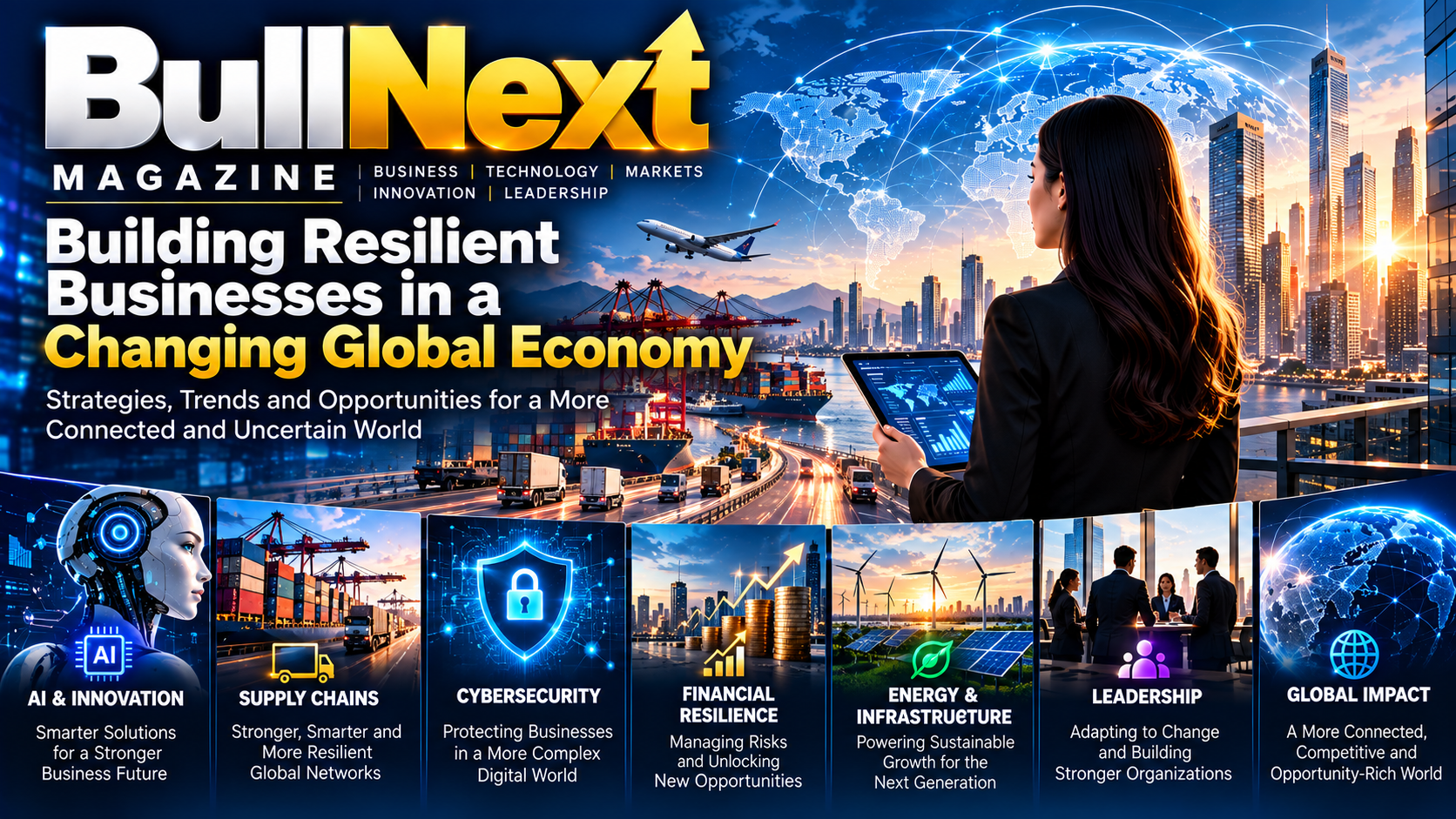
This is the broader business environment explored by BullNext Magazine, which covers technology, business, markets, innovation, leadership and emerging economic trends.
What Does Business Resilience Mean?
Business resilience is the ability of an organization to continue operating, adapt to disruption and recover when unexpected challenges occur.
A resilient company does not necessarily avoid every problem.
Instead, it prepares for problems and develops the flexibility needed to respond.
For example, a company may maintain multiple suppliers instead of depending entirely on one.
A technology company may operate systems across multiple cloud environments.
A retailer may sell through several channels instead of depending on one platform.
A manufacturer may develop alternative production locations.
A financial organization may strengthen cybersecurity and backup systems.
These strategies can reduce dependence on a single point of failure.
Why Resilience Has Become More Important
Businesses have always faced risks.
But the modern economy is highly interconnected.
A disruption in one part of the world can affect companies thousands of miles away.
A semiconductor shortage can affect automobile production.
A shipping disruption can affect retail inventory.
A cyberattack can interrupt business operations.
An energy shortage can affect manufacturing.
A sudden change in consumer demand can leave companies with excess inventory.
This interconnected environment means businesses need to think about risk across the entire organization.
Supply Chains Are Changing
One of the biggest changes taking place in global business is the redesign of supply chains.
For many years, companies prioritized efficiency.
They wanted products manufactured at the lowest possible cost and delivered through highly optimized networks.
Efficiency remains important.
But recent disruptions have demonstrated that maximum efficiency can sometimes create vulnerability.
If a company depends on a single supplier or geographic region, a disruption can have a significant impact.
As a result, businesses are increasingly considering supply-chain diversification.
This can involve:
Multiple suppliers
Regional manufacturing
Alternative logistics routes
Larger inventories of critical components
Local sourcing
Digital supply-chain monitoring
Supplier risk analysis
The objective is not to eliminate global supply chains.
It is to make them more flexible.
The Rise of Regional Manufacturing
Manufacturing is also becoming more geographically diversified.
Companies are evaluating where products should be manufactured based on more than labor costs.
Other factors now include:
Infrastructure
Energy availability
Political stability
Transportation
Tariffs
Skilled labor
Technology capabilities
Access to customers
This is creating opportunities for emerging manufacturing markets.
Countries in Asia, the Middle East, Eastern Europe and other regions are competing for investment.
The result could be a more distributed global manufacturing system.
Technology Can Make Supply Chains More Resilient
Technology is playing an increasingly important role in supply-chain management.
Companies can use data analytics and artificial intelligence to monitor inventory, forecast demand and identify potential disruptions.
Internet-connected sensors can provide real-time information about shipments, warehouses and manufacturing equipment.
Cloud platforms can allow suppliers and business partners to share information more efficiently.
AI can analyze large quantities of data and identify patterns that humans may not notice immediately.
The goal is to create greater visibility.
A business cannot respond effectively to a problem it cannot see.
Artificial Intelligence and Business Resilience
Artificial intelligence is often discussed as a productivity technology.
But AI can also become a resilience tool.
For example, an AI system could monitor supplier performance and identify unusual delays.
A company could use predictive analytics to forecast changes in customer demand.
Manufacturers could use AI to predict equipment failures before they cause production interruptions.
Financial organizations could use AI to detect unusual transactions.
Customer-service systems could automatically manage routine requests during periods of unusually high demand.
These applications can help businesses respond faster.
However, AI itself introduces risks.
Companies need reliable data, cybersecurity controls and human oversight.
Cybersecurity Is Now a Business Issue
As organizations become more digital, cybersecurity becomes increasingly important.
A cyberattack can do more than compromise information.
It can stop operations.
A ransomware attack can prevent employees from accessing critical systems.
A data breach can damage customer trust.
A compromised payment system can create financial losses.
A security incident can also create regulatory and legal consequences.
This means cybersecurity can no longer be treated as an issue belonging only to the IT department.
It is a business risk.
Executives and boards increasingly need to understand the organization's cybersecurity exposure.
Building a Strong Cybersecurity Strategy
A resilient cybersecurity strategy involves multiple layers.
Companies should consider:
Identity Security
Employees should have access only to the systems and information required for their roles.
Data Protection
Sensitive information should be appropriately protected.
Network Security
Businesses need systems capable of detecting and responding to suspicious activity.
Employee Training
Human behavior remains an important part of cybersecurity.
Employees should understand phishing, social engineering and other common threats.
Backup Systems
Critical information should be backed up so organizations can recover after incidents.
Incident Response
Companies should know what to do when an attack occurs.
Preparation can significantly improve the speed of recovery.
Cloud Computing and Resilience
Cloud computing has changed how businesses manage technology infrastructure.
Instead of maintaining every system internally, companies can use cloud platforms for computing, storage, applications and data management.
Cloud infrastructure can improve flexibility.
Businesses can increase capacity when demand rises and reduce capacity when demand falls.
However, cloud dependency also creates new risks.
Companies need to understand their dependence on providers, applications and network connectivity.
A resilient technology strategy may therefore require redundancy and carefully designed backup systems.
The Energy Challenge
Energy is becoming another strategic issue for modern businesses.
Technology infrastructure requires electricity.
Manufacturing requires electricity.
Transportation requires energy.
Data centers require significant power.
As AI and digital infrastructure expand, energy demand is becoming increasingly important to technology companies and investors.
Businesses may need to consider both energy costs and energy reliability when choosing locations for operations.
Regions with strong energy infrastructure could become increasingly attractive for technology and industrial investment.
The AI Data Center Connection
The expansion of artificial intelligence is creating demand for data centers.
AI systems require significant computing resources.
Data centers provide the infrastructure needed to operate these systems.
But data centers require:
Electricity
Cooling
Networking
Land
Construction
Security
Skilled workers
This means AI investment is also creating opportunities for energy companies, construction firms, semiconductor manufacturers, cooling providers and infrastructure businesses.
The AI economy is therefore much broader than software.
Sustainability and Resilience
Sustainability is increasingly becoming connected to resilience.
A company that reduces energy consumption may lower operating costs.
A manufacturer that reduces waste may improve resource efficiency.
A business that diversifies energy sources may become less vulnerable to price fluctuations.
Renewable energy can also provide opportunities for companies seeking to reduce exposure to fossil-fuel price volatility.
However, sustainability strategies need to be economically practical.
Businesses must balance environmental goals with financial performance and operational reliability.
The Importance of Financial Resilience
Technology and supply chains are not the only areas where businesses need resilience.
Financial resilience is equally important.
Companies need sufficient liquidity to survive unexpected disruptions.
Strong cash management can help businesses continue operating during difficult periods.
Companies should also carefully evaluate debt, operating costs and capital expenditure.
Rapid expansion can create opportunities, but excessive financial commitments can increase vulnerability.
A resilient company therefore needs both growth and financial discipline.
Managing Interest-Rate Risk
Interest rates can influence business decisions.
Higher borrowing costs can make expansion more expensive.
Lower rates can encourage investment.
Companies with significant debt may become particularly sensitive to changes in financing costs.
Business leaders therefore need to consider how monetary policy could affect capital spending, hiring, expansion and profitability.
This is another example of why businesses cannot operate independently from global markets.
The Changing Role of Leadership
Resilience begins with leadership.
Executives need to think beyond short-term growth.
They must ask:
What could disrupt our business?
Which suppliers are critical?
Which systems are essential?
Where are our biggest cybersecurity risks?
How dependent are we on one market?
How quickly can we respond to changing customer demand?
Do we have sufficient financial flexibility?
These questions can help leaders identify vulnerabilities before a crisis occurs.
Leadership in an Uncertain Economy
Modern leaders are operating in an environment where uncertainty is increasingly normal.
They may face changing regulations, technology disruptions, economic volatility, geopolitical developments and evolving customer expectations.
The most effective leaders may therefore be those who are comfortable making decisions without having perfect information.
This requires:
Strategic thinking
Communication
Adaptability
Risk management
Financial discipline
Technology awareness
Employee engagement
Leadership is not simply about predicting the future.
It is about preparing the organization for multiple possible futures.
Employees Are Part of Resilience
Employees play an important role in business resilience.
Technology can automate many processes, but people remain responsible for understanding customers, managing relationships, solving complex problems and responding to unexpected situations.
Companies therefore need to invest in skills.
Employees may need training in:
AI tools
Cybersecurity
Data analysis
Digital collaboration
Automation
Customer experience
New operational systems
A workforce that can adapt to new technologies can become a major competitive advantage.
The Future of Work
The workplace is changing as AI and automation become more common.
Some repetitive tasks can be automated.
Other responsibilities are becoming more analytical and strategic.
This does not necessarily mean that human employees become less important.
Instead, their roles may change.
Employees may increasingly work alongside AI systems.
A marketing employee could use AI to analyze campaigns.
A financial analyst could use AI to process large datasets.
A logistics manager could use predictive systems to identify potential delays.
A software developer could use AI tools to accelerate development.
The future workplace may therefore be based on collaboration between humans and intelligent systems.
Customer Expectations Are Rising
Customers are also contributing to the need for resilience.
Consumers increasingly expect businesses to provide fast service, digital convenience and personalized experiences.
A company that cannot respond quickly may lose customers.
Technology can help businesses meet these expectations.
AI can support customer service.
Analytics can improve personalization.
Cloud platforms can support digital experiences.
Automation can reduce processing time.
But businesses also need to maintain human relationships.
Customers may appreciate automation for simple tasks but still want human support when problems become complicated.
Innovation as a Resilience Strategy
Innovation is not only about creating new products.
It can also help companies become more resilient.
A company can innovate by redesigning processes.
It can develop alternative revenue streams.
It can create new distribution channels.
It can improve its supply chain.
It can introduce new digital services.
Innovation can therefore reduce dependence on a single business model.
The Role of Small Businesses
Resilience is particularly important for small businesses.
Smaller companies may have fewer financial resources and less negotiating power with suppliers.
However, they can also have advantages.
Small businesses can often make decisions faster.
They can change products quickly.
They can adopt new technology without managing large legacy systems.
They can develop closer relationships with customers.
Digital platforms also allow small businesses to access customers beyond their local markets.
AI and cloud computing can give small companies access to capabilities that were once available mainly to large corporations.
Global Markets and Business Resilience
Global markets influence business resilience in many ways.
Currency movements can affect international companies.
Energy prices can influence production costs.
Interest rates affect borrowing.
Commodity prices affect manufacturers.
Consumer spending influences retailers.
Geopolitical developments can affect trade.
Business leaders therefore need to understand the broader economic environment.
BullNext's magazine broader editorial coverage connects technology, business, markets, innovation and global economic trends because these subjects increasingly influence one another.
Asia and the New Global Supply Chain
Asia remains central to global manufacturing and technology.
China is a major manufacturing and technology market.
India is expanding its digital economy, manufacturing capacity and technology services.
Japan remains important in advanced manufacturing, robotics and industrial technology.
South Korea plays a major role in semiconductors and electronics.
Southeast Asian economies are becoming increasingly important in manufacturing, logistics and digital services.
This creates opportunities for businesses seeking to diversify production and supply chains.
The Importance of Infrastructure
Business resilience ultimately depends on infrastructure.
Companies need reliable:
Roads
Ports
Airports
Electricity
Telecommunications
Cloud systems
Payment networks
Data centers
Infrastructure investment can therefore influence where businesses choose to operate.
Regions with strong digital and physical infrastructure may attract greater investment.
Digital Infrastructure Becomes Critical
Digital infrastructure is increasingly as important as physical infrastructure.
Businesses depend on internet connectivity, cloud computing, cybersecurity, digital payments and data systems.
A company may have excellent physical facilities but still struggle if its digital infrastructure is unreliable.
This is particularly important for modern service businesses.
The Role of Digital Payments
Digital payments are changing how businesses interact with customers.
Customers increasingly expect fast and convenient payment options.
Businesses can use digital payment systems to reduce friction and improve transaction efficiency.
Digital payment infrastructure can also help companies expand into new markets.
However, security remains critical.
Payment systems contain sensitive financial information and therefore require strong protection.
Preparing for Multiple Futures
One of the biggest lessons from the modern economy is that businesses cannot assume the future will follow one predictable path.
Instead, companies can develop scenarios.
What happens if demand increases?
What happens if demand falls?
What happens if a supplier fails?
What happens if energy costs rise?
What happens if a major technology changes the industry?
What happens if regulations change?
Scenario planning allows businesses to prepare responses before problems occur.
The Balance Between Efficiency and Resilience
There is an important balance between efficiency and resilience.
Maximum efficiency can reduce costs.
But excessive optimization can create vulnerability.
Maintaining alternative suppliers may cost more.
Keeping additional inventory may require more capital.
Building backup systems may increase technology expenses.
But these investments can become valuable when disruptions occur.
The best business strategy may therefore not be the cheapest strategy.
It may be the strategy that provides the strongest combination of efficiency, flexibility and reliability.
Technology Can Improve Decision-Making
Modern businesses have access to more information than ever.
The challenge is turning information into decisions.
AI and analytics can help leaders identify trends, compare scenarios and detect unusual patterns.
But technology should support decision-making rather than eliminate accountability.
Leaders remain responsible for important decisions.
Responsible Technology Adoption
Businesses should also consider the risks associated with technology.
AI systems can produce inaccurate information.
Automation can create unexpected errors.
Cloud systems can become critical dependencies.
Digital platforms can expose companies to cyber threats.
Technology decisions therefore require governance.
Companies should define:
Who is responsible?
What information can be used?
How will performance be measured?
What happens if the system fails?
When should humans intervene?
These questions become increasingly important as technology becomes more integrated into business operations.
What Resilient Businesses May Look Like in 2030
The resilient company of the future could look very different from today's organization.
It may have:
AI-assisted operations
Automated workflows
Diversified suppliers
Cloud-based infrastructure
Strong cybersecurity
Flexible employees
Multiple sales channels
Digital customer experiences
Data-driven decision-making
Diverse energy sources
Strong financial reserves
Such organizations may be better prepared for unexpected changes.
BullNext Magazine's Broader Perspective
BullNext Magazine explores the intersection of business, technology, markets, innovation and leadership.
Resilience connects all of these areas.
Technology can improve operational flexibility.
Markets influence financial strategy.
Innovation creates new opportunities.
Leadership determines how risks are managed.
Global developments shape supply chains.
Customer expectations influence business models.
Understanding these connections can help readers look beyond individual headlines.
What Businesses Can Do Today
Businesses do not need to transform everything at once.
They can begin with practical steps.
Review Critical Dependencies
Identify suppliers, systems and markets that are essential to operations.
Strengthen Cybersecurity
Protect critical systems and train employees.
Improve Data Visibility
Use analytics to understand operations and customer behavior.
Test AI Applications
Identify specific workflows where AI can create measurable value.
Diversify Supply Chains
Develop alternatives for critical suppliers and locations.
Build Financial Flexibility
Maintain appropriate liquidity and manage debt carefully.
Train Employees
Help workers develop the skills needed for a changing economy.
Develop Scenarios
Prepare responses to multiple possible disruptions.
These steps can make an organization more adaptable without requiring massive transformation overnight.
The Future Belongs to Adaptable Businesses
The business world will continue changing.
New technologies will emerge.
Markets will rise and fall.
Consumer expectations will evolve.
Supply chains will be redesigned.
Energy systems will transform.
AI will become increasingly integrated into everyday business.
The organizations that remain successful may not be the ones that predict every change correctly.
They may be the ones that can respond quickly when change arrives.
That is the essence of resilience.
Conclusion
Business resilience is becoming a strategic advantage in an increasingly interconnected world.
Companies must think beyond growth.
They need to consider cybersecurity, supply chains, financial stability, technology, energy, employees and customers as parts of one interconnected system.
Artificial intelligence can improve efficiency.
Cloud computing can increase flexibility.
Data analytics can improve visibility.
Digital platforms can expand market access.
Diversified supply chains can reduce dependency.
Strong leadership can bring these capabilities together.
The future will inevitably bring unexpected challenges.
But businesses that prepare today can improve their ability to respond tomorrow.
For entrepreneurs, executives and investors, resilience is becoming more than a defensive strategy.
It is becoming a competitive advantage.
BullNext Magazine continues to explore the technologies, markets, businesses and ideas shaping the next phase of the global economy.
Frequently Asked Questions
What is business resilience?
Business resilience is an organization's ability to continue operating, adapt to disruption and recover from unexpected challenges.
Why is business resilience important?
Modern companies depend on interconnected supply chains, technology, energy, employees and financial systems. Disruption in one area can affect the entire organization.
How can AI improve business resilience?
AI can help companies forecast demand, monitor operations, identify unusual activity, automate workflows and support faster decision-making.
Why is cybersecurity part of business resilience?
Cyberattacks can interrupt operations, expose sensitive information and create financial and reputational damage. Strong cybersecurity can reduce these risks.
How can companies make supply chains more resilient?
Businesses can diversify suppliers, use multiple manufacturing locations, improve inventory visibility, develop alternative logistics routes and use technology to monitor supply-chain risks.
Why is financial resilience important?
Strong liquidity and responsible debt management can help companies continue operating during periods of lower revenue or unexpected costs.
How does technology affect business resilience?
Cloud computing, AI, analytics, automation and digital platforms can improve flexibility and visibility, but businesses must also manage technology dependencies and cybersecurity risks.
Why are Asian markets important for resilient supply chains?
Asia contains major manufacturing, technology and consumer markets. Diversifying operations across different Asian markets can provide businesses with additional sourcing and production options.
What will resilient businesses look like in the future?
Future resilient businesses are likely to combine AI, automation, strong cybersecurity, diversified supply chains, flexible employees, digital infrastructure and disciplined financial management.
Is resilience more important than growth?
Businesses need both. Growth creates opportunities, while resilience helps organizations protect those opportunities when market conditions change