The modern business world is entering a period of transformation unlike anything seen in recent decades. Artificial intelligence is changing how companies develop products, analyze information, serve customers and manage employees. At the same time, global markets are responding to massive investment in computing infrastructure, semiconductors, data centers, energy and digital services.
These changes are creating a new business environment in which technology, finance, markets and leadership are increasingly connected.
For companies, the challenge is no longer simply adopting digital tools. Businesses must understand how technology can create measurable value while preparing for changes in competition, workforce structures, consumer behavior and global investment.
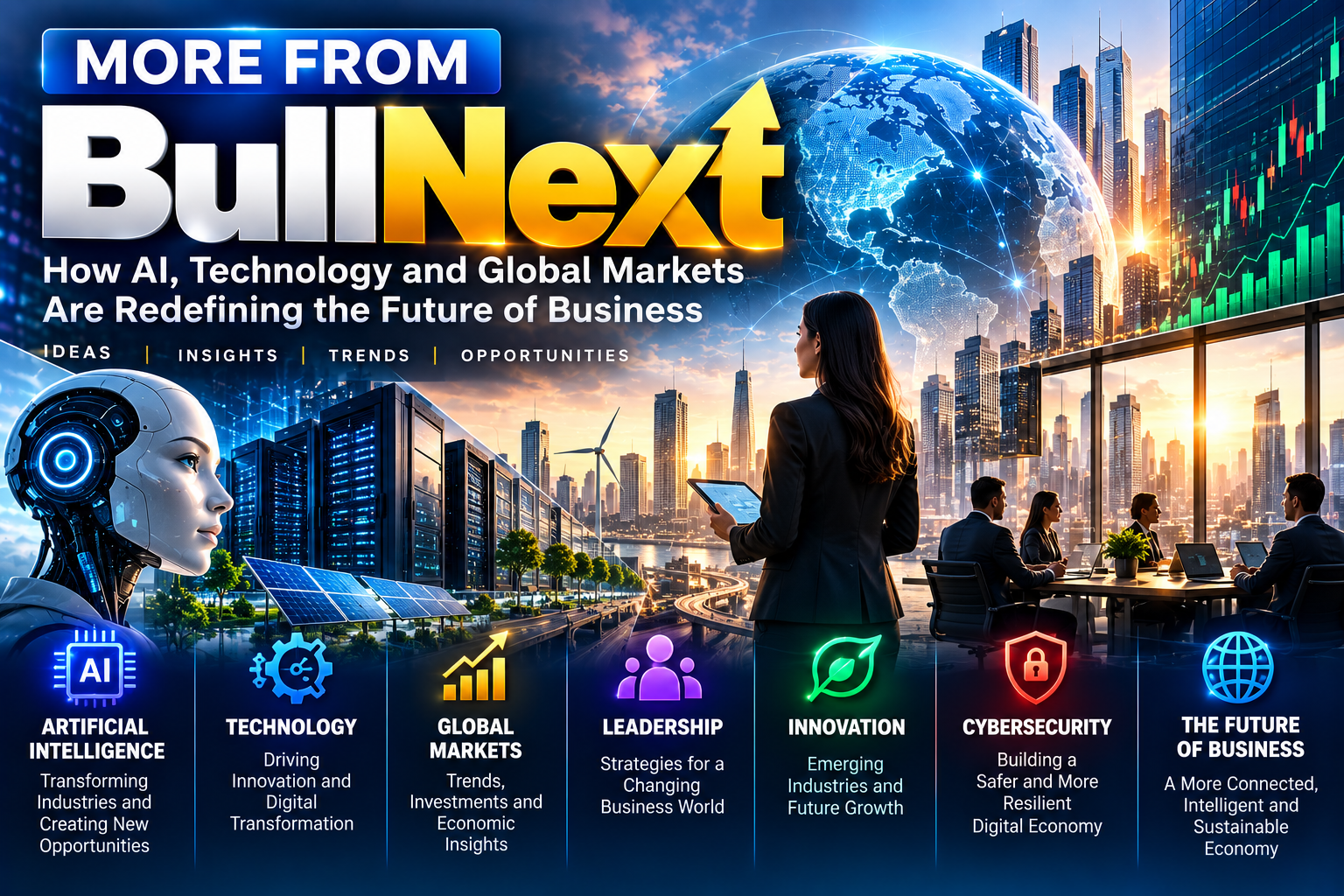
This is the broader perspective behind More From BullNext.
BullNext's coverage extends across business, technology, markets, innovation, leadership and global economic developments. Its existing editorial themes include technology-driven business transformation and the changing role of global markets.
As 2026 progresses, one trend stands above many others: artificial intelligence is moving from an experimental technology into a major economic force.
The Business World Is Entering a New Technology Cycle
Technology has always influenced business.
The internet transformed communication and commerce. Cloud computing changed enterprise software. Smartphones changed consumer behavior. E-commerce reshaped retail.
Artificial intelligence is now creating another major shift.
Unlike many previous technologies, AI can influence knowledge-based work across almost every department of an organization.
Marketing teams can use AI to analyze campaigns and generate content.
Financial teams can use AI to identify patterns in large datasets.
Customer-service departments can automate routine interactions.
Software teams can use AI coding assistants.
Executives can use AI systems to summarize information and support decision-making.
Manufacturers can combine AI with robotics and computer vision.
The result is not simply another software upgrade.
It is a change in how organizations think about productivity.
AI Is Becoming an Infrastructure Story
The AI conversation initially focused heavily on models and applications.
Today, the investment story is much larger.
AI requires enormous amounts of computing power, memory, networking equipment, data-center capacity and electricity.
Research from S&P Global published in October 2026 shows that AI investment is increasingly affecting companies throughout the infrastructure ecosystem, including semiconductors, memory, data centers, connectivity, industrial equipment, cloud computing and power.
This creates a powerful economic chain.
AI models require computing.
Computing requires chips.
Chips require semiconductor manufacturing.
Data centers require electricity.
Data centers also require cooling, networking equipment and physical infrastructure.
Cloud providers require additional capacity to serve businesses.
As a result, AI investment is spreading far beyond traditional software companies.
The Semiconductor Industry Has Become Strategically Important
Semiconductors are at the center of the modern technology economy.
Every major AI system depends on specialized computing hardware.
Demand for processors, memory and networking components has increased as companies expand their AI infrastructure.
This has made semiconductor production strategically important for governments and businesses.
Companies are investing in new manufacturing facilities, advanced packaging technologies and supply-chain capacity.
The semiconductor industry is also closely connected to geopolitical policy.
Countries want greater control over critical technologies because disruptions in chip supply can affect automobiles, telecommunications, defense, consumer electronics and AI infrastructure.
The result is a technology industry that is increasingly connected to national economic strategy.
Data Centers Are Becoming Critical Business Infrastructure
AI is also changing the economics of data centers.
Traditional cloud applications already required large computing facilities.
AI workloads can require significantly more computational resources.
This has created growing demand for data-center construction, electricity generation, cooling technology, networking equipment and specialized infrastructure.
For investors and businesses, data centers are becoming more than buildings containing servers.
They are strategic infrastructure assets.
Locations with reliable electricity, strong connectivity and suitable land can become attractive destinations for data-center investment.
This also creates challenges.
Power grids must accommodate rising electricity demand.
Communities must consider water use and environmental impact.
Governments must balance economic development with infrastructure constraints.
The growth of AI therefore creates both opportunities and difficult policy questions.
AI Is Reshaping Corporate Investment
Businesses are increasingly evaluating AI as an investment rather than simply a technology experiment.
Companies want to know whether AI can:
Reduce operating costs
Increase productivity
Improve customer service
Generate additional revenue
Improve forecasting
Reduce operational risk
Accelerate product development
Improve employee efficiency
Create new products
This shift toward measurable returns is important.
Early AI adoption often involved experimentation.
Companies tested chatbots, image-generation tools and basic productivity assistants.
The next phase is more focused on integration.
Organizations are asking how AI can become part of their core workflows.
That could involve connecting AI systems with customer databases, enterprise software, financial systems, supply-chain platforms and internal knowledge.
Software Companies Are Adapting to AI
The impact of AI on software companies has been one of the most closely watched developments in technology markets.
Some investors initially feared that AI could disrupt traditional software companies by allowing businesses to build applications internally.
However, recent market performance suggests that investors are increasingly seeing AI as an opportunity for established software companies as well.
Reuters reported on October 6 that U.S. software stocks had reached fresh 2026 highs as concerns about AI-driven disruption eased. The S&P 500 software and services index gained 1.3% during the session, while expectations for 2026 software earnings growth had increased.
This illustrates an important point.
AI does not necessarily eliminate existing software markets.
In many cases, it can increase demand for software by making existing products more powerful.
A customer-management platform can add AI capabilities.
An accounting system can automate analysis.
A cybersecurity platform can use AI to identify unusual behavior.
A productivity application can become an intelligent assistant.
The companies that adapt quickly may therefore benefit from AI rather than be replaced by it.
Cybersecurity Is Becoming More Important
AI creates opportunities, but it also introduces new security risks.
Businesses are increasingly dependent on digital systems.
That makes cybersecurity a strategic issue rather than simply an IT concern.
AI can help organizations identify threats, monitor systems and analyze large quantities of security information.
At the same time, malicious actors can use AI to improve phishing, automate attacks and create more convincing fraudulent communications.
This creates an ongoing technology race.
Businesses must invest in cybersecurity infrastructure while also training employees to recognize new forms of digital risk.
As AI adoption expands, cybersecurity spending could become increasingly important across industries.
The Workforce Is Changing
Perhaps the most controversial impact of AI is its effect on employment.
AI can automate certain repetitive tasks.
However, automation does not necessarily mean that entire occupations disappear.
In many cases, individual tasks within jobs are changing.
A marketing employee may spend less time drafting basic content and more time developing strategy.
A software engineer may spend less time writing repetitive code and more time reviewing architecture.
A financial analyst may spend less time collecting information and more time interpreting it.
A customer-service employee may handle complex cases while AI manages routine questions.
The challenge is that workforce transformation can happen faster than employee skills can adapt.
Companies therefore face a growing responsibility to provide training and create pathways for employees to work effectively with new technology.
The Human Role Remains Important
Despite rapid AI development, human judgment remains critical.
AI systems can process enormous amounts of information, but businesses still need people to determine:
What problem should be solved?
Which information is reliable?
What risks are acceptable?
How should customers be treated?
Which decisions require human approval?
How should technology be used responsibly?
The most effective companies may therefore not be those that remove humans from every process.
Instead, they may be organizations that combine human judgment with machine capabilities.
This creates a model of human-AI collaboration.
Global Markets Are Responding to the AI Boom
The impact of AI is increasingly visible in financial markets.
Technology stocks have become major drivers of market performance.
The S&P 500 reached a record high on October 6, with AI-related companies contributing significantly to investor optimism. At the same time, rising Treasury yields and oil prices created concerns about market breadth and valuations.
This creates an interesting market environment.
Investors are optimistic about AI-driven earnings growth.
But they are also questioning whether valuations have moved too quickly.
That tension could remain a major theme for financial markets.
The AI Investment Question
One of the biggest questions facing investors is whether current AI investment will generate sufficient economic returns.
Companies are spending enormous amounts on computing infrastructure.
Data centers require billions of dollars of capital.
AI developers need expensive computing resources.
Cloud providers are expanding infrastructure.
Semiconductor manufacturers are increasing production.
The investment cycle can continue only if the resulting technology produces sufficient revenue and productivity gains.
Reuters recently highlighted this concern, noting that global AI infrastructure investment is reaching extraordinary levels while economists continue debating how quickly productivity gains will materialize.
This does not mean the AI boom will fail.
It means investors must distinguish between technological potential and financial returns.
Productivity Could Become the Real AI Test
The long-term economic value of AI may ultimately be measured through productivity.
If companies can produce more with the same number of employees and resources, AI could significantly increase economic output.
Productivity improvements could appear in areas such as:
Faster software development
More efficient customer support
Automated financial analysis
Better logistics
Faster research
Improved manufacturing
More efficient marketing
Automated administrative tasks
However, productivity gains can take time.
Companies need to redesign workflows, train employees and integrate systems before the benefits become visible.
This means the economic impact of AI could develop gradually even if investment happens rapidly.
Asia's Role in the Technology Economy
Asia is particularly important to the future of technology.
The region combines major manufacturing centers, semiconductor companies, technology markets and rapidly growing digital economies.
China remains an important manufacturing and technology market.
Japan and South Korea remain significant players in electronics, automobiles and advanced manufacturing.
India continues to expand its technology and digital-services capabilities.
Southeast Asia is becoming increasingly important for manufacturing diversification and digital commerce.
BullNext's existing Asia coverage highlights how supply-chain changes, AI, manufacturing, semiconductors and infrastructure are reshaping the region's economic future.
The region's importance is therefore likely to continue increasing as technology investment expands.
Supply Chains Are Being Redesigned
Businesses are also changing how they think about supply chains.
For decades, companies often prioritized efficiency and low costs.
Recent disruptions demonstrated the risks of excessive concentration.
Companies are now increasingly considering resilience.
That can mean:
Multiple suppliers
Multiple manufacturing locations
Regional production
Larger inventories for critical components
Alternative transportation routes
Greater visibility into suppliers
AI can support this transformation.
Companies can use data and predictive analytics to forecast demand, identify bottlenecks and optimize logistics.
The combination of AI and supply-chain management could therefore become an important source of competitive advantage.
Digital Transformation Is No Longer Optional
Digital transformation was once treated as a long-term strategic initiative.
Today, it is increasingly becoming a basic requirement.
Customers expect digital experiences.
Employees expect modern workplace tools.
Businesses need real-time information.
Markets move quickly.
Competitors can launch new services faster than ever.
Companies that continue relying on outdated manual processes may find it increasingly difficult to compete.
However, digital transformation does not mean buying every new technology.
The best approach is to identify specific business problems and select technologies that solve them.
The Importance of Leadership
Technology alone cannot transform an organization.
Leadership determines how technology is adopted.
Executives must establish priorities, allocate capital and create a culture that supports innovation.
The role of the C-suite is therefore changing.
Chief technology officers and chief information officers increasingly participate in strategic business decisions.
Chief financial officers must evaluate technology investments.
Chief marketing officers must understand AI-driven customer engagement.
Chief human-resources officers must prepare employees for changing workflows.
Chief executive officers must connect all of these areas into a coherent strategy.
BullNext's C-suite coverage similarly emphasizes the growing connection between technology, strategy, financial performance, operations and organizational culture.
Innovation Is Becoming Continuous
Innovation used to be associated with major product launches.
Today, innovation can happen continuously.
A company can improve its customer journey.
Automate an internal process.
Create a new digital service.
Use data to improve pricing.
Develop a new subscription model.
Integrate AI into an existing product.
The cumulative impact of these smaller improvements can be significant.
This is particularly important for established companies.
They do not necessarily need to reinvent their entire business.
They need to continuously improve how the business operates.
New Business Models Are Emerging
Technology is also creating new ways to make money.
Subscription businesses have become common.
Digital marketplaces connect buyers and sellers.
Cloud software allows businesses to pay for services based on usage.
AI platforms can charge based on computing or model consumption.
Digital assets are creating new forms of ownership and financial infrastructure.
The common theme is flexibility.
Businesses increasingly have the ability to create products and services that can scale digitally.
The Energy Challenge
One of the most important issues surrounding AI is energy.
Large data centers consume substantial amounts of electricity.
As AI workloads expand, energy infrastructure becomes increasingly important.
This creates opportunities for power companies, renewable-energy developers, grid operators, cooling-system providers and infrastructure companies.
But it also creates challenges.
Countries and regions must determine how to expand electricity capacity without creating excessive environmental or economic costs.
The relationship between AI and energy could therefore become one of the defining infrastructure stories of the coming decade.
AI and Sustainability
AI can potentially help businesses improve sustainability.
Companies can use AI to optimize energy consumption, reduce waste, improve transportation routes and monitor industrial processes.
However, AI infrastructure itself consumes resources.
This creates a complicated balance.
Technology may help reduce waste in one area while increasing electricity consumption in another.
Businesses therefore need to evaluate the complete lifecycle of their technology investments.
What Investors Should Watch
Investors following the AI economy should look beyond headline AI companies.
The broader ecosystem includes:
Semiconductor manufacturers
Memory companies
Data-center operators
Cloud providers
Networking companies
Power producers
Industrial equipment suppliers
Cybersecurity companies
Enterprise software companies
Cooling technology providers
Infrastructure developers
S&P Global's October research highlights how AI-related spending is spreading across this broader infrastructure stack.
This means the economic impact of AI may be much larger than the performance of a small group of technology companies.
Risks of the AI Economy
The AI transformation also creates substantial risks.
Valuation Risk
If investors become excessively optimistic, technology valuations can rise beyond what future earnings can support.
Infrastructure Risk
Rapid data-center development can create pressure on electricity grids, land and water resources.
Cybersecurity Risk
More connected systems create additional attack surfaces.
Regulatory Risk
Governments are developing rules around AI, data privacy and automated decision-making.
Workforce Risk
Rapid automation can create skills gaps and employee uncertainty.
Concentration Risk
If AI infrastructure becomes concentrated among a small number of companies, supply-chain disruptions could have broad consequences.
Technology Risk
Not every AI application will succeed.
Some products may fail to generate sufficient returns despite significant investment.
The Next Phase of Business Transformation
The next stage of AI adoption is likely to focus on integration.
Companies will increasingly connect AI with existing enterprise systems.
Instead of asking employees to open a separate AI application, businesses may integrate intelligent systems directly into workflows.
An AI assistant could review a sales pipeline.
Another system could identify unusual financial transactions.
A manufacturing platform could predict equipment failures.
A logistics system could automatically adjust delivery routes.
A customer-service platform could identify when a human employee needs to intervene.
This is where AI could become less visible but more important.
Why Adaptability Matters
The speed of technological change means businesses cannot rely entirely on today's competitive advantages.
A successful company must be able to adapt.
That requires:
Flexible technology
Skilled employees
Strong leadership
Reliable data
Financial discipline
Customer understanding
Continuous innovation
Companies that develop these capabilities may be better prepared for future technological shifts.
The Broader BullNext Perspective
The purpose of broader business journalism is not simply to report individual headlines.
It is to connect them.
An AI investment announcement can be connected to semiconductor demand.
Semiconductor demand can be connected to data centers.
Data centers can be connected to energy.
Energy demand can influence infrastructure investment.
Infrastructure investment can influence markets.
Markets can affect corporate financing.
Corporate financing can influence business expansion.
This interconnected perspective is increasingly important.
That is where More From BullNext can provide value.
The category can bring together business, technology, markets, leadership and innovation to explain the forces shaping the global economy.
What Businesses Should Do Next
Companies do not need to adopt every new technology immediately.
Instead, businesses should begin with practical questions.
Where are the biggest inefficiencies?
Which processes consume the most employee time?
Where are customers experiencing friction?
Which decisions require better data?
Where could automation reduce costs?
Which AI applications can produce measurable returns?
Once these questions are answered, technology becomes a tool rather than a goal.
The Future Will Be More Connected
The biggest lesson from the current technology cycle is that industries are becoming increasingly interconnected.
AI is not just a software story.
It is a semiconductor story.
It is a data-center story.
It is an energy story.
It is a labor-market story.
It is a financial-market story.
It is a leadership story.
It is a global-business story.
The companies that understand these connections may be better positioned to identify opportunities and manage risks.
Conclusion
The future of business is being shaped by a combination of artificial intelligence, digital infrastructure, global markets, changing supply chains and evolving leadership.
AI is becoming one of the largest technology investment cycles in history, but its long-term success will depend on whether businesses can turn enormous infrastructure spending into measurable productivity, revenue and economic value.
Technology companies are adapting.
Semiconductor manufacturers are expanding.
Data centers are becoming strategic infrastructure.
Financial markets are responding.
Businesses are redesigning their workflows.
Employees are learning new skills.
Governments are reconsidering technology policy.
And investors are trying to determine which parts of the AI economy will generate lasting returns.
For businesses, the message is clear: technology is no longer separate from strategy.
It is strategy.
Companies that understand how to combine technology with human judgment, strong leadership and disciplined investment may have the strongest opportunity to compete in the next phase of the global economy.
For investors, the challenge is different.
The opportunity is to distinguish between genuine long-term transformation and short-term market enthusiasm.
And for readers, understanding the connections between these developments is becoming increasingly important.
That broader perspective is at the heart of More From BullNext — following the companies, technologies, markets, leaders and ideas that are shaping what comes next.
Frequently Asked Questions
What does More From BullNext cover?
More From BullNext covers broader stories involving business, technology, markets, leadership, innovation, global economic developments and emerging trends.
Why is artificial intelligence important for businesses?
AI can help businesses automate tasks, analyze information, improve customer experiences, increase productivity and develop new products and services.
Is AI only a technology-sector story?
No. AI is increasingly affecting semiconductors, energy, data centers, financial markets, manufacturing, cybersecurity, logistics and professional services.
Why are data centers important to AI?
AI models require significant computing infrastructure. Data centers provide the computing, networking, cooling and power infrastructure needed to operate AI systems.
How is AI affecting financial markets?
AI is influencing corporate earnings expectations, technology investment, semiconductor demand and investor sentiment. Recent market gains have been strongly influenced by expectations surrounding AI-related growth.
Will AI replace human workers?
AI is likely to automate some tasks and change many jobs, but the extent of job displacement will vary by industry. Many businesses are expected to use AI alongside employees rather than completely replacing human workers.
Why are semiconductors important to AI?
Semiconductors provide the processors, memory and networking components required to operate modern AI infrastructure.
What should businesses consider before adopting AI?
Businesses should consider the expected return on investment, data quality, cybersecurity, employee training, regulatory requirements and whether AI solves a genuine business problem.
What are the biggest risks associated with AI investment?
Major risks include excessive valuations, infrastructure constraints, cybersecurity threats, regulatory uncertainty, high capital requirements and slower-than-expected returns.
What is the future of business technology?
Business technology is likely to become increasingly integrated, with AI, cloud computing, automation, data analytics and digital platforms becoming embedded directly into everyday workflows.
Disclaimer: This article is for informational purposes only and does not constitute financial, investment, business or technology advice. Market conditions and technology developments can change rapidly. Readers should conduct their own research and consult qualified professionals where appropriate.