Artificial intelligence is rapidly changing the way businesses operate, compete and create value. What once appeared to be an emerging technology used primarily by technology companies has become an important part of business strategy across industries.
From customer service and marketing to finance, manufacturing, healthcare, logistics and software development, organizations are increasingly exploring AI to automate repetitive work, analyze information, improve decision-making and develop new products.
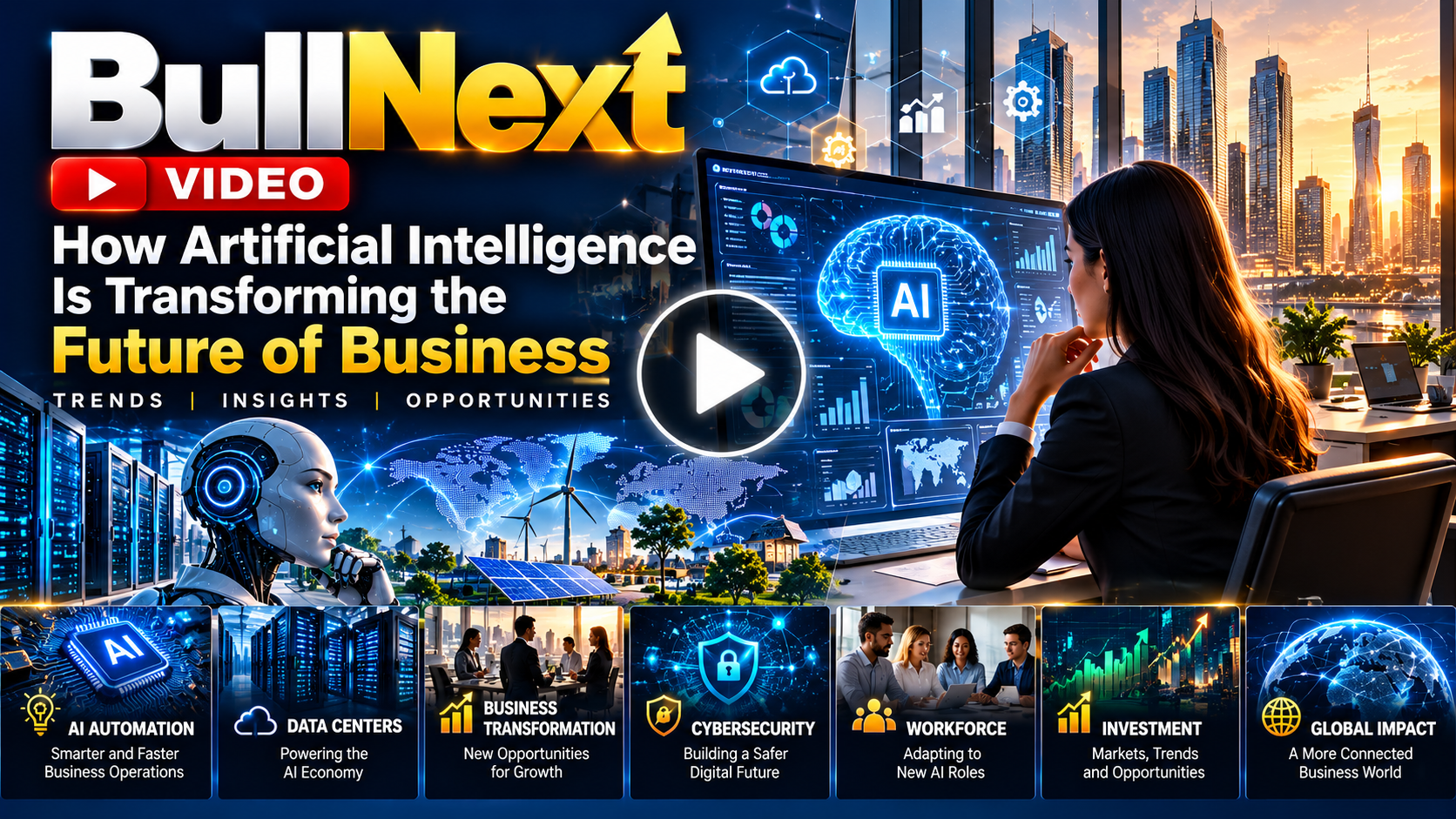
In this BullNext Video, we explore how artificial intelligence is transforming modern business, why companies are investing heavily in AI infrastructure, how employees are adapting to new technologies and what businesses should consider as they enter the next phase of digital transformation.
BullNext's current technology coverage already highlights AI, automation, cloud computing, data analytics and connected technologies as major forces reshaping modern organizations.
Watch the BullNext Video
The BullNext Video explores the major trends shaping the AI-driven business environment.
From intelligent software and AI agents to data infrastructure and cybersecurity, the video provides a broad overview of how companies are preparing for a technology-driven future.
The central message is simple:
Artificial intelligence is becoming part of business infrastructure, not simply another software tool.
Companies that understand how to integrate AI into their operations may have opportunities to improve productivity, reduce costs and develop new services.
At the same time, businesses must manage cybersecurity, data privacy, employee training, regulation and the risks associated with relying on automated systems.
AI Is Moving Into Everyday Business Operations
The first stage of the AI boom was dominated by experimentation.
Businesses tested chatbots, content-generation tools, image generators and basic automation platforms.
The next stage is more practical.
Companies are increasingly asking how AI can become part of everyday operations.
For example, a company might use AI to analyze customer requests before sending complex cases to employees.
A financial organization could use machine learning to identify unusual transactions.
A retailer could use AI to forecast demand and personalize recommendations.
A manufacturer could combine AI with sensors to identify potential equipment failures.
A software company could use AI coding assistants to accelerate development.
These applications have something in common.
They are connected to specific business processes.
This represents an important change in how companies approach AI.
Instead of asking what an AI model can do, businesses are increasingly asking:
What business problem can AI solve?
From AI Experiments to AI Strategy
Artificial intelligence is becoming a strategic issue for executives.
Technology departments can no longer be the only teams responsible for AI.
Marketing leaders need to understand AI-powered customer engagement.
Finance teams need to evaluate AI investment.
Human-resources departments need to prepare employees for changing roles.
Operations teams need to identify opportunities for automation.
Cybersecurity teams need to understand new AI-related threats.
Senior executives need to determine how AI fits into the company's long-term strategy.
This means successful AI adoption requires cooperation across an organization.
Technology is only one part of the transformation.
Leadership, employees, data, processes and organizational culture are equally important.
AI Agents Could Change How Businesses Work
One of the most important developments in business AI is the growth of AI agents.
Traditional AI applications generally respond to individual prompts.
AI agents are designed to perform sequences of tasks.
For example, an AI agent could receive a customer request, search a company's internal information, analyze the customer's account, prepare a response and send the case to a human employee if additional approval is required.
Another agent could help manage a sales pipeline.
It could analyze leads, identify high-priority opportunities, prepare information for sales representatives and update relevant systems.
These capabilities could change the role of software inside businesses.
Instead of employees simply using software, software may increasingly perform work on behalf of employees.
The Importance of Data
AI systems are only as useful as the information available to them.
Businesses generate enormous quantities of data through websites, applications, customer interactions, financial systems, supply chains and connected devices.
The challenge is turning that information into something useful.
Data may be incomplete, duplicated, outdated or stored in disconnected systems.
Companies therefore need strong data infrastructure before they can fully benefit from advanced AI.
BullNext's existing coverage of Big Data highlights how organizations across finance, healthcare, retail, manufacturing and technology are increasingly using large datasets for analytics, forecasting and decision-making.
The connection between AI and data will become increasingly important.
AI models may become more capable, but businesses still need accurate and reliable information.
AI Infrastructure Is Becoming a Major Industry
AI also depends on physical infrastructure.
Advanced AI systems require significant computing power.
That means businesses and technology companies are investing in:
Data centers
Advanced processors
Memory
Networking equipment
Cloud infrastructure
Storage
Cooling systems
Electricity generation
Cybersecurity
The AI economy therefore extends far beyond software.
A company developing AI applications may depend on cloud providers.
Cloud providers depend on data centers.
Data centers depend on energy infrastructure.
Energy infrastructure depends on equipment manufacturers and utilities.
This creates an interconnected technology ecosystem.
Data Centers and the AI Economy
Data centers are becoming increasingly important as AI adoption expands.
Traditional cloud computing already required large amounts of infrastructure.
AI workloads can require additional computing capacity, especially for large-scale model training and inference.
This has created new opportunities for companies involved in data-center construction, networking, cooling and energy.
However, expansion also creates challenges.
Data centers require electricity.
Some facilities require significant cooling capacity.
Communities must consider land use and infrastructure requirements.
Energy providers must determine how to accommodate additional demand.
The future of AI is therefore closely connected to the future of energy and infrastructure.
AI and the Changing Workforce
One of the biggest questions surrounding AI is what it means for workers.
Some tasks will likely become increasingly automated.
But automation does not necessarily mean that entire professions disappear.
In many cases, AI changes the tasks within a job.
A marketer may spend less time creating routine content and more time developing strategy.
An analyst may spend less time collecting information and more time interpreting results.
A software developer may spend less time writing repetitive code and more time reviewing architecture.
A customer-service employee may focus on complex cases while AI handles routine questions.
This could create a new model of work in which humans and AI systems operate together.
Human Judgment Remains Important
AI can process large quantities of information quickly.
But businesses still need human judgment.
Employees and executives must determine whether information is accurate, whether a decision is appropriate and whether an automated recommendation should be accepted.
This is particularly important in sensitive areas such as finance, healthcare, employment and legal services.
Human oversight can help organizations manage errors, bias, privacy concerns and unexpected outcomes.
The future may therefore be less about replacing people and more about increasing the capabilities of people.
AI Could Improve Productivity
Productivity is one of the most important potential benefits of AI.
If employees can complete tasks faster, companies may be able to produce more without increasing resources at the same rate.
AI could potentially improve productivity through:
Automated document processing
Faster research
Intelligent customer support
Predictive analytics
Software development assistance
Automated reporting
Supply-chain optimization
Marketing personalization
Financial forecasting
Knowledge management
However, productivity gains are not automatic.
Companies need to redesign workflows and train employees.
Simply purchasing an AI tool does not guarantee better performance.
The technology must be integrated into the way employees actually work.
Small Businesses Can Also Benefit
AI is not limited to large corporations.
Small businesses can access many AI-powered tools through cloud platforms and software subscriptions.
A small retailer can use AI for marketing.
A startup can use AI-assisted software development.
A consulting company can use AI to summarize research.
An online business can use AI customer support.
A local company can use AI-powered analytics to understand customer behavior.
This could reduce some of the technology advantages traditionally enjoyed by large organizations.
Small businesses may be able to compete more effectively if they use technology efficiently.
AI Is Changing Marketing
Marketing is another area experiencing significant AI adoption.
Businesses can use AI to analyze customer behavior, identify audience segments, personalize communications and automate parts of campaign management.
Generative AI can also assist with:
Content creation
Product descriptions
Advertising concepts
Email campaigns
Social media planning
Market research
Customer analysis
But human creativity remains important.
Brands need a clear identity and understanding of their audiences.
AI can help accelerate production, but businesses still need people to determine what message should be communicated and why.
AI and Customer Service
Customer service is one of the most visible applications of business AI.
AI assistants can answer common questions at any time.
They can help customers find information, track orders and troubleshoot simple problems.
This can reduce the workload on human service teams.
However, businesses need to make sure customers can reach a human when necessary.
A poorly designed automated system can create frustration.
The most effective model may therefore combine AI efficiency with human escalation.
AI in Finance
Financial services are particularly suitable for data-driven technologies.
AI can analyze large quantities of financial information and identify patterns that might be difficult for humans to detect manually.
Potential applications include:
Fraud detection
Risk analysis
Financial forecasting
Customer segmentation
Automated reporting
Compliance monitoring
Market analysis
However, financial AI systems require strong governance.
Incorrect recommendations can have significant consequences.
Companies must therefore evaluate models carefully and maintain appropriate oversight.
AI and Cybersecurity
AI creates opportunities and risks for cybersecurity.
Security teams can use AI to identify unusual activity and analyze large volumes of security data.
AI can help organizations detect potential threats faster.
At the same time, attackers can use AI to create more sophisticated scams, automate attacks and generate convincing fraudulent communications.
This means cybersecurity is becoming even more important as businesses increase their dependence on AI.
Organizations need security strategies that address both traditional cyber threats and emerging AI-related risks.
The Rise of AI-Powered Enterprise Technology
Enterprise technology is evolving from simple software applications toward intelligent systems.
BullNext's vedio enterprise technology coverage describes how organizations are combining AI, cloud computing, Big Data, cybersecurity, automation, IoT and enterprise software to create more connected business operations.
This convergence could become one of the defining trends of the next decade.
An enterprise system may increasingly be able to understand information, identify patterns, recommend actions and execute certain tasks.
The result could be organizations that operate with greater automation while maintaining human control over important decisions.
AI and Digital Transformation
Digital transformation has traditionally involved moving business processes from manual or physical systems into digital environments.
AI takes that transformation further.
Instead of simply digitizing a process, companies can make the process intelligent.
For example:
A traditional company might digitize customer records.
A digitally transformed company might connect those records to analytics.
An AI-driven company could use those records to predict customer needs and automatically recommend actions.
This progression demonstrates why AI is becoming an important part of digital transformation.
The Importance of Cloud Computing
Cloud infrastructure is another important part of the AI ecosystem.
Businesses can access computing power, storage and software without building all infrastructure themselves.
This makes advanced technology more accessible.
Companies can scale their computing resources depending on demand.
Cloud platforms also allow organizations to connect AI tools with existing business systems.
As AI adoption expands, cloud providers are likely to remain important players in the technology economy.
AI and Global Competition
AI is also becoming a major factor in international competition.
Countries and companies are investing heavily in research, computing infrastructure, semiconductor manufacturing and technical talent.
The competition is not simply about developing the best AI model.
It is also about controlling the infrastructure required to operate AI at scale.
This includes chips, data centers, energy, cloud computing and telecommunications.
As a result, AI is increasingly connected to national economic strategy.
The Semiconductor Connection
Semiconductors are fundamental to modern AI.
Advanced processors allow companies to train and operate sophisticated models.
Demand for AI computing has therefore increased the strategic importance of semiconductor companies and manufacturing infrastructure.
Governments are also paying greater attention to semiconductor supply chains.
The technology industry depends on a complex international network of design companies, manufacturing facilities, equipment suppliers and materials providers.
Any disruption can affect industries far beyond technology.
AI and the Future of Entrepreneurship
AI may also change how startups are created.
Entrepreneurs can now access tools that assist with:
Market research
Coding
Marketing
Design
Customer support
Financial analysis
Content creation
Business planning
This can allow small teams to accomplish more with limited resources.
However, technology does not eliminate the need for strong business ideas.
Entrepreneurs still need to understand customers, develop products and build sustainable business models.
AI can accelerate execution, but it cannot guarantee demand.
Risks Businesses Need to Consider
AI adoption also comes with significant risks.
Data Privacy
Businesses need to understand how customer and employee information is processed.
Security
AI systems can create new attack surfaces.
Accuracy
AI-generated information can sometimes be incorrect.
Bias
AI systems can reproduce problems in the data used to train them.
Regulation
Governments continue to develop rules for AI and digital technologies.
Employee Adoption
Employees may resist technologies that they do not understand or trust.
Cost
Advanced AI infrastructure can require significant investment.
Businesses therefore need responsible AI strategies.
Responsible AI Is Becoming More Important
Responsible AI means developing and using artificial intelligence with appropriate safeguards.
Businesses should consider:
Transparency
Privacy
Security
Human oversight
Accuracy
Fairness
Accountability
This is particularly important when AI is used to make decisions affecting customers or employees.
Trust could become a major competitive advantage.
Customers may prefer companies that clearly explain how their AI systems are used and provide appropriate human support.
What Businesses Should Do Now
Companies preparing for the next stage of AI adoption can take several practical steps.
Start With a Business Problem
Do not adopt AI simply because competitors are doing so.
Identify a specific problem where technology could create measurable value.
Improve Data Quality
Clean, organized and accessible data provides a stronger foundation for AI.
Train Employees
Employees need to understand how AI tools work and how they should be used.
Establish Governance
Companies should define who is responsible for AI systems and how performance will be monitored.
Protect Sensitive Information
Cybersecurity and privacy should be included from the beginning.
Measure Results
Businesses should track productivity, costs, revenue, customer satisfaction and other relevant outcomes.
Scale Gradually
Successful pilot projects can be expanded once their value has been demonstrated.
What the Future Could Look Like
The future of business may involve AI systems operating continuously alongside employees.
An organization could have AI systems monitoring sales, analyzing financial information, supporting customers, identifying operational problems and assisting managers.
Employees could focus more heavily on strategy, creativity, relationships and complex decision-making.
This does not mean businesses will become completely automated.
Instead, organizations may become more intelligent and connected.
The most successful companies may be those that combine advanced technology with strong human leadership.
Why AI Matters for Investors
AI is also creating a major investment theme.
Investors are looking beyond software companies to the broader ecosystem.
Potential beneficiaries include:
Semiconductor manufacturers
Cloud providers
Data-center operators
Networking companies
Cybersecurity firms
Enterprise software companies
Energy infrastructure companies
Industrial technology companies
However, investors also need to consider valuation and execution risk.
A company operating in the AI industry does not automatically become a successful investment.
The important questions include whether the company has sustainable demand, competitive advantages, strong financial performance and a realistic path to profitability.
The Next Decade of Business Technology
The next decade could see AI becoming embedded in almost every major industry.
Healthcare could use AI for research and administrative processes.
Manufacturing could use intelligent robotics.
Finance could use advanced risk systems.
Retail could become more personalized.
Transportation could become increasingly automated.
Education could become more adaptive.
Professional services could use AI to accelerate research and analysis.
The scale of transformation will depend on technology development, regulation, infrastructure investment and consumer adoption.
BullNext Video: The Bigger Picture
The AI story is not simply about robots or chatbots.
It is about how technology changes the structure of the economy.
AI affects businesses.
Businesses affect employment.
Employment affects consumers.
Consumers influence markets.
Markets influence investment.
Investment determines which technologies receive more capital.
That creates a cycle in which technology and economics increasingly influence one another.
This is why understanding AI requires more than understanding technology.
It requires understanding business.
Final Thoughts
Artificial intelligence is becoming one of the most important forces shaping the future of business.
Companies are moving from experimentation toward practical implementation.
AI is becoming part of customer service, marketing, finance, software development, cybersecurity, logistics and decision-making.
At the same time, the technology is creating demand for new infrastructure, including data centers, semiconductors, cloud platforms and energy systems.
The transformation will create opportunities, but it will also create challenges.
Businesses must manage privacy, cybersecurity, regulation, employee adoption and investment costs.
The organizations that succeed may not necessarily be those with the most advanced technology.
They may be the organizations that understand how to connect technology with real business problems.
AI can provide speed.
Data can provide insight.
Automation can provide efficiency.
But leadership determines how these capabilities are used.
That combination will shape the next generation of business.
Watch the BullNext Video to explore how artificial intelligence, digital transformation and emerging technologies are redefining the modern business landscape.
Frequently Asked Questions
What is the BullNext Video about?
This BullNext Video explores how artificial intelligence is transforming businesses through automation, data analysis, intelligent software, AI agents and digital infrastructure.
Why is AI important for modern businesses?
AI can help businesses automate repetitive tasks, analyze information, improve customer service, support employees and develop new products and services.
What are AI agents?
AI agents are systems designed to perform multiple connected tasks rather than simply responding to individual prompts. They can potentially interact with business systems and complete workflows with appropriate human oversight.
Will AI replace employees?
AI is expected to automate some tasks and change many jobs, but businesses may increasingly use AI alongside employees. Human judgment, creativity and decision-making will remain important.
Why is data important for AI?
AI systems depend on data to generate useful analysis and recommendations. Poor-quality or incomplete data can reduce the effectiveness of AI applications.
What industries are using AI?
AI is being explored across technology, finance, healthcare, retail, manufacturing, logistics, marketing, cybersecurity and professional services.
What are the risks of business AI?
Major risks include privacy problems, cybersecurity threats, inaccurate outputs, bias, regulatory uncertainty, employee resistance and implementation costs.
How can small businesses use AI?
Small businesses can use AI for marketing, customer support, research, content creation, data analysis, administrative tasks and software development.
What is the future of AI in business?
AI is likely to become increasingly integrated into everyday workflows, with intelligent systems assisting employees, automating routine processes and supporting business decisions.
Why should businesses invest in AI infrastructure?
AI requires computing, data, cloud platforms, networking and security infrastructure. Strong infrastructure can help businesses deploy AI systems more reliably and at greater scale.
Disclaimer: This article is for informational purposes only and does not constitute financial, investment, business, technology or professional advice. AI developments and market conditions can change rapidly, and readers should conduct their own research where appropriate.