
Artificial intelligence is moving beyond experimentation and becoming part of everyday business operations. Companies are increasingly looking for practical ways to use AI to reduce repetitive work, improve efficiency, process information, and create faster workflows.
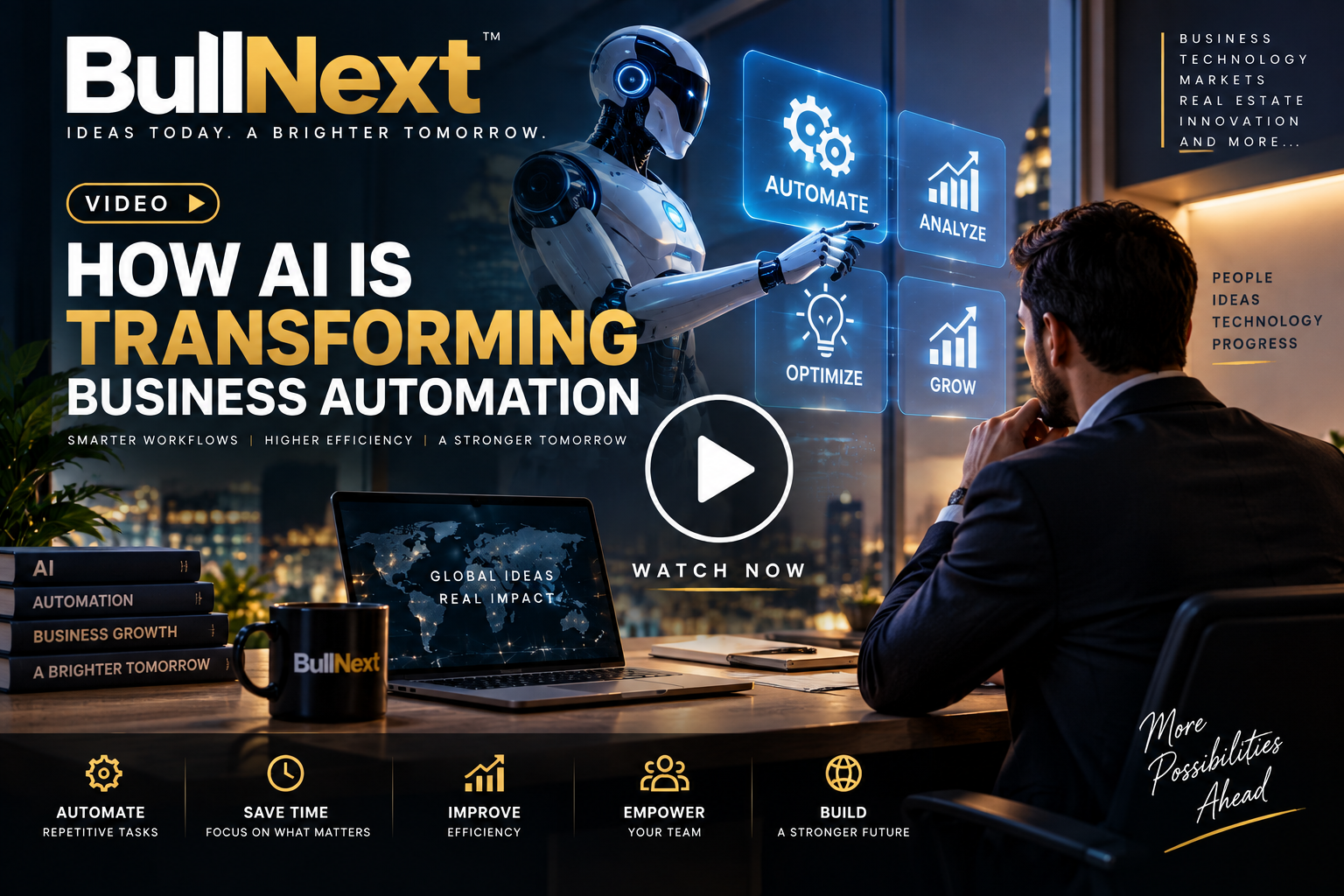
The BullNext video on AI and business automation explores how intelligent systems can help businesses turn repetitive processes into automated workflows that operate continuously.
From Manual Work to Intelligent Automation
Many businesses still depend on employees to perform repetitive tasks every day.
Processing orders, organizing information, responding to routine requests, preparing documents, updating systems, and monitoring workflows can consume valuable time.
AI automation offers a different approach.
Instead of requiring employees to complete every repetitive step manually, intelligent systems can process information, execute predefined actions, identify exceptions, and send important tasks to people when human attention is required.
The BullNext Approach
The BullNext video highlights a practical approach to AI development built around four stages:
Research → Build → Launch → Improve
The process begins by understanding a real business problem rather than simply introducing AI because the technology is available.
Once a valuable opportunity is identified, an AI system can be designed around the specific workflow. After development, the system can be launched into a real business environment and continuously improved based on performance and feedback.
What Can AI Automation Handle?
AI automation can potentially support a wide range of business processes.
Examples include:
Processing incoming orders
Organizing business information
Generating documents
Classifying data
Handling repetitive customer workflows
Monitoring operational processes
Identifying exceptions
Connecting different software systems
Supporting internal business operations
The objective is not necessarily to replace people. Instead, automation can handle repetitive work while employees focus on tasks requiring judgment, creativity, relationships, and strategic thinking.
The Value of Always-On Systems
One of the major advantages of automation is the ability to operate continuously.
An automated workflow does not need to follow traditional working hours. Depending on how it is designed, it can process information and perform routine operations around the clock.
For businesses handling large volumes of information or repetitive processes, this can create opportunities to improve response times and operational efficiency.
AI Agents and Business Workflows
The next generation of business automation is increasingly focused on AI agents.
AI agents can be designed to perform multiple steps within a workflow rather than simply responding to individual prompts.
For example, an automated system could receive information, analyze it, determine the appropriate next step, update another system, generate documentation, and flag an unusual case for human review.
This moves AI from a simple conversational tool toward a more integrated business capability.
Why Practical AI Matters
AI technology receives significant attention, but successful implementation depends on solving real problems.
A business does not necessarily need the most advanced AI system available. It needs a system that addresses a meaningful problem and produces measurable value.
That is why understanding the workflow, identifying bottlenecks, establishing clear objectives, and continuously improving the system are important parts of AI adoption.
The Future of Business Automation
As AI technology continues to develop, more companies are likely to integrate intelligent automation into everyday operations.
Businesses may increasingly use AI to process information, coordinate workflows, support employees, interact with customers, and make operational decisions.
The companies that benefit most may not simply be those that adopt AI first. They may be those that understand where AI can create genuine value and integrate it effectively into their existing operations.
Watch the BullNext Video
The BullNext video provides a practical look at how AI can move from an idea into a working business system.
It highlights the shift from AI demonstrations toward production-ready automation designed around real business needs.
For entrepreneurs, business leaders, and technology professionals, the video offers a useful perspective on how intelligent automation could shape the next generation of business operations.
Conclusion
AI automation is changing how businesses approach repetitive work.
By combining intelligent software with clearly defined business processes, organizations can automate routine operations, improve efficiency, and allow employees to spend more time on higher-value activities.
The future of business automation will likely be less about AI as a standalone technology and more about AI becoming an integrated part of everyday workflows.
Watch the BullNext video to explore how practical AI automation is transforming the way businesses work.