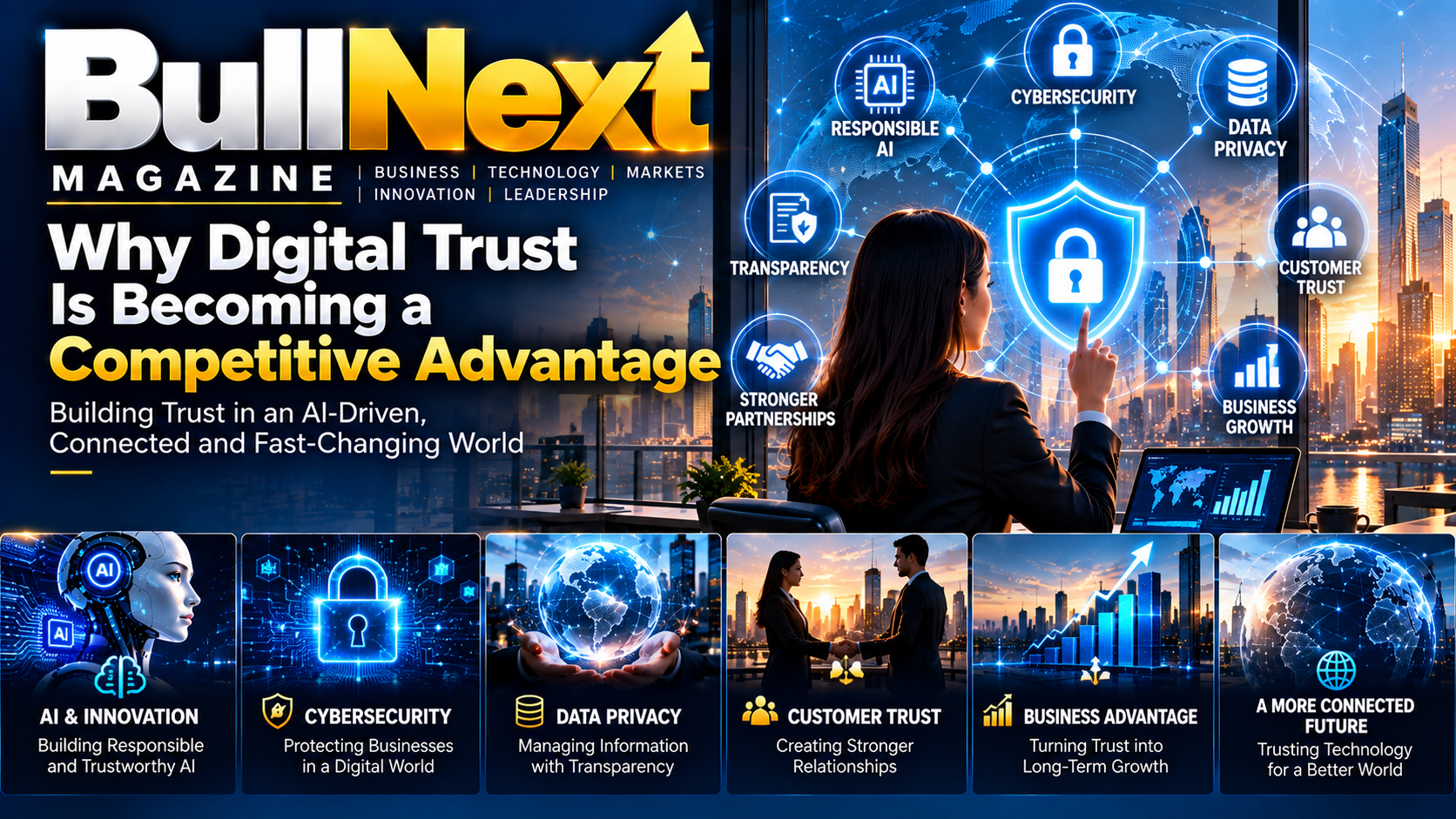
Trust has always been one of the most valuable assets in business.
Customers need to trust companies with their money, personal information and purchases. Employees need to trust the organizations they work for. Investors need confidence in management. Partners need reliable systems and transparent communication.
But as more business activity moves into digital environments, trust is changing.
Companies are no longer judged only by the quality of their products or services. They are increasingly judged by how they handle data, protect digital systems, use artificial intelligence, communicate with customers and respond when something goes wrong.
This is creating a new business concept: digital trust.
Digital trust is becoming particularly important as companies adopt AI, cloud platforms, digital payments, bullnext magazine connected systems and automated decision-making. The World Economic Forum has highlighted trust, governance and human oversight as important challenges as organizations scale AI.
For modern businesses, trust is no longer simply a branding issue.
It is becoming part of infrastructure.
What Is Digital Trust?
Digital trust is the confidence that customers, employees, partners and other stakeholders have in a company's digital systems and practices.
It includes questions such as:
Is customer information protected?
Is the company's website secure?
Are digital transactions reliable?
Is AI being used responsibly?
Can customers understand how their data is used?
Are automated decisions monitored?
Can the company respond quickly to cyber incidents?
Does the organization take responsibility when something goes wrong?
A business can have excellent technology and still lose trust if customers do not understand or believe how that technology is being used.
Digital trust therefore sits at the intersection of technology, cybersecurity, privacy, transparency, governance and customer experience.
Why Trust Is Becoming More Important
Digital transformation has created enormous convenience.
Customers can open accounts online, make payments instantly, communicate with companies through messaging platforms and receive personalized recommendations.
Businesses can analyze huge quantities of information, automate operations and use AI to support employees.
But greater digital dependence also creates greater exposure.
A security incident can damage a company's reputation.
A poorly designed AI system can produce incorrect information.
A data leak can affect customers and employees.
A confusing automated system can frustrate users.
A cyberattack can interrupt operations.
The World Economic Forum's 2026 cybersecurity research describes cyber risk as increasingly strategic rather than simply technical, with AI, geopolitical volatility and supply-chain vulnerabilities increasing the complexity of the threat environment.
This means businesses need to think about trust before problems occur rather than trying to rebuild confidence afterward.
AI Is Changing the Definition of Trust
Artificial intelligence has introduced a new dimension to digital trust.
Traditional software generally follows predefined instructions.
AI systems can analyze information, generate content, make recommendations and, increasingly, interact with other systems.
As businesses give AI greater responsibilities, customers and employees may naturally ask:
Can we trust the system to make the right decision?
That question becomes even more important when AI is involved in financial services, healthcare, customer support, hiring, cybersecurity or other sensitive areas.
The challenge is not simply making AI powerful.
The challenge is making AI reliable, understandable, secure and accountable.
The World Economic Forum has argued that AI's economic potential depends heavily on responsible deployment and verifiable trust, including transparency, traceability and accountability.
The Rise of Trusted AI
The next stage of enterprise AI may therefore focus less on simply deploying more models and more on creating systems that businesses can confidently control.
Trusted AI can involve several elements:
Governance
Companies need clear rules for how AI systems are selected, deployed and monitored.
Data Quality
AI depends heavily on the information provided to it. Poor, outdated or fragmented data can produce poor results.
Security
AI systems must be protected from unauthorized access, manipulation and malicious use.
Human Oversight
Important decisions may still require human review, particularly when errors could create significant consequences.
Transparency
Organizations should understand where AI is being used and communicate appropriately with affected users.
Monitoring
AI systems can change their behavior based on inputs, updates and surrounding systems, making ongoing monitoring important.
These principles can help businesses move from AI experimentation toward responsible implementation.
Data Has Become a Trust Asset
Data is one of the most valuable resources in the modern economy.
Companies collect information from websites, applications, payment systems, customer-service interactions, connected devices and other digital channels.
But collecting data creates responsibility.
Customers increasingly want to know:
What information is being collected?
Why is it being collected?
Who can access it?
How long is it stored?
Is it shared with third parties?
How is it protected?
Businesses that answer these questions clearly can create stronger relationships with customers.
Companies that hide their practices or make privacy policies unnecessarily difficult to understand can create uncertainty.
Data governance should therefore be viewed not only as a compliance function but also as a trust-building activity.
Cybersecurity Is Now a Business Issue
Cybersecurity was once primarily viewed as an IT department responsibility.
That approach is becoming increasingly difficult to maintain.
A serious cyber incident can affect sales, customer relationships, operations, finances and reputation.
Cyber-enabled fraud is also becoming a major concern. The World Economic Forum's 2026 Global Cybersecurity Outlook identified cyber-enabled fraud as a pervasive global threat and highlighted the increasing role of AI in both attacks and defence.
This creates a need for executives and boards to understand cyber risk as part of overall business strategy.
A company does not become resilient simply by purchasing more security software.
It also needs:
Employee awareness
Strong access controls
Incident-response planning
Secure software development
Data protection
Vendor risk management
Regular testing
Leadership accountability
Cybersecurity is ultimately about protecting the ability of a business to operate and maintain confidence.
Customer Experience and Digital Trust
Trust directly influences customer experience.
Imagine two companies offering similar products.
Company A provides clear information about pricing, privacy and security. Its digital systems are reliable, and customers can easily reach a human representative when necessary.
Company B has confusing policies, unreliable digital services and limited communication about how customer information is handled.
Even if the products are similar, customers may feel more comfortable with Company A.
This demonstrates an important point:
Digital trust can become part of the customer experience.
Security should not always be invisible.
Clear communication can help customers understand how a company protects their information and uses technology.
Digital Payments and Trust
The growth of digital payments provides another example.
Consumers increasingly expect payments to be fast and convenient.
At the same time, they need confidence that transactions are accurate and secure.
If customers see an unfamiliar transaction description, experience repeated payment failures or receive confusing information, trust can decline.
Technology can help improve transparency.
AI and data systems can potentially identify unusual activity, improve transaction information and reduce friction.
The World Economic Forum's 2026 discussion of AI in financial services highlights customer trust, transparency and human oversight as important considerations as institutions scale AI.
The lesson extends beyond financial services.
Whenever money moves digitally, trust becomes part of the product.
The Importance of Transparency
Transparency does not mean revealing every technical detail.
It means giving stakeholders enough understandable information to make informed decisions.
For example, an organization using AI for customer support could explain:
That AI is being used
What types of questions it handles
When a customer can request human assistance
How information is protected
What happens when the system cannot provide a reliable answer
This approach can reduce uncertainty.
Transparency also becomes important when businesses make mistakes.
A company that acknowledges a problem, explains what happened and communicates corrective actions may have a better opportunity to preserve trust than an organization that remains silent.
Trust and Business Reputation
Reputation can take years to build and very little time to damage.
A single cybersecurity incident does not automatically destroy a company.
The response can matter just as much.
Businesses should prepare for difficult situations before they occur.
An effective response can include:
Detecting the problem quickly
Containing the incident
Protecting affected systems
Communicating with relevant stakeholders
Investigating the cause
Fixing vulnerabilities
Explaining corrective measures
The goal is not to pretend that problems will never happen.
The goal is to demonstrate that the organization is prepared to respond responsibly.
Supply Chains and Digital Trust
Modern businesses rarely operate alone.
They depend on software providers, cloud platforms, payment processors, logistics companies, manufacturers, consultants and other partners.
This creates another dimension of digital trust.
A company may have excellent internal security but still face risk through a third-party supplier.
Businesses therefore need to consider:
Vendor security
Data-sharing practices
Access permissions
Software dependencies
Cloud infrastructure
Supplier continuity
Incident-response responsibilities
Trust increasingly extends beyond the company's own walls.
A business ecosystem is only as resilient as its weakest important connection.
Employees Are Part of the Trust Equation
Technology cannot create digital trust by itself.
Employees play a major role.
A company may have sophisticated security systems, but employees still need to recognize suspicious messages, protect credentials and follow appropriate procedures.
AI also creates new workforce questions.
Employees need to understand when AI can be used, what information should not be entered into AI systems and when human review is required.
Training is therefore becoming an important part of responsible technology adoption.
The strongest digital-trust strategy combines technology with informed people.
Trust Can Become a Competitive Advantage
For years, businesses competed through price, product quality, distribution and branding.
Digital trust adds another potential source of differentiation.
Customers may prefer companies that demonstrate:
Strong security
Responsible AI use
Clear privacy practices
Reliable digital services
Transparent communication
Accountable leadership
This can be particularly important in industries where customers provide sensitive information or depend heavily on digital systems.
Trust can influence whether someone completes a purchase, opens an account, signs a contract or recommends a company to others.
In this sense, trust can become an economic asset.
Small Businesses Need Digital Trust Too
Digital trust is not only a concern for large corporations.
Small businesses increasingly depend on websites, ecommerce platforms, digital payments, social media, cloud applications and online advertising.
A small business can take practical steps without building a massive security department.
These can include:
Using strong passwords and multi-factor authentication
Keeping software updated
Limiting employee access
Backing up important information
Choosing reputable technology providers
Training employees about phishing
Creating a basic incident-response plan
Explaining privacy practices clearly
Small improvements can significantly reduce avoidable risks.
Building a Digital Trust Strategy
A practical digital-trust strategy can begin with five questions.
1. What digital assets are most important?
Identify customer data, financial systems, websites, applications and other critical assets.
2. Who has access?
Review employees, vendors and applications that can access sensitive information.
3. Where is AI being used?
Create visibility into AI tools and identify what information they process.
4. What happens when something goes wrong?
Develop a response plan for cyber incidents, data exposure and technology failures.
5. How do customers experience trust?
Review the company's website, payment process, privacy communication and customer-support experience from the user's perspective.
These questions can help turn digital trust from an abstract concept into a practical business discipline.
The Economics of Trust
Trust can be difficult to measure directly.
However, its business effects can appear through measurable outcomes.
Trust can influence:
Customer retention
Conversion rates
Brand reputation
Partnership opportunities
Employee confidence
Investor relationships
Adoption of new technologies
Customer support costs
When customers trust a digital service, they may be more willing to use additional features.
When employees trust technology, they may be more willing to adopt it.
When partners trust an organization, collaboration can become easier.
Trust therefore has the potential to support growth as well as risk reduction.
The Future of Digital Trust
The future will likely involve even deeper integration between humans, AI and digital systems.
AI agents may increasingly interact with business applications.
Automated systems may make recommendations or execute routine actions.
Digital identities may become more important.
Businesses may rely on increasingly interconnected technology ecosystems.
These developments can create enormous opportunities.
They can also create new questions.
Who is responsible when an AI agent makes a mistake?
How can businesses prove that automated systems are operating within policy?
How can customers understand how their information is being used?
How can companies verify the reliability of third-party systems?
These questions will become increasingly important as technology moves from assisting people to acting on their behalf.
Trust Will Shape the Next Business Era
The next generation of digital businesses may not be defined simply by how advanced their technology is.
They may be defined by how confidently people can use that technology.
The companies that combine innovation with security, transparency and accountability could have an important advantage.
This does not mean businesses should slow down innovation.
It means innovation should be designed with trust from the beginning.
The World Economic Forum's recent work emphasizes that cybersecurity resilience increasingly requires verification, collaboration and trust across business ecosystems.
The message is straightforward:
Technology creates possibilities. Trust makes those possibilities usable.
What Businesses Can Do Now
Companies looking to strengthen digital trust can begin with a practical checklist:
Audit important digital systems
Review access permissions
Strengthen authentication
Identify AI applications across the organization
Establish AI governance rules
Improve employee security training
Review third-party technology providers
Test incident-response plans
Communicate privacy practices clearly
Monitor important digital systems
Establish leadership accountability
Measure customer confidence and digital experience
These steps do not require every company to become a technology giant.
They require organizations to understand that trust is now part of how digital business works.
Frequently Asked Questions
What is digital trust?
Digital trust is the confidence that customers, employees, partners and other stakeholders have in an organization's digital technology, data practices, security and responsible use of technology.
Why is digital trust important for businesses?
Digital trust can influence customer relationships, technology adoption, reputation, cybersecurity resilience and long-term business growth.
How does AI affect digital trust?
AI can create new opportunities but also raises questions about accuracy, privacy, security, accountability and human oversight. Responsible governance can help businesses build confidence in AI systems.
Is cybersecurity part of digital trust?
Yes. Cybersecurity is one of the fundamental components of digital trust because customers and partners need confidence that their information and digital interactions are protected.
Can small businesses build digital trust?
Yes. Small businesses can improve digital trust through strong authentication, secure software, employee training, reliable technology providers, clear privacy practices and basic incident-response planning.
How can companies build trust in AI?
Companies can establish clear AI governance, monitor AI systems, protect data, maintain human oversight, document important decisions and communicate appropriately with users.
Is digital trust only about cybersecurity?
No. Digital trust also includes privacy, transparency, reliability, accountability, responsible AI, customer experience and ethical technology use.
Will digital trust become more important?
As businesses become more dependent on AI, cloud systems, digital payments and connected platforms, confidence in those systems is likely to become increasingly important.
Conclusion
The digital economy is entering a new phase.
Technology is becoming more powerful, more connected and increasingly capable of acting on behalf of people and organizations.
That creates opportunities for greater efficiency, personalization and innovation.
But it also creates a fundamental requirement:
Trust.
Businesses need customers to trust their platforms.
Employees need to trust the systems they use.
Partners need confidence in shared technology.
Leaders need visibility into digital risks.
And AI systems need governance, monitoring and accountability.
The companies that recognize this early may gain an advantage.
Digital trust should not be treated as a final layer added after technology has been built.
It should become part of the design.
As BullNext Magazine continues exploring business, technology, markets and innovation, digital trust represents one of the most important connections between them.
The future of business will not simply belong to the companies with the most advanced technology.
It may belong to the companies people trust to use that technology responsibly.
Disclaimer: This article is for informational and educational purposes only and does not constitute financial, investment, legal or cybersecurity advice.