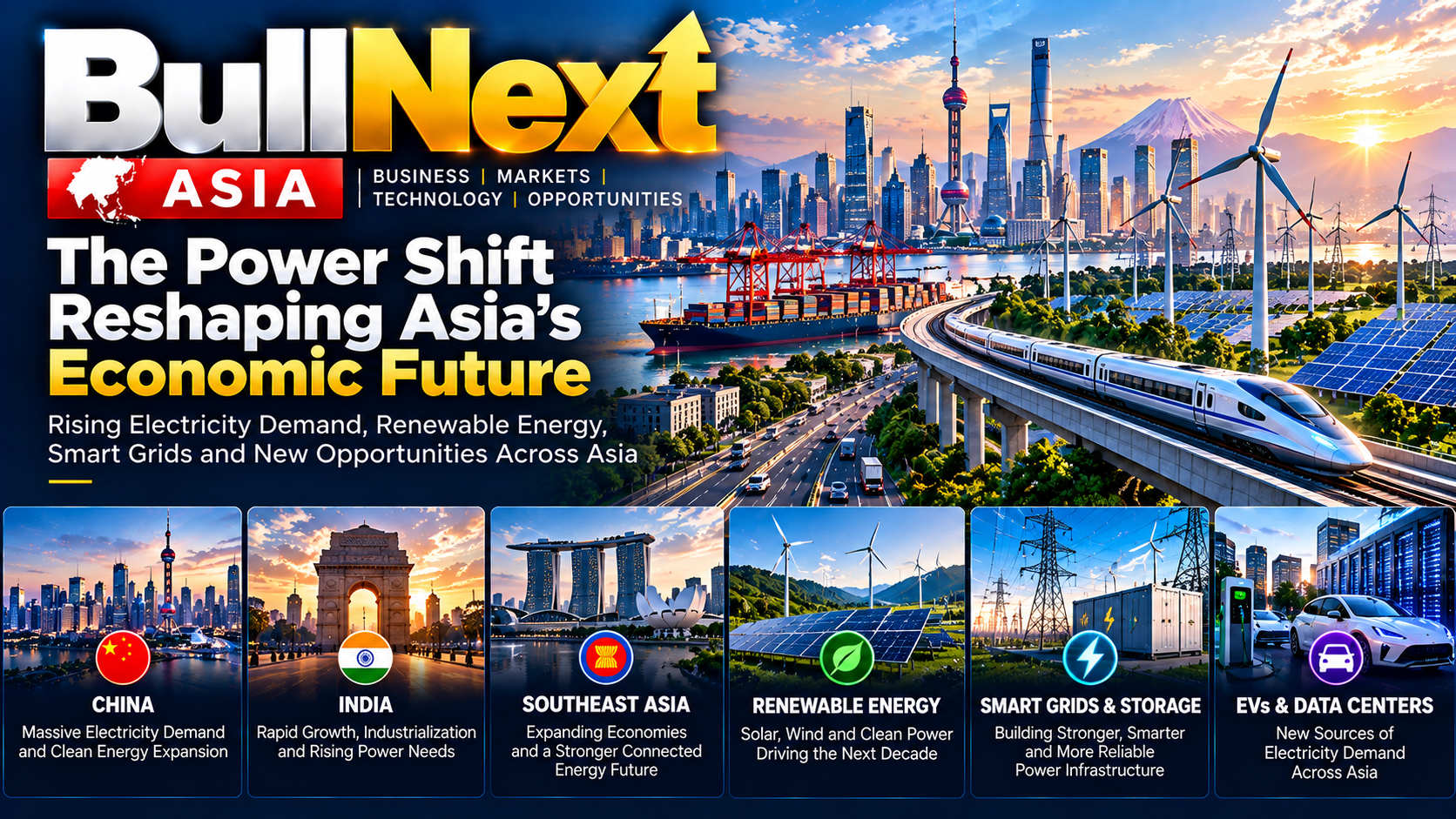
bullnext Asia's next major economic transformation may be powered by something more fundamental than artificial intelligence or digital commerce: electricity.
Across the region, factories are becoming more automated, cities are expanding, electric vehicles are gaining momentum, data centers are growing and millions of households are using more cooling and digital technology.
All of these developments require one thing: reliable power.
The International Energy Agency expects electricity demand in China, India and Southeast Asia to remain a major source of global growth through 2030. China alone is projected to account for nearly half of global electricity-demand growth during the 2026–2030 period, while electricity demand is forecast to grow by about 6.4% annually in India and 5.3% in Southeast Asia.
This is creating a new economic opportunity across Asia.
The future will not simply be about producing more electricity. It will be about building smarter grids, renewable generation, energy storage, transmission networks and resilient infrastructure capable of supporting the next generation of Asian growth.
Asia Is Entering an Age of Electricity
Electricity has always been important to economic development.
But its role is expanding rapidly.
Manufacturing plants increasingly depend on automation and robotics. Transportation is becoming more electrified. Businesses rely on cloud computing and data centers. Consumers use more digital devices. Air-conditioning demand continues to rise as cities expand and temperatures increase.
The IEA expects global electricity demand to grow at an average rate of 3.6% annually between 2026 and 2030, significantly faster than the average rate recorded over the previous decade.
Asia is at the center of this transformation.
China, India and Southeast Asia are among the most important drivers of future electricity demand.
That means power infrastructure is increasingly becoming an economic-growth issue.
Why Electricity Matters for Asian Businesses
For businesses, reliable electricity is not simply a utility requirement.
It is part of competitiveness.
A factory needs stable power to operate production lines.
A semiconductor facility needs highly reliable electricity for sophisticated manufacturing equipment.
A data center needs continuous power to keep digital services running.
A logistics center needs electricity for automation, refrigeration and communications.
A shopping center needs electricity for lighting, cooling and digital systems.
When power systems become unreliable or expensive, businesses can face higher operating costs and greater uncertainty.
This is why investment in power infrastructure could become one of Asia's most important economic themes.
China: Scale Meets Electrification
China remains the largest electricity market in Asia and one of the most important power markets in the world.
The country's industrial base, electric-vehicle sector, technology industry and expanding digital infrastructure all contribute to electricity demand.
The IEA expects China's electricity demand to grow by an average of 4.9% annually between 2026 and 2030. Over that period, China is expected to add electricity demand equivalent to the current consumption of the European Union.
At the same time, China's rapid expansion of renewable generation is changing the structure of its electricity system.
This creates a major infrastructure challenge.
Generating electricity is only one part of the equation.
Power must also be transmitted, distributed, stored and delivered to consumers when they need it.
That makes grids increasingly important.
India’s Growing Power Demand
India represents another major part of Asia's electricity story.
The country is experiencing industrial development, urbanization, digitalization and rising consumer demand.
Electricity is required across almost every part of this transformation.
Factories need power.
Data centers need power.
Rail and transportation systems increasingly need electricity.
Homes and businesses require more cooling.
Digital services depend on reliable infrastructure.
The IEA forecasts India's electricity demand to increase by about 6.4% annually from 2026 to 2030, making the country one of the world's major sources of additional power demand.
This could create opportunities across India's energy ecosystem, including renewable energy, transmission, batteries, grid technology, energy efficiency and power-management systems.
Southeast Asia Faces a Major Energy Challenge
Southeast Asia may be one of the most interesting regions in the global energy transition.
The region combines rapid economic growth, urbanization, industrialization, rising incomes and expanding digital infrastructure.
Electricity demand is already growing faster than total energy consumption.
According to the IEA, Southeast Asia's electricity demand is expected to rise significantly over the coming decades, while demand from cooling, industry, electric mobility and data centers creates additional pressure on power systems.
This creates both a challenge and an opportunity.
Countries need more electricity, but they also need to ensure that new generation can be connected to the grid.
The Grid Could Become Asia’s Next Infrastructure Frontier
One of the biggest obstacles to the energy transition is not necessarily a shortage of generation projects.
It is the ability to connect them.
Solar farms and wind projects can be developed relatively quickly, but transmission and distribution infrastructure often takes much longer to plan, approve and construct.
The IEA estimates that more than 2,500 gigawatts of renewable, storage and large-load projects are currently stalled in grid connection queues worldwide. It also says annual grid investment would need to increase by roughly 50% by 2030 from today's level to meet projected electricity demand.
For Asia, this creates an enormous infrastructure opportunity.
Businesses involved in:
Transmission equipment
Power cables
Transformers
Smart-grid technology
Battery storage
Grid software
Energy management
Power electronics
Engineering
Construction
could become increasingly important to the region's economic development.
ASEAN Power Integration
Southeast Asia is also exploring greater regional electricity connectivity.
The concept behind the ASEAN Power Grid is to strengthen connections between countries so electricity can move across borders more efficiently.
Regional interconnection could allow countries to make better use of different energy resources.
For example, one country may have strong solar potential while another has hydropower or geothermal resources.
Greater connectivity could help balance supply and demand across the region.
The IEA estimates that planned cross-border interconnections under the ASEAN Power Grid could require approximately USD 27 billion through 2040.
This illustrates how energy infrastructure can also become regional economic infrastructure.
Renewable Energy Is Changing the Investment Landscape
Solar and wind power are becoming increasingly important across Asia.
Solar has particular advantages in many parts of the region because of strong sunlight and falling technology costs.
Wind power can also play an important role in markets with suitable geography.
Hydropower remains significant in several Asian economies, while geothermal energy offers opportunities in countries such as Indonesia and the Philippines.
The transition is not simply about replacing one energy source with another.
It requires a complete ecosystem.
That includes:
Generation → Transmission → Storage → Distribution → Digital Management → Consumers
Investment in one part of the system can create demand for the others.
Energy Storage Becomes More Important
Renewable electricity creates an important challenge.
Solar generation is strongest during daylight hours.
Wind output changes depending on weather conditions.
Electricity demand, however, continues throughout the day.
Energy storage can help bridge this gap.
Battery systems can store electricity when supply is high and release it when demand increases.
The IEA expects battery storage to expand substantially in Southeast Asia as countries modernize their electricity systems. Under its announced-pledges scenario, regional battery capacity could rise from just over 1 GW today to more than 60 GW by 2035.
This could create opportunities for battery manufacturers, technology companies, utilities and infrastructure investors.
Data Centers Add a New Layer of Demand
Asia's digital economy is creating another major source of electricity demand.
Data centers support:
Artificial intelligence
Cloud computing
Streaming
Ecommerce
Financial services
Social media
Enterprise software
Digital payments
AI is particularly power-intensive because advanced computing requires large amounts of electricity and cooling.
The IEA notes that data centers are becoming an important driver of electricity demand, alongside electric vehicles, air conditioning and industrial activity.
This means the expansion of AI infrastructure is increasingly connected to the expansion of energy infrastructure.
The technology economy and energy economy are becoming more closely connected.
Cooling Could Become a Major Power Challenge
Asia's growing middle class and expanding cities are also increasing demand for air conditioning.
As incomes rise, more households and businesses can afford cooling systems.
This improves living standards but increases electricity consumption, especially during periods of extreme heat.
In Southeast Asia, the IEA expects the stock of residential air conditioners to triple by 2035.
This creates a major opportunity for energy-efficient technologies.
Businesses that develop more efficient air conditioners, buildings, cooling systems, smart controls and energy-management technologies could benefit from the region's changing demand patterns.
Energy Efficiency Becomes a Business Opportunity
The cheapest electricity is often electricity that does not need to be generated.
Energy efficiency can reduce costs for companies while lowering pressure on power systems.
Businesses can improve efficiency through:
Smart buildings
Efficient cooling
Industrial automation
Energy-management software
Efficient motors
Smart lighting
Better insulation
Battery storage
Demand-response systems
Governments can also support efficiency through building standards and appliance-performance requirements.
The result is potentially beneficial for both businesses and consumers.
Manufacturing and Energy Are Becoming More Connected
bullnext Asia's manufacturing future depends heavily on energy.
Advanced manufacturing facilities require reliable electricity and increasingly sophisticated power systems.
Semiconductor factories are an especially important example.
Modern chip manufacturing requires precision, controlled environments and highly reliable infrastructure.
As Asia competes for investment in advanced manufacturing, the availability and reliability of electricity can become an important factor in where companies build new facilities.
This creates a connection between energy policy and industrial policy.
Countries that invest in reliable infrastructure may become more attractive locations for high-value manufacturing.
Electric Vehicles Add Another Demand Source
Electric vehicles are also changing electricity markets.
As EV adoption increases, electricity becomes part of transportation.
This creates new demand for:
Charging stations
Distribution networks
Battery systems
Smart charging
Grid management
Renewable power
Southeast Asia is already experiencing rapid growth in EV adoption. The IEA reports that EV sales in the region more than doubled in 2025 to around half a million vehicles, representing nearly 20% of sales.
The long-term opportunity extends beyond vehicle manufacturers.
Charging infrastructure and electricity networks will also need to expand.
Climate Resilience Is Becoming Essential
Energy infrastructure must also withstand climate-related risks.
Power plants, transmission networks and other infrastructure can be vulnerable to flooding, storms, heat and other extreme conditions.
The IEA estimates that more than 52 GW of thermal generation capacity and nearly 4 GW of solar PV capacity in Southeast Asia are exposed to flood risks reaching at least one metre.
This means future infrastructure planning needs to consider resilience from the beginning.
Building infrastructure in the right location, strengthening equipment and improving climate data can reduce long-term risks.
The Economic Opportunity Behind the Energy Transition
The energy transition is often discussed as an environmental story.
But it is also an economic story.
Asia will need:
New power plants
Solar farms
Wind projects
Battery factories
Transmission lines
Distribution networks
Smart-grid systems
Charging infrastructure
Data centers
Energy-efficient buildings
Power-management software
This creates opportunities for companies across construction, engineering, manufacturing, finance, technology and infrastructure.
The transition could therefore support entire new business ecosystems.
What Investors and Businesses Should Watch
For businesses and investors following Asia, several indicators could become increasingly important.
Electricity Demand
Rapid demand growth can signal expanding industrial and consumer activity.
Grid Investment
New generation is valuable only if electricity can reach consumers.
Renewable Capacity
Solar, wind, hydro and geothermal development can reshape national energy systems.
Battery Deployment
Storage will become increasingly important as renewable penetration rises.
Data Center Growth
AI and cloud infrastructure can create concentrated new electricity demand.
EV Adoption
Electric vehicles can gradually shift transportation energy demand toward electricity.
Energy Prices
Fuel costs can influence inflation, manufacturing competitiveness and household spending.
Cross-Border Power Trading
Regional electricity connections could create new opportunities across Southeast Asia.
Asia's Energy Future Will Not Look the Same Everywhere
One of the most important points for businesses is that Asia is not a single market.
China has enormous industrial capacity.
India has rapidly rising demand and a large consumer economy.
Japan has advanced industrial technology.
South Korea is a major technology and semiconductor center.
Southeast Asia is experiencing strong growth in manufacturing, digital services and consumer markets.
Each economy has different energy resources, regulations, infrastructure and development priorities.
Businesses therefore need country-specific strategies rather than treating Asia as one uniform market.
The Next Infrastructure Cycle
Asia's next major infrastructure cycle may extend well beyond roads, ports and buildings.
It could increasingly focus on the systems that power the digital economy.
Power grids, batteries, data centers, renewable generation, charging networks and digital energy-management systems could become central to economic development.
The IEA estimates that Southeast Asia alone could require more than USD 300 billion of investment in electricity-grid expansion and modernization between 2025 and 2040 under its assessment of regional needs.
That illustrates the scale of the opportunity.
What This Means for Asian Businesses
For companies operating across Asia, energy should increasingly be considered a strategic issue.
Businesses can prepare by:
Assessing their exposure to electricity prices.
Improving energy efficiency.
Exploring renewable power options.
Evaluating backup and storage systems.
Considering the energy requirements of AI adoption.
Preparing for EV-related infrastructure changes.
Reviewing climate risks to physical facilities.
Monitoring changes in energy regulations.
Building more resilient supply arrangements.
Including energy availability in long-term expansion decisions.
Companies that understand these changes early may be better positioned for the next phase of Asian growth.
The Bigger Picture
Asia's economic transformation is often described through familiar themes: AI, manufacturing, semiconductors, ecommerce and digital finance.
But behind all of them is a less visible foundation.
Electricity.
AI requires data centers.
Factories require power.
Electric vehicles require charging.
Cities require cooling.
Digital economies require reliable infrastructure.
Advanced manufacturing requires high-quality electricity.
The more digital and industrial Asia becomes, the more important its power systems will become.
Frequently Asked Questions
Why is electricity becoming so important to Asia's economy?
Economic growth, industrialization, AI, data centers, electric vehicles, digital services and rising cooling demand are all increasing electricity consumption across the region.
Which Asian countries have the fastest-growing electricity demand?
India and Southeast Asia are expected to experience particularly strong electricity-demand growth through 2030, while China remains the largest source of additional global electricity demand.
Why are power grids important?
Electricity generation cannot reach customers without adequate transmission and distribution networks. Grid capacity is increasingly becoming a bottleneck for new generation and large electricity users.
Is renewable energy growing in Asia?
Yes. Solar, wind, hydro and other low-emissions technologies are expanding across the region, although the pace and energy mix vary significantly between countries.
Why are batteries important?
Battery storage can help balance electricity supply and demand, particularly as variable renewable sources such as solar and wind become more important.
How will AI affect Asia's energy demand?
AI requires data centers and advanced computing infrastructure, which can create significant concentrated electricity demand. This makes energy availability increasingly relevant to digital infrastructure investment.
Why is Southeast Asia important?
Southeast Asia combines economic growth, industrialization, urbanization, rising consumer demand and expanding digital infrastructure, creating significant future electricity needs.
Conclusion
Asia's next economic chapter will require more than factories, software and capital.
It will require power.
The region's rising electricity demand is creating challenges, but it is also opening a huge new investment and business opportunity.
Renewable energy, batteries, transmission systems, smart grids, electric vehicles, data centers and energy-efficiency technologies are becoming increasingly interconnected.
China's scale, India's growth, Japan's industrial expertise, South Korea's technology capabilities and Southeast Asia's expanding economies each contribute to this transformation.
The biggest opportunity may not come from choosing between technology and energy.
It may come from understanding that the two are becoming inseparable.
As Asia becomes more digital, industrial and connected, the companies building the infrastructure behind that transformation could become some of the most important businesses of the next decade.
Asia's next growth story may be powered by electricity — and the infrastructure built around it.
Disclaimer: This article is for informational and educational purposes only. It does not constitute financial, investment, energy, legal or business advice. Market conditions and forecasts can change, and readers should conduct independent research before making investment or business decisions.