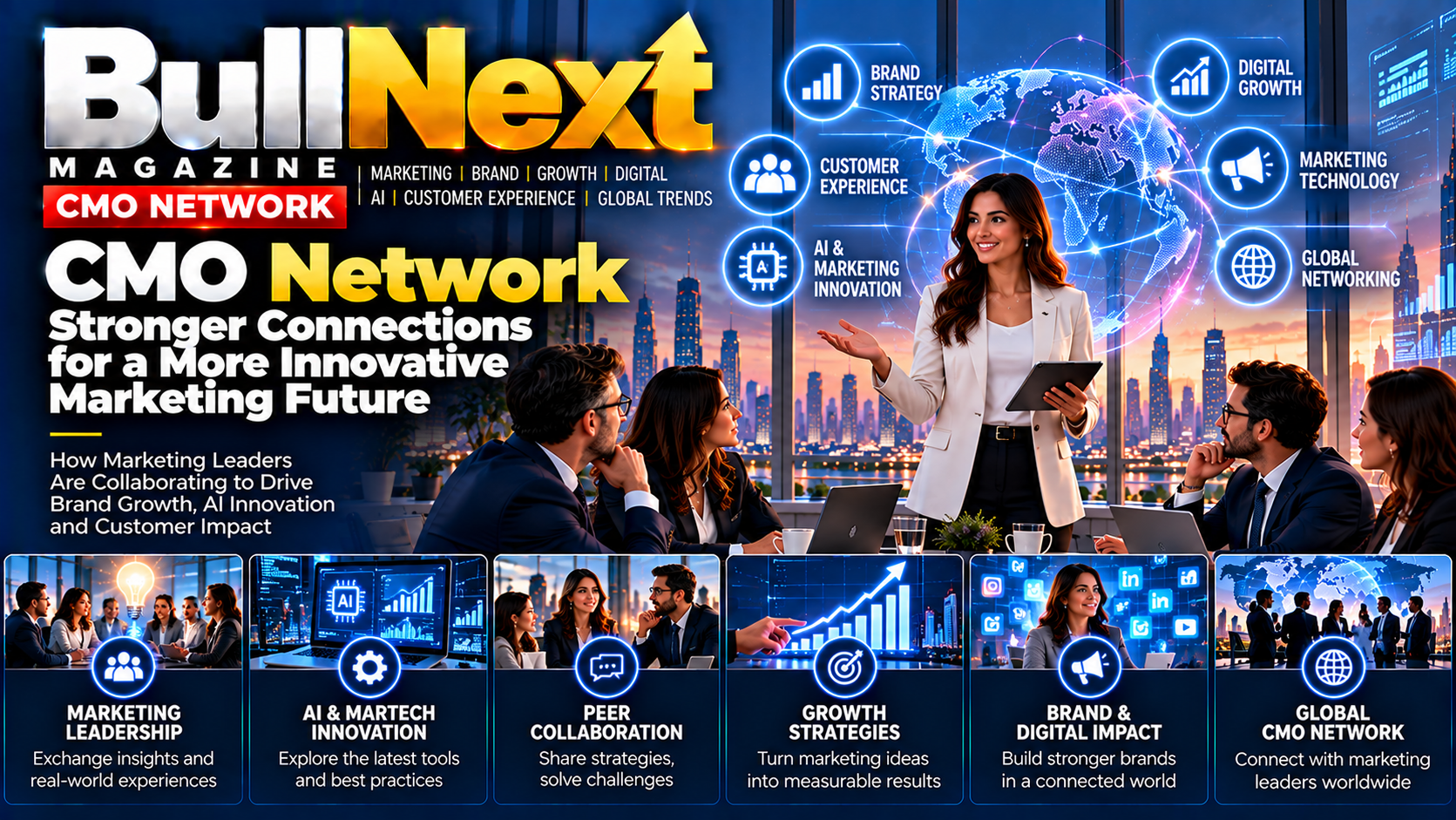
The role of the Chief Marketing Officer has never been more complicated.
CMOs are expected to build brands, generate demand, understand customers, manage marketing technology, demonstrate measurable revenue impact and increasingly lead artificial intelligence transformation. At the same time, they are operating under pressure to deliver faster results while marketing budgets and organizational resources remain constrained.
In this environment, relationships among senior marketing leaders are becoming increasingly valuable.
A CMO network is more than a professional networking group. The strongest networks can become strategic ecosystems where marketing leaders exchange knowledge, discuss emerging technologies, compare customer strategies, learn from failures and build trusted relationships across industries.
The transformation is already visible. PwC identifies artificial intelligence, business growth and customer experience as three major areas of focus for CMOs in 2026. Its research also highlights the importance of connecting marketing decisions to broader business performance.
Gartner's 2026 research found that 65% of CMOs expect AI to dramatically change their role within two years, yet only 32% believe significant changes to the CMO skill profile are necessary. Gartner warns that this gap could become a leadership vulnerability as AI becomes more deeply embedded in marketing.
This is precisely where peer networks can make a difference.
The CMO Role Is Becoming a Business Leadership Role
For decades, marketing was often evaluated primarily through brand awareness, campaigns, advertising and communications.
Today, the CMO increasingly sits at the intersection of:
Brand strategy
Revenue growth
Customer experience
Artificial intelligence
Data analytics
Digital transformation
Product strategy
Customer acquisition
Retention
Marketing technology
Corporate reputation
Business strategy
The modern CMO must understand not only how to attract customers but also how marketing contributes to enterprise value.
That requires closer relationships with CEOs, CFOs, CIOs, COOs and other members of the executive team.
It also requires relationships outside the organization.
A CMO facing a difficult strategic decision may benefit enormously from talking with another marketing leader who has already encountered the same problem.
That is the fundamental value of a CMO network.
Why CMO Networks Matter in the AI Era
Artificial intelligence is changing marketing at extraordinary speed.
AI is being used for content creation, personalization, customer analysis, campaign optimization, targeting, predictive analytics, automation and customer service.
The 2026 CMO Survey reported that 73.9% of surveyed marketing organizations were using AI for content creation, 65.4% for personalization and 49.5% to improve marketing ROI through content and timing optimization.
But adopting AI is not the same as creating value from AI.
Gartner found that CMOs allocate an average of 15.3% of their marketing budgets to AI initiatives, while only 30% report mature or fully developed AI-readiness capabilities.
This creates a major opportunity for CMO networks.
Marketing leaders can share practical experiences around:
Which AI applications actually work
How to measure AI ROI
How to organize AI teams
How to protect brand identity
How to maintain human oversight
How to manage customer data
How to evaluate AI vendors
How to train marketing employees
How to integrate AI into existing workflows
Instead of every CMO learning independently, networks allow executives to learn collectively.
From Networking to Strategic Intelligence
Traditional networking often focuses on introductions, conferences and exchanging contact information.
The future CMO network can go much further.
It can become a source of strategic intelligence.
Consider a CMO preparing to implement an AI-powered personalization platform.
Rather than relying only on vendor presentations, the executive could speak with several peers who have already implemented similar systems.
They might discover that:
Data quality was a bigger challenge than expected.
Employees needed additional training.
Integration with existing technology took longer than planned.
Customer trust became a major consideration.
The expected ROI depended on organizational changes.
Human oversight remained essential.
This type of practical knowledge can be difficult to obtain from public research.
Peer experience provides another layer of information.
The Value of Learning From Other CMOs
Marketing success stories receive enormous attention.
Failures rarely do.
Companies publish case studies when campaigns succeed. They are less likely to publicly explain why an expensive campaign failed to produce results.
Trusted CMO networks can provide a safer environment for discussing those lessons.
A marketing leader might explain how a major rebranding initiative failed to connect with customers.
Another might share how an AI content strategy damaged brand consistency.
Another might describe how a performance-marketing program generated leads but failed to create profitable customers.
These conversations can be extremely valuable.
Learning from another executive's mistake may prevent an organization from repeating it.
Building a Personal Board of Marketing Advisors
A CMO network can eventually become a personal advisory board.
This does not need to be a formal board.
Instead, it can consist of several trusted executives whom a CMO can contact when facing an important decision.
The group might include:
A CMO from the same industry
A brand-building expert
A technology-focused marketing leader
A customer-experience executive
A former CMO
A growth marketing leader
A data and analytics specialist
A CEO with strong customer expertise
A global marketing executive
An emerging AI marketing leader
The value comes from diversity of perspective.
The objective should not be to surround the CMO with people who always agree.
The strongest networks encourage constructive disagreement.
A trusted peer who challenges an assumption can sometimes provide more value than a peer who simply confirms it.
CMO Networks and Revenue Growth
The modern CMO is increasingly expected to demonstrate measurable business impact.
PwC's 2026 CMO guidance emphasizes connecting marketing with business growth rather than treating marketing as an isolated function.
This creates an important opportunity for CMO networks.
Marketing leaders can compare how they measure:
Customer acquisition cost
Customer lifetime value
Marketing ROI
Revenue contribution
Brand value
Customer retention
Pipeline generation
Conversion rates
Customer experience
Campaign profitability
Different industries may use different measurement models.
A CMO network allows executives to understand how other organizations connect marketing activity with financial outcomes.
This can strengthen the CMO's position in the boardroom.
The New Relationship Between CMO and CFO
One of the most important relationships for modern marketing leaders is the relationship between the CMO and CFO.
Marketing requires investment.
AI requires investment.
Brand building requires investment.
Customer experience requires investment.
Yet executives must determine where those investments create the greatest return.
CMO networks can help marketing leaders develop stronger financial thinking.
A CMO can learn from peers about:
Marketing budget allocation
AI investment decisions
Attribution
ROI measurement
Cost optimization
Brand investment
Performance marketing
Customer profitability
The objective is not to turn every CMO into a financial executive.
It is to help CMOs communicate marketing's value in business language.
CMO Networks and Customer Experience
Marketing is increasingly connected to the complete customer journey.
A campaign can attract a customer, but the customer's experience with the product, website, sales team, customer service and digital channels ultimately shapes loyalty.
PwC lists customer experience as one of the major focus areas for CMOs in 2026.
This means marketing leaders need to collaborate with executives across the organization.
A CMO network can provide examples of how other organizations are connecting:
Marketing → Sales → Product → Service → Customer Experience → Loyalty
This broader perspective helps CMOs move beyond campaign management toward customer leadership.
The Rise of the AI-Enabled CMO
The future CMO will not necessarily be a technical expert.
But the CMO will need sufficient AI literacy to understand how AI changes marketing strategy.
Gartner predicts that AI-driven automation of marketing work could increase from 16% in 2026 to 36% by 2028.
This could change the structure of marketing teams.
Some repetitive activities may become automated.
Content production may become faster.
Customer analysis may become more predictive.
Campaign optimization may become increasingly automated.
Marketing teams may therefore spend more time on:
Strategic thinking
Brand positioning
Creative direction
Customer insight
Innovation
Governance
Experimentation
Business strategy
A CMO network can help leaders understand how peers are preparing their teams for this transition.
The Importance of Human Judgment
AI can generate enormous amounts of content and analysis.
But marketing is not simply an information-processing function.
It is also about culture, emotion, identity, trust and human behavior.
A brand can have technically optimized content and still fail to connect with customers.
This is why human judgment remains essential.
The emerging CMO must know when to rely on algorithms and when to challenge them.
This is especially important as AI becomes capable of influencing:
Customer targeting
Pricing
Recommendations
Messaging
Personalization
Media buying
Customer service
Brand communications
Research from the California Management Review argues that governing AI is becoming a core marketing competency, reinforcing the importance of human oversight and responsible decision-making.
CMO networks can provide a valuable forum for these discussions.
CMO Networks and Brand Leadership
One risk of an increasingly performance-driven marketing environment is the potential decline of long-term brand investment.
Research from Lippincott and Bloomberg Media found that CMOs are increasingly balancing short-term performance demands with longer-term brand-building priorities. It also identified organizational alignment as an important driver of marketing effectiveness.
This creates a strategic dilemma.
Should a company prioritize immediate conversion?
Or should it invest in brand awareness that may create value over several years?
The answer is rarely one or the other.
Strong CMOs need to understand how brand and performance work together.
A network of experienced marketing executives can help leaders examine this balance from multiple perspectives.
Cross-Industry CMO Connections
Some of the most valuable marketing ideas come from outside an executive's own industry.
A financial-services CMO might learn from a retail brand about personalization.
A technology CMO might learn from hospitality about customer loyalty.
A healthcare marketing executive might learn from entertainment about community building.
A consumer brand might learn from B2B companies about thought leadership.
Cross-industry connections encourage new thinking.
They also reduce the risk of becoming trapped within conventional industry assumptions.
CMO Networks and Cultural Intelligence
Marketing operates within culture.
Consumer expectations change.
Social platforms change.
Language changes.
Customer values change.
New communities emerge.
Global audiences become increasingly interconnected.
A CMO therefore needs more than demographic data.
They need cultural awareness.
Strong CMO networks can expose executives to perspectives from different countries, industries, generations and consumer communities.
This can improve global marketing decisions.
It can also help companies avoid cultural mistakes that damage reputation.
The Importance of Trust
A large network is not automatically a valuable network.
The quality of relationships matters more than the number of connections.
A strong CMO network should prioritize:
Trust
Executives need confidence that sensitive conversations will remain appropriately confidential.
Relevance
Discussions should focus on real executive challenges.
Diversity
Different industries, regions and perspectives create stronger conversations.
Experience
Members should bring meaningful practical knowledge.
Generosity
The strongest networks are built around knowledge sharing rather than constant self-promotion.
Long-Term Relationships
Strategic relationships become more valuable over time.
The objective is not simply to meet more people.
It is to build relationships that improve decision-making.
CMO Networks and Marketing Talent
The evolution of marketing also creates a talent challenge.
Marketing teams increasingly need people who understand both creative and technical disciplines.
Future marketing professionals may need knowledge of:
AI
Data analytics
Automation
Customer experience
Content strategy
Brand management
Digital commerce
Marketing technology
Search
Social media
Business strategy
The emergence of roles such as the “marketing engineer” reflects this growing intersection between marketing and technology. Recent reporting indicates that organizations are increasingly seeking professionals who can combine marketing expertise with technical AI capabilities.
CMO networks can help executives understand these emerging roles and develop future-ready teams.
From Marketing Network to Growth Ecosystem
The strongest CMO networks will eventually become more than professional communities.
They can become growth ecosystems.
Imagine a network where marketing leaders can:
Exchange AI strategies
Benchmark marketing performance
Share customer insights
Discuss emerging technologies
Identify potential partnerships
Find executive talent
Mentor future CMOs
Collaborate on research
Explore international markets
Discuss brand challenges
Compare customer-experience strategies
This transforms networking into a business capability.
The CMO's Expanding Relationship With Technology
Technology is now embedded throughout marketing.
Marketing platforms depend on data.
Customer experience depends on technology.
AI depends on infrastructure and governance.
Personalization depends on analytics.
Digital commerce depends on technology.
This means the CMO's relationship with the CIO and technology organization is becoming increasingly important.
A strong CMO network can help marketing executives develop better technology literacy while also helping them communicate their needs more effectively to CIOs and other technology leaders.
The future is not about marketing versus technology.
It is about marketing and technology working together.
CMO Networks and Executive Leadership
The CMO is increasingly expected to participate in enterprise-wide strategy.
That means understanding:
Revenue
Profitability
Operations
Customer economics
Technology
Talent
Risk
Corporate reputation
A CMO who understands the broader business can become a more influential member of the executive team.
Deloitte's 2026 CMO research highlights economic pressure, AI and C-suite expectations as major forces shaping marketing priorities.
In this environment, peer relationships can help CMOs navigate pressure without losing strategic perspective.
How to Build a High-Value CMO Network
CMOs who want to build a meaningful network should focus on quality rather than quantity.
A practical network might include:
Peer CMOs: Leaders facing similar strategic challenges.
Former CMOs: Experienced executives who can provide historical perspective.
Growth leaders: Experts focused on revenue and customer acquisition.
Brand leaders: Executives with deep experience in long-term brand building.
Technology leaders: CIOs, CTOs and marketing-technology experts.
Customer leaders: Executives focused on customer experience and loyalty.
Data leaders: Specialists who understand analytics and AI.
International executives: Leaders who understand global markets.
Creative leaders: People who can challenge conventional thinking.
Future leaders: Emerging executives who bring new perspectives.
The best network should evolve continuously.
The Future of the CMO Network
The next generation of CMO networks will likely combine physical relationships with digital communities.
Executive roundtables can create trust.
Digital platforms can provide continuous communication.
AI can help identify relevant insights.
Research can provide market intelligence.
Peer discussions can provide real-world experience.
Together, these elements can create a powerful leadership ecosystem.
AI may even help personalize executive networks by identifying which discussions, peers or research are most relevant to a particular CMO's strategic priorities.
But technology should remain the facilitator.
The foundation will still be human relationships.
Why the Best CMOs Will Be Connected CMOs
Marketing is becoming too complex for executives to operate in isolation.
The CMO must understand AI without abandoning human creativity.
The CMO must deliver short-term performance while protecting long-term brand value.
The CMO must use data without losing customer empathy.
The CMO must prove financial impact while continuing to invest in innovation.
And the CMO must influence the organization beyond the marketing department.
These challenges become easier to navigate when leaders have access to trusted peers.
A strong CMO network provides that advantage.
It creates a space where executives can exchange experience, challenge assumptions and discover new opportunities.
Conclusion: Stronger Connections, Smarter Marketing Leadership
The future of marketing will not be defined only by technology.
It will be defined by how effectively leaders combine technology, creativity, customer understanding and business strategy.
Artificial intelligence is accelerating this transformation. Marketing teams are adopting AI at scale, while CMOs face growing pressure to demonstrate measurable growth and organizational value. Gartner, PwC, BCG and other 2026 research all point toward a marketing function undergoing significant structural change.
In this environment, CMO networks can become strategic assets.
They can help leaders learn faster.
They can reduce duplicated mistakes.
They can provide access to diverse perspectives.
They can strengthen executive confidence.
They can create opportunities for collaboration.
And they can help CMOs prepare for a future in which marketing, technology and business strategy become increasingly interconnected.
The most successful CMOs of the future may not simply be those who understand customers best.
They may be those who know how to connect with the people, ideas and experiences that help them understand what comes next.
The future of marketing leadership is connected.
Frequently Asked Questions
What is a CMO network?
A CMO network is a professional community connecting Chief Marketing Officers and senior marketing executives to exchange knowledge, strategic insights, experiences and business opportunities.
Why are CMO networks important in 2026?
CMOs are facing rapid changes from AI, customer behavior, marketing technology and increasing pressure to demonstrate business growth. A strong network gives executives access to peer experience and strategic perspectives.
What can CMOs gain from networking?
CMOs can gain insights into AI adoption, customer experience, brand strategy, marketing ROI, technology, talent, growth strategies and emerging market trends.
Should a CMO network include executives from different industries?
Yes. Cross-industry relationships can expose marketing leaders to new ideas and strategies that may not emerge within a single industry.
How is AI changing the CMO role?
AI is automating and augmenting activities such as content creation, personalization, analytics, targeting and marketing operations. CMOs increasingly need AI literacy, governance skills and the ability to connect AI investments with business outcomes.
What makes a CMO network valuable?
Trust, confidentiality, high-quality members, diverse perspectives, practical knowledge and long-term relationships are more important than simply having a large number of members.
Can a CMO network help with AI strategy?
Yes. Peer CMOs can share practical experiences around AI implementation, governance, data, talent, customer experience, automation and measuring AI-driven marketing ROI.