Technology has become one of the most important parts of modern business. Cloud computing, artificial intelligence, cybersecurity, data analytics, automation, and digital platforms now influence almost every department within an organization.
As technology becomes more deeply connected to business strategy, the role of the Chief Information Officer (CIO) continues to evolve. CIOs are no longer simply responsible for maintaining IT systems. They are increasingly expected to help organizations innovate, improve productivity, manage digital risk, and create long-term competitive advantages.
This makes a strong CIO network more valuable than ever.
A network of CIOs, CTOs, cybersecurity leaders, technology entrepreneurs, consultants, investors, and business executives can give technology leaders access to practical experience, new ideas, strategic partnerships, and lessons from organizations facing similar challenges.
What Is a CIO Network?
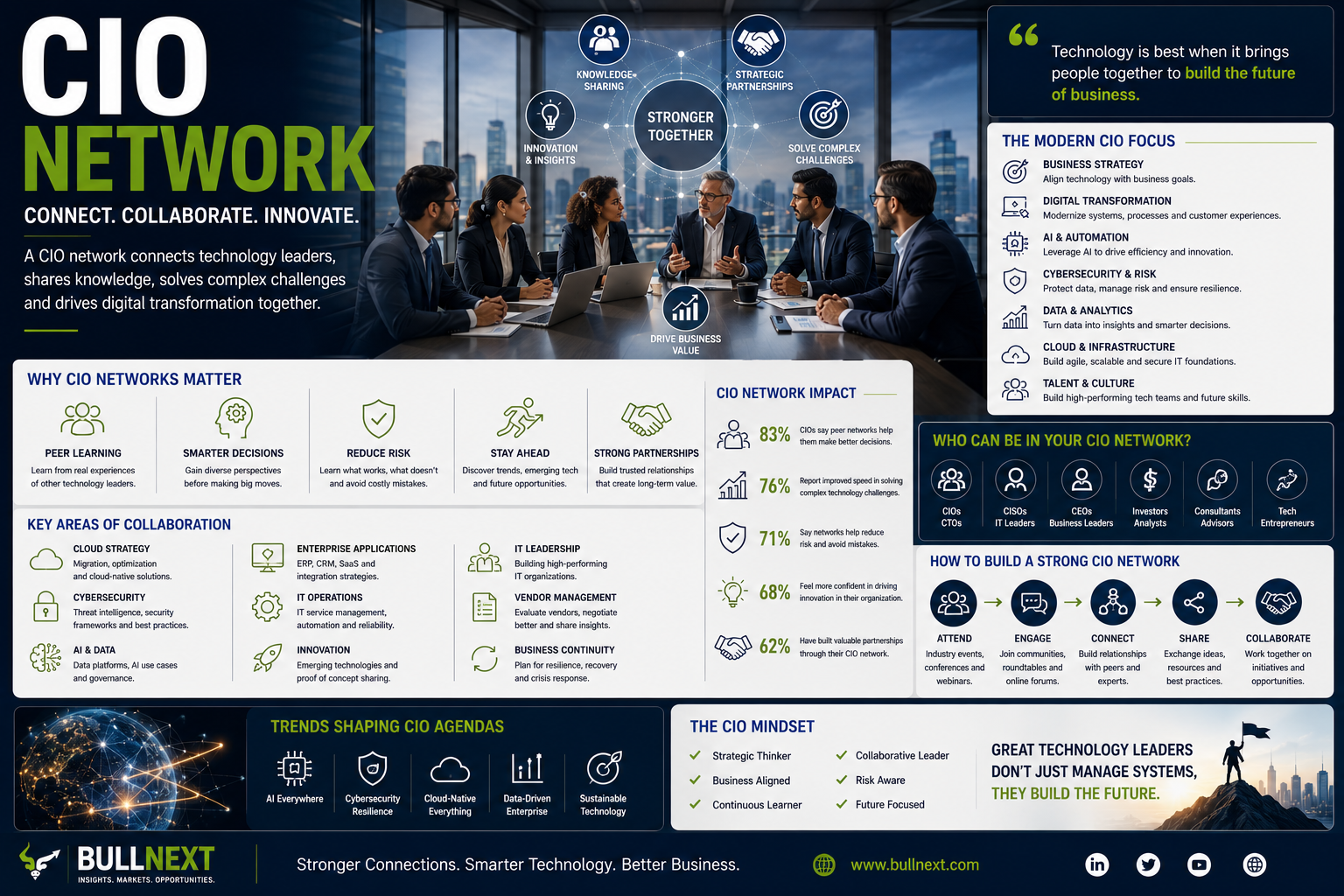
A CIO network is a professional community of technology executives and business leaders who connect to exchange knowledge, experiences, ideas, and opportunities.
A strong CIO network can include:
Chief Information Officers
Chief Technology Officers
Chief Information Security Officers
Chief Digital Officers
Technology executives
IT directors
Data leaders
AI specialists
Cybersecurity professionals
CEOs
Investors
Technology entrepreneurs
Consultants
Industry experts
The purpose isn't simply to collect contacts.
The real objective is to create trusted relationships that help technology leaders make better decisions.
Why CIO Networks Matter
Technology decisions can have major consequences for an organization.
A CIO may be responsible for choosing a cloud provider, implementing an enterprise system, managing cybersecurity, developing an AI strategy, or modernizing outdated infrastructure.
These decisions can involve significant investments and long-term commitments.
A trusted CIO network can provide another perspective.
Instead of solving every problem independently, a CIO can ask other technology leaders:
Which platform did you choose?
What problems did you encounter?
How did you manage the implementation?
What would you do differently?
How did your employees respond?
These conversations can help leaders identify potential problems before they become expensive mistakes.
The Changing Role of the CIO
The traditional CIO was often viewed primarily as the head of IT.
The modern CIO has a much broader role.
Today's CIO may be responsible for:
Digital transformation
Cloud strategy
Artificial intelligence
Cybersecurity
Data management
Enterprise software
IT infrastructure
Automation
Technology budgets
Innovation
Business continuity
The CIO increasingly works directly with the CEO and other C-suite leaders.
Technology is no longer simply supporting the business.
In many industries, technology is the business.
CIOs and Artificial Intelligence
Artificial intelligence is one of the biggest topics for technology leaders.
Organizations are exploring AI for:
Customer service
Software development
Data analysis
Marketing
Finance
Operations
Supply chains
Cybersecurity
Document processing
Workflow automation
The CIO often has to determine how these technologies can be integrated safely and effectively.
A CIO network can provide valuable insight because different organizations may be at different stages of AI adoption.
One company may be experimenting with AI assistants.
Another may already be deploying AI agents across multiple departments.
Learning from both experiences can help CIOs create more realistic technology strategies.
Building an AI Leadership Network
AI decisions increasingly require collaboration across the C-suite.
The CIO may work with:
The CEO on business strategy.
The CFO on investment and return.
The COO on operational automation.
The CHRO on workforce transformation.
The CISO on security and risk.
The CMO on customer and marketing applications.
This means a CIO network should not be limited to technology professionals.
Business perspectives are equally important.
CIO Networks and Cybersecurity
Cybersecurity is one of the most important responsibilities facing technology leadership.
Organizations face threats involving:
Data breaches
Ransomware
Phishing
Account compromise
Supply-chain attacks
Cloud vulnerabilities
Insider threats
AI-enabled attacks
A cybersecurity incident can affect the entire company.
It can disrupt operations, damage reputation, create financial losses, and affect customer trust.
CIOs therefore benefit from relationships with CISOs and cybersecurity specialists who can share practical approaches to risk management.
Learning From Other Technology Leaders
Technology changes quickly.
A CIO who made a major technology decision several years ago may already have valuable lessons about implementation and long-term maintenance.
Peer learning can cover areas such as:
Cloud migration
ERP implementation
Data platforms
AI adoption
Cybersecurity
Remote work technology
Software modernization
IT outsourcing
Technology procurement
These conversations can help CIOs understand both the benefits and limitations of different approaches.
CIO and CEO Relationships
The relationship between the CIO and CEO has become increasingly important.
The CEO defines the organization's broader vision.
The CIO helps determine how technology can support that vision.
For example, if a company wants to expand globally, technology may need to support:
International operations
Data systems
Customer platforms
Cybersecurity
Collaboration
Payment systems
Analytics
The CIO needs to understand the business objective before choosing the technology.
A strong CIO network can help technology executives develop the business and communication skills needed to operate effectively at the executive level.
CIO and CFO Collaboration
Technology spending is often significant.
Cloud services, software licenses, cybersecurity systems, AI infrastructure, and digital transformation programs can require substantial investment.
The CFO focuses on financial performance.
The CIO focuses on technology capabilities.
Together, they can evaluate:
Total cost of ownership
Return on investment
Implementation costs
Productivity gains
Security benefits
Long-term scalability
The goal shouldn't simply be to reduce the technology budget.
It should be to ensure technology spending produces measurable business value.
CIO and CHRO Collaboration
Technology is changing the workforce.
Automation can change job responsibilities.
AI can introduce new tools.
Remote and hybrid work require new systems.
Employees need new digital skills.
This creates an important relationship between the CIO and CHRO.
The CIO understands the technology.
The CHRO understands people and workforce strategy.
Together, they can develop programs that help employees adapt to technological change.
CIO Networks and Digital Transformation
Digital transformation is more than buying new software.
It often requires changing how an organization operates.
A transformation may involve:
Old process → New technology → New workflow → Employee adoption → Measurement → Continuous improvement
The technology is only one part of the equation.
People, processes, leadership, and organizational culture are equally important.
CIOs can learn from peers who have successfully completed large digital transformations.
Global CIO Networks
Technology has made global business more interconnected.
A CIO may manage systems supporting employees and customers across several countries.
This creates challenges involving:
Data regulations
Cybersecurity
Cloud infrastructure
International vendors
Currency
Local technology requirements
Workforce collaboration
A global CIO network can provide access to leaders with experience in different markets.
This can be particularly valuable when organizations expand internationally.
CIO Networks and Asian Technology Markets
Asia is one of the world's most important technology regions.
Countries such as India, China, Japan, South Korea, Singapore, and others are major contributors to software, semiconductors, electronics, telecommunications, AI, and digital commerce.
CIOs looking toward Asian markets can benefit from connecting with technology leaders who understand the region's unique business environments.
Local knowledge can help organizations evaluate:
Technology suppliers
Talent
Regulations
Infrastructure
Partnerships
Market opportunities
How to Build a Strong CIO Network
Attend Technology Conferences
Industry conferences provide opportunities to meet other CIOs and technology professionals.
Join Executive Communities
Structured CIO communities can create opportunities for peer discussions and leadership development.
Participate in Roundtables
Smaller discussions can encourage more open conversations about technology challenges.
Connect With Entrepreneurs
Technology startups often experiment with emerging technologies before larger organizations.
Build Relationships With Vendors
Technology vendors can provide valuable expertise, although CIOs should maintain an objective approach when evaluating products.
Develop Mentor Relationships
Experienced CIOs can help emerging technology leaders understand executive decision-making and organizational challenges.
Quality Over Quantity
A strong CIO network isn't measured by the number of people in your contact list.
A network of 20 trusted technology and business leaders can be more valuable than thousands of passive connections.
The best relationships are built through:
Trust
Consistent communication
Knowledge sharing
Mutual support
Honest feedback
Collaboration
Networking should be about creating long-term professional value.
CIO Networks and Innovation
Innovation often happens when people with different perspectives collaborate.
A CIO may discover a new approach by speaking with:
A startup founder
A university researcher
Another CIO
A cybersecurity expert
An AI engineer
A business strategist
Cross-industry networking can be especially useful.
A solution developed for one industry may inspire an entirely new approach in another.
The Importance of Digital Networking
Professional networking is no longer limited to physical events.
CIOs can now connect through:
Professional networks
Technology communities
Virtual conferences
Webinars
Industry newsletters
Podcasts
Executive forums
Online discussion groups
Digital networking makes it easier to build international relationships.
However, meaningful networking still requires genuine interaction.
A simple connection request is only the beginning.
Common CIO Networking Mistakes
Focusing Only on Technology
Business strategy is just as important as technical knowledge.
Networking Only When You Need Help
Relationships should be developed before a crisis occurs.
Talking Only About Your Own Company
Listening to other executives can provide valuable insights.
Ignoring Smaller Technology Companies
Startups can sometimes provide innovative ideas and new perspectives.
Failing to Follow Up
Regular communication helps turn introductions into long-term relationships.
CIO Networks During a Crisis
The value of a strong network becomes particularly obvious during a major technology crisis.
Imagine an organization experiencing:
A cybersecurity attack
Major system outage
Cloud disruption
Data-loss event
Software failure
A CIO with a strong network may be able to quickly contact peers who have faced similar problems.
They can ask:
What worked?
What failed?
Which experts helped?
What should we do first?
This doesn't replace professional incident-response procedures, but peer experience can provide valuable perspective during stressful situations.
The Future of CIO Networks
The future of CIO networking is likely to become more global, digital, and AI-assisted.
AI may help executives identify relevant experts, analyze industries, discover potential partnerships, and find technology trends.
Virtual communities may make it easier for CIOs from different countries to collaborate.
Yet human relationships will remain important.
Technology can identify a connection.
Trust has to be built by people.
What Makes a Great CIO Network?
A strong CIO network should contain people who bring different perspectives.
For example:
CIOs provide technology leadership experience.
CTOs provide product and engineering perspectives.
CISOs provide cybersecurity expertise.
CEOs provide business strategy.
CFOs provide financial insight.
Entrepreneurs provide innovation.
Investors provide market perspectives.
This diversity can make the network significantly more valuable.
CIO Leadership in 2026
The modern CIO must increasingly think like a business leader.
Technology decisions should connect directly to measurable outcomes.
Instead of simply asking:
"What technology should we implement?"
the CIO should ask:
"What business problem are we trying to solve?"
This change in thinking can help organizations avoid unnecessary technology investments and focus resources on areas where digital solutions can create genuine value.
Final Thoughts
A strong CIO network can be one of the most valuable resources available to a modern technology executive.
As businesses navigate AI, cybersecurity, cloud computing, automation, digital transformation, and global competition, CIOs need more than technical expertise.
They need relationships, experience, business knowledge, and trusted advice.
The strongest CIO networks aren't built by collecting the largest number of contacts.
They are built by creating meaningful relationships with people who can share knowledge, challenge assumptions, provide expertise, and collaborate on new opportunities.
Technology may continue to evolve at extraordinary speed, but the importance of human relationships will remain.
A CIO who builds a strong network doesn't have to face every technology challenge alone.
Connect with technology leaders. Share knowledge. Learn from experience. Build partnerships. Create the future.