
The pace of technological change has accelerated dramatically. Organizations across industries are adopting artificial intelligence, modern computing architectures, cloud environments, data analytics, and digital platforms to improve productivity and create new opportunities.
For business leaders, the challenge is no longer simply deciding whether to adopt new technology. The larger question is how technology can be integrated into the organization in a way that creates measurable value.
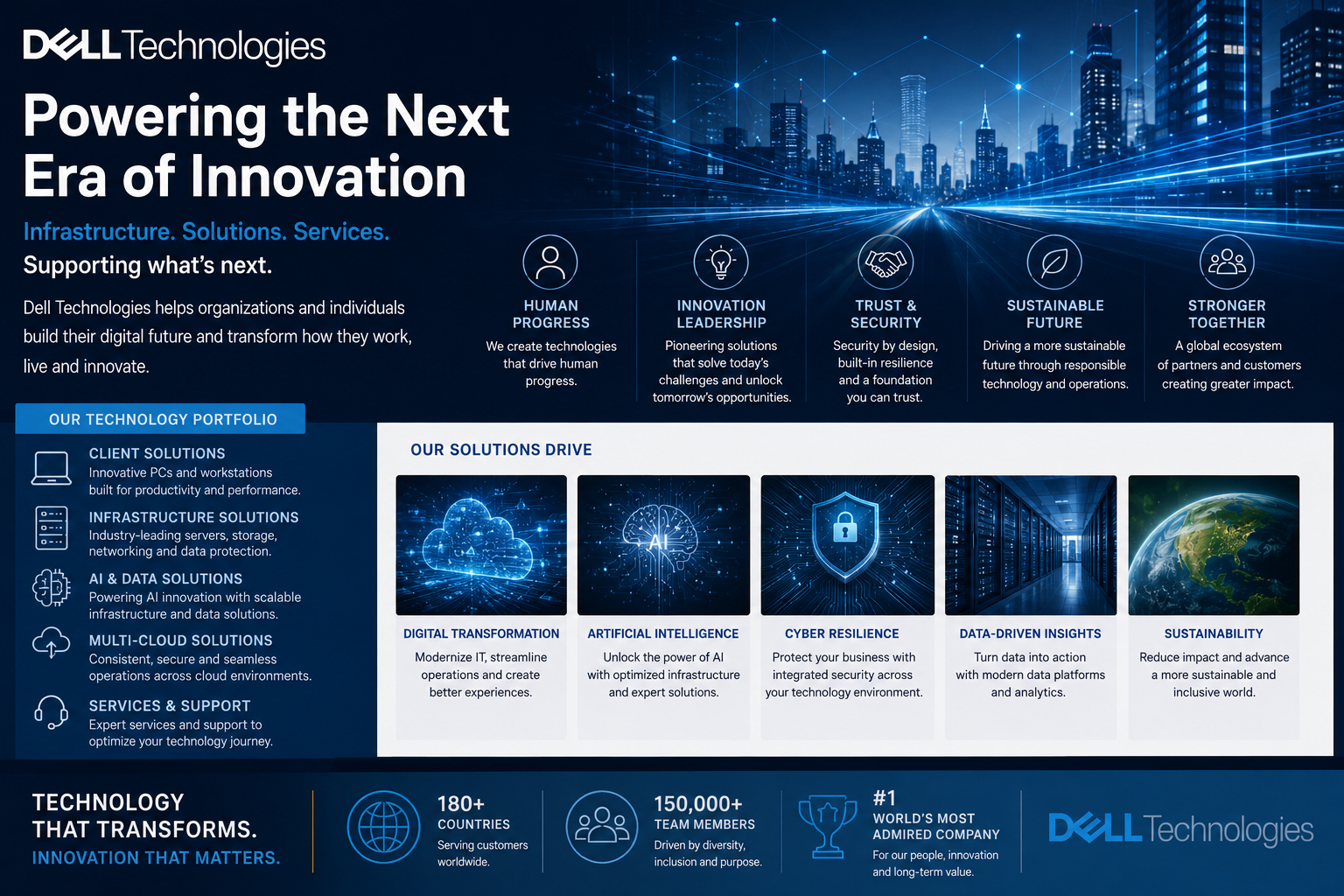
Dell Technologies has built its business around helping organizations navigate this evolving environment. The company describes its purpose as creating technologies that drive human progress, with a vision of becoming an essential technology partner.
This approach reflects an important shift in technology leadership: infrastructure is no longer simply an IT concern. It is increasingly a foundation for business strategy.
From Infrastructure to Innovation
Modern businesses depend on technology at nearly every level.
Employees rely on connected devices and applications. Customers expect fast and personalized digital experiences. Organizations depend on data to make decisions, while artificial intelligence is creating new possibilities for automation, analytics, and innovation.
This means the underlying technology infrastructure must be capable of supporting both today's requirements and tomorrow's opportunities.
Dell Technologies has positioned its portfolio around end-to-end technology capabilities, including client devices, workstations, servers, storage, backup infrastructure, and AI infrastructure. Its current company fact sheet also identifies AI infrastructure as one of its leading solution areas.
For organizations, this broader approach can help simplify technology environments while creating a foundation for continued innovation.
The Rise of Artificial Intelligence
Artificial intelligence is one of the most significant forces shaping the technology landscape.
Businesses are exploring AI for customer experiences, employee productivity, data analysis, software development, automation, research, and operational decision-making.
But successful AI adoption requires more than sophisticated software. Organizations also need the computing power, data infrastructure, storage, security, and governance necessary to support AI workloads.
This is where infrastructure becomes strategically important.
As AI applications become more demanding, organizations need technology environments capable of handling increasingly complex workloads. Dell Technologies has identified AI infrastructure as a major part of its current portfolio, reflecting the growing importance of the technology foundation required for AI adoption.
For business leaders, the opportunity is to move from experimentation toward practical applications that improve productivity, create better experiences, and generate measurable business outcomes.
Turning Data Into Business Value
Data has become one of the most important resources organizations possess.
Every interaction, transaction, device, application, and business process can generate information. The challenge is turning that information into useful insight.
Modern data strategies require infrastructure that can store, protect, process, and move information efficiently.
Organizations must also consider where data is generated and where it needs to be processed. Data may exist across employee devices, business locations, data centers, cloud environments, and edge locations.
A connected technology strategy can help organizations make better use of information while maintaining performance and security.
The ability to transform data into insight can support everything from operational efficiency to customer experience and strategic decision-making.
Security and Resilience by Design
As organizations become more dependent on technology, security becomes increasingly important.
Cybersecurity is no longer an issue limited to IT departments. A security incident can affect business continuity, customer trust, financial performance, and organizational reputation.
Dell Technologies emphasizes security and trust as important components of its approach, including security by design, resilience, transparency, and secure product development.
Building security into technology environments from the beginning can help organizations address risk more proactively.
Resilience is equally important.
Organizations need systems that can continue operating and recover effectively when unexpected events occur. This includes cybersecurity incidents, infrastructure failures, supply-chain disruptions, and other operational challenges.
A resilient technology foundation gives businesses greater confidence as they expand their digital operations.
Supporting the Modern Workforce
The workplace has also undergone significant technological change.
Employees increasingly work across offices, homes, mobile environments, and collaborative digital platforms. This creates new expectations for devices, connectivity, security, and productivity tools.
Technology needs to support employees without creating unnecessary complexity.
Organizations are therefore looking for solutions that can help employees work effectively while maintaining appropriate security and manageability.
Dell Technologies' client and infrastructure portfolio reflects this broader workplace environment, spanning devices and enterprise technologies.
The goal is not technology for its own sake. It is technology that helps people work, collaborate, create, and solve problems more effectively.
Technology With a Human Purpose
The most meaningful technology innovations are ultimately about people.
A faster computer, more powerful server, or advanced AI system matters because of what it enables people and organizations to accomplish.
Dell Technologies' stated purpose of driving human progress through technology reflects this human-centered perspective.
Technology can help organizations improve healthcare, expand educational opportunities, support businesses, strengthen communities, and address complex challenges.
This perspective changes the conversation around digital transformation.
Instead of asking only what technology can do, organizations can ask what people can accomplish when they have access to the right technology.
Building a Future-Ready Business
Future-ready organizations need flexibility.
Technology investments made today should be capable of supporting evolving business requirements rather than solving only a single immediate problem.
This requires leaders to consider scalability, interoperability, security, performance, sustainability, and long-term value when evaluating technology strategies.
It also requires collaboration between technology leaders and business executives.
CIOs, CEOs, CFOs, COOs, and other senior leaders increasingly need to work together when making major technology decisions.
When business strategy and technology strategy are closely aligned, organizations can respond more quickly to market changes and identify new opportunities.
Sustainability and Responsible Technology
Technology also has an important role to play in sustainability.
Organizations are examining how infrastructure can become more efficient, how technology products can be designed and managed responsibly, and how digital solutions can support broader environmental goals.
Responsible technology involves more than reducing environmental impact. It also includes responsible data management, security, privacy, ethical practices, and inclusive access.
Dell Technologies highlights climate action, the circular economy, digital inclusion, and an inclusive workforce among its broader impact commitments.
These priorities demonstrate how technology companies increasingly operate within a wider social and environmental context.
Collaboration as a Driver of Innovation
No single organization can solve every technology challenge alone.
Innovation often depends on collaboration between technology providers, customers, partners, developers, researchers, and business leaders.
Dell Technologies has emphasized its ecosystem of customers and partners as part of its broader technology strategy. Its current company materials describe an extensive global technology ecosystem alongside direct sales and other routes to market.
Collaboration can help organizations bring together different areas of expertise and accelerate the development of practical solutions.
For customers, this can mean access to a broader range of technologies and expertise as they work through complex transformation projects.
Preparing for the Next Digital Era
The next stage of digital transformation will likely be defined by the convergence of AI, data, computing, security, and connected infrastructure.
Organizations that successfully bring these capabilities together may be better positioned to innovate and respond to changing market conditions.
But transformation should not be viewed as a one-time project.
Technology will continue to evolve, meaning organizations need strategies that support continuous improvement.
Leaders should regularly evaluate their infrastructure, workforce capabilities, security posture, data strategy, and technology investments to ensure they remain aligned with business objectives.
Conclusion
The future of business will increasingly depend on the strength of its technology foundation.
From artificial intelligence and data analytics to cybersecurity, modern computing, storage, and connected workplaces, technology is becoming deeply integrated into how organizations create value.
Dell Technologies represents a broad approach to this transformation, combining infrastructure, devices, AI capabilities, security, and services to support organizations as they navigate the digital era. The company's stated purpose centers on using technology to drive human progress, while its current strategy emphasizes its role as an essential technology partner.
For organizations, the opportunity is clear: use technology not simply to keep pace with change, but to create new possibilities.
The businesses that succeed in the next era will be those that combine strong technology foundations with human creativity, strategic leadership, responsible innovation, and a willingness to continuously adapt.
Technology is the foundation. People are the force behind it. Together, they can shape what comes next.