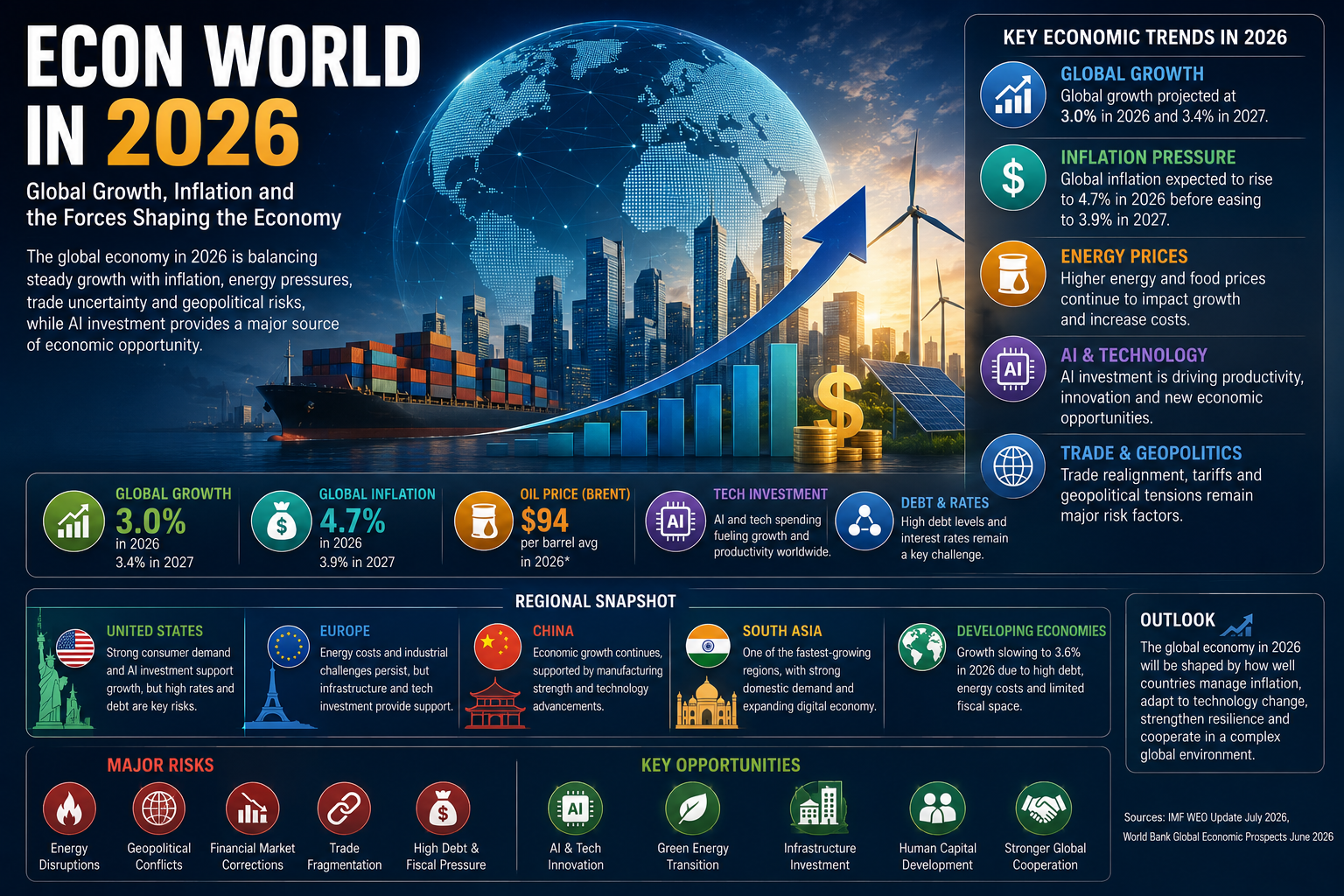
The global economy is moving through a complicated period in 2026. Growth remains positive, but countries are facing different combinations of inflation, energy costs, trade uncertainty, changing interest rates and geopolitical risks.
At the same time, artificial intelligence and technology investment are creating new opportunities for productivity and economic growth.
The International Monetary Fund projects global economic growth of 3.0% in 2026 and 3.4% in 2027. However, the IMF also expects global inflation to rise to 4.7% in 2026, reflecting the impact of higher energy and food prices.
Global Growth Remains Resilient
Despite significant economic challenges, the global economy has continued to expand.
The IMF says the world economy has weathered recent shocks better than initially expected, although the recovery is uneven across countries. Economies exposed to energy disruptions face greater pressure, while countries integrated into technology and AI supply chains are benefiting from stronger investment.
This creates a divided global economy.
Some countries are dealing with higher costs and weaker demand, while others are benefiting from new technology investment.
Inflation Remains a Concern
Inflation remains one of the biggest economic issues in 2026.
The IMF expects global headline inflation to increase from 4.1% in 2025 to 4.7% in 2026, before declining to 3.9% in 2027.
Higher energy and food prices are important contributors.
Persistent inflation can affect consumers through higher prices for:
Food
Energy
Housing
Transportation
Services
Consumer goods
For businesses, inflation can increase labor, transportation and production costs.
Energy Prices Affect the World Economy
Energy remains closely connected to global economic growth.
Oil and natural-gas prices influence transportation, manufacturing, electricity generation and household spending.
The World Bank's June 2026 outlook said disruptions in energy markets were a major reason for its lower global growth forecast, with Brent crude projected to average around $94 per barrel in 2026 under its assumptions.
Higher energy costs can create a difficult combination of slower economic growth and higher inflation.
Economists often describe this environment as a form of stagflation risk when price pressures remain elevated while growth weakens.
AI Is Becoming an Economic Force
Artificial intelligence is one of the most important positive forces in the global economy.
Companies are investing heavily in:
Data centers
Semiconductors
Cloud computing
AI software
Electricity infrastructure
Advanced computing
The IMF says technology-driven investment is helping offset some of the negative effects of the energy shock. Countries that are integrated into the global technology supply chain are benefiting particularly strongly.
The economic impact of AI could become even larger if businesses successfully use the technology to improve productivity.
AI Could Help Developing Economies
AI is not only relevant to advanced economies.
The World Bank's 2026 World Development Report describes AI as a potential path to greater prosperity for developing economies, particularly if countries can improve digital infrastructure, skills and access to technology.
Emerging economies could use AI in areas such as:
Agriculture
Healthcare
Education
Manufacturing
Banking
Logistics
Government services
However, countries without reliable electricity, internet access or skilled workers may struggle to benefit equally.
Trade Remains an Important Economic Issue
International trade continues to influence economic growth.
Companies are reassessing supply chains because of tariffs, geopolitical tensions and changes in global manufacturing.
This has encouraged businesses to diversify production across multiple countries.
Countries that can offer reliable infrastructure, skilled workers and competitive production costs could benefit from these supply-chain changes.
Developing Economies Face Greater Pressure
Developing economies are facing some of the most difficult conditions.
The World Bank forecasts growth in developing economies to slow to 3.6% in 2026, down from 4.4% in 2025.
Higher energy costs can be particularly challenging for countries that depend heavily on imported fuel.
Higher global borrowing costs can also increase debt-service expenses.
This means some developing economies have less room to respond to economic shocks.
South Asia Remains a Growth Region
South Asia continues to be one of the faster-growing regions of the global economy.
The World Bank projects South Asian growth at 6.3% in 2026, followed by 6.9% in 2027.
India remains a major contributor because of its large domestic economy, expanding services sector, manufacturing investment and digital economy.
Other South Asian economies are also seeking to expand infrastructure, trade and technology investment.
China Remains a Major Economic Driver
China continues to play a central role in the global economy.
Its manufacturing industry, exports, technology sector and domestic consumer market have major effects on global trade.
China's economy is also becoming increasingly connected to the global AI and technology investment cycle.
The IMF expects China's inflation to rise from very low levels, while its broader economic outlook remains influenced by domestic demand and global trade conditions.
Europe Faces a Different Economic Environment
European economies are dealing with a combination of energy concerns, industrial challenges and changing monetary policy.
Higher energy prices can affect European manufacturers because the region has significant exposure to imported energy.
At the same time, investment in infrastructure, defense and technology could provide support for economic activity.
The European Central Bank's decisions will remain important for borrowing costs and business investment.
The U.S. Economy Remains Important
The United States continues to be one of the most important drivers of global economic activity.
Its large consumer market, technology industry and financial system influence markets around the world.
AI investment is particularly significant for the U.S. economy.
Large technology companies are spending heavily on computing infrastructure, data centers and AI development.
However, high valuations in technology markets could create risks if expectations become too optimistic.
Central Banks Face Difficult Decisions
Central banks around the world are trying to balance two objectives:
Control inflation
and
Support economic growth.
If interest rates remain too high for too long, borrowing and investment can weaken.
If rates fall too quickly while inflation remains elevated, price pressures could return.
This makes monetary policy particularly challenging in 2026.
Central banks are therefore closely monitoring inflation, employment, energy prices and economic activity.
Global Debt Remains a Challenge
Government debt is another important issue for the global economy.
Higher interest rates can increase the cost of servicing existing debt.
Countries with limited fiscal space may have less ability to respond to economic downturns.
The IMF has emphasized the importance of rebuilding fiscal buffers while maintaining price stability and strengthening financial oversight.
The Changing Global Supply Chain
The global economy is becoming more geographically diversified.
Companies are increasingly considering where they manufacture products and source critical components.
Factors such as:
Trade policy
Transportation costs
Energy availability
Labor costs
Political stability
Infrastructure
are influencing corporate decisions.
This could create new opportunities for emerging economies that attract manufacturing investment.
The Role of Green Energy
The transition toward cleaner energy is another major economic trend.
Renewable-energy investment can reduce dependence on fossil fuels over time while creating demand for infrastructure and commodities such as copper and other industrial metals.
The IMF notes that rising renewable-energy use and lower energy intensity have helped make some economies more resilient to energy shocks.
However, the transition also requires substantial investment in electricity grids, storage and generation capacity.
What Could Drive Global Growth?
Several forces could support the global economy over the next few years.
AI Investment
Technology spending could increase productivity and create new industries.
Consumer Demand
Strong household spending can support economic growth.
Infrastructure
Investment in transport, energy and digital infrastructure can improve productivity.
Trade
Reduced trade barriers could strengthen global economic activity.
Productivity
Technological improvements can allow businesses to produce more with fewer resources.
What Could Hurt the Global Economy?
The risks are equally important.
Energy Disruptions
Higher oil and gas prices could push inflation higher.
Geopolitical Conflicts
New conflicts can disrupt trade and supply chains.
Trade Fragmentation
Increasing trade restrictions can raise costs and reduce efficiency.
Financial Market Corrections
Sharp declines in major asset markets could affect consumer and business confidence.
High Debt
Large debt burdens can restrict government spending during downturns.
The IMF continues to describe renewed conflict, trade fragmentation and a potential correction in technology-driven market expectations as important downside risks.
The Global Economy Is Becoming More Uneven
One of the clearest economic themes of 2026 is that countries are not experiencing the same conditions.
Energy importers can face higher costs.
Energy exporters may benefit from higher prices.
Technology producers can benefit from AI investment.
Countries with weak infrastructure may struggle to capture the same gains.
This means investors, businesses and policymakers increasingly need to look at individual economies rather than relying only on global averages.
Final Thoughts
The global economy in 2026 is being shaped by two powerful forces: economic disruption and technological transformation.
The IMF expects global growth to remain around 3%, but inflation has become more difficult as energy and food prices rise.
At the same time, AI investment is creating new opportunities for countries, companies and workers connected to the technology economy.
The outlook remains uncertain, but the global economy has demonstrated considerable resilience.
For businesses and investors, the most important themes to watch are inflation, interest rates, energy markets, AI investment, global trade and economic growth.
As these forces continue to interact, the global economy could enter a period where technological innovation becomes increasingly important in determining which countries and industries emerge as the strongest performers.
FAQs
What is the global economic outlook for 2026?
The IMF projects global growth of 3.0% in 2026 and 3.4% in 2027, although growth remains uneven across countries.
Why is inflation rising in 2026?
Higher energy and food prices are among the main factors pushing global inflation higher.
How is AI affecting the global economy?
AI is driving investment in technology, data centers, semiconductors and digital infrastructure while potentially improving productivity.
Which economies are benefiting from AI?
Countries with strong technology industries and positions in semiconductor, computing and digital supply chains are particularly well placed to benefit.
Why are energy prices important?
Energy affects transportation, manufacturing, electricity and household expenses, making it a major driver of both inflation and economic growth.
What are the biggest risks to global growth?
Major risks include geopolitical conflict, energy disruptions, trade fragmentation, financial-market corrections and persistent inflation.
Will global growth improve in 2027?
The IMF currently projects global growth to increase from 3.0% in 2026 to 3.4% in 2027.