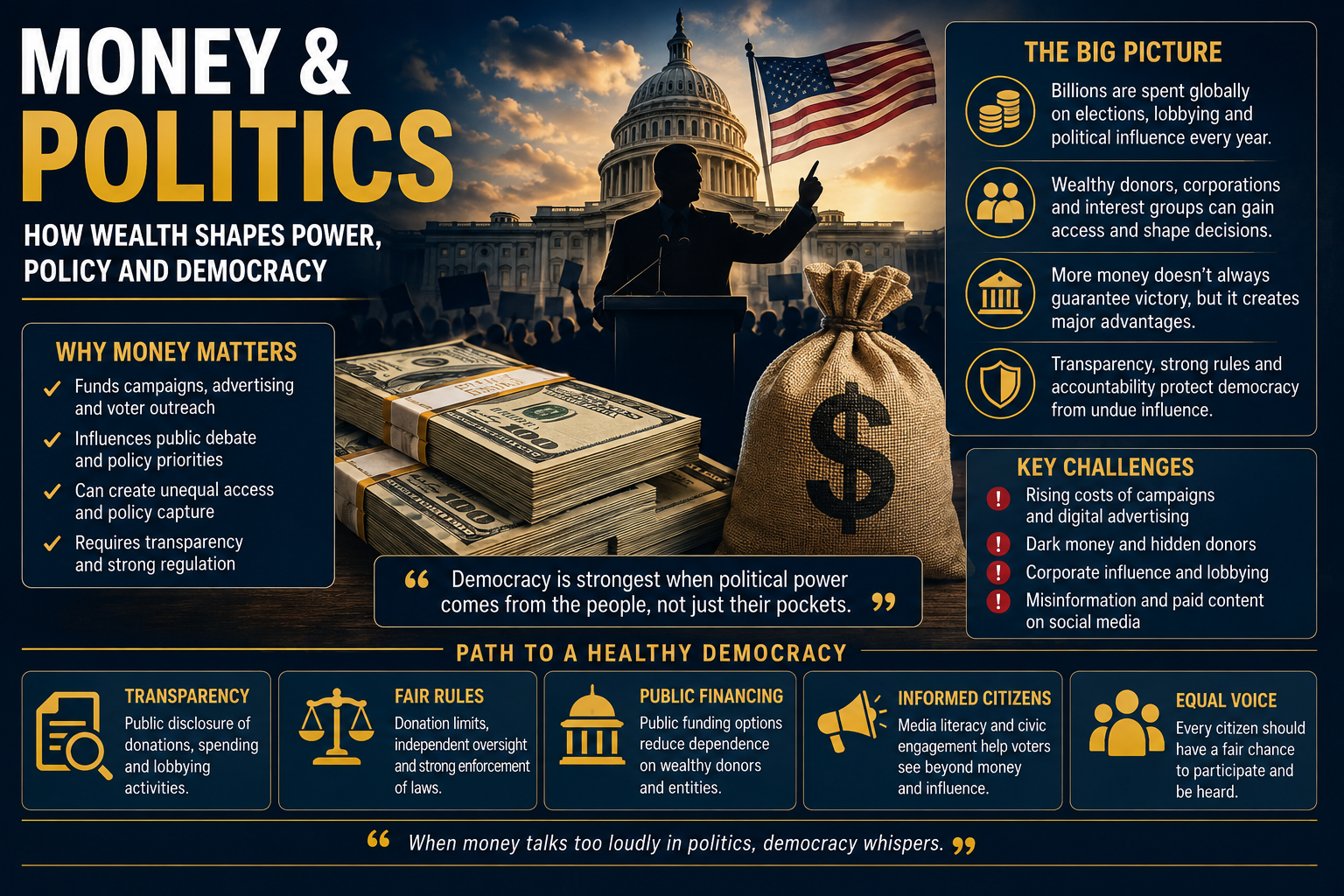
Money and politics have always been closely connected. Political parties need funding to run campaigns, communicate with voters, organize events and promote their policies. At the same time, wealthy individuals, corporations and interest groups may use financial resources to gain access to politicians and influence public debate.
The relationship has become even more important in 2026 as elections increasingly depend on expensive advertising, digital campaigns, data, social media and political organizations. Recent developments in the United States show how cryptocurrency, artificial intelligence and online betting companies are becoming major political spenders.
The central question is not simply whether money should be involved in politics. It is how much influence money should have over political decisions—and how democratic systems can maintain transparency and accountability.
What Does “Money in Politics” Mean?
Money in politics refers broadly to financial resources used to participate in or influence political processes.
This can include:
Political donations
Campaign spending
Political advertising
Party funding
Lobbying
Political action committees
Donations from corporations and wealthy individuals
Funding for advocacy organizations
Digital and social-media campaigns
Election-related research and polling
Political finance is not necessarily negative. Elections require resources, and funding can allow candidates and political parties to communicate their ideas with voters. International IDEA notes that money can enable political participation and representation, but poorly regulated political finance can also undermine democratic institutions.
The challenge is finding a balance between political participation and excessive financial influence.
Why Does Politics Require So Much Money?
Modern political campaigns are expensive because candidates compete for public attention.
Television advertising, online advertising, campaign staff, polling, travel, offices, security, technology and voter outreach can require substantial financial resources.
Digital politics has added another layer. Candidates can now target voters through social media, search advertising, online videos and sophisticated databases.
This means campaigns can spend money not only on traditional advertisements but also on highly targeted digital communication.
As elections become more competitive, political organizations often feel pressure to raise increasingly large amounts of money.
Wealthy Donors and Political Influence
One of the biggest debates surrounding money and politics concerns wealthy donors.
A wealthy individual can potentially contribute far more to political causes than an ordinary citizen. This can create concerns that people with greater financial resources may have greater access to political leaders.
Research and public-opinion surveys have repeatedly shown concern about the influence of major donors and special interests. Pew Research Center found that many Americans believe wealthy political donors and special interests have too much influence, while ordinary citizens have too little.
However, money does not automatically guarantee political victory.
Recent U.S. elections have provided examples of candidates defeating better-funded opponents. Analysts have argued that voter enthusiasm, endorsements, grassroots organization and political momentum can sometimes outweigh financial advantages.
This distinction is important: money can increase political opportunities, but it does not completely control voter behavior.
The Rise of Corporate Political Spending
Corporations have become increasingly visible participants in political debates.
Businesses may spend money to support candidates, ballot initiatives or policies that affect their industries. Companies may also lobby governments on taxation, environmental regulations, technology rules, trade and other issues.
In the 2026 U.S. midterm cycle, corporate political spending has reached record levels. Reuters reported that corporate spending had reached approximately $517 million through the first quarter of the cycle, with emerging industries such as cryptocurrency, AI and online betting becoming particularly active.
This represents a broader trend: new industries often become politically active when governments begin creating rules that could significantly affect their future.
Cryptocurrency and Politics
Cryptocurrency has become one of the clearest examples of the relationship between emerging industries and political influence.
Crypto companies and investors have increasingly spent money supporting candidates and political organizations that favor policies seen as beneficial to the industry.
The reason is straightforward. Government regulations can have a major impact on cryptocurrency businesses.
Rules concerning digital assets, taxation, securities, stablecoins and financial services can determine which companies succeed or fail.
As a result, the cryptocurrency industry has increasingly treated political engagement as an important part of its business strategy.
Artificial Intelligence Enters the Political Arena
Artificial intelligence is another emerging force in political finance.
AI companies face major policy questions involving data, copyright, employment, national security, competition and regulation.
As governments consider how AI should be regulated, companies in the sector have stronger incentives to participate in political discussions.
Recent reporting indicates that AI companies have become significant political spenders during the 2026 U.S. election cycle.
This raises an important question for policymakers: How can governments regulate rapidly developing technologies without allowing financial influence to determine the rules?
Lobbying and Political Access
Political influence does not always come through campaign donations.
Lobbying is another major part of the relationship between money and politics.
Companies, industry associations, labor organizations and advocacy groups may hire professional lobbyists to communicate their interests to lawmakers and government officials.
Lobbying itself can serve a legitimate purpose. Policymakers need information about complicated industries, and businesses can explain how proposed laws may affect workers, consumers and investment.
The problem arises when political access becomes heavily dependent on financial resources.
International IDEA emphasizes that political-finance and lobbying regulations are important tools for promoting integrity, transparency and accountability.
Does Money Buy Elections?
Money can certainly help campaigns, but it does not guarantee victory.
Financial resources can provide candidates with greater visibility, better organization and more opportunities to communicate with voters.
However, elections are also influenced by:
Candidate reputation
Political issues
Economic conditions
Voter turnout
Grassroots organization
Party support
Media coverage
Public sentiment
Political scandals
Endorsements
Recent 2026 U.S. election examples have demonstrated that candidates can sometimes defeat opponents who spend considerably more money.
Therefore, it is more accurate to say that money creates political advantages rather than guaranteeing political success.
The Risk of Policy Capture
One of the most serious concerns is policy capture.
Policy capture occurs when public decisions increasingly reflect the interests of a narrow group rather than the broader public interest.
The OECD has examined the risks associated with political-party and campaign financing, particularly the possibility that financial relationships can create opportunities for policy capture.
For example, if an industry provides significant financial support to politicians and those politicians later oversee regulations affecting that industry, the public may question whether policy decisions are independent.
Even when no illegal activity occurs, the appearance of a financial conflict can damage public trust.
Transparency Is Essential
One of the most important solutions is transparency.
Citizens should be able to understand:
Who is funding political campaigns?
How much money is being donated?
Which organizations are spending money?
Who benefits from political advertising?
Who is lobbying government officials?
How are political organizations using donated funds?
International IDEA describes disclosure as a foundational principle of political-finance regulation because transparency allows citizens and institutions to understand where political money comes from.
Without transparency, voters may find it difficult to evaluate potential conflicts of interest.
Campaign Finance Reform
Governments around the world have adopted different approaches to controlling political money.
Possible reforms include:
Donation Limits
Governments can place limits on how much individuals or organizations can donate.
Disclosure Requirements
Political organizations can be required to publicly disclose major donors and expenditures.
Public Campaign Financing
Governments can provide candidates or parties with public funds, reducing dependence on wealthy private donors.
Stronger Enforcement
Rules are less effective when violations are difficult to detect or penalties are weak.
Digital Advertising Transparency
Political advertisements on social media and digital platforms can be required to identify who paid for them.
These approaches differ significantly between countries, but the broader objective is similar: protect political competition while reducing opportunities for hidden influence.
Social Media Has Changed Political Money
Political spending is no longer limited to television, newspapers and billboards.
Social media platforms have transformed political communication.
Campaigns can target specific demographic groups, geographic areas and interest communities. Influencers and online creators can also become part of political communication strategies.
This has created new transparency challenges.
In the United States, California lawmakers are considering stronger penalties for content creators who fail to disclose payments for political posts. The debate reflects growing concern about paid political influence on social platforms.
As political advertising becomes more personalized, voters need clear information about who is behind the message.
Money, Politics and Democracy
Money is not inherently harmful to democracy.
Candidates need resources to communicate. Political parties need organizations. Advocacy groups need funding to participate in public debate.
The problem begins when financial power becomes so concentrated that ordinary citizens feel they cannot compete politically.
International IDEA warns that poorly regulated political money can undermine political integrity and democratic institutions.
A healthy democratic system therefore needs both political freedom and financial accountability.
The Future of Money and Politics
The relationship between money and politics is likely to become even more complicated.
Artificial intelligence could make political advertising more personalized. Cryptocurrency could create new forms of political fundraising. Influencers could become increasingly important political messengers. Digital platforms could make political campaigns faster and more targeted.
At the same time, governments are likely to face pressure to improve disclosure and regulate political advertising.
The central challenge will be ensuring that innovation does not create new opportunities for hidden political influence.
Final Thoughts
Money is an essential part of modern politics, but excessive financial influence can create serious questions about fairness, representation and public trust.
The 2026 political environment demonstrates that the debate is evolving. Traditional wealthy donors remain influential, while cryptocurrency, AI, technology and digital businesses are becoming increasingly active in political spending.
The goal should not necessarily be to eliminate money from politics. Instead, democratic systems need transparency, strong enforcement, fair competition and clear rules.
When citizens can see where political money comes from and how it is spent, they are better equipped to judge political messages and hold elected officials accountable.
Ultimately, the health of a democracy depends on ensuring that political power comes from voters—not simply from the people or organizations with the deepest pockets.
FAQs
What is money in politics?
Money in politics refers to financial resources used to support candidates, political parties, campaigns, lobbying and other activities intended to influence political processes.
Why is money important in politics?
Political campaigns require money for advertising, staff, research, transportation, technology and voter outreach. Funding allows candidates and parties to communicate their ideas with voters.
Can money buy political elections?
Money can provide major advantages, but it does not guarantee victory. Candidate quality, voter sentiment, grassroots organization, political issues and turnout can all affect election outcomes.
Why are wealthy donors controversial?
Wealthy donors can contribute significantly more money than ordinary citizens, raising concerns that financial resources may translate into greater political access or influence.
What is campaign finance?
Campaign finance refers to the money raised and spent by candidates, political parties and organizations during election campaigns.
What is political lobbying?
Lobbying involves communicating with government officials and policymakers to influence legislation, regulations or public policy.
How can governments reduce excessive political influence?
Possible measures include donation limits, public financing, stronger disclosure rules, lobbying regulations and better enforcement of campaign-finance laws.
Why is transparency important?
Transparency allows voters and regulators to see who is funding political campaigns and organizations, helping identify potential conflicts of interest.
How is AI changing money and politics?
AI companies are becoming political participants while governments consider rules covering AI safety, competition, copyright, employment and data. AI-related businesses have also become significant political spenders in 2026.
Is money in politics a problem in every country?
The scale and rules differ between countries. However, political finance is a global governance issue, and organizations such as International IDEA and the OECD study ways to improve transparency and accountability.