
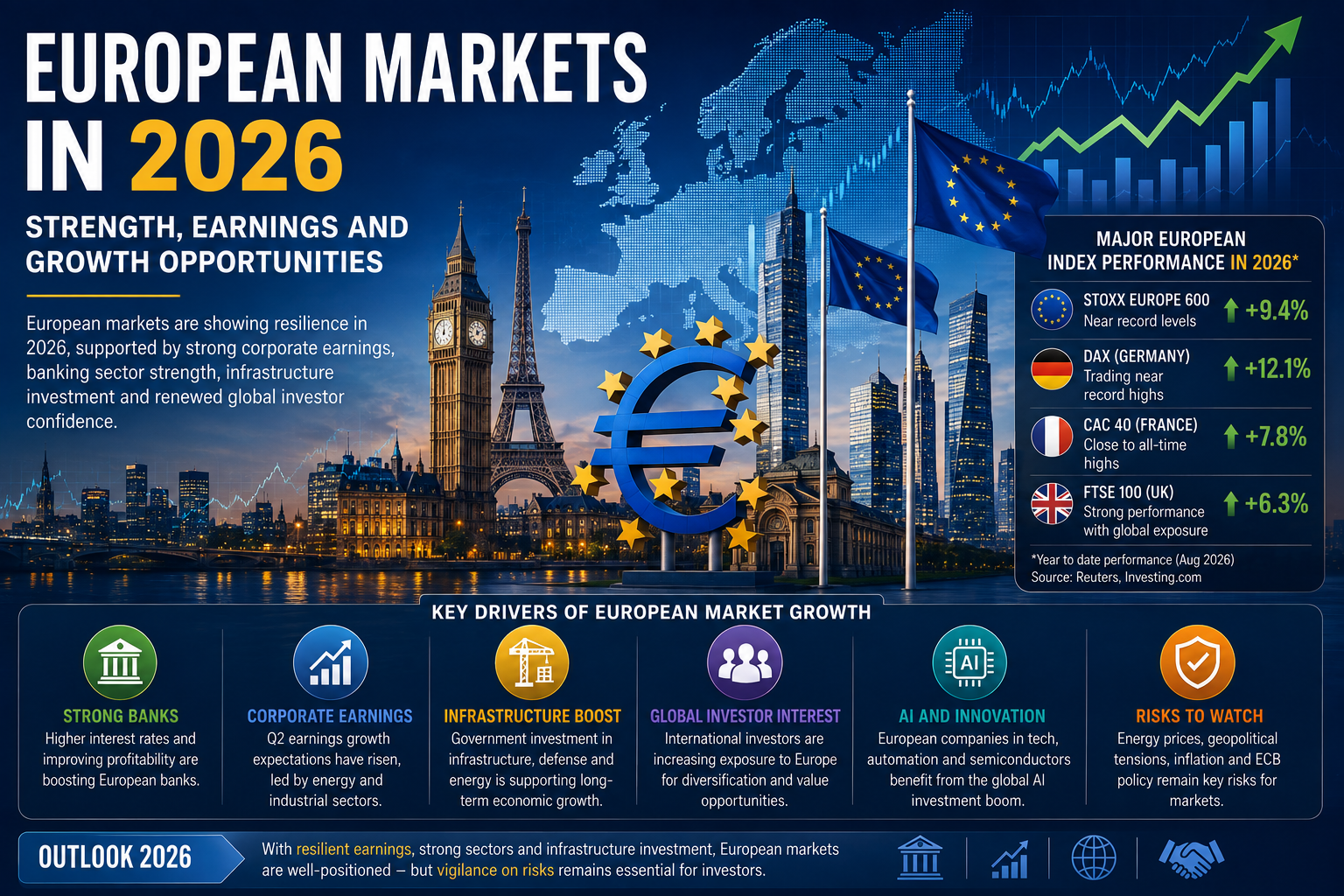
European markets have become one of the most closely watched parts of the global investment landscape in 2026. After years of concerns about weak growth and limited technology exposure, European equities have shown surprising resilience, supported by corporate earnings, financial stocks, infrastructure spending and improving investor sentiment.
The STOXX Europe 600 has remained near record levels, while European markets have attracted renewed international investor interest. Reuters reported in August that European markets were back in favor as the region weathered the Middle East energy shock better than initially expected, while its lower exposure to AI-driven technology volatility also supported sentiment.
European Stocks Have Defied Expectations
For years, investors often viewed European equities as less attractive than U.S. stocks because of slower economic growth and Europe's smaller technology sector.
That perception has started to change.
European shares have performed strongly in 2026, with the STOXX Europe 600 reaching record levels earlier in August. The DAX has also traded around record highs, while France's CAC 40 has remained close to its peak.
The rally has been supported by several sectors rather than only technology.
Banks, energy companies, industrial businesses, defense companies and infrastructure-related stocks have all contributed to the region's performance.
Strong Corporate Earnings Support Markets
Corporate earnings have become an important reason for the European market's strength.
Reuters reported that second-quarter earnings growth expectations for STOXX 600 companies had risen sharply, with energy companies accounting for a significant portion of the improvement.
Strong earnings matter because stock prices ultimately depend on expectations for corporate profits.
If companies continue to generate stronger revenue and earnings, investors may become more comfortable paying higher prices for their shares.
European Banks Are Attracting Attention
European banks have been among the strongest performers.
Higher interest rates can benefit banks by supporting net interest income, although the overall effect depends on deposit costs, loan demand and credit quality.
European financial stocks have also benefited from improving profitability and investor interest.
The Financial Times recently highlighted the strong performance of European banks compared with major U.S. technology stocks, noting that financial companies have become an important part of Europe's market strength.
Germany Remains a Key Market
Germany's DAX is one of Europe's most important stock indexes.
The index has benefited from strength in several major companies and growing expectations around infrastructure and economic reforms.
Germany is also central to Europe's industrial economy.
Its automotive, chemical, engineering and manufacturing sectors make the country's economic outlook particularly important for the broader European market.
Recent investment strategies have highlighted German reform and infrastructure plans as potential support for European growth.
France Offers a Different Investment Mix
France's CAC 40 provides exposure to a different group of industries.
Major French companies have significant international revenues across luxury goods, aerospace, healthcare, energy and consumer products.
This international exposure means French companies are not entirely dependent on domestic economic conditions.
However, political and fiscal developments remain important factors for French assets.
The UK Market Remains Strong
The UK's FTSE 100 is another major European benchmark.
The index has significant exposure to energy, mining, financial services and multinational companies.
That composition can make the FTSE 100 behave differently from technology-heavy U.S. indexes.
In August, UK shares continued to show resilience alongside broader European markets, with mining and resource companies providing support on some trading sessions.
Europe Has Less Exposure to AI Stocks
One interesting advantage for European markets is their relatively smaller exposure to the largest AI technology companies.
The U.S. stock market has become heavily concentrated in a handful of major technology companies.
The European market is more diversified across banks, energy, industrials, healthcare and consumer companies.
This can help Europe when investors are concerned about high technology valuations.
However, it also means European markets may not benefit as dramatically if the AI boom continues driving U.S. technology stocks higher.
AI Still Matters to Europe
Europe may not have as many mega-cap AI companies as the United States, but AI is still important to European markets.
Companies involved in:
Semiconductor equipment
Industrial automation
Software
Data centers
Telecommunications
Energy infrastructure
can benefit from the growing demand for artificial intelligence.
Dutch semiconductor-equipment company ASML is one example of how European companies can play a critical role in the global technology supply chain.
The ECB Remains a Major Market Driver
European Central Bank policy is one of the most important factors for European stocks and bonds.
Interest rates influence borrowing costs, consumer spending, business investment and bank profitability.
The ECB has also highlighted how financial markets have been balancing two major forces in 2026: geopolitical and energy risks on one side and strong AI-related investment and earnings expectations on the other.
This balance could remain important throughout the year.
Inflation and Energy Prices
Energy prices remain one of Europe's biggest economic risks.
Europe imports substantial amounts of energy, making the region sensitive to changes in oil and gas prices.
Higher energy prices can increase production costs and household expenses, potentially pushing inflation higher.
The ECB has warned that energy supply disruptions can create both upside risks to inflation and downside risks to economic growth.
This creates a difficult environment for policymakers.
Infrastructure Spending Could Support Growth
Infrastructure investment is another important theme.
European governments are increasingly focused on:
Roads
Railways
Electricity grids
Defense infrastructure
Digital networks
Energy systems
Industrial capacity
Infrastructure spending can benefit construction companies, engineering firms, industrial manufacturers and financial institutions.
It can also improve long-term productivity.
Defense Stocks Become More Important
Geopolitical uncertainty has increased attention toward European defense companies.
European governments are reassessing defense spending and military capabilities, creating potential long-term demand for defense equipment and technology.
This has made aerospace and defense stocks an increasingly important part of the European investment story.
Reuters reported gains in European aerospace and defense shares during periods of heightened geopolitical risk in 2026.
European Markets and Global Investors
International investors are increasingly looking toward Europe for diversification.
European equities can offer exposure to industries that may be less represented in U.S. indexes.
These include:
Banks
Luxury goods
Industrial machinery
Energy
Defense
Healthcare
Utilities
Infrastructure
Recent market analysis has highlighted strong foreign inflows into European equities as investors seek alternatives to highly concentrated U.S. markets.
Risks Facing European Markets
Despite the positive outlook, European markets still face significant risks.
Energy Shock
Higher oil and gas prices could increase inflation and reduce consumer purchasing power.
Geopolitical Tensions
Conflict and trade disputes can affect supply chains and investor confidence.
ECB Policy
Higher interest rates could pressure economic growth and borrowing-sensitive sectors.
AI Valuations
A major correction in global technology stocks could also affect European markets.
The ECB recently warned that a significant U.S. technology-stock correction could have consequences for euro-area financial stability because European households and institutions have substantial exposure to U.S. technology equities.
Weak Economic Growth
Europe still faces structural challenges involving productivity, demographics and industrial competitiveness.
What Investors Are Watching
Several indicators could determine the direction of European markets during the remainder of 2026.
Corporate earnings: Stronger-than-expected profits could support valuations.
ECB policy: Interest-rate expectations will influence stocks and bonds.
Energy prices: Oil and gas remain major inflation risks.
German growth: Europe's largest economy is crucial to regional performance.
Infrastructure investment: Government spending could support industrial and construction companies.
Foreign capital flows: International investment can provide additional support to European equities.
The European Market Opportunity
One of the biggest changes in 2026 is that investors are increasingly looking at Europe as more than a value market.
European equities offer exposure to businesses with strong global revenues, established brands, infrastructure assets and industrial capabilities.
Many European companies generate a large share of their revenue outside Europe, which means investors can gain international exposure through European-listed stocks.
This is particularly relevant when comparing European markets with more concentrated national indexes elsewhere.
What Could Happen Next?
The outlook remains constructive but uncertain.
European equities have already experienced significant gains, meaning valuations are no longer as low as they were earlier in the cycle.
The market therefore needs continued earnings growth to justify further increases.
Goldman Sachs recently raised its 12-month STOXX 600 target to 695, citing resilient growth and strong corporate earnings.
Other analysts remain cautious because geopolitical risks and energy prices could create new volatility.
Final Thoughts
European markets have surprised many investors in 2026.
The region's stock markets have benefited from strong corporate earnings, financial-sector strength, infrastructure investment and renewed international interest.
At the same time, Europe remains exposed to energy prices, geopolitical uncertainty, inflation and changes in ECB policy.
The biggest opportunity may be the market's diversity.
European investors can gain exposure to banking, energy, industrials, healthcare, luxury goods, defense, infrastructure and technology through a single regional investment landscape.
As the rest of 2026 unfolds, the key question will be whether strong earnings and improving investor confidence can continue to outweigh Europe's economic and geopolitical challenges.
For investors looking beyond the U.S. market, European equities are becoming increasingly difficult to ignore.
FAQs
What are European markets?
European markets include the stock, bond and financial markets of countries across Europe, including Germany, France, the UK, Italy, Spain and Switzerland.
What is the STOXX Europe 600?
The STOXX Europe 600 is a major European stock-market index representing companies across multiple European countries and industries.
Why are European stocks performing strongly in 2026?
Strong corporate earnings, financial stocks, infrastructure investment and foreign investor interest have supported European equities.
Which European markets are important?
Germany's DAX, France's CAC 40, the UK's FTSE 100, Italy's FTSE MIB and Spain's IBEX 35 are among Europe's major stock indexes.
How does the ECB affect European markets?
ECB interest-rate decisions influence borrowing costs, currencies, bonds, bank profitability and investor expectations.
Why are European banks performing well?
Improved profitability and interest-rate conditions have helped European banks attract investor attention.
What are the biggest risks for European markets?
Energy prices, inflation, geopolitical tensions, weak growth and potential corrections in global technology stocks are important risks.
Is Europe benefiting from AI?
Yes. European companies involved in semiconductor equipment, industrial technology, software and infrastructure can benefit from the global AI investment cycle.