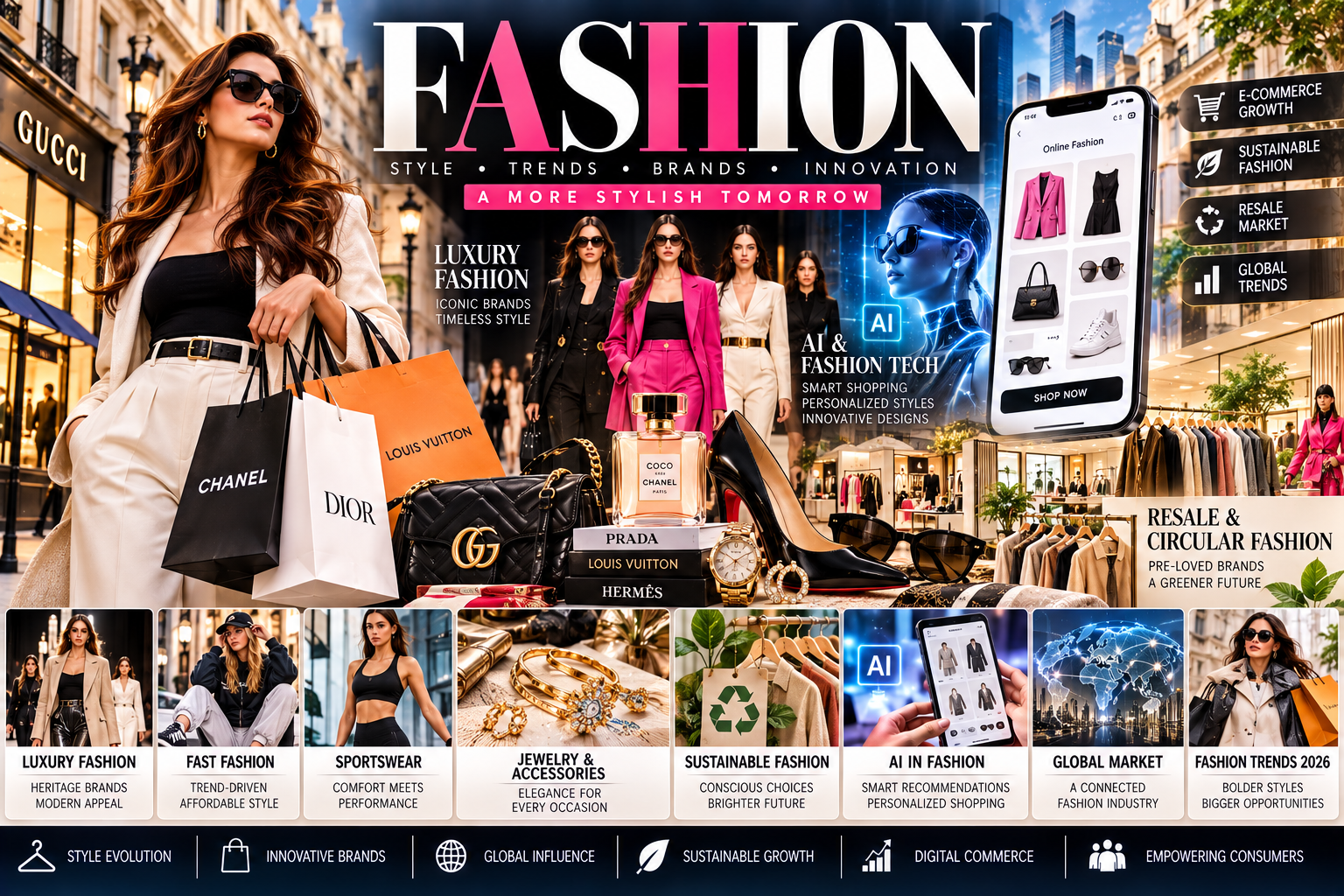
Fashion is a global industry that combines creativity, design, manufacturing, retail, technology, entertainment, and consumer culture. From luxury houses and international apparel companies to independent designers, fast-fashion retailers, resale platforms, and digital brands, fashion influences how people express identity and respond to changing cultural and economic trends.
In 2026, the fashion industry is navigating a rapidly changing environment shaped by artificial intelligence, shifting consumer spending, trade disruptions, resale, sustainability, luxury-market adjustments, and digital commerce. McKinsey and The Business of Fashion identify AI, resale, efficiency, changing consumer behavior, and luxury-sector recalibration among the major themes shaping the industry this year.
What Is Fashion?
Fashion refers to the design, production, marketing, distribution, and consumption of clothing, footwear, accessories, beauty-related products, and lifestyle products.
The industry includes:
Apparel
Luxury fashion
Fast fashion
Sportswear
Footwear
Accessories
Jewelry
Beauty and personal care
Fashion technology
Resale and secondhand fashion
Textile manufacturing
Fashion retail
E-commerce
Fashion also extends beyond products. Brand identity, cultural influence, social media, celebrity collaborations, entertainment, and customer communities increasingly contribute to the value of fashion companies.
The Global Fashion Industry
Fashion is a highly interconnected global industry. A single garment can involve design in one country, materials from another, manufacturing in a third, and sales across dozens of markets.
Major fashion centers include:
Paris
Milan
London
New York
Tokyo
Seoul
Los Angeles
Shanghai
Dubai
The global industry includes luxury houses, mass-market retailers, sportswear companies, independent labels, online marketplaces, and specialized manufacturers.
McKinsey's 2026 analysis projects low single-digit growth for the global fashion industry, reflecting a challenging environment for brands and retailers.
Major Fashion Categories
Luxury Fashion
Luxury fashion includes high-end apparel, handbags, footwear, watches, jewelry, and accessories.
Luxury brands often compete through:
Design
Craftsmanship
Heritage
Exclusivity
Brand recognition
Store experience
Customer relationships
The luxury segment has faced changing consumer behavior and questions around pricing and value. McKinsey and BoF describe 2026 as a period of strategic recalibration for luxury brands as companies work to strengthen consumer relationships and redefine value.
Fast Fashion
Fast fashion focuses on rapidly translating trends into affordable products.
Its business model often emphasizes:
Speed
Low prices
Frequent product launches
Global supply chains
High-volume retail
Digital marketing
The segment continues to face scrutiny around environmental impact, labor practices, waste, and supply-chain transparency.
Sportswear and Athleisure
Sportswear has expanded beyond athletic activities into everyday clothing.
Popular categories include:
Sneakers
Leggings
Performance tops
Running apparel
Training clothing
Lifestyle footwear
Outdoor apparel
The combination of fashion, fitness, wellness, and casual lifestyles continues to influence product development.
Streetwear
Streetwear combines casual clothing with elements of music, art, sports, gaming, and youth culture.
Limited releases, collaborations, community engagement, and social media can create significant demand for streetwear products.
Fashion Brands
Fashion brands compete through a combination of product quality, design, storytelling, customer experience, distribution, and cultural relevance.
A strong brand can create value through:
Customer loyalty
Pricing power
Repeat purchases
Global recognition
Community
Intellectual property
Retail presence
Digital engagement
In 2026, brand discovery is increasingly influenced by AI-powered search and recommendation systems. McKinsey reports that consumers are increasingly using large language models to search for products, compare options, and receive personalized recommendations.
Fashion and Artificial Intelligence
Artificial intelligence is becoming a major force across the fashion value chain.
Fashion companies are using AI for:
Product recommendations
Customer service
Demand forecasting
Inventory planning
Content creation
Image generation
Product discovery
Marketing
Pricing
Trend analysis
Supply-chain management
McKinsey reports that more than 35% of surveyed fashion executives said their companies were already using generative AI in areas such as online customer service, image creation, copywriting, consumer search, or product discovery.
The AI Shopper
AI is also changing how customers discover fashion.
Instead of searching through hundreds of products, consumers can increasingly ask AI assistants questions such as:
What should I wear to a wedding?
Which sneakers match these clothes?
Find a winter jacket under a specific budget.
Which handbag works for a business event?
This creates a new challenge for fashion companies: products need to be discoverable not only through traditional search engines but also through AI-powered recommendation systems.
Fashion E-Commerce
Online shopping has transformed the fashion industry.
E-commerce allows consumers to:
Compare products
Read reviews
Discover international brands
Shop through mobile devices
Receive personalized recommendations
Purchase directly from brands
Fashion companies are increasingly investing in digital storefronts, social commerce, mobile experiences, personalization, and customer data.
Social platforms have also become important discovery channels, particularly for younger consumers.
Social Media and Fashion
Social media has shortened the distance between fashion brands and consumers.
Platforms can help brands:
Launch collections
Build communities
Work with creators
Promote products
Generate trends
Receive customer feedback
Drive online sales
Influencer marketing and creator partnerships have become important tools for both established and emerging brands.
A fashion trend can now move from a social-media post to a global consumer phenomenon in a very short period.
Fashion Resale
The resale market has become an increasingly important part of fashion.
Resale platforms allow consumers to buy and sell pre-owned:
Clothing
Handbags
Sneakers
Watches
Jewelry
Accessories
McKinsey estimates that resale is positioned to grow significantly faster than the firsthand fashion market and reports that brands are increasingly considering resale as part of their broader strategy.
Resale can appeal to consumers looking for:
Lower prices
Rare products
Vintage pieces
Sustainability
Unique items
Access to luxury brands
For brands, resale can also create another relationship with consumers and potentially introduce younger shoppers to established labels.
Sustainability in Fashion
Sustainability remains an important issue across the fashion value chain.
Key areas include:
Sustainable materials
Recycling
Product durability
Circular fashion
Secondhand markets
Supply-chain transparency
Energy efficiency
Waste reduction
Responsible manufacturing
Circular business models can include repair, resale, rental, recycling, and product take-back programs.
However, sustainability strategies can involve significant operational costs and require changes across design, sourcing, manufacturing, logistics, and retail.
Fashion Supply Chains
Fashion relies on complex international supply chains.
They can include:
Raw materials
Textile production
Fabric processing
Manufacturing
Packaging
Transportation
Warehousing
Wholesale
Retail
Customer delivery
Disruptions at any stage can affect prices, inventory, delivery times, and profitability.
Trade policies and tariffs are particularly important because apparel and footwear companies often source products internationally.
The 2026 State of Fashion report identifies trade disruptions and tariffs as major concerns for fashion executives.
Fashion and Tariffs
Trade policy can directly affect fashion companies because clothing and footwear frequently cross international borders.
Higher tariffs can increase:
Import costs
Product costs
Retail prices
Supply-chain complexity
Margin pressure
Companies may respond by:
Diversifying suppliers
Moving production
Negotiating with manufacturers
Adjusting prices
Reducing costs
Using technology to improve efficiency
McKinsey and BoF report that tariff changes have already influenced sourcing and supply-chain decisions across the industry.
Fashion Retail
Fashion retail includes:
Department stores
Specialty stores
Shopping malls
Outlet stores
Brand-owned stores
E-commerce
Marketplaces
Social commerce
Physical stores remain important because they provide consumers with experiences that online shopping cannot completely replicate.
Modern fashion stores increasingly combine:
Product discovery
Personalization
Events
Technology
Entertainment
Community
Customer service
Luxury Retail
Luxury brands are adapting their retail strategies as consumers increasingly evaluate whether products justify premium prices.
Luxury companies are investing in:
Store design
Personalized services
Exclusive products
Clienteling
Digital experiences
Events
Cultural partnerships
The goal is to strengthen the relationship between brand identity and customer experience.
Fashion and Gen Z
Gen Z has become an important fashion consumer group.
Their behavior can combine different priorities, including:
Value
Individuality
Social identity
Sustainability
Resale
Digital discovery
Luxury
Wellness
McKinsey's 2026 research describes a duality in Gen Z fashion behavior, with consumers simultaneously showing interest in resale and value while also participating in luxury and innovation-driven categories.
Jewelry and Accessories
Jewelry continues to be an important fashion category.
Consumers may purchase jewelry for:
Self-expression
Personal milestones
Investment
Gifting
Fashion
Everyday wear
The State of Fashion 2026 identifies jewelry as a strong category, with demand supported by self-expression, gifting, and interest in products perceived as lasting investments.
Smart Fashion and Wearable Technology
Technology is increasingly being integrated into fashion products.
Examples include:
Smart glasses
Connected watches
Fitness wearables
Smart clothing
Technology-enabled accessories
Smart eyewear is attracting particular attention because it combines technology with fashion and everyday consumer use. The State of Fashion 2026 identifies smart frames as an emerging growth area.
Fashion and Personalization
Personalization can help brands create more relevant shopping experiences.
Technology can analyze:
Purchase history
Product preferences
Browsing behavior
Size information
Style preferences
Customer interactions
This information can support personalized recommendations and marketing.
AI-powered personalization could increasingly allow customers to interact with fashion websites through conversational interfaces rather than traditional product menus.
Fashion Business Models
Fashion companies operate through several business models.
Direct-to-Consumer
Brands sell directly to customers through their own websites and stores.
Wholesale
Brands sell products to retailers that then sell them to consumers.
Marketplace
Third-party platforms connect brands with consumers.
Licensing
A brand allows another company to produce products using its intellectual property under an agreement.
Resale
Companies facilitate the sale of previously owned products.
Rental
Customers temporarily access products instead of purchasing them outright.
Each model has different implications for margins, customer relationships, inventory, and brand control.
Fashion Investment and M&A
Fashion brands can become acquisition targets for strategic companies and private-equity investors.
Potential reasons include:
Strong brand recognition
Loyal customers
International expansion opportunities
Digital growth
Attractive product categories
Retail networks
Intellectual property
Acquisitions can allow companies to expand their portfolios and enter new categories.
Major Fashion Trends for 2026
1. AI-Powered Shopping
Consumers are increasingly using AI tools to discover and compare fashion products.
2. Resale Growth
Secondhand fashion is becoming a more established part of the industry, supported by value-conscious consumers and interest in unique products.
3. Greater Focus on Value
Consumers are becoming more selective about spending, creating pressure on brands to demonstrate product and experience value.
4. Luxury Recalibration
Luxury brands are reassessing pricing, creativity, customer relationships, and brand positioning.
5. Smart Eyewear
Fashion and technology are increasingly converging through connected eyewear and other wearable products.
6. Supply-Chain Adaptation
Brands are diversifying sourcing and improving supply-chain efficiency in response to tariffs, costs, and geopolitical changes.
7. AI-Driven Operations
Companies are using AI for customer service, content creation, demand forecasting, search, marketing, and inventory management.
Challenges Facing Fashion Companies
Fashion businesses face several challenges in 2026.
These include:
Weak or uneven consumer demand
Higher costs
Tariffs
Supply-chain disruptions
Inventory management
Changing consumer preferences
Sustainability requirements
Technology investment
Competition
Luxury-market pressure
The industry therefore needs to balance creativity with operational efficiency.
The Future of Fashion
The fashion industry is moving toward a more technology-driven and consumer-focused model.
AI will increasingly influence product discovery, marketing, customer service, design, merchandising, and supply-chain management. Resale and circular business models will continue to expand, while luxury brands will focus on strengthening consumer trust and demonstrating value.
At the same time, fashion will remain fundamentally connected to creativity and culture.
Technology can change how consumers discover and purchase products, but design, identity, storytelling, craftsmanship, and community will continue to influence why consumers connect with particular brands.
Frequently Asked Questions
What is the fashion industry?
The fashion industry includes the design, production, marketing, distribution, retail, and resale of clothing, footwear, accessories, jewelry, and related lifestyle products.
What are the major fashion trends in 2026?
Major themes include AI-powered shopping, resale, value-conscious consumers, luxury recalibration, smart eyewear, supply-chain changes, and greater use of technology.
How is AI changing fashion?
AI is being used for product discovery, customer service, content creation, demand forecasting, personalization, marketing, and inventory management.
Is fashion resale growing?
Yes. Industry research indicates that resale is growing faster than the firsthand fashion market and is becoming a more important strategic channel for brands.
Why is sustainability important in fashion?
Sustainability addresses issues including material use, waste, emissions, product longevity, recycling, and supply-chain practices.
How is e-commerce changing fashion?
E-commerce gives consumers access to more brands and products while allowing fashion companies to sell directly, personalize recommendations, collect customer insights, and reach international markets.
Conclusion
Fashion remains one of the world's most dynamic consumer industries, combining creativity, commerce, technology, culture, and global supply chains.
In 2026, the sector is adapting to AI-powered shopping, changing consumer priorities, resale growth, supply-chain disruption, sustainability expectations, and a renewed focus on value. McKinsey and The Business of Fashion describe AI, resale, efficiency, trade disruption, and luxury recalibration as central themes for the year.
The next phase of fashion will likely combine technological innovation with stronger brand identity and more personalized consumer experiences. Companies that understand changing customer behavior while maintaining creativity, operational flexibility, and clear brand positioning will be better positioned to navigate the industry's evolving landscape.