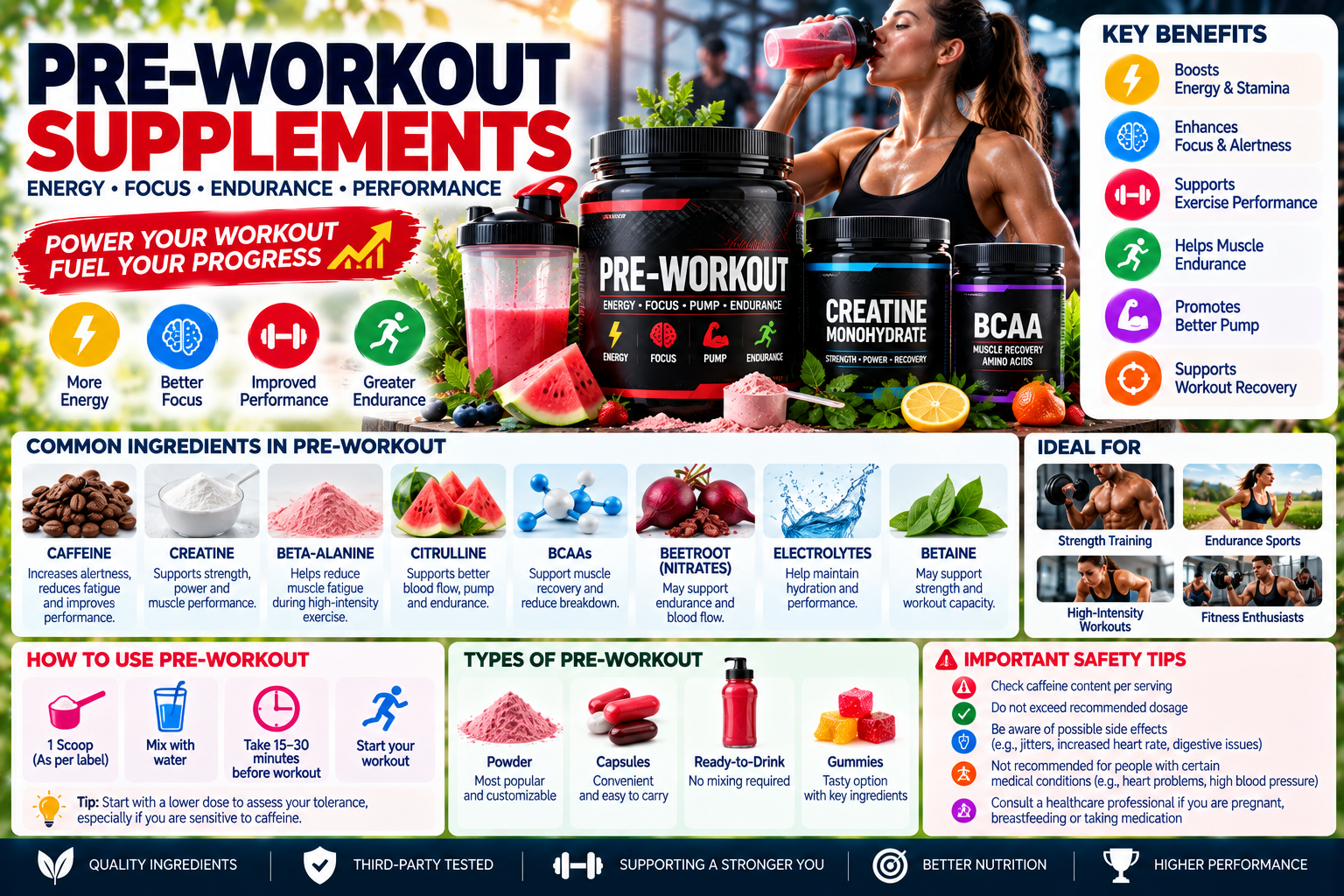
Pre-workout supplements have become a popular part of fitness routines for people who want a convenient way to prepare for exercise. These products are commonly sold as powders, capsules, drinks, or ready-to-mix formulas and may contain ingredients such as caffeine, creatine, beta-alanine, citrulline, amino acids, electrolytes, and other compounds.
The purpose of a pre-workout is generally to provide ingredients that may support energy, alertness, exercise performance, or training capacity. However, not every ingredient has equally strong scientific evidence, and combination products can contain substantially different amounts of each ingredient.
The NIH Office of Dietary Supplements notes that research on exercise-performance supplements varies by ingredient, exercise type, training level, and individual characteristics.
What Is a Pre-Workout Supplement?
A pre-workout is a dietary supplement intended to be consumed before exercise.
Most products are designed to be taken approximately 15–60 minutes before training, although timing depends on the ingredients.
Common pre-workout ingredients include:
Caffeine
Creatine
Beta-alanine
Citrulline or citrulline malate
Betaine
BCAAs
Electrolytes
Carbohydrates
Vitamins and minerals
Flavoring and sweeteners
Some formulas contain only a few ingredients, while others contain long lists of compounds marketed for energy, endurance, focus, pumps, strength, or recovery.
Why Do People Take Pre-Workout?
People commonly use pre-workout supplements to make their training routine more convenient or to consume specific performance-related ingredients.
Common reasons include:
Increasing alertness before exercise
Reducing feelings of fatigue
Supporting exercise performance
Supporting high-intensity training
Supporting endurance
Providing caffeine before a workout
Combining several sports-nutrition ingredients in one product
However, a pre-workout is not essential for having a productive workout.
Sleep, hydration, nutrition, appropriate training, and recovery remain fundamental parts of exercise performance.
Caffeine: The Most Common Pre-Workout Ingredient
Caffeine is one of the most extensively studied ingredients found in pre-workout products.
It stimulates the central nervous system and can reduce perceived fatigue and exertion. Research summarized by the NIH indicates that caffeine can improve performance in some endurance and intermittent high-intensity activities.
For sports performance, studies commonly use approximately 2–6 mg of caffeine per kilogram of body weight, although individual responses vary. More is not necessarily better.
The FDA states that, for most adults, around 400 mg of caffeine per day is an amount not generally associated with negative effects, although sensitivity varies according to medications, health conditions, body weight, and individual response.
Potential Caffeine Benefits
Caffeine may:
Increase alertness
Reduce perceived fatigue
Reduce perceived effort during some activities
Support endurance performance
Support performance during certain high-intensity activities
Possible Caffeine Side Effects
Too much caffeine can cause:
Restlessness
Anxiety
Insomnia
Nausea
Vomiting
Rapid heartbeat
Heart rhythm disturbances
The NIH also notes that heavy caffeine use can interfere with sleep and may increase irritability or anxiety.
Because caffeine from coffee, tea, energy drinks, medications, and supplements all contributes to total daily intake, consumers should consider their entire caffeine consumption rather than looking only at the pre-workout label.
Creatine in Pre-Workout
Creatine is another widely researched sports-nutrition ingredient.
Unlike caffeine, creatine does not need to be consumed immediately before a workout to work. Its effects are associated with increasing muscle creatine stores over time.
Creatine helps provide energy for short-duration, high-intensity activity and has substantial research supporting improvements in strength, power, and repeated high-intensity exercise.
Creatine monohydrate is the most extensively studied form.
Some pre-workout formulas contain creatine, while others leave it out so consumers can take it separately.
Does Creatine Need to Be Taken Before Exercise?
Not necessarily.
The important factor is consistent supplementation over time rather than taking it at a specific minute before training.
This is one reason consumers should not assume that every ingredient in a pre-workout needs to work immediately.
Beta-Alanine
Beta-alanine is commonly included in pre-workout formulas.
The body uses beta-alanine to help produce carnosine in skeletal muscle. Carnosine can help buffer changes in muscle acidity during high-intensity exercise.
Research summarized by NIH suggests that beta-alanine may provide some benefits for certain high-intensity activities, although findings are not consistent across all forms of exercise.
Why Does Pre-Workout Make the Skin Tingle?
Beta-alanine can cause a temporary tingling or prickling sensation called paresthesia.
It may be felt around the:
Face
Neck
Hands
Upper body
This sensation is generally temporary, but it can be uncomfortable.
The tingling does not necessarily mean that a pre-workout is "working better."
Citrulline and Citrulline Malate
Citrulline is another popular pre-workout ingredient.
It is involved in the body's production of arginine and nitric oxide, which are associated with blood-vessel dilation.
Pre-workout manufacturers commonly market citrulline for "pump," blood flow, or exercise performance.
However, NIH notes that research supporting citrulline for exercise performance is limited and mixed.
Consumers should therefore distinguish between marketing claims and the strength of available evidence.
BCAAs in Pre-Workout
Branched-chain amino acids, or BCAAs, include:
Leucine
Isoleucine
Valine
They are found naturally in protein-rich foods and protein supplements.
Although BCAAs are frequently included in sports supplements, NIH notes that research has not consistently demonstrated that supplemental BCAAs improve exercise performance, muscle growth, or recovery beyond what can be achieved through adequate high-quality protein intake.
For someone already consuming enough complete protein, additional BCAAs may therefore provide limited practical value.
Betaine
Betaine is included in some performance supplements.
Research has explored its potential effects on strength and power, but available studies have produced mixed findings.
This illustrates an important point about pre-workouts: an ingredient being included in a popular formula does not automatically mean that it has strong evidence for every type of exercise.
Beetroot and Nitrates
Beetroot and beetroot juice contain dietary nitrate.
Some research suggests that beetroot products may improve performance or endurance in certain activities, particularly some endurance-based exercise.
However, results vary depending on the type of exercise, product, dosage, and individual.
NIH describes the evidence as limited and mixed.
What Does "Pump" Mean?
The term "pump" is commonly used in bodybuilding and fitness.
It generally describes the temporary feeling of increased blood flow and muscle fullness during resistance exercise.
Pre-workout formulas marketed for pump may contain ingredients such as citrulline.
A stronger pump should not automatically be interpreted as greater muscle growth.
Long-term muscle development depends on consistent resistance training, adequate nutrition, recovery, and other factors.
Pre-Workout for Energy
Energy is one of the most common marketing themes for pre-workout supplements.
Caffeine is usually the main ingredient responsible for the noticeable stimulant effect.
Some formulas also include carbohydrates or other ingredients.
However, the feeling of stimulation should not be confused with actual improvement in physical performance.
A product may make someone feel more awake without necessarily producing a meaningful improvement in every type of exercise.
Pre-Workout and Muscle Growth
Pre-workout supplements are not muscle-building products by themselves.
Muscle growth is primarily supported by:
Progressive resistance training
Adequate protein
Sufficient calories and nutrients
Recovery
Sleep
Consistency
Creatine is one ingredient with strong evidence for supporting high-intensity exercise and training adaptations, but it is not necessary to consume creatine specifically as part of a pre-workout formula.
Pre-Workout for Weight Loss
Many pre-workout products are marketed toward people interested in fat loss.
These formulas may contain caffeine or other stimulant ingredients.
However, taking a pre-workout does not automatically cause meaningful weight loss.
Sustainable weight management depends primarily on overall energy balance, nutrition, physical activity, sleep, and long-term habits.
Consumers should be especially cautious with products making dramatic "fat burner" or rapid-weight-loss claims.
Pre-Workout vs Energy Drink
Pre-workout and energy drinks can both contain caffeine, but they are not necessarily identical.
A pre-workout may contain sports-nutrition ingredients such as:
Beta-alanine
Creatine
Citrulline
Electrolytes
Amino acids
An energy drink may primarily provide:
Caffeine
Sugar or alternative sweeteners
Flavoring
Other stimulant ingredients
The most important comparison is the actual ingredient and caffeine content rather than the product category.
How to Read a Pre-Workout Label
A complicated label does not necessarily mean a better formula.
Before purchasing a product, check:
1. Caffeine Amount
Look for the exact caffeine quantity per serving.
2. Serving Size
Some products define a serving as one scoop, while others may require multiple scoops.
3. Proprietary Blends
Be cautious when a label lists a blend without clearly showing how much of each ingredient it contains.
4. Ingredient List
Look for unnecessary ingredients, allergens, sweeteners, and other compounds you may not want.
5. Third-Party Testing
Independent certification or testing can provide additional information about product quality and prohibited substances.
6. Sugar and Calories
Some pre-workouts contain meaningful amounts of carbohydrates or calories.
7. Total Daily Caffeine
Calculate caffeine from all sources, not only the pre-workout.
Are Pre-Workout Supplements Safe?
Safety depends on the product, ingredients, dose, individual health status, and other substances being consumed.
The FDA does not approve dietary supplements for safety and effectiveness before they are marketed. Manufacturers are responsible for ensuring that their products meet applicable requirements.
Pre-workout users should pay particular attention to stimulant ingredients.
Potential concerns include:
Excessive caffeine
Increased heart rate
Anxiety
Sleep disruption
Digestive problems
Tingling from beta-alanine
Interactions with medications
Allergic reactions
Contaminated or inaccurately labeled products
Pre-Workout and Sleep
Taking a highly caffeinated pre-workout later in the day may interfere with sleep.
This can create an unfortunate cycle:
Pre-workout → increased stimulation → poorer sleep → greater fatigue → more stimulant use
For people who exercise in the evening, a lower-caffeine or caffeine-free option may be worth considering.
Pre-Workout and Anxiety
Caffeine can increase feelings of nervousness or anxiety in sensitive individuals.
The FDA notes that individual responses to caffeine vary.
People who already experience significant anxiety or stimulant sensitivity should be cautious with highly caffeinated pre-workouts.
Pre-Workout and Heart Health
Stimulant-heavy products can increase heart rate and may cause palpitations or other uncomfortable effects.
Anyone with a cardiovascular condition, uncontrolled blood pressure, or concerns about stimulant use should discuss pre-workout supplements with a qualified healthcare professional before using them.
Seek urgent medical attention for severe symptoms such as chest pain, fainting, severe shortness of breath, or a sustained abnormal heartbeat.
Pre-Workout for Beginners
Beginners do not necessarily need an aggressive pre-workout formula.
A simple approach may be more appropriate:
Eat a balanced meal or snack when appropriate.
Stay hydrated.
Get adequate sleep.
Establish a consistent exercise routine.
Learn how your body responds to exercise.
Consider supplements only when there is a clear reason.
For many beginners, improving sleep and nutrition can have a much greater effect on training than adding a complicated supplement.
Natural Pre-Workout Options
A pre-workout routine does not have to involve a commercial supplement.
Depending on the workout and individual needs, people may choose:
Water
Coffee or tea
Fruit
Oatmeal
Yogurt
A balanced meal
A small carbohydrate-rich snack
The best choice depends on the exercise, timing, digestive tolerance, and overall diet.
When Should You Take Pre-Workout?
There is no universal timing for every pre-workout because ingredients behave differently.
Caffeine, for example, is rapidly absorbed and commonly reaches peak blood concentrations within approximately 45 minutes. NIH notes that caffeine used for potential exercise-performance benefits is commonly consumed about 15–60 minutes before exercise.
Other ingredients, such as creatine, are not dependent on immediate pre-workout timing.
Always follow the product's directions and consider your total daily intake.
Pre-Workout and Hydration
Exercise increases fluid requirements, particularly in hot or humid environments.
Pre-workout does not replace water.
People exercising for long periods or in challenging conditions may also need electrolytes depending on sweat losses and exercise duration.
Avoid assuming that a stimulant-heavy supplement provides adequate hydration.
Choosing a Quality Pre-Workout
A practical checklist can help consumers compare products.
Look for:
Transparent ingredient amounts
Clearly stated caffeine content
Reasonable serving sizes
Reputable manufacturers
Independent testing where available
Clear allergen information
Manufacturing information
No exaggerated medical claims
Avoid products promising unrealistic results such as instant muscle growth, guaranteed fat loss, or dramatic performance improvements.
Pre-Workout and Athletes
Competitive athletes have an additional concern: banned or prohibited substances.
Some sports organizations maintain rules concerning particular substances.
Athletes subject to anti-doping regulations should use products that have appropriate independent testing or certification designed for athletes.
The NIH notes that athletes should be aware of the possibility of contamination in dietary supplements.
2026 Pre-Workout Trends
The pre-workout category continues to evolve in several directions.
Transparent Labels
Consumers increasingly want to know exactly how much of each active ingredient is included.
Lower-Stimulant Formulas
Not everyone wants a high-caffeine product, particularly people training later in the day.
This is encouraging interest in lower-stimulant and stimulant-free formulas.
Personalized Sports Nutrition
Products are increasingly marketed according to:
Strength training
Endurance
High-intensity exercise
Weight management
Plant-based diets
Different caffeine preferences
Greater Testing and Transparency
Independent testing, ingredient transparency, and clear labeling are increasingly important considerations when purchasing sports supplements.
Multi-Ingredient Formulas
Many products continue to combine caffeine, creatine, beta-alanine, citrulline, amino acids, electrolytes, and other ingredients.
Consumers should evaluate each ingredient individually instead of assuming that a longer ingredient list means a more effective product.
Frequently Asked Questions
What is pre-workout?
Pre-workout is a dietary supplement designed to be consumed before exercise. Products may contain caffeine, creatine, beta-alanine, citrulline, amino acids, electrolytes, or other ingredients.
Does pre-workout build muscle?
Not directly. Muscle growth depends mainly on resistance training, adequate nutrition, protein intake, and recovery.
Is pre-workout necessary?
No. Many people can exercise effectively without using a pre-workout supplement.
Is caffeine good before a workout?
Caffeine can improve performance for some people and some types of exercise, but individual responses vary. Excessive caffeine can cause unwanted effects.
Why does pre-workout make me tingle?
Beta-alanine can cause temporary tingling called paresthesia. This is a known effect of the ingredient.
Can you take pre-workout every day?
That depends on the formula, particularly its caffeine and stimulant content. Daily use of high-caffeine products can contribute to excessive caffeine intake and sleep problems.
Can you take pre-workout at night?
Caffeinated pre-workouts may interfere with sleep, especially when consumed close to bedtime.
Is creatine a pre-workout?
Creatine can be included in pre-workout products, but it does not need to be taken immediately before exercise to provide its benefits.
What is the best pre-workout?
There is no single best product for everyone. The appropriate choice depends on caffeine tolerance, exercise type, ingredients, dietary preferences, health considerations, and product quality.
Conclusion
Pre-workout supplements can be a convenient addition to an exercise routine, but they are not a substitute for proper nutrition, hydration, sleep, and consistent training.
Caffeine has some of the strongest evidence among common pre-workout ingredients, particularly for certain endurance and high-intensity activities. Creatine also has substantial evidence for supporting repeated high-intensity exercise and training adaptations. Other popular ingredients, including beta-alanine and citrulline, have more specific or mixed evidence depending on the exercise and individual.
The smartest approach is to read the label carefully, understand the caffeine content, avoid unnecessary stimulant combinations, consider third-party testing, and choose a product that fits your individual needs.
As the pre-workout market develops in 2026, transparency and evidence-based ingredient selection are likely to remain more valuable than flashy marketing claims.
This article is for general educational purposes and is not a substitute for individualized medical, nutritional, or sports-medicine advice.