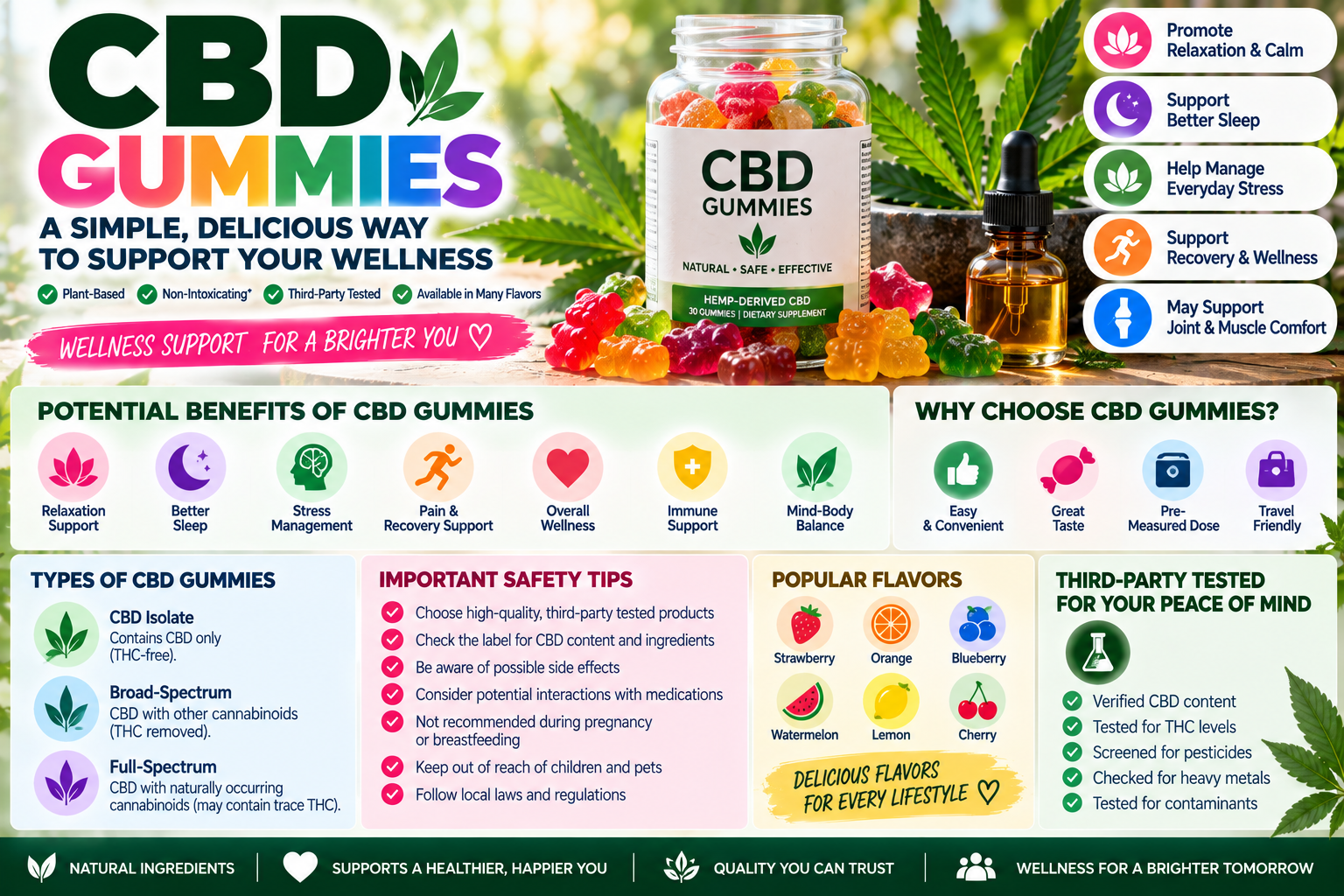
CBD gummies have become one of the most recognizable forms of cannabidiol products. They combine CBD with a sweet, chewable format that can be easier for some consumers to use than oils or capsules.
CBD, or cannabidiol, is a cannabinoid found in cannabis plants. Unlike THC, CBD does not produce the typical intoxicating “high” associated with THC. However, CBD products are not automatically risk-free, and the scientific evidence behind many popular wellness claims remains limited.
CBD gummies are marketed for purposes ranging from relaxation and sleep support to pain and general wellness. But consumers should distinguish between marketing claims, early research, and established medical evidence. In the United States, the FDA has approved one prescription CBD medicine for specific seizure disorders, but it has not approved ordinary CBD gummies as treatments for medical conditions.
This guide explains what CBD gummies are, how they work, potential uses, safety considerations, product quality, CBD versus THC, medication interactions, legal considerations, and important trends in 2026.
What Are CBD Gummies?
CBD gummies are edible products containing cannabidiol.
They typically resemble conventional gummy candies and may come in flavors such as:
Berry
Citrus
Tropical fruit
Watermelon
Mixed fruit
Mint
Other flavored varieties
CBD gummies may contain:
CBD isolate
Broad-spectrum CBD
Full-spectrum CBD
CBD combined with other cannabinoids
Additional ingredients such as flavorings, sweeteners, vitamins, or botanical extracts
The amount of CBD can vary substantially from one product to another.
Because gummies are edible, CBD passes through the digestive system before being absorbed. This makes them different from products such as oils taken under the tongue or topical CBD products applied to the skin.
CBD Gummies vs. THC Gummies
CBD and THC are different cannabinoids.
CBD
CBD is not considered intoxicating in the same way THC is.
It is commonly used in wellness products and has been studied for several potential therapeutic applications.
THC
THC is the cannabinoid primarily responsible for the intoxicating effects associated with marijuana.
Some products labeled as CBD may contain measurable amounts of THC, depending on the formulation and manufacturing process.
This makes it important to read the cannabinoid information on a product label rather than assuming that every CBD gummy contains only CBD.
Types of CBD Gummies
Not all CBD gummies are formulated the same way.
CBD Isolate Gummies
CBD isolate products are designed to contain cannabidiol without other cannabis cannabinoids.
They may appeal to consumers specifically seeking CBD without THC, although product testing is important to verify the actual contents.
Broad-Spectrum CBD Gummies
Broad-spectrum products generally contain CBD and other cannabis compounds while being formulated to remove or minimize THC.
The exact cannabinoid profile varies between manufacturers.
Full-Spectrum CBD Gummies
Full-spectrum products contain CBD along with other naturally occurring cannabis compounds and may contain THC within applicable legal limits.
Consumers who need to avoid THC should check the certificate of analysis and product labeling carefully.
How Do CBD Gummies Work?
After a person consumes a CBD gummy, the digestive system processes it before CBD enters circulation.
The body's metabolism can influence how much CBD becomes available and how long it remains active.
This is one reason edible CBD products may behave differently from oils or other formulations.
The effects can vary according to:
Product concentration
Amount consumed
Individual metabolism
Food intake
Other medications
Product formulation
Body chemistry
There is therefore no universal response to a particular CBD gummy.
Potential Benefits of CBD Gummies
CBD gummies are marketed for many wellness purposes, but the strength of evidence varies considerably.
Relaxation and Stress
CBD is often marketed as a product for relaxation and stress management.
Some preliminary research has explored cannabinoids and anxiety-related symptoms, but there is not enough evidence to consider ordinary CBD gummies an established treatment for anxiety disorders.
Sleep
CBD gummies are frequently promoted as nighttime wellness products.
However, evidence remains insufficient to establish CBD as a reliable treatment for sleep disorders. NCCIH notes that research on cannabinoids, including CBD, for sleep disorders is limited and that more rigorous evidence is needed.
Pain
CBD products are also marketed for pain.
Research into cannabinoids and chronic pain has produced some evidence of modest short-term benefits for certain cannabinoid formulations, but this does not establish that ordinary CBD gummies will relieve every type of pain.
General Wellness
Many consumers use CBD gummies as part of a broader wellness routine.
However, “wellness” is a broad marketing category rather than a specific medical indication.
A CBD gummy should not be viewed as a replacement for appropriate medical treatment.
CBD Gummies and Anxiety
Anxiety is one of the most common reasons people search for CBD products.
Some human studies have explored CBD and anxiety-related symptoms, but research remains limited and does not establish commercial CBD gummies as a proven treatment for anxiety disorders.
People experiencing persistent or severe anxiety should seek evidence-based healthcare rather than relying solely on CBD products.
CBD Gummies and Sleep
CBD gummies are frequently marketed as nighttime products.
Some consumers report using them as part of a bedtime routine, but subjective experiences do not establish medical effectiveness.
NCCIH reports that there is currently insufficient evidence to support cannabinoid therapies for treating sleep disorders. CBD has also been associated with side effects such as changes in alertness and gastrointestinal symptoms.
Persistent insomnia or significant sleep problems can have many causes and should be evaluated by a healthcare professional.
CBD Gummies and Pain
Cannabinoids have been studied for chronic pain, particularly neuropathic pain.
NCCIH reports evidence of a small benefit from some cannabis or cannabinoid preparations, while also noting that adverse events can be more common. The evidence cannot automatically be applied to every CBD gummy sold commercially.
Consumers should be particularly cautious about products claiming to cure arthritis, severe chronic pain, neuropathy, or other diseases.
Are CBD Gummies Safe?
CBD gummies should not automatically be considered harmless because they are sold as wellness products.
The FDA identifies several potential safety concerns associated with CBD, including:
Liver injury
Drug interactions
Sleepiness
Changes in alertness
Gastrointestinal effects
Other adverse reactions
The FDA also states that safety information remains limited for many nonprescription CBD products.
NCCIH similarly reports potential side effects and notes concerns involving liver injury and interactions with other drugs.
CBD Gummies Side Effects
Possible CBD-related side effects may include:
Drowsiness
Reduced alertness
Diarrhea
Changes in appetite
Mood changes
Liver-related effects
Drug interactions
Individual responses can vary.
The risk may also depend on the concentration, frequency of use, other ingredients, and whether the product contains THC or other cannabinoids.
CBD Gummies and Medication Interactions
One of the most important considerations is medication interaction.
CBD can affect how certain medicines are metabolized, potentially changing their effects or increasing adverse reactions. The FDA specifically warns that CBD can interact with other medications.
People taking prescription or over-the-counter medicines should discuss CBD use with a healthcare professional before adding it to their routine.
This is particularly important for people taking several medications or medicines that can affect the liver or central nervous system.
CBD Gummies and Alcohol
CBD can contribute to drowsiness or reduced alertness.
The FDA warns that combining CBD with alcohol or other substances that slow brain activity may increase the risk of sedation and drowsiness.
Consumers should therefore avoid assuming that combining CBD with alcohol is harmless.
CBD Gummies During Pregnancy or Breastfeeding
CBD gummies are not considered appropriate for casual use during pregnancy or breastfeeding.
The FDA strongly advises against using CBD, THC, or marijuana in any form during pregnancy or breastfeeding because important safety questions remain unanswered.
Anyone who is pregnant, planning pregnancy, or breastfeeding should speak with an appropriate healthcare professional before using cannabinoid products.
CBD Gummies and Children
CBD gummies can look very similar to ordinary candy.
This creates a particular concern because children may accidentally consume them.
The FDA has specifically highlighted the risk of CBD products in candy-like forms being mistaken for conventional foods and has expressed concern about accidental consumption by children.
CBD gummies should therefore be kept securely away from children and pets.
If a child accidentally consumes a cannabinoid product, seek appropriate medical or poison-control guidance immediately.
CBD Gummies and Product Quality
Product quality is one of the biggest challenges in the CBD market.
The FDA has reported that some CBD products contain different amounts of CBD than stated on their labels and may contain contaminants or THC.
Consumers should therefore pay attention to:
CBD amount per gummy
Total CBD per package
Ingredient list
THC information
Batch number
Manufacturer information
Third-party laboratory testing
Certificate of analysis
Expiration date
Storage instructions
What Is a Certificate of Analysis?
A Certificate of Analysis (COA) is a laboratory report showing information about a product's tested contents.
Depending on the laboratory and product, a COA may provide information about:
CBD concentration
THC concentration
Other cannabinoids
Heavy metals
Pesticides
Microbial contamination
Other contaminants
A transparent manufacturer should make relevant testing information reasonably accessible.
However, consumers should also consider whether the laboratory appears independent and whether the report matches the specific product batch.
How to Read a CBD Gummy Label
Before purchasing CBD gummies, check the label carefully.
CBD Per Gummy
This tells you how much CBD is listed for one gummy.
Total CBD
A package might contain several gummies, so check the total CBD amount separately from the amount per serving.
THC Content
Check whether THC is present and in what amount.
Ingredients
Look for:
Sugar
Sweeteners
Artificial flavors
Natural flavors
Gelatin or plant-based alternatives
Allergens
Additional cannabinoids
Botanical ingredients
Serving Information
Make sure the serving size is clearly stated.
Avoid products where the amount of CBD is difficult to determine.
CBD Gummies and Third-Party Testing
Third-party testing can provide additional information about the contents of a product.
Consumers may want to look for evidence that a product has been tested for:
Cannabinoid concentration
THC
Heavy metals
Pesticides
Microorganisms
Solvents
Testing does not guarantee that a product is medically effective, but it can provide useful information about composition and contamination.
Are CBD Gummies FDA Approved?
In the United States, the FDA has approved one prescription CBD drug for specific seizure disorders.
It has not approved ordinary commercial CBD gummies as treatments for medical conditions.
The FDA also states that CBD cannot lawfully be added to foods or marketed as a dietary supplement under the federal framework it describes.
This is an important distinction for consumers because a product being sold online or in a store does not necessarily mean it has been evaluated and approved by the FDA.
CBD Gummies and Legal Considerations
CBD laws vary significantly around the world.
The legal status may depend on:
Source of CBD
THC concentration
Product category
Intended use
Local legislation
Import rules
Medical or recreational regulations
The WHO notes that countries have discretion in how CBD and cannabis-related substances are regulated nationally.
Consumers should check local laws before buying, possessing, importing, or traveling with CBD gummies.
CBD Gummies and Travel
Traveling internationally with CBD gummies can be complicated.
A product that is permitted in one location may be restricted in another.
Before traveling, check:
Destination-country rules
Transit-country rules
Airline policies
THC limits
Prescription requirements
Import restrictions
Never assume that a CBD product can legally cross an international border simply because it was purchased legally in the country of departure.
CBD Gummies vs. CBD Oil
Both products contain CBD, but they are used differently.
Feature | CBD Gummies | CBD Oil |
|---|---|---|
Format | Edible | Liquid |
Convenience | Very convenient | Requires measuring |
Flavor | Usually sweet/flavored | Can have a natural taste |
Portability | Easy to carry | Easy but may require a dropper |
Dose visibility | Listed per gummy | Usually listed per serving/dropper |
Onset | Depends on digestion | Depends on administration method |
Portion control | Pre-portioned | More adjustable |
Discretion | High | Moderate |
Neither format is automatically better for everyone.
CBD Gummies vs. CBD Capsules
CBD capsules and gummies are both oral products.
Capsules may provide a more straightforward, premeasured format, while gummies can be more appealing to people who prefer flavored products.
Both are processed through the digestive system.
The most important factors are the actual CBD content, product quality, individual circumstances, and safety considerations.
How Long Do CBD Gummies Take to Work?
There is no universal time at which a CBD gummy will produce an effect.
Oral CBD products must pass through the digestive system, and factors such as food intake, metabolism, formulation, and individual biology can influence how the body processes them.
Consumers should avoid repeatedly consuming more simply because an effect is not immediately noticeable.
Following the product's instructions and discussing CBD use with a healthcare professional is safer than experimenting with increasingly large amounts.
How Long Does CBD Stay in the Body?
The amount of time CBD remains in the body varies between individuals.
Factors can include:
Amount consumed
Frequency of use
Metabolism
Body composition
Other medications
Product formulation
There is no reliable single number that applies to everyone.
People who need to avoid cannabinoids for medical, employment, athletic, legal, or other reasons should consider the possibility that some products may contain THC.
CBD Gummies and Drug Testing
CBD itself is different from THC, but some CBD products can contain THC.
Full-spectrum products may contain measurable THC, and inaccurate labeling can create additional uncertainty.
Anyone subject to drug testing should carefully consider product composition and the possibility of THC exposure.
2026 CBD Gummies Trends
The CBD market continues to evolve, with consumers increasingly interested in product transparency and formulation.
Greater Demand for Testing
Consumers are paying more attention to laboratory testing, cannabinoid concentrations, and ingredient transparency.
More Product Variety
CBD is appearing in increasingly diverse formats, including:
Gummies
Capsules
Oils
Topicals
Beverages
Skincare
Other wellness products
Focus on Responsible Marketing
Regulators continue to address products making unsupported medical claims.
In April 2026, the FDA warned consumers against a product marketed as KUKA FLEX CBD after laboratory testing found undeclared diclofenac, a prescription-strength NSAID, in the product.
The case illustrates why consumers should be cautious about products marketed as “natural” treatments and why ingredient transparency matters.
More Consumer Education
As CBD becomes more mainstream, consumers are increasingly looking for information about:
CBD vs. THC
Product testing
Drug interactions
Side effects
Legal status
Dosage information
Product quality
How to Choose CBD Gummies Responsibly
If you are considering a CBD gummy, consider the following checklist.
Check the CBD Amount
Know exactly how much CBD is listed per gummy.
Check for THC
Determine whether the product contains THC.
Review the Ingredients
Look beyond the CBD and examine the complete ingredient list.
Look for Testing
Look for accessible third-party laboratory results.
Avoid Medical Miracle Claims
Be cautious about products claiming to cure serious diseases or replace prescription treatments.
Consider Your Medications
Speak with a healthcare professional if you take prescription or over-the-counter medicines.
Store Gummies Securely
Because they resemble candy, keep CBD gummies somewhere children and other unintended users cannot access them.
Frequently Asked Questions About CBD Gummies
What are CBD gummies?
CBD gummies are edible products containing cannabidiol, a cannabinoid found in cannabis plants.
Do CBD gummies get you high?
CBD itself is not intoxicating in the same way THC is. However, some CBD products can contain THC, so consumers should check the label and laboratory testing.
Are CBD gummies safe?
CBD can have side effects and may interact with medications. Product quality also varies, so CBD gummies should not automatically be considered risk-free.
Can CBD gummies help with sleep?
CBD is marketed for sleep, but current evidence is insufficient to establish CBD as a reliable treatment for sleep disorders.
Can CBD gummies help with anxiety?
Some preliminary research has investigated CBD and anxiety, but evidence is not strong enough to establish ordinary CBD gummies as a proven treatment for anxiety disorders.
Can CBD gummies help with pain?
Some cannabinoid research suggests modest benefits for certain types of chronic pain, but the evidence cannot automatically be applied to every CBD gummy.
Can CBD gummies damage the liver?
CBD has been associated with liver injury, particularly in research involving higher exposures. The FDA recommends considering this potential risk and discussing CBD use with a healthcare professional.
Can CBD gummies interact with medications?
Yes. CBD can affect the way some medications work and may increase the risk of adverse effects.
Can you take CBD gummies during pregnancy?
The FDA strongly advises against using CBD during pregnancy or breastfeeding.
Are CBD gummies legal?
The answer depends on the country and jurisdiction, as well as the product's CBD and THC content and how it is classified.
Should CBD gummies be given to children?
General CBD gummies should not be given to children without appropriate medical guidance. Candy-like CBD products can also create a risk of accidental consumption.
Conclusion
CBD gummies are a convenient and popular way to consume cannabidiol, but their popularity should not be confused with proof of medical effectiveness.
Research continues to explore CBD for areas such as pain, anxiety, sleep, and neurological conditions, while the strongest established medical application remains specific prescription CBD treatment for certain seizure disorders.
Consumers should pay close attention to CBD concentration, THC content, laboratory testing, ingredients, product claims, medication interactions, and local regulations.
Safety is particularly important because commercial CBD products can vary in quality. The FDA has identified concerns involving inaccurate labeling, contaminants, drug interactions, liver injury, and products containing undeclared pharmaceutical ingredients.
CBD gummies may be convenient, but they should be approached as cannabinoid products rather than ordinary candy or automatically safe wellness supplements.
This article is for general educational purposes and is not medical advice, diagnosis, or treatment. Speak with a qualified healthcare professional before using CBD for a medical purpose, especially if you take medication, are pregnant or breastfeeding, or have an existing medical condition. Laws and regulations vary by jurisdiction.