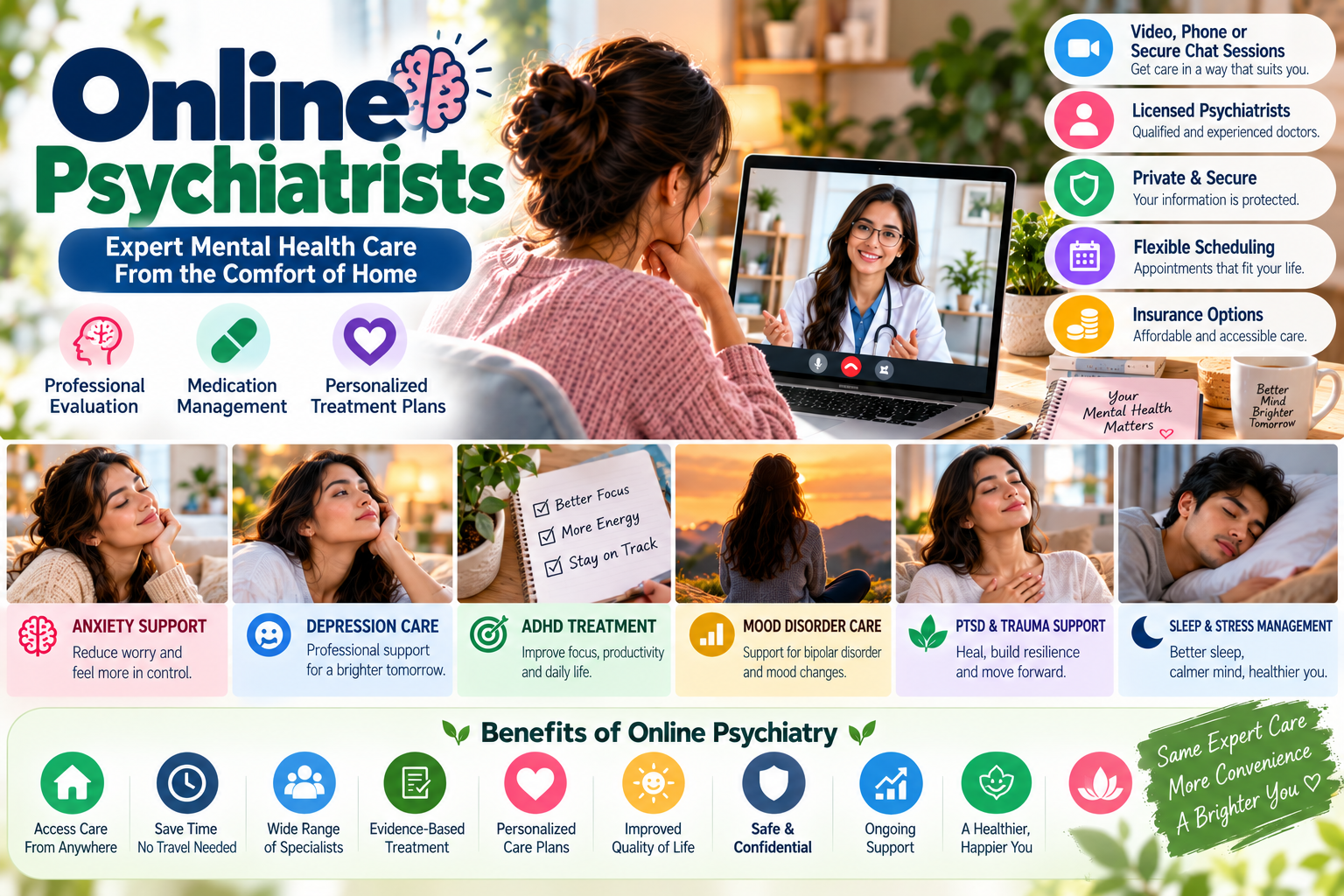
Mental healthcare is increasingly available through digital platforms, making it possible to meet with a psychiatrist without traveling to a traditional clinic. Online psychiatrists provide psychiatric consultations through secure video, telephone, and, in some settings, other telehealth technologies.
Online psychiatric care can include evaluation, diagnosis, treatment planning, medication management, follow-up appointments, and coordination with other healthcare professionals. The American Psychiatric Association describes telepsychiatry as an important component of modern mental-health care and notes that it can improve access to convenient and accessible psychiatric services.
This guide explains how online psychiatry works, who may benefit from it, what happens during an appointment, how medication management works, what to look for when choosing a psychiatrist, and what trends are shaping online psychiatric care in 2026.
What Is an Online Psychiatrist?
An online psychiatrist is a medical doctor specializing in psychiatry who provides some or all psychiatric services remotely.
Instead of visiting a physical clinic, a patient may meet with the psychiatrist using a secure video platform or, when clinically appropriate, another permitted telehealth method.
Psychiatrists differ from many other mental-health professionals because they are physicians and can evaluate mental-health conditions from a medical perspective and prescribe medication when legally authorized.
Depending on the psychiatrist and local regulations, online psychiatric care may include:
Psychiatric evaluations
Mental-health assessments
Diagnosis
Medication evaluation
Prescription management
Medication follow-ups
Treatment planning
Therapy or supportive counseling
Coordination with psychologists or therapists
Referrals to other healthcare professionals
Follow-up monitoring
Telepsychiatry has become an established part of mental-health delivery. The American Psychiatric Association maintains dedicated telepsychiatry resources covering clinical practice, training, reimbursement, legal considerations, and technology.
How Does Online Psychiatry Work?
The process is similar to an in-person psychiatric appointment, although the consultation takes place remotely.
1. Find a qualified psychiatrist
Patients typically search for a psychiatrist based on:
Location and licensing
Area of specialization
Experience
Appointment availability
Insurance
Cost
Communication preferences
Medication-management needs
Language and cultural considerations
Licensing is particularly important because healthcare regulations can depend on where the patient is physically located when receiving care.
2. Complete an intake form
Before the appointment, an online psychiatry service may request information about:
Current concerns
Previous diagnoses
Medications
Medical history
Family history
Sleep
Mood
Anxiety
Substance use
Previous psychiatric treatment
Allergies
Current healthcare providers
Providing accurate information helps the psychiatrist understand the patient's situation.
3. Attend the psychiatric appointment
The psychiatrist may ask about symptoms, daily functioning, relationships, sleep, medications, physical health, previous treatment, and other relevant factors.
The appointment may take place through secure video or another permitted telehealth format.
4. Discuss treatment options
After the assessment, the psychiatrist may discuss options such as:
Medication
Psychotherapy referral
Lifestyle and behavioral strategies
Additional evaluation
Follow-up monitoring
Coordination with another healthcare professional
Not everyone who sees an online psychiatrist will need medication.
5. Schedule follow-up care
Psychiatric treatment often involves follow-up appointments, particularly when medication is started or changed.
Follow-ups allow the psychiatrist to evaluate progress, side effects, concerns, and whether the treatment plan needs adjustment.
Online Psychiatrist vs. Online Therapist
Although the terms are sometimes used interchangeably, psychiatrists and therapists have different roles.
Online Psychiatrist | Online Therapist |
|---|---|
Medical doctor specializing in psychiatry | Mental-health professional providing psychotherapy |
Can evaluate psychiatric conditions | Provides psychological or behavioral treatment |
May prescribe medication when authorized | Generally does not prescribe medication |
Can provide medication management | Focuses primarily on therapy |
May provide or coordinate therapy | Provides counseling/psychotherapy |
Can evaluate medical factors affecting mental health | Primarily focuses on psychological and behavioral concerns |
Some people benefit from both psychiatry and psychotherapy.
For example, a psychiatrist may manage medication while a psychologist or therapist provides regular cognitive behavioral therapy or another evidence-based therapy approach.
What Conditions Can Online Psychiatrists Treat?
Online psychiatric services may be available for a range of mental-health concerns.
Depending on the psychiatrist's qualifications and the patient's circumstances, online appointments may address:
Anxiety Disorders
Psychiatric care may be used for conditions involving persistent anxiety, panic symptoms, excessive worry, or related problems.
Depression
Psychiatrists can evaluate symptoms associated with depressive disorders and discuss treatment options, including medication and psychotherapy.
Bipolar Disorder
Psychiatric monitoring can be particularly important for people experiencing significant mood changes, manic or hypomanic symptoms, or depressive episodes.
Attention-Deficit/Hyperactivity Disorder
Some psychiatrists provide ADHD evaluations and ongoing treatment. However, requirements for diagnosis, medication, and controlled substances can vary significantly by jurisdiction.
Obsessive-Compulsive Disorder
Psychiatric treatment may form part of a broader treatment plan that can also include specialized psychotherapy.
Post-Traumatic Stress Disorder
Psychiatrists may evaluate trauma-related symptoms and discuss medication, psychotherapy, or referral options.
Sleep-Related Mental-Health Concerns
Sleep problems can occur alongside anxiety, depression, and other conditions. A psychiatrist may evaluate whether mental-health symptoms are contributing to sleep difficulties.
Substance Use Disorders
Psychiatric services can also play a role in evaluating and treating substance-use conditions, although some situations require specialized or in-person services.
Not every online psychiatrist treats every condition. Patients should check the clinician's stated specialties before booking an appointment.
Can Online Psychiatrists Prescribe Medication?
In many jurisdictions, psychiatrists can prescribe medication through telehealth when they meet applicable licensing, clinical, and regulatory requirements.
However, online prescribing rules vary by country, state, medication type, and individual circumstances.
This is especially important for controlled medications.
For example, in the United States, the DEA extended certain telemedicine flexibilities for prescribing controlled medications through December 31, 2026, subject to applicable requirements and federal and state law.
Therefore, patients should not assume that every online psychiatrist can prescribe every medication remotely.
Before an appointment, check:
Whether the psychiatrist is licensed where you are located
Whether the service offers medication management
Whether your medication can legally be prescribed through telehealth
Whether an in-person examination is required
Whether the provider can coordinate with your pharmacy
Whether additional monitoring is required
What Happens During an Online Psychiatric Evaluation?
An initial psychiatric appointment can be more detailed than a standard follow-up visit.
The psychiatrist may ask about:
Mental-health symptoms
This can include questions about:
Mood
Anxiety
Concentration
Energy
Sleep
Appetite
Irritability
Motivation
Thoughts and behaviors
Medical history
Physical health can be relevant to psychiatric care because some medical conditions and medications can influence mood, sleep, concentration, or other symptoms.
Previous psychiatric treatment
The psychiatrist may ask about:
Previous diagnoses
Previous medications
Therapy
Hospitalizations
Treatment response
Medication side effects
Family history
Family mental-health history can provide useful context during an assessment.
Daily functioning
A psychiatrist may also ask how symptoms affect:
Work
Education
Relationships
Social activities
Self-care
Sleep
Daily responsibilities
Benefits of Online Psychiatry
Online psychiatric care can offer several practical advantages.
Convenient Access
Patients may be able to attend appointments from home instead of traveling to a clinic.
The American Psychiatric Association identifies telepsychiatry as a way to improve access to psychiatric services, particularly where access to specialists may be limited.
Reduced Travel
Virtual appointments can eliminate or reduce travel time, parking, and transportation challenges.
Access to Specialists
Telepsychiatry can potentially connect patients with psychiatrists outside their immediate neighborhood, subject to licensing and jurisdictional rules.
Flexible Scheduling
Some services offer evening or weekend appointments, although availability varies.
Continuity of Care
Online appointments can make it easier for some patients to maintain regular follow-up care.
Comfortable Environment
Some people feel more comfortable discussing sensitive concerns from a familiar private environment.
Potential Accessibility Benefits
Telepsychiatry can help address geographical, mobility, transportation, and other access barriers. APA's position statement emphasizes access and health equity as important potential benefits of telepsychiatry.
Limitations of Online Psychiatry
Online psychiatry is not appropriate for every situation.
Potential limitations include:
Poor internet connection
Lack of private space
Technology problems
Difficulty performing certain physical assessments
Licensing restrictions
Medication restrictions
Limited availability in some locations
Need for in-person laboratory testing or medical examinations
Difficulty managing certain emergencies remotely
APA guidance emphasizes that telepsychiatry should protect patient autonomy, confidentiality, and privacy and comply with applicable laws and professional standards.
Online Psychiatry and Privacy
Privacy is one of the most important issues when choosing an online psychiatrist.
Patients should understand:
What platform is being used
How appointments are conducted
How medical information is stored
Who can access health information
How prescriptions are handled
Whether records can be transferred
What happens if the technology fails
A private location is also important. Patients should ideally attend appointments somewhere they can speak openly without being overheard.
The APA's telepsychology guidance highlights privacy, security, informed consent, and technology-related considerations in remote mental-health care.
How Much Does an Online Psychiatrist Cost?
The cost of online psychiatry varies widely.
Factors affecting price can include:
Country
Location
Psychiatrist's experience
Appointment length
Initial versus follow-up appointment
Insurance coverage
Medication management
Platform fees
Specialist services
Some services charge per appointment, while others use membership or subscription structures.
Before booking, check the complete cost rather than looking only at the advertised consultation price.
Ask whether the fee includes:
Initial evaluation
Follow-up appointments
Prescription management
Medication-related consultations
Insurance processing
Additional assessments
Cancellation fees
Does Insurance Cover Online Psychiatry?
In some healthcare systems, insurance plans cover telepsychiatry.
However, coverage depends on the insurer, plan, provider, location, and type of service.
Before scheduling an appointment, patients can ask:
Is this psychiatrist in-network?
Is telepsychiatry covered?
What is my copayment?
Is there a deductible?
Are psychiatric medications covered separately?
Are follow-up appointments covered?
Is prior authorization required?
Coverage rules can change, so patients should confirm directly with their insurer.
How to Choose an Online Psychiatrist
Choosing a psychiatrist involves more than finding the earliest available appointment.
Verify Credentials
Look for a properly licensed psychiatrist who is authorized to practice where the patient is located.
Check Specialization
Consider whether the psychiatrist has experience with the particular concern requiring treatment.
Review Communication Options
Determine whether appointments are conducted by:
Video
Telephone
Secure messaging
A combination of methods
Understand Medication Policies
If medication management is important, check whether the provider offers it and what prescribing limitations apply.
Ask About Follow-Up
Good continuity of care requires a clear plan for future appointments and communication.
Review Privacy Information
Understand how the platform handles personal and health information.
Consider Cultural and Language Needs
Patients may prefer a psychiatrist who understands their language, culture, or background.
The APA specifically identifies cultural considerations and barriers such as language and disability as important factors in telepsychiatric care.
Questions to Ask an Online Psychiatrist
Before or during the first appointment, patients can ask:
Are you licensed to practice where I am located?
Do you provide medication management?
What conditions do you commonly treat?
How often will follow-up appointments be needed?
How do you handle medication side effects?
What happens if I have a problem between appointments?
What happens if the video platform stops working?
When would you recommend in-person care?
How do you handle psychiatric emergencies?
Can you coordinate with my therapist or primary-care doctor?
What are the total appointment costs?
Does my insurance cover your services?
These questions can help clarify whether the service matches the patient's needs.
Online Psychiatry and Medication Management
Medication management may involve several stages.
Starting medication
The psychiatrist evaluates whether medication is appropriate and discusses potential benefits, risks, alternatives, and monitoring.
Adjusting medication
If symptoms do not improve adequately or side effects occur, the psychiatrist may reassess the treatment plan.
Monitoring progress
Follow-up appointments can help evaluate:
Symptom changes
Side effects
Medication adherence
Daily functioning
Other health changes
Medication should be taken only as prescribed, and patients should discuss significant side effects or concerns with their healthcare professional.
Online Psychiatry vs. In-Person Psychiatry
Neither format is automatically appropriate for everyone.
Online psychiatry may be convenient for routine evaluations and follow-up care when clinically appropriate.
In-person care may be necessary when:
A physical examination is needed
Laboratory testing is required
The patient's condition requires a higher level of care
There is an immediate safety concern
Local regulations require an in-person assessment
The psychiatrist believes remote care is not clinically appropriate
A hybrid approach can combine virtual appointments with occasional in-person care.
Online Psychiatry and Artificial Intelligence
Artificial intelligence is increasingly being incorporated into healthcare technology.
Potential uses include:
Administrative support
Appointment scheduling
Clinical documentation assistance
Patient education
Digital symptom tracking
Decision-support tools
However, AI tools are not automatically equivalent to care from a licensed psychiatrist.
Patients should understand whether they are communicating directly with a licensed clinician or using an automated tool.
The American Psychiatric Association has expanded its focus on digital health, innovation, technology, and emerging issues including augmented intelligence in psychiatry.
Online Psychiatry Trends in 2026
Several developments are shaping the online psychiatry landscape.
Hybrid Mental Healthcare
Healthcare systems increasingly combine virtual appointments with traditional in-person care.
Digital Mental-Health Tools
Psychiatric care can increasingly interact with digital tools for communication, monitoring, education, and self-management.
WHO notes that digital environments create opportunities to expand access to mental-health information and services, while also emphasizing the importance of evidence-based and safe digital experiences.
Greater Focus on Accessibility
Telepsychiatry can help reach people who face geographical or transportation barriers to specialist care.
Integration With Other Healthcare
Online psychiatric care may increasingly coordinate with primary-care doctors, therapists, pharmacies, and other healthcare professionals.
More Attention to Privacy and Security
As more healthcare moves online, privacy, cybersecurity, informed consent, and responsible technology use remain important considerations.
Remote Psychological Support
WHO is also expanding evidence-based psychological self-help resources that can be delivered remotely. In 2026, WHO highlighted digital and remote approaches as one way to expand access to psychological support.
When Online Psychiatry May Not Be Enough
Online psychiatry should not be considered a replacement for emergency services.
A person experiencing an immediate mental-health emergency, serious risk of self-harm or harm to others, severe confusion, or another urgent medical or psychiatric crisis should seek immediate local emergency assistance or go to the nearest emergency department.
Online psychiatric services should also have clear procedures for emergencies and situations where remote care is no longer appropriate.
How to Prepare for an Online Psychiatrist Appointment
Preparation can make an appointment more productive.
Before the appointment, consider writing down:
Your main concerns
When symptoms began
Current medications
Previous psychiatric medications
Medication side effects
Relevant medical conditions
Previous diagnoses
Previous therapy
Sleep patterns
Major recent life changes
Questions you want to ask
Keep medication bottles, medical records, or a current medication list nearby if they are relevant to the appointment.
Choose a quiet and private environment with a reliable internet connection.
The Future of Online Psychiatry
The future of psychiatric care is likely to involve a combination of in-person medicine, telepsychiatry, digital health tools, remote monitoring, and technology-assisted healthcare.
The goal is not simply to move every psychiatric appointment online. Instead, technology can provide another way to connect patients with qualified professionals when remote care is clinically appropriate.
The continuing development of telepsychiatry also makes professional standards, licensing, privacy, cybersecurity, informed consent, and patient safety increasingly important.
Frequently Asked Questions About Online Psychiatrists
Can an online psychiatrist prescribe medication?
In many locations, psychiatrists can prescribe medication through telehealth when legally and clinically permitted. Rules vary by jurisdiction and medication type.
Are online psychiatrists real doctors?
A psychiatrist is a medical doctor specializing in psychiatry. Patients should verify the clinician's professional license and credentials before receiving care.
Can online psychiatrists diagnose mental-health conditions?
A psychiatrist may conduct a psychiatric evaluation remotely and make a diagnosis when appropriate, subject to professional standards and local regulations.
Is online psychiatry private?
Professional telehealth services should have appropriate privacy and security measures. Patients should review the provider's privacy practices and use a private environment for appointments.
Can online psychiatry replace therapy?
Not necessarily. Psychiatry and psychotherapy serve different functions. Some people may benefit from psychiatric medication management, therapy, or a combination of both.
Is online psychiatry cheaper than in-person psychiatry?
It can be, but not always. Prices vary by provider, location, insurance, appointment type, and service.
Can I use an online psychiatrist for medication refills?
Some psychiatrists provide medication follow-up and refills when clinically appropriate. Requirements vary depending on the medication, provider, and local laws.
Is online psychiatry available internationally?
Telepsychiatry is available in many countries, but licensing and cross-border healthcare rules can restrict where a psychiatrist can legally treat a patient.
Conclusion
Online psychiatrists are becoming an important part of modern mental-healthcare delivery. Through secure virtual appointments, patients may be able to access psychiatric evaluations, medication management, follow-up care, and treatment planning without regularly traveling to a clinic.
The best approach depends on individual circumstances. When considering online psychiatric care, patients should verify professional credentials, licensing, privacy practices, treatment options, costs, medication policies, and emergency procedures.
As telepsychiatry continues developing in 2026, the combination of qualified psychiatric professionals and responsible digital technology may make mental-health services more accessible while maintaining the clinical standards required for safe patient care.
This article is for general educational purposes and is not a substitute for professional medical advice, diagnosis, or treatment.