Cryptocurrencies have evolved from a niche technology into an important part of the broader digital-asset and financial landscape. Bitcoin introduced a decentralized digital currency based on blockchain technology, while thousands of other crypto assets have since emerged with different purposes, technologies, and economic models.
Today, cryptocurrencies are used for a wide range of activities, including digital payments, decentralized applications, tokenization, trading, investment, fundraising, and cross-border transfers.
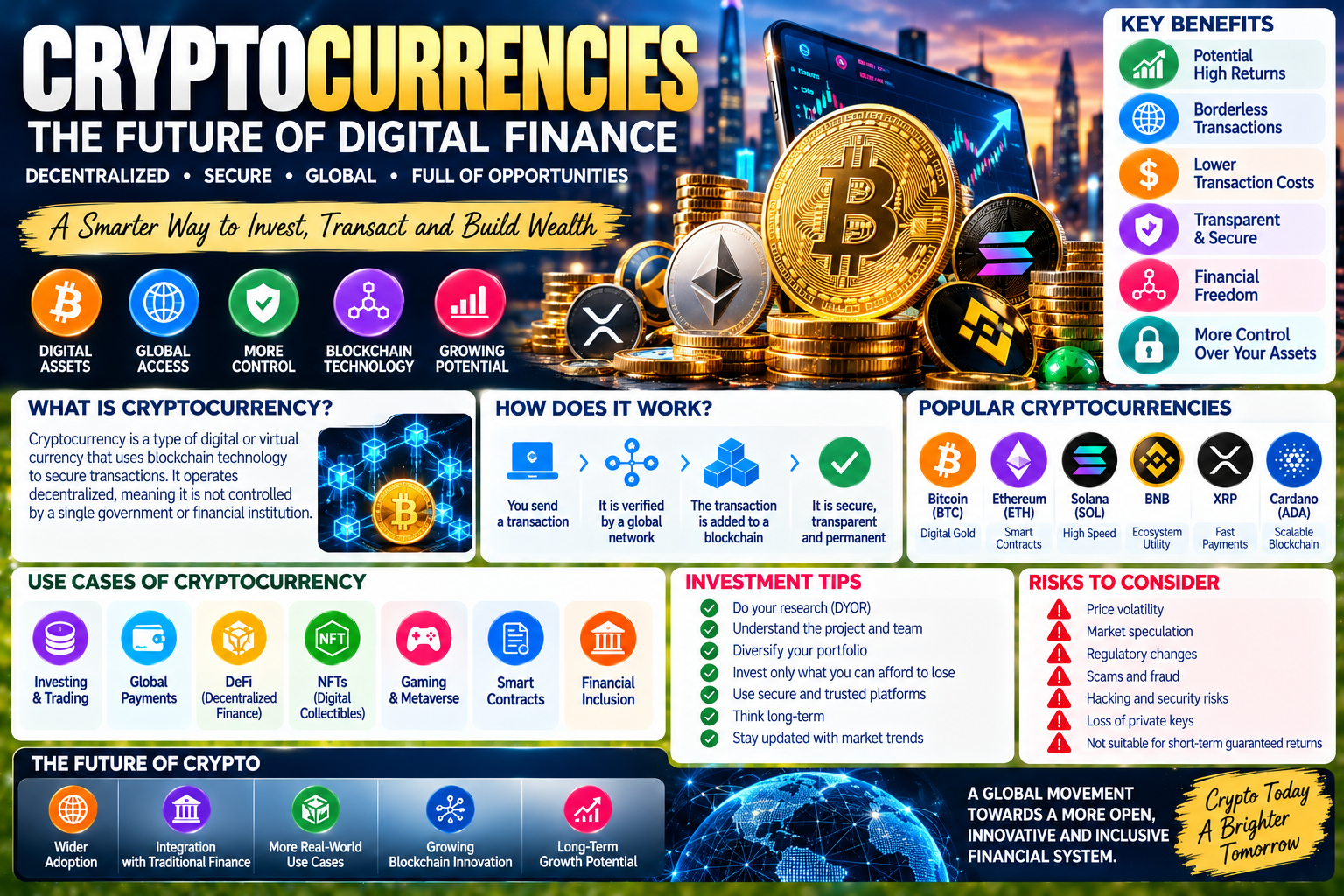
At the same time, cryptocurrency remains a high-risk area. Prices can change dramatically, scams are common, private keys can be lost or stolen, and regulatory requirements differ significantly between countries.
In 2026, the crypto industry is also moving toward greater institutional involvement, stablecoin adoption, tokenization, and regulatory clarity. The IMF describes stablecoins, digital payments, central bank digital currencies, and tokenization as important areas in the expansion of digital finance.
What Is Cryptocurrency?
Cryptocurrency is a type of digital asset that uses cryptography and distributed-ledger technology to record and verify transactions.
Unlike traditional currencies issued by central banks, many cryptocurrencies operate through decentralized networks of computers.
Bitcoin is the best-known example.
Other cryptocurrencies and digital assets may have completely different purposes. Some are designed as payment assets, some support blockchain applications, some represent stable-value assets, and others provide access to particular platforms or ecosystems.
The term "crypto" therefore describes a broad category rather than a single type of investment.
How Does Cryptocurrency Work?
Most cryptocurrencies rely on blockchain or another form of distributed ledger.
A blockchain is essentially a shared digital record maintained across a network.
When a transaction occurs, the network verifies it according to the rules of that blockchain. Valid transactions are then recorded on the ledger.
Depending on the blockchain, transaction validation may involve mechanisms such as:
Proof of work
Proof of stake
Other consensus mechanisms
Once transactions are confirmed, the information becomes part of the blockchain's historical record.
What Is Blockchain?
Blockchain is the underlying technology behind many cryptocurrencies.
A blockchain can provide:
Distributed record keeping
Transaction transparency
Cryptographic verification
Programmable transactions
Decentralized applications
Digital ownership records
Blockchain technology can also be used outside cryptocurrency, including tokenization, financial infrastructure, supply-chain applications, identity systems, and other digital services.
Bitcoin
Bitcoin was introduced in 2008 through the publication of the Bitcoin white paper and launched as a decentralized digital currency.
Bitcoin's supply is limited by its protocol, with a maximum of 21 million bitcoin units.
Bitcoin is often described as:
Digital money
A decentralized payment network
A digital asset
A store-of-value investment by some investors
Bitcoin's price, however, can be highly volatile.
The Federal Trade Commission warns consumers that cryptocurrency values can change rapidly and that crypto investments can be significantly more volatile than traditional investments.
Ethereum
Ethereum is a blockchain platform designed to support programmable applications and smart contracts.
Unlike Bitcoin, which is primarily associated with decentralized digital money, Ethereum provides infrastructure for applications built on blockchain technology.
Ethereum supports:
Smart contracts
Decentralized applications
Token creation
Decentralized finance
NFTs
Blockchain-based games
Tokenized assets
Its native cryptocurrency is called Ether, or ETH.
What Are Altcoins?
The term "altcoin" is commonly used for cryptocurrencies other than Bitcoin.
Altcoins include thousands of different projects with different technologies and purposes.
Examples may include:
Ethereum
Solana
Cardano
Avalanche
Polkadot
Litecoin
Chainlink
Not every cryptocurrency has the same level of adoption, development activity, liquidity, or security.
Investors should research an individual project rather than assuming that all cryptocurrencies have similar characteristics.
Stablecoins
Stablecoins are crypto assets designed to maintain a relatively stable value against another asset, most commonly a fiat currency such as the U.S. dollar.
Common stablecoin structures include:
Fiat-backed stablecoins
Crypto-backed stablecoins
Algorithmic or decentralized stablecoins
Stablecoins have become an important part of crypto markets because they can provide a digital representation of relatively stable value within blockchain networks.
The IMF says stablecoins have expanded into areas including cross-border payments and remittances, while also creating financial-stability and regulatory considerations.
A 2026 IMF analysis also describes stablecoins as potentially increasing competition in payment markets.
Are Stablecoins Completely Risk-Free?
No.
Stablecoins can have risks involving:
Reserve assets
Liquidity
Redemption
Issuer management
Regulatory requirements
Smart contracts
Market stress
Counterparty exposure
The IMF has highlighted the possibility of run risks and broader financial spillovers if stablecoins are not supported by appropriate regulation and safeguards.
What Are Crypto Tokens?
A cryptocurrency generally operates as the native asset of a blockchain.
A token can be created on top of an existing blockchain.
Tokens may represent:
Digital assets
Utility
Governance rights
Access to applications
Stable-value assets
Tokenized real-world assets
Digital collectibles
Because tokens are relatively easy to create, investors should be particularly careful when evaluating new projects.
A professional-looking website or social-media account does not prove that a token is legitimate.
What Are Smart Contracts?
Smart contracts are programs deployed on blockchain networks that can automatically execute predefined actions when specified conditions are met.
They can be used to create:
Decentralized exchanges
Lending platforms
NFT marketplaces
Gaming applications
Token systems
Financial applications
Smart contracts reduce the need for some intermediaries, but they also introduce technical risks.
Programming errors can potentially result in lost funds or exploited applications.
Decentralized Finance
Decentralized finance, commonly called DeFi, refers to blockchain-based financial applications.
DeFi can include:
Decentralized exchanges
Lending
Borrowing
Liquidity provision
Staking
Derivatives
Stablecoin applications
Unlike traditional financial systems, DeFi applications can operate through smart contracts rather than conventional financial intermediaries.
However, DeFi carries substantial risks, including smart-contract vulnerabilities, liquidity problems, market volatility, oracle failures, and scams.
Cryptocurrency Wallets
A cryptocurrency wallet allows users to interact with blockchain assets.
Wallets generally fall into several categories.
Hot Wallets
Hot wallets are connected to the internet.
Examples include:
Mobile wallets
Browser wallets
Desktop wallets
They can be convenient for frequent transactions but may have greater exposure to online threats.
Cold Wallets
Cold wallets keep private keys offline or otherwise separated from internet-connected environments.
Hardware wallets are a common example.
They can provide an additional layer of security for people holding crypto for longer periods.
Custodial Wallets
With a custodial service, another company controls the private keys on behalf of the user.
Cryptocurrency exchanges commonly provide custodial accounts.
Non-Custodial Wallets
With a non-custodial wallet, the user generally controls the private keys or recovery phrase.
This provides greater direct control but also greater responsibility.
If the recovery credentials are lost, there may be no central institution capable of restoring access.
The FTC warns that losing wallet credentials or having a wallet compromised can result in funds becoming inaccessible or stolen.
What Is a Private Key?
A private key is a cryptographic credential that can authorize transactions involving assets associated with a blockchain address.
It should be treated as extremely sensitive information.
Never share a private key or recovery phrase with:
Strangers
"Investment managers"
Customer-support impersonators
Social-media accounts
Telegram or WhatsApp contacts
Giveaway promoters
A legitimate wallet provider will not need your recovery phrase to "unlock" your account.
What Is a Seed Phrase?
A seed phrase, also called a recovery phrase, is a sequence of words used by many non-custodial wallets to restore access.
Anyone who obtains the seed phrase may potentially gain control over the assets associated with that wallet.
For this reason:
Never store a recovery phrase in a public post, screenshot, social-media message, or unsecured cloud document.
How to Buy Cryptocurrency
A typical crypto purchase may involve several steps:
Choose a reputable exchange or regulated provider where available.
Create an account.
Complete required identity verification.
Secure the account with strong authentication.
Deposit funds.
Select the cryptocurrency.
Review the transaction details.
Purchase the asset.
Decide whether to keep it with the provider or transfer it to a personal wallet.
Availability, regulations, payment methods, taxes, and withdrawal options vary by country.
Cryptocurrency Exchanges
Crypto exchanges provide platforms where users can buy, sell, trade, or convert digital assets.
Exchange services may differ in:
Supported assets
Trading fees
Withdrawal fees
Security features
Regulatory status
Payment methods
Liquidity
Customer support
Geographic availability
Users should research an exchange before depositing money.
A large number of users or followers does not guarantee that a platform is safe.
Cryptocurrency Investing
Crypto investing can involve purchasing an asset with the expectation that its value will increase over time.
However, cryptocurrency is a highly volatile asset class.
Potential investment risks include:
Rapid price declines
Liquidity problems
Project failure
Exchange failures
Hacks
Regulatory changes
Market manipulation
Fraud
Loss of private keys
The FTC specifically warns consumers that there is no legitimate guarantee of cryptocurrency profits or large returns.
Long-Term Holding
Some crypto investors purchase assets and hold them for extended periods.
This approach is sometimes called "HODLing."
Holding does not eliminate risk.
A cryptocurrency can lose a significant portion of its value even when an investor intends to hold for years.
Cryptocurrency Trading
Crypto trading involves buying and selling assets more frequently to attempt to benefit from price movements.
Trading strategies may include:
Day trading
Swing trading
Trend following
Technical analysis
Arbitrage
Active trading can involve significantly more risk and complexity than simply holding an asset.
What Is Crypto Market Volatility?
Volatility refers to how dramatically an asset's price changes.
Cryptocurrency prices can move quickly because markets may be influenced by:
Investor sentiment
Market liquidity
Regulation
Macroeconomic conditions
Technology developments
Exchange activity
Large transactions
Social-media trends
Project announcements
This makes risk management particularly important.
Cryptocurrency Scams
Crypto scams are one of the biggest risks facing new users.
Common scams include:
Fake investment platforms
Romance scams
Giveaway scams
Fake airdrops
Phishing websites
Fake wallet-support accounts
Impersonation scams
Pump-and-dump schemes
Fake tokens
Ponzi-style investment schemes
Fake mining opportunities
Recovery scams
The FTC warns that scammers frequently promise guaranteed profits, impersonate legitimate organizations, or pressure victims to send cryptocurrency.
In 2026, the FTC also reported that people continued to lose substantial amounts through scams involving cryptocurrency payments.
The Guaranteed Profit Warning
One of the biggest red flags is:
"Guaranteed profit."
Crypto markets are inherently uncertain.
Anyone promising guaranteed daily, weekly, or monthly returns should be treated with extreme caution.
How to Protect Cryptocurrency
Good security practices include:
Use strong, unique passwords.
Enable two-factor authentication.
Never share your recovery phrase.
Verify website addresses before connecting a wallet.
Avoid clicking unexpected crypto links.
Keep software updated.
Use hardware wallets for appropriate long-term holdings.
Verify wallet addresses before sending funds.
Test unfamiliar transactions with a small amount when appropriate.
Avoid sharing screenshots containing sensitive information.
Be skeptical of unsolicited investment offers.
What Is a Crypto Airdrop?
Airdrops involve distributing crypto tokens to users, often to promote a project or encourage participation.
Some legitimate projects use airdrops.
However, fake airdrops are also common.
A scammer may ask users to connect a wallet to a malicious website or sign a transaction that gives an attacker access to assets.
Never connect a wallet to an unfamiliar website simply because someone promises free tokens.
NFTs
NFT stands for non-fungible token.
Unlike interchangeable cryptocurrency units, NFTs can represent unique digital records.
They have been used for:
Digital art
Collectibles
Gaming assets
Memberships
Event access
Digital identity
Tokenized ownership concepts
NFT markets can be highly speculative, and ownership of an NFT does not automatically mean ownership of copyright or intellectual-property rights.
Tokenization of Real-World Assets
Tokenization involves representing assets or financial claims digitally on a blockchain.
Potential examples include:
Bonds
Funds
Real estate interests
Commodities
Private-market assets
Deposits
Other financial instruments
Tokenization is becoming an important theme in digital finance.
The IMF's 2026 work describes tokenization as part of a broader transformation in financial infrastructure alongside stablecoins, digital payments, and CBDCs.
Cryptocurrency Regulation in 2026
Cryptocurrency regulation continues to develop around the world.
Different countries may regulate crypto through:
Securities laws
Banking laws
Payment regulations
Anti-money-laundering requirements
Consumer-protection rules
Tax regulations
Licensing frameworks
Regulation is therefore not identical from one country to another.
In the United States, the SEC proposed "Regulation Crypto Assets" in August 2026. The proposal would create a tailored securities-offering framework for certain investment contracts involving crypto assets, including proposed exemptions and a conditional safe harbor. The proposal was subject to public comment, meaning it was not itself a final rule.
The broader global regulatory landscape is also developing around stablecoins and tokenization.
Why Regulation Matters
Regulation can affect:
Which exchanges can operate
How tokens can be offered
Stablecoin requirements
Consumer protections
Tax treatment
Institutional participation
Reporting obligations
Investors should check the rules that apply in their own jurisdiction.
Cryptocurrency and Taxes
Crypto transactions can create tax obligations depending on the country.
Potentially relevant events may include:
Selling cryptocurrency
Exchanging one crypto asset for another
Spending cryptocurrency
Receiving crypto as income
Mining
Staking
Certain airdrops
Operating a crypto business
Tax treatment varies significantly between jurisdictions.
Investors should maintain accurate records of purchases, sales, transfers, fees, and other relevant transactions and obtain professional tax advice when necessary.
Cryptocurrency Mining
Mining is a method used by some blockchain networks to validate transactions and secure the network.
Bitcoin uses proof-of-work mining.
Mining requires specialized hardware and significant electricity consumption.
The economics of mining depend on:
Hardware costs
Electricity prices
Mining difficulty
Network rewards
Cryptocurrency price
Operating expenses
Not every cryptocurrency uses mining.
Proof of Stake
Proof of stake is another consensus mechanism.
Instead of relying primarily on computational work, proof-of-stake networks generally involve participants committing or "staking" assets to help secure the network.
Participants may receive rewards for contributing to network validation according to the blockchain's rules.
Staking carries its own risks, including:
Price volatility
Lock-up periods
Slashing
Platform risk
Smart-contract risk
Cryptocurrency and Payments
Cryptocurrencies can be used to transfer value digitally without relying on the same infrastructure as traditional bank payments.
Potential advantages include:
Global accessibility
Programmable payments
Blockchain-based settlement
Potentially faster transfers in some cases
24/7 network availability
However, transaction fees, confirmation times, volatility, regulatory requirements, and user experience can vary substantially.
Stablecoins are particularly relevant to payment discussions because they are designed to reduce the price volatility associated with many other crypto assets. The IMF has highlighted their potential role in cross-border payments while emphasizing associated risks.
Cryptocurrency and Artificial Intelligence
AI and cryptocurrency are increasingly overlapping.
Potential applications include:
Automated trading research
Blockchain analytics
Fraud detection
Smart-contract analysis
AI-agent payments
Decentralized AI networks
Data marketplaces
Tokenized computing resources
However, AI branding can also be used to make fraudulent crypto projects appear more sophisticated.
Consumers should evaluate the actual technology and documentation rather than relying on buzzwords.
Cryptocurrency in 2026: Major Trends
Several developments are shaping the crypto industry in 2026.
Stablecoins
Stablecoins continue to attract attention as potential payment and settlement tools.
Tokenization
Financial institutions and technology companies are exploring blockchain-based representations of traditional financial assets.
Institutional Adoption
Traditional financial institutions are increasingly exploring digital assets, custody, tokenization, and blockchain infrastructure.
Regulatory Clarity
Governments and regulators continue developing frameworks for crypto assets, stablecoins, exchanges, and tokenized finance.
Digital Payments
Stablecoins and blockchain infrastructure are increasingly discussed in the context of cross-border payments and financial inclusion.
Blockchain Applications
Blockchain development is expanding beyond simple cryptocurrency transfers into programmable finance, decentralized applications, gaming, identity, and tokenization.
Advantages of Cryptocurrency
Potential advantages include:
Decentralization
Some crypto networks operate without a central institution controlling every transaction.
Global Accessibility
Internet-connected users can potentially access blockchain networks from many locations.
Programmability
Smart contracts can automate transactions and financial processes.
Transparency
Public blockchains can provide publicly viewable transaction histories.
Innovation
Blockchain technology enables new digital-asset and financial applications.
Disadvantages of Cryptocurrency
Important disadvantages include:
Volatility
Prices can change dramatically.
Security Risks
Wallets, exchanges, smart contracts, and users can become targets for attacks.
Irreversible Transactions
Some blockchain transactions cannot easily be reversed after confirmation.
Scams
Fraud and impersonation are significant problems.
Regulatory Uncertainty
Rules can change and vary across jurisdictions.
Technical Complexity
Understanding wallets, private keys, networks, fees, and smart contracts can be challenging for beginners.
Cryptocurrency vs Traditional Currency
Traditional currencies such as the U.S. dollar are issued within centralized monetary systems.
Cryptocurrencies generally operate through blockchain networks.
Feature | Traditional Currency | Cryptocurrency |
|---|---|---|
Issuer | Central bank/government | Varies by blockchain |
Physical form | Often available | Digital |
Transactions | Banks/payment networks | Blockchain networks |
Volatility | Generally lower | Often much higher |
Reversibility | Often possible through institutions | Often limited |
Regulation | Established frameworks | Developing/varies |
Storage | Banks/cash | Wallets/custodians |
This comparison is simplified because different cryptocurrencies have very different designs.
Cryptocurrency for Beginners
New users should start with education rather than immediately purchasing an unfamiliar token.
A sensible learning process can include:
Understand blockchain basics.
Learn how wallets work.
Understand private keys and recovery phrases.
Research exchanges.
Learn about transaction fees.
Understand volatility.
Research the specific asset.
Learn common scams.
Understand applicable regulations and taxes.
Only use money you can afford to lose.
How to Research a Cryptocurrency
Before purchasing a crypto asset, consider researching:
What problem does the project solve?
Who developed it?
Is the team identifiable?
Is the code publicly available?
What blockchain does it use?
What is the token supply?
How are tokens distributed?
Is there meaningful liquidity?
How active is development?
Does the project have real users?
Are there independent security audits?
What are the token's actual use cases?
Are there unusual promises of guaranteed returns?
A polished website alone is not evidence of legitimacy.
Common Cryptocurrency Mistakes
Beginners often make mistakes such as:
Investing based on social-media hype
Buying without understanding the project
Sharing wallet recovery phrases
Using excessive leverage
Chasing rapidly rising prices
Ignoring transaction fees
Putting all funds into one token
Trusting guaranteed-profit claims
Connecting wallets to unknown websites
Sending funds to unverified addresses
Avoiding these mistakes can be as important as learning how to trade.
Frequently Asked Questions
Is cryptocurrency a good investment?
There is no universal answer. Cryptocurrency can offer significant opportunities but also carries substantial volatility and loss risk. It should not be treated as a guaranteed investment.
What is the safest cryptocurrency?
No cryptocurrency is completely risk-free. Bitcoin and other established networks may have greater adoption and liquidity than many smaller tokens, but they still carry market and security risks.
Is Bitcoin the same as cryptocurrency?
Bitcoin is a cryptocurrency. Cryptocurrency is the broader category that includes Bitcoin and many other digital assets.
What is the difference between Bitcoin and Ethereum?
Bitcoin primarily focuses on decentralized digital money and payments, while Ethereum is a programmable blockchain designed to support smart contracts and decentralized applications.
What is a stablecoin?
A stablecoin is a crypto asset designed to maintain a relatively stable value against another asset, commonly a fiat currency.
Can cryptocurrency be hacked?
Blockchain networks themselves and the surrounding ecosystem face different security risks. Exchanges, wallets, smart contracts, and users can be attacked or compromised.
Can crypto transactions be reversed?
Many blockchain transactions are difficult or impossible to reverse after confirmation. Users should carefully verify addresses and transaction details before sending funds.
Can you lose cryptocurrency?
Yes. Crypto can be lost through price declines, scams, hacks, mistaken transfers, lost private keys, compromised wallets, or failures of service providers.
Are crypto profits guaranteed?
No. Anyone promising guaranteed crypto profits should be treated as a major warning sign. The FTC specifically warns consumers about guaranteed-profit crypto scams.
Conclusion
Cryptocurrency is no longer simply a discussion about Bitcoin. The broader digital-asset ecosystem now includes smart-contract platforms, stablecoins, decentralized finance, tokenization, NFTs, blockchain infrastructure, and emerging applications involving AI and digital payments.
At the same time, cryptocurrency remains a high-risk area where education and security are essential.
Understanding how wallets work, protecting private keys, researching projects, recognizing scams, and learning the regulatory environment can help users make more informed decisions.
The 2026 crypto landscape is increasingly shaped by stablecoins, tokenization, institutional participation, digital payments, and evolving regulation. The IMF identifies stablecoins, tokenization, digital payments, and CBDCs as important components of the expanding digital-finance ecosystem.
Cryptocurrency may continue to transform parts of finance and digital commerce, but technological innovation does not eliminate investment risk. Responsible participation starts with understanding the technology, evaluating risks realistically, and never treating speculative assets as guaranteed sources of profit.
This article is for general educational purposes and does not constitute financial, investment, tax, or legal advice.