Pain is one of the most common reasons people explore complementary and alternative wellness products. Among the products attracting attention is cannabidiol, commonly known as CBD.
CBD is a cannabinoid found in cannabis and hemp plants. Unlike THC, CBD is generally considered non-intoxicating, meaning it does not produce the characteristic "high" associated with THC.
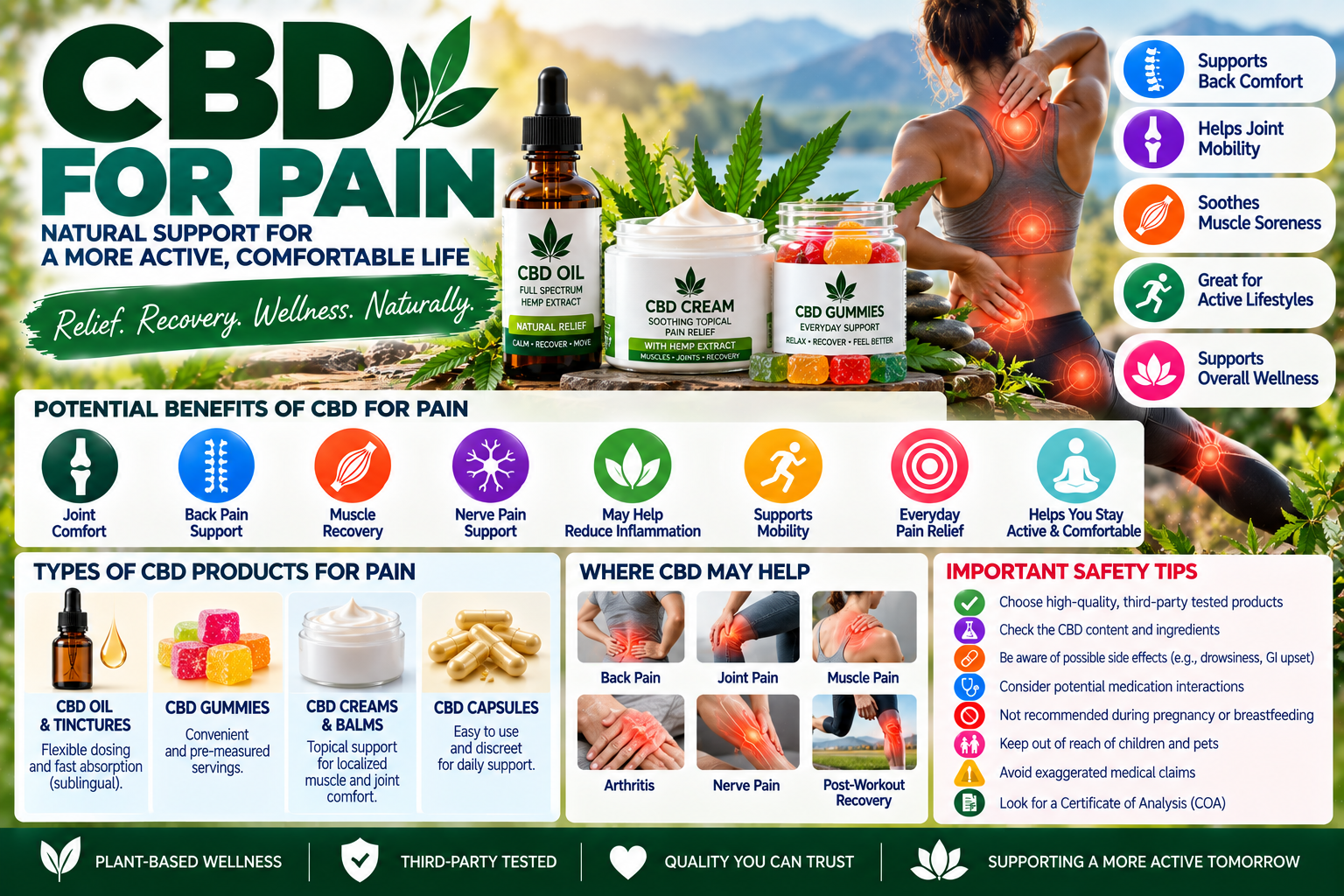
CBD products are now available as oils, tinctures, gummies, capsules, creams, balms, lotions, and other formulations. Many are marketed for muscle discomfort, joint discomfort, chronic pain, post-workout recovery, and general wellness.
But how strong is the evidence?
Research suggests that some cannabis and cannabinoid products may provide modest short-term benefits for certain types of chronic pain, particularly neuropathic pain. However, the evidence does not establish that ordinary over-the-counter CBD oil or CBD creams are proven treatments for every type of pain. NCCIH also notes that much of the research involves cannabinoid products containing both THC and CBD rather than CBD alone.
This guide explains what researchers know about CBD and pain, different CBD products, potential benefits, limitations, safety concerns, medication interactions, and the future of CBD pain research in 2026.
What Is CBD?
CBD stands for cannabidiol.
It is one of the many naturally occurring cannabinoids found in cannabis plants.
Another well-known cannabinoid is THC, or tetrahydrocannabinol.
The two compounds have different properties.
CBD
CBD is generally considered non-intoxicating.
THC
THC is the cannabinoid primarily responsible for cannabis's intoxicating effects.
CBD products may contain CBD alone or a combination of CBD with other cannabinoids.
Common CBD formulations include:
CBD oil
CBD tinctures
CBD gummies
CBD capsules
CBD creams
CBD balms
CBD lotions
CBD gels
The composition and quality of these products can vary considerably.
What Is Pain?
Pain is a protective signal that alerts the body to actual or potential tissue damage.
Pain can be classified in different ways.
Acute Pain
Acute pain generally develops suddenly and is often associated with an injury, procedure, illness, or other identifiable event.
Chronic Pain
Chronic pain persists or recurs over an extended period.
Examples can include chronic back pain, neuropathic pain, arthritis-related pain, and other persistent conditions.
Neuropathic Pain
Neuropathic pain is associated with damage or dysfunction involving nerves.
It may feel like:
Burning
Tingling
Electric shocks
Pins and needles
Shooting pain
Numbness
The underlying cause of pain matters when considering treatment options.
Does CBD Help With Pain?
This is one of the most important questions surrounding CBD.
The answer is complicated because research has examined many different cannabinoid products, and not all of them contain CBD alone.
NCCIH reports that some evidence suggests modest benefits from cannabis or cannabinoids for chronic pain, but side effects are more common than with placebo in some studies.
A review summarized by NCCIH found a small difference between cannabis/cannabinoids and placebo in the proportion of people experiencing at least a 30% reduction in chronic pain. However, the difference may be too small to be meaningful for many patients.
This means that the evidence should not be simplified into the statement "CBD cures pain."
CBD vs. Cannabis for Pain
This distinction is extremely important.
Research showing potential benefits from cannabis or cannabinoid medicines does not automatically prove that a commercially available CBD oil will produce the same results.
Some clinical studies have examined products containing:
THC and CBD
Pharmaceutical cannabinoids
Specific cannabinoid combinations
Sublingual cannabinoid formulations
Cannabis-based medicines
These are different from many consumer CBD products.
NCCIH specifically notes that not much is known about many other cannabinoid formulations or the effects of long-term use.
CBD for Chronic Pain
Chronic pain is one of the areas where cannabinoid research has received considerable attention.
Studies have investigated cannabinoids for conditions including:
Neuropathic pain
Chronic musculoskeletal pain
Multiple sclerosis-related symptoms
Other persistent pain conditions
Some evidence suggests cannabinoids may produce modest improvements in chronic pain.
However, side effects can include dizziness, sleepiness, gastrointestinal symptoms, and other unwanted effects depending on the formulation.
CBD should therefore be viewed as an area of research rather than a universally established chronic-pain treatment.
CBD for Nerve Pain
Neuropathic pain is one of the most studied categories of cannabinoid-related pain research.
Some reviews have found improvements with cannabis-based medicines for neuropathic pain, but many of the products studied contained both THC and CBD rather than CBD alone.
NCCIH notes that evidence for cannabis-based medicines in neuropathic pain has been low to moderate quality in some reviews, with concerns about study size, bias, and side effects.
Therefore, evidence involving a THC/CBD medicine should not automatically be applied to a THC-free CBD oil.
CBD for Back Pain
Back pain is extremely common, and CBD products are frequently marketed for this purpose.
However, the evidence is not strong enough to conclude that ordinary CBD products are an established treatment for back pain.
Back pain can result from many different causes, including muscle strain, spinal problems, nerve compression, inflammatory conditions, or other medical issues.
Persistent, severe, or unexplained back pain should be evaluated appropriately rather than managed solely with CBD.
CBD for Arthritis Pain
CBD products are often marketed toward people with arthritis and joint discomfort.
Although cannabinoid research has investigated pain and inflammation, evidence specifically establishing CBD products as effective arthritis treatments remains limited.
Consumers should be especially cautious of products claiming that CBD can "cure" arthritis or reverse joint damage.
Those claims go beyond what current evidence supports.
CBD for Muscle Pain
CBD creams and balms are commonly marketed for muscle discomfort.
Some products also contain ingredients such as:
Menthol
Camphor
Eucalyptus
Arnica
Essential oils
These ingredients can create cooling, warming, or soothing sensations.
Consumers should examine the complete ingredient list rather than assuming every sensation comes from CBD.
Research specifically supporting topical CBD for muscle pain is still developing.
CBD for Post-Workout Recovery
CBD has become popular in sports and wellness markets.
Some consumers use CBD products after exercise as part of a recovery routine.
However, claims that CBD directly speeds muscle recovery or prevents exercise-related injuries require more evidence.
A recovery routine can include:
Adequate sleep
Hydration
Appropriate nutrition
Rest days
Mobility work
Gradual training progression
CBD should not be viewed as a substitute for these fundamentals.
CBD Oils for Pain
CBD oil is one of the most common CBD products.
Oils may contain:
CBD isolate
Broad-spectrum CBD
Full-spectrum CBD
CBD Isolate
Designed to contain purified CBD.
Broad-Spectrum CBD
Generally contains CBD and other cannabis compounds while being formulated without THC.
Full-Spectrum CBD
Contains multiple naturally occurring cannabis compounds and may contain trace amounts of THC.
The evidence for a particular CBD oil depends on the actual formulation, concentration, quality, and research available for that specific type of product.
CBD Creams for Pain
CBD creams are applied directly to the skin.
They are often marketed for localized muscle or joint comfort.
However, topical CBD should not automatically be assumed to work like oral CBD.
The FDA has noted that important questions remain regarding how much CBD is absorbed through CBD-containing topical products.
The overall formulation also matters.
A cream containing CBD plus menthol, botanical extracts, or moisturizing ingredients may produce sensations or effects that cannot be attributed exclusively to CBD.
CBD Gummies for Pain
CBD gummies are another popular format.
They provide a pre-measured amount of CBD and are convenient for many consumers.
However, edible CBD is processed through the digestive system, and its effects can differ from topical or other formulations.
There is also a major distinction between consumer CBD gummies and pharmaceutical cannabinoid products studied in clinical trials.
Consumers should avoid assuming that a CBD gummy is a clinically proven pain medicine simply because it contains a specific amount of CBD.
How CBD May Affect Pain
Researchers are investigating how cannabinoids may influence biological systems involved in pain perception.
The endocannabinoid system is one important area of interest.
It includes cannabinoid receptors and naturally occurring signaling molecules that participate in several physiological processes.
Researchers are studying whether cannabinoids can influence pain signaling through these systems.
However, the exact mechanisms involved in human pain relief remain an active area of research.
NCCIH continues to fund research into minor cannabinoids and other cannabis compounds to better understand their potential pain-relieving properties.
Is CBD a Painkiller?
CBD should not simply be described as a conventional painkiller.
Traditional pain medicines include different categories of drugs with established mechanisms, indications, dosing standards, and safety information.
Commercial CBD products do not generally have the same level of evidence and regulatory oversight as approved prescription pain medicines.
The FDA has approved one prescription CBD medicine for certain rare seizure disorders, but it has not approved ordinary CBD products as general pain medicines.
Is CBD Safe for Pain?
CBD is not automatically risk-free.
The FDA has identified potential risks including:
Liver injury
Drug interactions
Drowsiness
Changes in alertness
Gastrointestinal symptoms
Changes in mood
Product contamination
Incorrect labeling
The FDA has also warned that some CBD products are marketed with unproven medical claims.
CBD and Pain Medication
People experiencing chronic pain may already be taking prescription or over-the-counter medicines.
CBD can affect how certain medications work.
This can potentially increase side effects or change the effectiveness of another medication.
People taking medicines for pain, inflammation, sleep, anxiety, seizures, blood pressure, or other conditions should discuss CBD use with a doctor or pharmacist.
This is particularly important when several medications are being taken simultaneously.
CBD and Opioids
Some people wonder whether CBD can replace opioid pain medicines.
Current evidence does not establish that CBD can safely replace prescribed opioids.
NCCIH reports that studies examining cannabinoids alongside opioids have produced inconsistent results, and high-quality studies have not established that cannabinoids reliably reduce opioid use.
People taking opioid medication should never reduce or stop it without appropriate medical guidance.
CBD and Alcohol
Combining CBD for pain with alcohol may increase drowsiness and sedation.
The FDA specifically warns about increased sedation when CBD is combined with alcohol or other substances that slow brain activity.
This can increase the risk of impaired judgment, falls, or other injuries.
CBD and Liver Health
Liver safety is another important consideration.
The FDA identified potential liver injury during evaluation of the prescription CBD medicine Epidiolex.
The risk may be affected by CBD dose and interactions with other medications.
This does not mean that every person using a CBD product will develop liver problems, but it demonstrates why CBD should not automatically be regarded as harmless.
CBD During Pregnancy
The FDA advises against CBD use during pregnancy and breastfeeding.
Concerns include potential liver toxicity, drug interactions, contamination, and unanswered questions about exposure to the developing fetus or breastfed infant.
CBD should not be considered automatically safe simply because it is marketed as natural or plant-based.
CBD Product Quality
Product quality is a major concern in the CBD market.
NCCIH reports that some nonprescription CBD products contain substantially different amounts of cannabinoids than stated on their labels and may contain contaminants.
Consumers should therefore look beyond packaging and marketing.
How to Choose CBD for Pain
If someone is considering a CBD product, several quality checks can help.
Check the CBD Concentration
Look at the total CBD amount and amount per serving where applicable.
Read the Ingredient List
Look for:
CBD extract
Carrier oils
Flavorings
Botanical ingredients
Other cannabinoids
Preservatives
Look for Third-Party Testing
Independent laboratory testing can provide information about:
CBD concentration
THC levels
Cannabinoid profile
Heavy metals
Pesticides
Microbial contamination
Check the Certificate of Analysis
A Certificate of Analysis, or COA, is a laboratory report associated with a product or batch.
A COA can help determine whether the product's cannabinoid profile is consistent with its label.
However, laboratory testing does not prove that a product will relieve pain.
Hidden Ingredients and CBD Pain Products
Consumers should be especially cautious about products making strong pain-relief claims.
In July 2026, the FDA warned consumers not to purchase or use KUKA FLEX CBD, a product promoted for joint pain. Laboratory analysis found undeclared diclofenac, a nonsteroidal anti-inflammatory drug, in the product.
This is an important reminder that "natural" or "CBD" labeling does not guarantee that a product contains only the ingredients advertised.
CBD vs. THC for Pain
CBD and THC are not interchangeable.
CBD is generally non-intoxicating.
THC can cause intoxicating effects.
Some clinical cannabinoid research involves combinations of THC and CBD rather than CBD alone.
This distinction matters when evaluating claims about pain relief.
A study of cannabis-based medicines cannot automatically be used as evidence that THC-free CBD oil will produce the same effects.
CBD and Drug Testing
Some CBD products contain THC.
Full-spectrum CBD products may contain trace amounts of THC.
Inaccurate labeling can create additional uncertainty.
People subject to workplace, athletic, military, or other drug testing should consider the possibility of THC exposure before using CBD products.
CBD for Different Types of Pain
Headaches
Evidence is not sufficient to establish ordinary CBD products as a proven treatment for headaches.
Frequent or severe headaches should be evaluated to determine the underlying cause.
Menstrual Pain
CBD products are sometimes marketed for menstrual discomfort, but strong clinical evidence specifically supporting CBD for menstrual pain remains limited.
Muscle Soreness
CBD creams and oils are marketed for exercise-related muscle soreness, but evidence for CBD specifically remains developing.
Nerve Pain
Neuropathic pain has been studied more extensively in cannabinoid research than some other pain categories, although many studies involve products containing both THC and CBD.
Chronic Pain
Some evidence suggests modest benefits from cannabis or cannabinoids for chronic pain, but the clinical significance varies and side effects are more common in some studies.
Other Evidence-Based Pain Management Options
CBD is only one area of pain research.
Depending on the cause of pain, treatment may involve:
Physical therapy
Exercise
Cognitive behavioral therapy
Mindfulness
Relaxation techniques
Appropriate medications
Sleep improvement
Weight management where appropriate
Treatment of the underlying medical condition
NCCIH reports that approaches such as cognitive behavioral therapy and mindfulness-based interventions can help some people with chronic pain.
When to See a Doctor About Pain
CBD should not delay medical evaluation.
Seek professional assessment for pain that is:
Severe
Persistent
Getting worse
Associated with significant swelling
Associated with weakness or numbness
Following a serious injury
Associated with unexplained weight loss
Accompanied by fever
Interfering significantly with daily life
Sudden severe pain, chest pain, major trauma, or other emergency symptoms require urgent medical attention.
CBD for Pain in 2026
The CBD pain market continues to evolve.
More Clinical Research
Researchers are studying CBD, THC, minor cannabinoids, and terpenes to determine which compounds may have meaningful pain-relieving properties.
Better Product Testing
Consumers are increasingly interested in independent laboratory testing and transparent cannabinoid profiles.
Greater Focus on Formulation
Researchers and manufacturers are exploring whether different delivery methods—such as oral, sublingual, and topical formulations—produce different effects.
More Regulatory Attention
Regulators continue to investigate product quality, hidden ingredients, labeling accuracy, and unsupported medical claims.
Evidence-Based Consumer Education
The market is gradually moving toward greater awareness that "CBD" is not a single standardized medicine. Products differ in concentration, ingredients, cannabinoid profile, manufacturing quality, and route of administration.
Frequently Asked Questions
Does CBD help with pain?
Some evidence suggests that cannabis and certain cannabinoid products may provide modest short-term benefits for some types of chronic pain. However, evidence specifically for CBD-only consumer products is more limited.
What type of pain is CBD best for?
There is no scientifically established "best" type of pain for over-the-counter CBD. Neuropathic pain has been studied extensively in cannabinoid research, but many studies involved products containing THC as well as CBD.
Does CBD cream help pain?
CBD creams are marketed for localized discomfort, but evidence specifically supporting topical CBD for pain remains limited. The amount of CBD absorbed through topical products can also vary.
Can CBD replace pain medication?
CBD should not automatically be considered a replacement for prescribed pain medication. Anyone considering changing medication should speak with a healthcare professional.
Is CBD safer than opioids?
It is not appropriate to make a blanket comparison. CBD has its own potential risks, including drug interactions and liver injury, while opioids have different risks. Treatment decisions depend on the individual and the cause of pain.
Can CBD cause side effects?
Yes. Reported concerns include drowsiness, changes in alertness or mood, gastrointestinal symptoms, medication interactions, and potential liver injury.
Can CBD be used with pain medication?
Potential drug interactions are possible. People taking pain medicines or other prescription drugs should consult a healthcare professional before using CBD.
Is CBD FDA approved for pain?
No. The FDA has approved a purified CBD prescription medicine for certain rare seizure disorders, not ordinary CBD products as general pain treatments.
Conclusion
CBD for pain has become an increasingly popular product in the search for alternative approaches to pain management. Research into cannabis and cannabinoids suggests that some cannabinoid products may provide modest benefits for certain chronic pain conditions.
However, the evidence needs to be interpreted carefully.
Research involving cannabis or THC/CBD medicines does not automatically prove that an over-the-counter CBD oil, gummy, or cream will relieve pain. Product formulations vary, long-term evidence is limited for many products, and side effects and medication interactions are important considerations.
Consumers should look for transparent labeling, independent laboratory testing, and a verifiable Certificate of Analysis. They should also be cautious about products making dramatic medical claims.
The 2026 FDA warning about a CBD product containing undeclared diclofenac demonstrates why product quality and responsible purchasing matter.
As research continues, CBD may remain an interesting area of pain science—but for now, it is best viewed as a developing field rather than a universally proven pain treatment.
This article is for general educational purposes and is not a substitute for professional medical advice, diagnosis, or treatment.