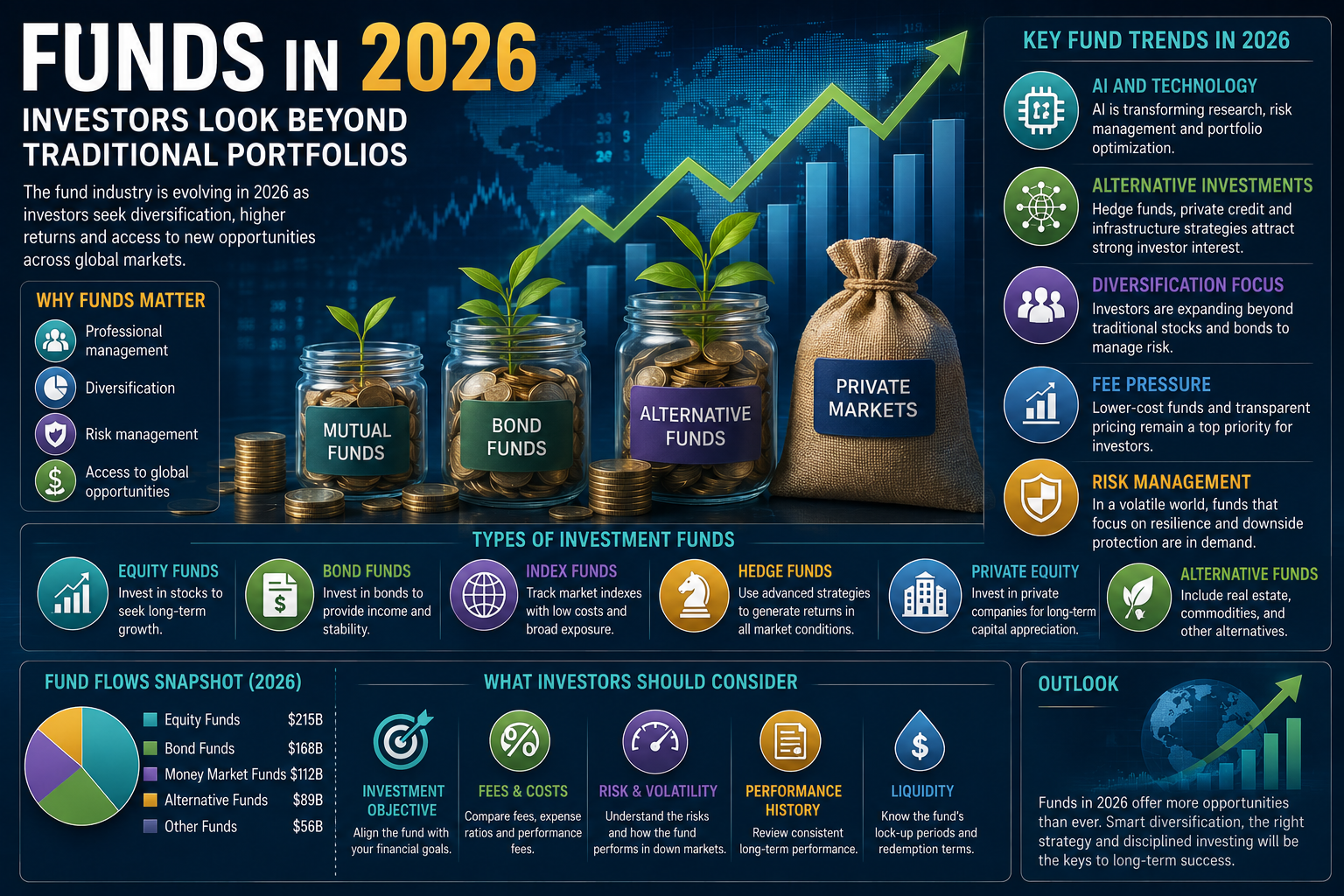
Investment funds remain a major part of global financial markets in 2026, giving investors access to stocks, bonds, private markets, alternative strategies and other assets through professionally managed portfolios.
The fund industry is also changing. Investors are looking beyond traditional stock and bond funds as market volatility, higher yields, artificial intelligence and changing economic conditions create demand for more flexible strategies.
Recent industry data shows continued interest in different types of funds. U.S. fund flows remained strong during 2026, with both equity and fixed-income funds attracting investor attention.
What Are Investment Funds?
An investment fund pools money from multiple investors and uses that capital to purchase a portfolio of assets.
Depending on the fund, those assets can include:
Stocks
Bonds
Government securities
Commodities
Real estate
Private companies
Alternative investments
Cash and money-market instruments
Funds allow investors to access diversified portfolios without having to select every individual investment themselves.
Mutual Funds Remain Important
Mutual funds continue to play a significant role in long-term investing and retirement planning.
They can provide exposure to broad stock markets, bonds, specific sectors or international markets.
Investors can generally choose between actively managed funds, where managers select investments, and index funds, which aim to track a particular benchmark.
The main considerations include fees, investment strategy, historical performance, risk and the fund manager's approach.
Hedge Funds Are Gaining Attention
Hedge funds have entered 2026 with strong momentum.
Goldman Sachs reported that hedge funds had delivered two consecutive years of double-digit returns through 2025, while investors were showing renewed interest in the asset class.
More recently, hedge funds have continued to attract attention as investors search for strategies that can potentially perform differently from traditional stock and bond portfolios.
Standard Chartered has been increasing its focus on hedge-fund strategies for wealth-management clients amid higher market volatility. The bank reported that hedge funds delivered an average 7% return during the first half of 2026, while total hedge-fund assets increased by $409 billion to $5.6 trillion.
Private Markets Continue to Develop
Private equity, private credit and private real estate are also important parts of the fund industry.
Private-market investments can give investors exposure to businesses and assets that are not traded on public stock exchanges.
However, private markets can involve:
Lower liquidity
Longer investment periods
Higher fees
Complex valuations
Greater investment minimums
McKinsey's 2026 Global Private Markets Report says private equity has entered a more mature phase, where returns increasingly depend on careful asset selection, operational improvements, AI adoption and disciplined risk management.
AI Is Changing Fund Management
Artificial intelligence is becoming increasingly important for fund managers.
Investment firms are using AI and data analytics to:
Analyze financial information
Identify market patterns
Monitor portfolios
Research companies
Manage risk
Automate administrative tasks
AI is unlikely to eliminate the need for investment professionals, but it can change how managers research opportunities and make portfolio decisions.
Funds that successfully use technology could potentially improve efficiency and respond more quickly to market developments.
Active Management Faces a Challenge
Active fund managers continue to face competition from low-cost passive strategies.
Index funds and ETFs have attracted investors because they can provide diversified market exposure at relatively low costs.
Recent Morningstar data cited by the Wall Street Journal showed that only 27% of actively managed U.S. large-cap equity funds outperformed their benchmarks over the 12 months ending June 2026.
This does not mean active funds are disappearing.
Instead, investors are increasingly asking whether active managers can justify their fees through better performance, downside protection or specialized expertise.
Bond Funds Remain Relevant
Bond funds are another major part of the investment-fund market.
They invest in government and corporate debt and can provide income and diversification.
Bond funds may become particularly attractive when investors want exposure to fixed income without buying individual bonds.
However, bond prices can fall when interest rates rise, meaning investors need to understand interest-rate risk.
Alternative Funds Expand
Alternative investment funds are gaining attention as investors search for ways to diversify portfolios.
These strategies can include:
Hedge funds
Private credit
Infrastructure
Private equity
Real estate
Commodity strategies
Absolute-return funds
Alternative investments can behave differently from traditional stocks and bonds, but they can also involve greater complexity and limited liquidity.
Investors Want More Diversification
One of the major themes in the fund industry is diversification.
Instead of relying entirely on one asset class, investors may combine different types of funds.
For example, a portfolio could include:
Equity funds for long-term growth.
Bond funds for income and diversification.
International funds for geographic exposure.
Alternative funds for additional diversification.
Money-market funds for short-term liquidity.
The right combination depends on an investor's goals, time horizon and risk tolerance.
Fund Fees Matter
Costs remain one of the most important factors when choosing a fund.
Fees can include:
Management fees
Expense ratios
Performance fees
Trading costs
Administrative expenses
Even relatively small annual fees can have a significant effect on long-term returns.
Investors should therefore compare similar funds based on both costs and investment strategy.
Fund Flows Provide Market Signals
Fund flows can provide insight into investor sentiment.
When large amounts of money move into equity funds, it can indicate stronger demand for stocks.
When investors increase allocations to bond or money-market funds, it may indicate greater demand for income, stability or liquidity.
Morningstar continues to track monthly fund flows across equity, fixed-income and sector funds, providing a useful view of where investor capital is moving.
The Growth of Multi-Strategy Funds
Multi-strategy funds are becoming increasingly popular because they can invest across several strategies.
A manager might use:
Long and short equity positions
Bonds
Commodities
Currencies
Derivatives
Global macro strategies
The objective is often to find opportunities across different market environments rather than depending on one asset class.
Hedge-fund demand for multi-strategy approaches has been particularly strong in 2026.
What Investors Should Check Before Choosing a Fund
Before investing in a fund, investors should consider several factors.
Investment Objective
Understand exactly what the fund is designed to achieve.
Holdings
Review what assets the fund actually owns.
Fees
Compare expenses with similar funds.
Risk
Understand potential losses and volatility.
Liquidity
Check how easily the investment can be bought or sold.
Manager
For actively managed funds, examine the manager's experience and investment approach.
Performance
Look at performance over appropriate periods rather than focusing only on the latest return.
What Could Shape the Fund Market in 2026?
Several trends could influence the industry through the rest of the year.
AI adoption: Fund managers are increasingly using artificial intelligence and advanced analytics.
Alternative investments: Investors continue to explore private markets and hedge-fund strategies.
Income demand: Bonds and other income-producing strategies remain important.
Fee pressure: Investors continue to favor cost-efficient products.
Market volatility: Uncertain markets can increase demand for diversified and alternative strategies.
Final Thoughts
The fund industry is evolving as investors look for more than traditional stock and bond exposure.
Mutual funds and index funds remain important, but hedge funds, private equity, private credit and multi-strategy products are attracting increasing attention.
At the same time, technology and AI are changing how fund managers research investments, manage portfolios and control risk.
The most important consideration for investors is not simply choosing the fund with the highest recent return. Understanding the fund's strategy, fees, risks, liquidity and long-term objective is essential.
As financial markets become more complex, funds will continue to play an important role in helping investors diversify and access a wider range of global opportunities.
FAQs
What is an investment fund?
An investment fund pools money from investors and uses it to purchase a portfolio of assets.
What types of funds are available?
Common types include mutual funds, index funds, bond funds, hedge funds, private-equity funds, money-market funds and alternative investment funds.
Are funds diversified?
Many funds are diversified, but some specialize in a single sector, country or asset class.
Are hedge funds risky?
Hedge funds can use complex strategies, leverage or derivatives, so their risk can vary significantly from one fund to another.
Why are private-market funds becoming popular?
They can provide access to private companies, credit, infrastructure and real estate, although they often involve lower liquidity and longer investment periods.
Do fund fees matter?
Yes. Higher fees can reduce long-term returns, making cost an important factor when comparing similar funds.