Global markets are moving through a highly changeable period in 2026, with investors closely tracking data across stocks, bonds, currencies and commodities. Interest-rate expectations, energy prices, artificial intelligence investment and geopolitical developments are creating significant differences between asset classes and regions.
Recent market data shows that global equities have remained relatively resilient despite pressure from higher bond yields and rising oil prices. LSEG's August performance review highlighted a shift toward value-oriented industries, with energy and financials outperforming while technology hardware faced pressure.
Global Stocks Remain Resilient
Equity markets have continued to attract investors despite periods of volatility.
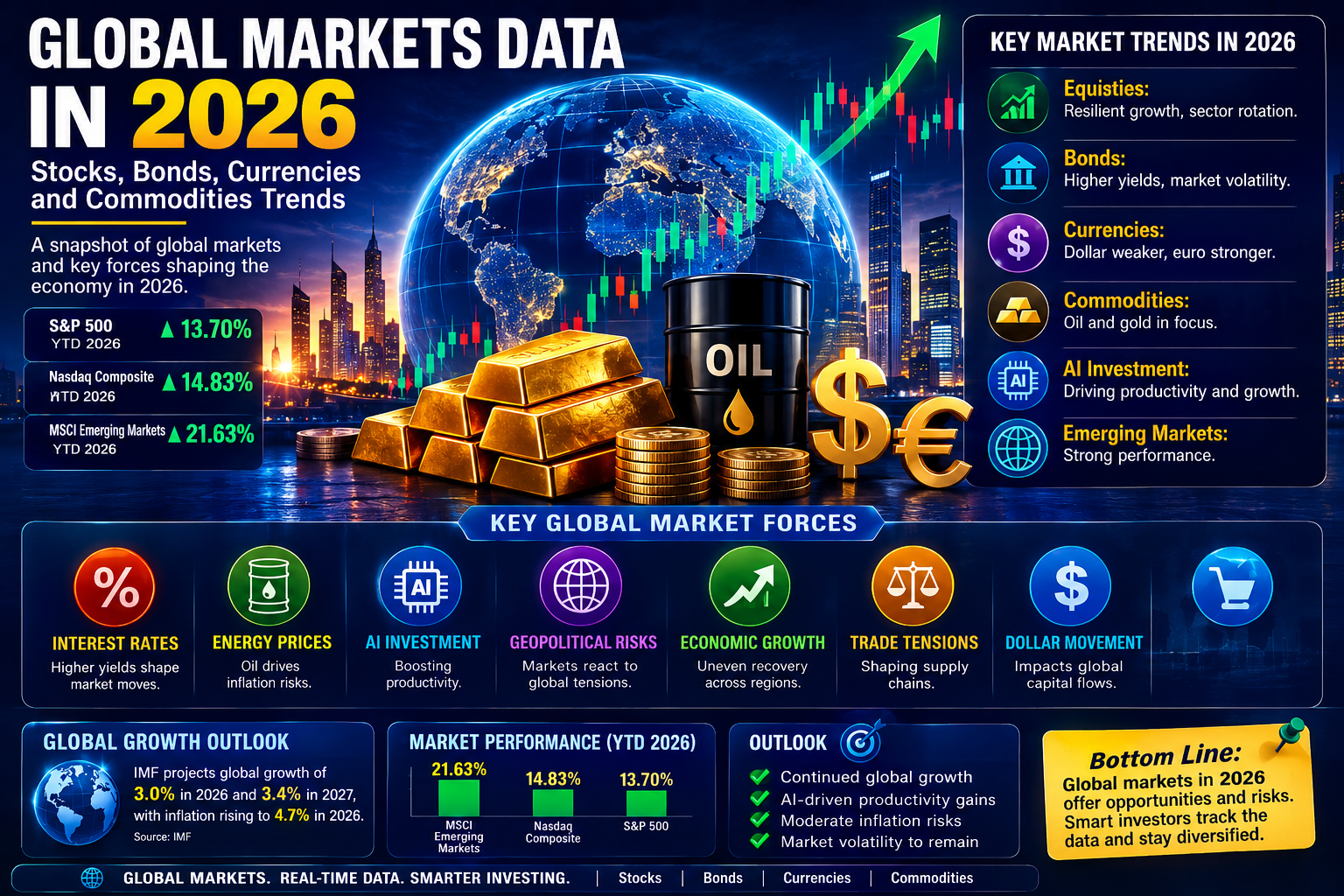
Data from LPL Research showed that, through August 14, the S&P 500 was up 13.70% year to date, while the Nasdaq Composite had gained 14.83% and the MSCI Emerging Markets index had risen 21.63%.
The numbers demonstrate that market performance has varied significantly by region and asset class.
Emerging-market equities have performed particularly strongly, while some technology-heavy markets have experienced greater volatility.
U.S. Markets Remain a Major Benchmark
U.S. stock indexes continue to influence global market sentiment.
The S&P 500 remains one of the world's most closely followed benchmarks, while the Nasdaq provides significant exposure to technology and AI-related companies.
However, investors are increasingly watching whether high technology valuations can be supported by actual earnings growth.
AI investment remains a major source of optimism, but rising borrowing costs could put pressure on companies spending heavily on infrastructure.
Emerging Markets Gain Momentum
Emerging-market stocks have been among the stronger performers in 2026.
The MSCI Emerging Markets index was up more than 21% year to date through August 14, according to LPL Research.
Several factors can influence emerging-market performance, including:
Economic growth
Commodity prices
Foreign investment
Currency movements
Interest rates
Technology investment
The performance also shows why global investors increasingly look beyond developed markets for diversification.
European Markets Show Different Leadership
European markets have also remained important to global investors.
LSEG's August data showed the UK leading among major developed markets during the month, while energy and financial companies helped support European performance.
European markets have a different sector composition from the U.S., with greater exposure to financials, industrial companies, energy and consumer businesses.
This can help create diversification when U.S. technology stocks experience volatility.
Bond Yields Are Reshaping Markets
Bond markets have become one of the most important sources of market volatility in 2026.
Long-term government-bond yields have risen as investors assess inflation, energy prices, government borrowing and future interest-rate policy.
Recent U.S. Treasury data showed the 30-year yield reaching around 5.3%, its highest level since 2007.
Higher yields can affect nearly every other asset class.
When bonds offer higher returns, stocks may become relatively less attractive, particularly companies whose valuations depend heavily on future growth.
The Yield Curve Matters
Investors also monitor the relationship between short- and long-term interest rates.
A steepening yield curve can signal changing expectations for economic growth, inflation and government borrowing.
In August, long-term Treasury yields rose more sharply than shorter-term yields, reflecting concerns about inflation and fiscal conditions.
Yield-curve movements can influence banks, mortgage rates, corporate borrowing and investment decisions.
The Dollar Moves Lower
Currency data has also become important.
The U.S. dollar weakened during August as investors reassessed Federal Reserve policy and concerns about U.S. fiscal conditions increased.
Reuters reported that the dollar declined nearly 1% during the week ending August 21, while the euro and several other currencies strengthened.
A weaker dollar can affect global markets in several ways.
It can support commodities priced in dollars, improve the relative value of foreign assets for U.S. investors and potentially ease financial pressure on countries with dollar-denominated debt.
Gold Reaches New Attention
Gold has benefited from a combination of geopolitical uncertainty, dollar weakness and investor demand.
Reuters reported that gold reached a three-month high during the week ending August 21.
Gold is often viewed as a defensive asset during periods of uncertainty.
However, its price can also respond to real interest rates, currency movements, central-bank demand and investor positioning.
Oil Becomes a Key Market Indicator
Oil prices have been one of the biggest sources of volatility in 2026.
Renewed geopolitical tensions and concerns about supply disruptions have pushed crude prices higher.
Reuters reported that Brent crude was approaching $95 per barrel in late August amid concerns about prolonged disruptions around the Strait of Hormuz.
Higher oil prices can increase inflation and raise costs for consumers and businesses.
Commodities Move Differently
Not every commodity is responding to the same forces.
LSEG reported that energy was a major driver of commodity performance, while metals and other commodity groups responded differently to changing global growth expectations.
This highlights why investors often examine individual commodity markets rather than treating commodities as one asset class.
AI Remains a Major Market Theme
Artificial intelligence continues to influence global market data.
Technology companies are investing heavily in:
Data centers
Semiconductors
Cloud infrastructure
AI models
Electricity systems
Networking equipment
The market question is increasingly whether these investments will produce enough future revenue and productivity gains to justify their enormous costs.
LSEG noted that technology-heavy Asia faced pressure as investors reassessed AI hardware demand and valuations.
Market Leadership Is Changing
One of the most interesting trends in 2026 is the rotation in market leadership.
Energy and financial stocks have performed strongly, while some technology hardware companies have struggled.
LSEG's August review identified energy and financials as leading equity industries, while technology hardware was a drag on performance.
This suggests that investors are becoming more selective rather than simply buying the strongest technology names.
Global Markets Are Highly Connected
Today's financial markets are closely linked.
A change in oil prices can influence inflation.
Inflation can influence interest rates.
Interest rates can influence bond yields.
Bond yields can influence stocks.
Currency movements can affect commodities.
This creates a chain reaction across global asset classes.
For investors, understanding these connections is often more useful than looking at a single market in isolation.
What Market Data Investors Watch
Professional investors track a wide range of indicators.
Equity Indexes
Major benchmarks show how stock markets are performing.
Bond Yields
Government yields provide important signals about interest rates and economic expectations.
Currency Indexes
Currency data helps investors understand global capital flows.
Commodity Prices
Oil, gold, copper and agricultural prices provide information about supply and demand.
Volatility
Volatility indexes can indicate changes in investor risk appetite.
Market Breadth
The number of companies participating in a market rally can help show whether gains are broad or concentrated.
Why Market Data Matters
Market data is more than a collection of numbers.
It provides information about investor expectations.
For example, rising bond yields can suggest increasing inflation or fiscal concerns.
A weaker dollar can indicate changing expectations for U.S. monetary policy.
Higher oil prices can signal supply concerns.
Strong emerging-market stocks can indicate increased appetite for risk.
Understanding the context behind market data is therefore essential.
The Outlook for Global Markets
The remainder of 2026 could remain volatile.
Investors are likely to focus on:
Central-bank decisions
Inflation data
Oil prices
Corporate earnings
AI investment
Government borrowing
Currency movements
Geopolitical developments
Recent market reports show that investors are already balancing strong corporate earnings against higher bond yields and energy costs.
This could lead to continued rotation between sectors and regions.
Final Thoughts
Global markets in 2026 are being shaped by a complicated combination of economic data, interest rates, energy prices, technology investment and geopolitical developments.
Stocks have remained relatively strong, but bond yields have created new challenges. The dollar has weakened, gold has attracted defensive demand and oil has become a major source of inflation concerns.
At the same time, emerging markets have delivered strong performance while market leadership has broadened beyond technology.
For investors, the most important lesson is that market data needs to be viewed together rather than separately.
Stocks, bonds, currencies and commodities are interconnected, and changes in one market can quickly influence another.
As the year continues, tracking these relationships will be essential for understanding where global markets may be heading next.
FAQs
What is global markets data?
Global markets data includes information about stocks, bonds, currencies, commodities, interest rates and other financial markets around the world.
Why is bond-yield data important?
Bond yields influence borrowing costs, investment decisions, currencies and stock valuations.
Why are oil prices important for markets?
Oil prices affect inflation, transportation, manufacturing and consumer spending, making them an important global economic indicator.
What is influencing the dollar in 2026?
Interest-rate expectations, U.S. fiscal concerns, economic data and global capital flows are among the major factors influencing the dollar.
Why is gold attracting investors?
Gold can benefit from geopolitical uncertainty, dollar weakness and demand for defensive assets.
Are emerging markets performing well in 2026?
Emerging-market equities have performed strongly. The MSCI Emerging Markets index was up 21.63% year to date through August 14, according to LPL Research.
What market indicators should investors follow?
Important indicators include stock indexes, bond yields, currencies, commodities, inflation, volatility and corporate earnings.