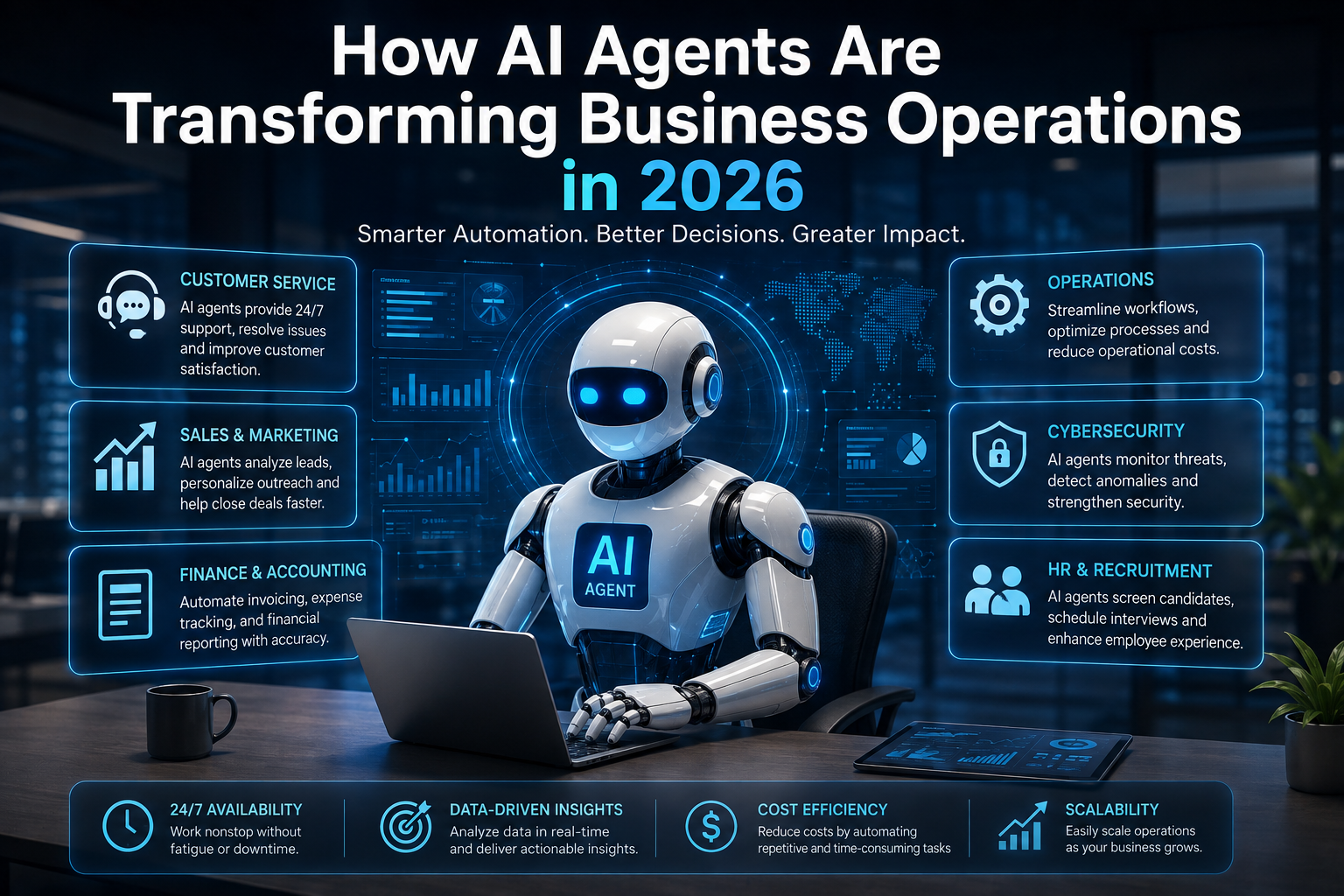
Artificial intelligence is moving beyond simple chatbots and automated software tools. In 2026, AI agents are becoming active participants in business operations, capable of analyzing information, making recommendations, executing tasks, and coordinating workflows with limited human intervention.
For modern organizations, this shift represents a major change in how work gets done. Instead of using AI only to generate content or answer questions, businesses can deploy AI agents across customer service, sales, finance, human resources, cybersecurity, supply chains, and internal operations.
What Are AI Agents?
AI agents are software systems designed to understand goals, evaluate information, make decisions, and take actions. Unlike traditional automation, which generally follows predefined rules, AI agents can adapt their actions based on changing circumstances.
For example, a traditional workflow may automatically send an email after a customer completes a form. An AI agent can go further by analyzing the customer's history, determining what information is relevant, preparing a personalized response, updating the CRM, and escalating the issue to an employee when necessary.
This ability to combine reasoning, data analysis, and action makes AI agents increasingly valuable for businesses.
Automating Repetitive Business Processes
One of the most immediate benefits of AI agents is the automation of repetitive tasks.
Employees often spend significant amounts of time processing documents, organizing information, responding to routine inquiries, preparing reports, and updating business systems. AI agents can handle many of these activities automatically.
For example, an AI agent supporting a finance department could collect invoices, extract important information, identify unusual transactions, organize records, and prepare reports for human review.
This allows employees to spend more time on strategic and creative responsibilities instead of routine administrative work.
Transforming Customer Service
Customer service is another area where AI agents are creating significant opportunities.
Modern AI agents can understand customer questions, access relevant information, troubleshoot common problems, and provide personalized responses. They can also determine when a situation requires human assistance.
Rather than replacing every customer-service employee, AI agents can function as digital assistants that handle high volumes of routine requests while allowing human representatives to focus on complex or sensitive cases.
The result can be faster response times, more consistent support, and improved operational efficiency.
AI Agents in Sales and Marketing
Sales teams are also benefiting from intelligent automation.
AI agents can analyze customer interactions, identify potential leads, prioritize prospects, research accounts, and assist sales representatives with follow-up activities. Marketing teams can use agents to analyze campaign performance, identify audience trends, generate content ideas, and support personalization.
This creates a more responsive sales and marketing environment. Instead of relying entirely on manual research and repetitive data entry, teams can use AI to process information quickly and focus their attention on relationships and strategy.
Smarter Business Decision-Making
Businesses generate enormous amounts of data, but collecting information is only the first step. Organizations also need to understand that data and turn it into useful decisions.
AI agents can continuously analyze business information and highlight important patterns. They can monitor sales performance, customer behavior, inventory levels, operational costs, and other business indicators.
For executives and managers, this can provide a more dynamic view of business performance. Instead of waiting for periodic reports, decision-makers can receive relevant insights as conditions change.
Improving Supply Chain Operations
Supply chains are particularly well suited to AI-powered decision-making because they involve large amounts of constantly changing information.
AI agents can monitor inventory, analyze demand patterns, track shipments, identify potential delays, and recommend adjustments. When connected to appropriate business systems, they can also initiate certain operational actions automatically.
For businesses operating across multiple markets, this type of intelligent coordination can help reduce inefficiencies and improve responsiveness.
AI Agents and Cybersecurity
Cybersecurity is becoming increasingly complex as businesses expand their digital infrastructure.
AI agents can assist security teams by monitoring systems, analyzing unusual activity, identifying potential threats, and helping prioritize security alerts. Instead of requiring security professionals to manually examine every event, AI can help filter large volumes of information and bring the most important issues to their attention.
Human oversight remains essential, particularly when automated systems are allowed to take security-related actions. However, AI agents can provide valuable support in environments where speed is critical.
The Rise of Digital Employees
One of the most interesting developments in 2026 is the concept of the digital employee.
A digital employee is not simply a chatbot. It can be designed to perform a defined business role by interacting with software, analyzing information, communicating with other systems, and completing workflows.
For example, a company could deploy an AI agent to assist with accounts payable, recruitment coordination, customer onboarding, or internal IT support.
These digital workers can operate continuously and handle large volumes of routine work. This does not necessarily eliminate human jobs; instead, it changes how organizations divide responsibilities between people and intelligent software.
Challenges Businesses Must Consider
Despite their potential, AI agents also introduce important challenges.
Businesses need to consider data security, privacy, accuracy, compliance, access controls, and accountability. An AI agent that can take action within business systems must operate within clearly defined permissions.
Organizations should also establish human-review processes for high-impact decisions. AI systems can make mistakes, misunderstand context, or act on incomplete information.
Successful adoption therefore requires more than simply purchasing an AI tool. Businesses need governance frameworks, monitoring systems, employee training, and clear policies for responsible AI use.
The Future of Business Operations
AI agents are helping businesses move toward more autonomous and intelligent operations. In the coming years, organizations are likely to connect multiple specialized agents across departments, allowing them to coordinate tasks and exchange information.
The businesses that benefit most may not necessarily be those that automate everything. Instead, they will be the organizations that identify where AI can create measurable value while maintaining appropriate human oversight.
In 2026, AI agents are becoming an important part of the modern enterprise technology stack. Their ability to analyze information, execute workflows, and support decision-making is changing the traditional relationship between employees and software.
The future of business operations is therefore likely to be a combination of human expertise and intelligent digital agents—where people focus on judgment, creativity, leadership, and relationships while AI handles an increasing share of repetitive and data-intensive work.