Customer expectations are changing rapidly. People want businesses to respond faster, understand their needs, provide personalized recommendations, and deliver consistent experiences across websites, mobile applications, social media, messaging platforms, and physical locations.
For many organizations, meeting these expectations has traditionally required large customer-service teams, extensive customer-data systems, and complex marketing operations.
In 2026, artificial intelligence is changing that model.
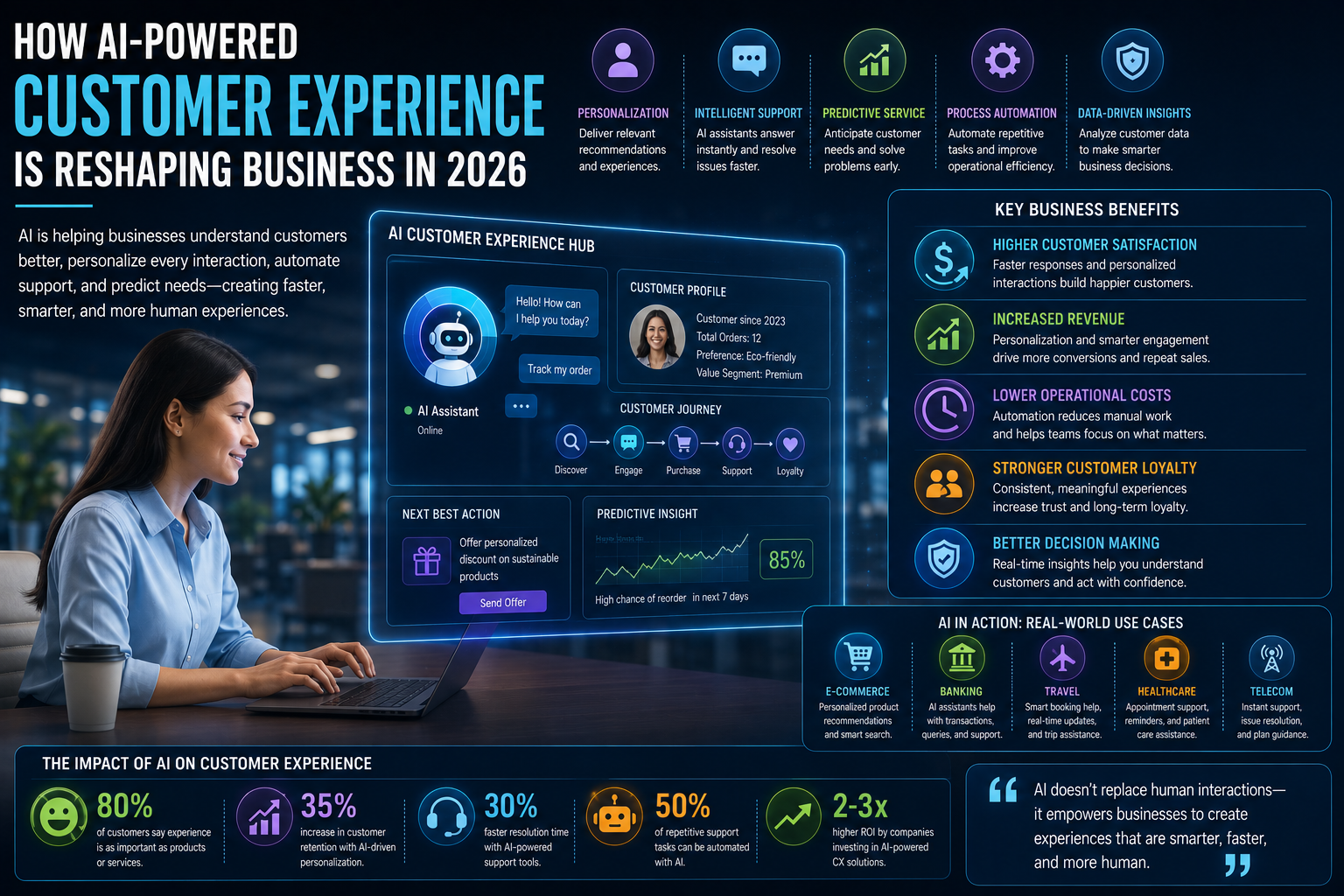
AI-powered customer experience is becoming an important business strategy as organizations use intelligent systems to understand customers, automate interactions, personalize recommendations, predict needs, and provide support around the clock.
The transformation goes beyond chatbots. Modern AI systems can connect customer information, analyze behavior, understand natural language, and coordinate actions across multiple business systems.
For companies competing in crowded markets, the ability to create faster and more relevant customer experiences could become a significant competitive advantage.
What Is AI-Powered Customer Experience?
AI-powered customer experience combines artificial intelligence, customer data, automation, predictive analytics, and conversational technologies to improve interactions between businesses and their customers.
Traditional customer-service systems generally respond to specific requests.
AI-powered systems can take a broader approach.
They can analyze a customer's history, understand the context of an interaction, identify potential needs, and recommend an appropriate response.
For example, when a customer contacts a company about an order, an AI system can retrieve the order information, check delivery status, review previous interactions, and provide a personalized response.
If the issue requires human assistance, the AI can transfer the conversation along with relevant information so the customer does not need to repeat everything.
This creates a smoother experience while reducing repetitive work for employees.
Why Customer Experience Matters More in 2026
Products and prices are no longer the only factors influencing customer decisions.
Customers increasingly compare businesses based on convenience, responsiveness, personalization, and overall experience.
A company may have a strong product but lose customers if support is slow or difficult to access.
AI can help organizations respond to this challenge by providing faster and more consistent interactions.
Businesses can use AI to support customers before, during, and after a purchase.
This creates opportunities to improve the entire customer journey rather than focusing only on customer service.
AI-Powered Personalization
Personalization is one of the most important applications of AI in customer experience.
Businesses collect information from purchases, website interactions, customer-service conversations, preferences, and other digital activities.
AI can analyze these signals to identify patterns and make personalized recommendations.
An online retailer, for example, can recommend products based on previous purchases and browsing behavior.
A financial platform can provide information that is more relevant to a customer's financial activity.
A streaming service can recommend content based on viewing patterns.
The goal is to make interactions more relevant rather than showing every customer the same experience.
However, personalization must be balanced with privacy. Businesses need clear policies around how customer information is collected, stored, and used.
Intelligent Customer Support
Customer support is one of the areas where AI adoption is growing rapidly.
AI assistants can answer common questions, guide customers through basic processes, provide product information, and help troubleshoot problems.
Unlike traditional automated systems that depend heavily on fixed menus, modern AI can understand natural language and conversational context.
A customer can describe a problem in their own words rather than selecting from a long list of options.
AI can then determine the likely issue and provide relevant information.
For complex cases, the system can transfer the conversation to a human employee.
This hybrid model allows AI to handle routine interactions while employees focus on situations that require judgment or empathy.
Predicting Customer Needs
AI can also move customer experience from reactive to proactive.
Instead of waiting for customers to report problems, businesses can use AI to identify potential issues before customers contact support.
For example, an AI system might identify unusual activity that suggests a payment problem, delivery delay, or service disruption.
The company can then proactively contact the customer with information or assistance.
This can reduce frustration and demonstrate that the business is actively monitoring the customer experience.
Proactive service may become particularly valuable for subscription businesses, financial services, telecommunications, travel, and other industries where disruptions can significantly affect customer satisfaction.
AI Across the Customer Journey
Customer experience does not begin when someone contacts support.
It starts when a potential customer first discovers a business.
AI can support different stages of the journey.
During discovery, AI can personalize content and recommendations.
During evaluation, intelligent assistants can answer questions and compare products.
During purchasing, AI can simplify transactions and recommend relevant options.
After the purchase, AI can provide support, monitor satisfaction, and identify opportunities for additional services.
This creates a more connected customer journey.
Instead of treating marketing, sales, and customer service as separate functions, businesses can use AI to connect them.
AI and Voice-Based Customer Service
Voice AI is another area with significant potential.
Customers can increasingly interact with AI systems through natural speech rather than typing messages or navigating complicated phone menus.
Voice-based AI can understand questions, retrieve information, and respond conversationally.
For businesses with high call volumes, this could reduce waiting times and provide support outside traditional operating hours.
However, voice AI needs to be carefully designed.
Customers should be able to reach a human representative when necessary, particularly for sensitive or complex issues.
AI Agents and Customer Experience
The growth of AI agents could take customer experience even further.
An AI agent can do more than provide an answer. It can perform tasks using connected business systems.
For example, a customer might ask an AI agent to change a delivery address.
The agent could verify the customer's identity, check whether the order has already shipped, update the appropriate system, and confirm the change.
Similarly, a travel customer could ask an AI agent to modify a booking.
The agent could review availability, evaluate the relevant policy, make an authorized change, and provide confirmation.
These capabilities can turn customer service from information delivery into action-oriented assistance.
Creating Consistent Experiences Across Channels
Customers interact with businesses through many different channels.
They may start a conversation on a website, continue through a mobile application, and later contact customer support.
One of the biggest challenges is maintaining context between these interactions.
AI can help connect customer information across channels.
When a customer moves from one platform to another, relevant information can be made available to the next interaction.
This can reduce repetitive questions and create a more seamless experience.
Consistency is particularly important for large organizations with multiple customer-service teams and communication channels.
Improving Employee Productivity
AI-powered customer experience is not only about customers.
It can also improve employee productivity.
Customer-service representatives often spend significant time searching for information, writing responses, summarizing conversations, and updating records.
AI can assist with these activities.
During a customer conversation, an AI assistant could recommend relevant information, summarize previous interactions, suggest possible responses, and automatically prepare notes.
The employee remains in control while AI handles much of the repetitive work.
This can allow customer-service teams to spend more time solving complex problems and building relationships.
Measuring Customer Experience With AI
Businesses need measurable ways to determine whether AI is improving customer experience.
Organizations can analyze customer satisfaction, response times, resolution rates, repeat contacts, conversation outcomes, and customer retention.
AI can also examine large volumes of customer feedback to identify recurring themes.
For example, if thousands of customers mention difficulty with a particular product feature, AI can identify the pattern and bring it to the attention of product and leadership teams.
This creates a feedback loop between customer experience and business improvement.
Protecting Customer Data
AI-powered customer experience depends heavily on customer information, which creates important security and privacy responsibilities.
Businesses need strong access controls and data-protection policies.
AI systems should only access information necessary for their specific tasks.
Sensitive information should be appropriately protected, and organizations should monitor how AI systems use customer data.
Transparency is also important.
Customers increasingly want to understand how businesses use their information, particularly when AI is involved.
Trust can become a major competitive factor as AI-powered personalization becomes more common.
Human Interaction Still Matters
AI can improve customer experience, but it cannot replace every form of human interaction.
Some customers need empathy, negotiation, creativity, or complex problem-solving.
A frustrated customer may prefer to speak with a human employee rather than interact with an automated system.
Businesses should therefore design AI systems with clear escalation paths.
The strongest customer-experience strategies will likely combine AI efficiency with human understanding.
AI handles routine tasks and information processing, while employees focus on situations where human judgment creates the greatest value.
Building an AI Customer Experience Strategy
Businesses should begin with specific customer problems rather than adopting AI simply because the technology is available.
Organizations can identify areas where customers experience long waiting times, repetitive processes, or inconsistent support.
A company might start by deploying an AI assistant for frequently asked questions.
Once the system demonstrates value, it can be connected to customer records and business applications.
Over time, organizations can introduce personalization, predictive support, AI agents, and cross-channel experiences.
Each stage should be measured using clear customer and business outcomes.
The Future of AI-Powered Customer Experience
The next generation of customer experience will likely become increasingly proactive.
AI systems may understand customer intent, predict potential problems, coordinate multiple business systems, and take appropriate actions automatically.
Instead of customers asking businesses to solve problems, intelligent systems may identify opportunities to help customers before problems occur.
For example, an AI system could notice that a customer's product is approaching the end of its expected lifecycle and proactively recommend replacement options.
Another system could identify that a customer may be experiencing a service issue and offer assistance before a complaint is submitted.
This could create a fundamentally different relationship between businesses and customers.
Conclusion
AI-powered customer experience is reshaping how businesses interact with customers in 2026.
Artificial intelligence can personalize recommendations, automate support, predict customer needs, connect communication channels, assist employees, and enable AI agents to complete real-world tasks.
The greatest opportunity is not simply replacing traditional customer-service tools. It is redesigning the entire customer journey around faster, more relevant, and more intelligent interactions.
Businesses that combine reliable customer data, responsible AI, human expertise, and strong privacy protections can create experiences that are both efficient and trustworthy.
As AI continues to mature, customer experience may become one of the most visible areas of business transformation.
The companies that succeed will not necessarily be those that use the most AI. They will be the ones that use AI to understand customers better, remove friction, and create genuinely useful experiences.