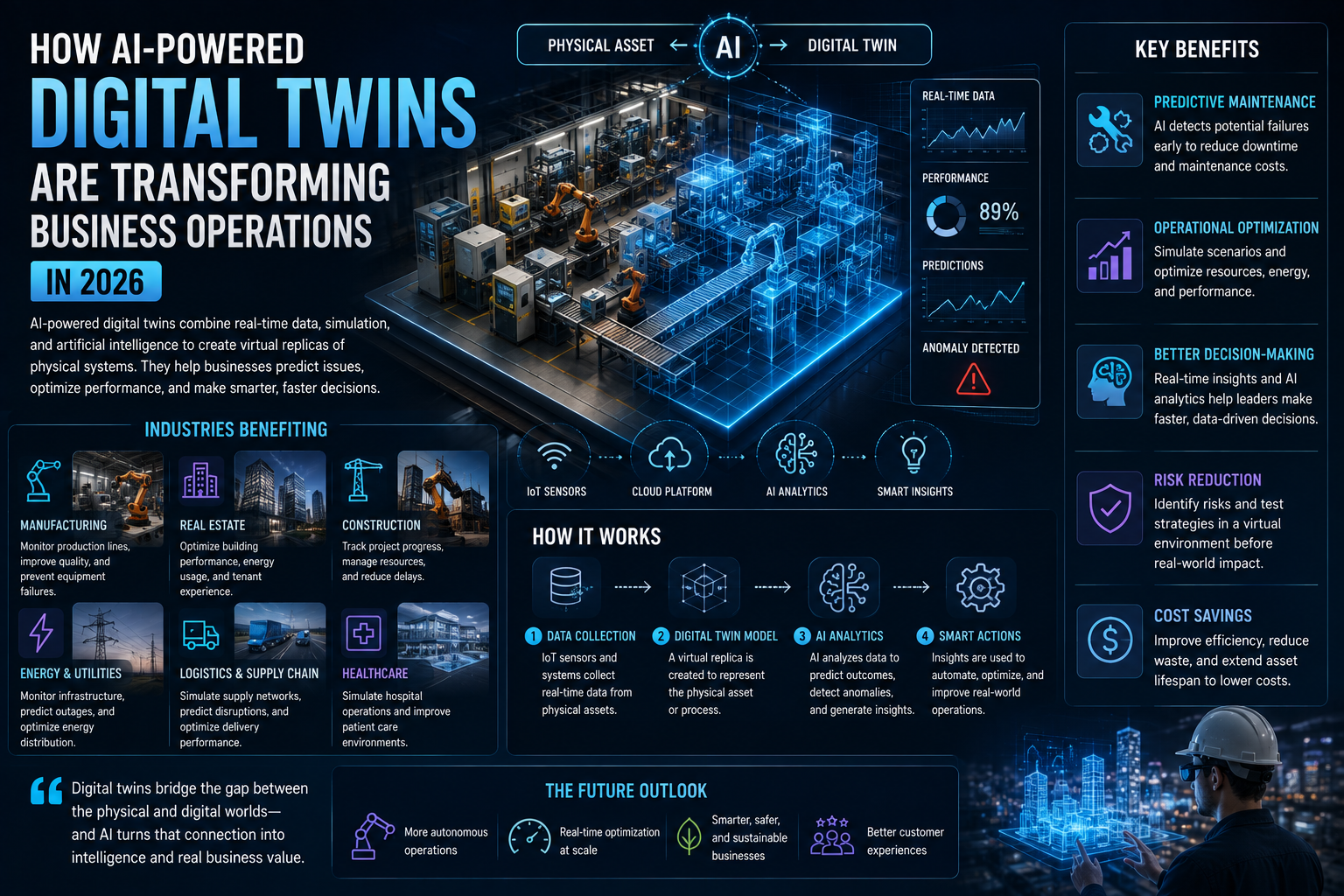
Businesses are becoming increasingly dependent on complex physical and digital systems. Factories contain connected machines, buildings rely on sophisticated infrastructure, supply networks span multiple regions, and companies operate thousands of digital processes simultaneously.
Understanding how all these systems behave can be difficult.
This is where digital twins are becoming increasingly valuable.
A digital twin is a virtual representation of a physical object, system, facility, or process. It can use information from sensors, software platforms, operational databases, and other sources to reflect what is happening in the real world.
When artificial intelligence is added to a digital twin, the system can do more than simply display information. AI can analyze patterns, identify potential problems, simulate scenarios, and help businesses make predictions.
In 2026, AI-powered digital twins are becoming an important tool for organizations looking to improve efficiency, reduce operational risks, and make better decisions.
What Is an AI-Powered Digital Twin?
A traditional digital model provides a representation of something physical.
A digital twin goes further by connecting that representation to real-world data.
For example, a manufacturer could create a digital twin of a production line. Sensors installed on machines can continuously provide information about temperature, vibration, production speed, energy consumption, and equipment performance.
The digital twin can reflect those changes in a virtual environment.
AI can then analyze the information and identify patterns that may not be obvious to human operators.
This combination creates a dynamic system that connects the physical and digital worlds.
Why Digital Twins Are Becoming More Important
Modern businesses generate enormous amounts of operational data.
The challenge is not necessarily collecting information. It is understanding what that information means and using it effectively.
Digital twins provide a way to organize operational information around a specific physical or business system.
AI adds analytical capabilities.
Instead of simply showing that a machine is operating at a certain temperature, an AI-powered digital twin could analyze historical data and determine whether the temperature indicates a potential problem.
This can turn raw data into actionable intelligence.
Digital Twins in Manufacturing
Manufacturing is one of the strongest applications for digital twin technology.
Factories contain complex production lines where one machine can affect many other processes.
A digital twin can provide manufacturers with a virtual representation of production operations.
Managers can monitor equipment, production rates, energy consumption, quality indicators, and other operational information from a centralized environment.
AI can analyze these signals to identify unusual patterns.
For example, if a machine begins showing subtle changes in vibration and temperature, the system may identify the combination as a possible indication of equipment deterioration.
Maintenance teams can investigate before the machine experiences a major failure.
Predictive Maintenance
Predictive maintenance is one of the most practical applications of AI-powered digital twins.
Traditional maintenance often follows a schedule.
Equipment may be inspected after a certain number of operating hours or replaced according to a predefined timetable.
This can lead to unnecessary maintenance or unexpected failures.
AI-powered digital twins can support a more flexible approach.
By analyzing sensor data and historical performance, AI can estimate when equipment may require attention.
Maintenance teams can prioritize machines showing the highest risk.
This can potentially reduce downtime, extend equipment life, and improve maintenance planning.
Optimizing Energy Consumption
Energy management is another area where digital twins can provide significant value.
Large buildings, factories, data centers, and infrastructure systems consume substantial amounts of energy.
A digital twin can represent how energy moves through a facility.
AI can analyze consumption patterns and identify opportunities for optimization.
For example, an intelligent system could identify equipment that consumes unusually high amounts of energy or determine how operating schedules influence consumption.
Businesses can then test potential changes in the digital environment before applying them to the physical facility.
This creates a safer way to evaluate operational improvements.
Digital Twins in Real Estate
The real estate industry can also benefit from digital twins.
A digital twin of a commercial building can combine information about HVAC systems, lighting, occupancy, security, energy consumption, elevators, and other building infrastructure.
Property managers can use the system to monitor building performance.
AI can identify unusual conditions and recommend areas for investigation.
For example, if energy consumption increases unexpectedly in a particular section of a building, the digital twin could help identify possible causes.
Over time, this can support more efficient building operations.
Smarter Construction Projects
Digital twins can also connect construction planning with real-world development.
Before construction begins, teams can create detailed digital representations of proposed buildings.
As construction progresses, real-world information can be compared with the digital model.
This can help project managers identify differences between planned and actual progress.
AI can analyze project information to identify potential schedule risks, resource problems, or design conflicts.
When combined with drones, sensors, building information modeling, and computer vision, digital twins can create a more connected construction environment.
Digital Twins for Product Development
Manufacturers can use digital twins before physical products are built.
Engineers can create virtual representations of products and test how they might perform under different conditions.
AI can analyze these simulations and identify potential design improvements.
For example, an engineering team could evaluate different materials, operating conditions, or component configurations in a virtual environment.
This can reduce the need for some physical prototypes and allow companies to explore more design possibilities.
The physical testing stage remains important, but digital simulation can make the development process more efficient.
Digital Twins and Supply Networks
Digital twins do not have to represent only physical machines or buildings.
They can also represent complex business systems.
A company could create a digital representation of its supply network, including suppliers, warehouses, transportation routes, inventory levels, and customer demand.
AI can then simulate how changes might affect the network.
For example, businesses could explore what happens if a major supplier experiences delays or if demand suddenly increases.
Instead of waiting for the disruption to happen, companies can use simulations to evaluate possible responses.
This can support more resilient planning.
Testing Business Decisions Before Implementation
One of the most powerful concepts behind digital twins is simulation.
Businesses can test potential decisions virtually before implementing them in the real world.
A manufacturer could simulate changes to a production line.
A property manager could evaluate different energy strategies.
A logistics company could test alternative warehouse configurations.
A city could model infrastructure changes.
AI can evaluate these scenarios and compare potential outcomes.
This does not guarantee that a simulation will perfectly predict reality, but it provides decision-makers with additional information before committing resources.
AI Makes Digital Twins More Predictive
Traditional digital twins primarily focus on monitoring.
AI allows them to become more predictive.
Instead of asking what is happening now, businesses can begin asking what is likely to happen next.
Machine-learning systems can analyze historical information and identify patterns associated with future outcomes.
This could help organizations anticipate equipment failures, changes in demand, energy consumption, or operational disruptions.
Predictive capabilities can make digital twins significantly more valuable for strategic planning.
AI Agents and Digital Twins
The next stage may involve combining digital twins with AI agents.
An AI agent could continuously monitor a digital twin, identify unusual conditions, evaluate potential responses, and recommend actions.
For example, if a digital twin detects that a production machine may fail soon, an AI agent could review maintenance schedules, check spare-part availability, and prepare a recommendation for the maintenance team.
Human approval could remain necessary for significant actions.
This approach could reduce the amount of time employees spend monitoring systems manually.
Improving Business Decision-Making
Executives often need to make decisions without having complete information.
Digital twins can provide a more detailed view of complex operations.
Instead of relying solely on historical reports, leaders can examine current operational conditions and simulate potential scenarios.
This can improve strategic planning.
For example, before investing in additional production capacity, a company could use a digital twin to evaluate whether existing facilities could be optimized first.
Similarly, before expanding a warehouse, a logistics company could simulate different layouts and workflows.
Data Quality Is Critical
AI-powered digital twins are only as useful as the information behind them.
If sensors produce inaccurate readings or business systems contain outdated information, the digital representation may not accurately reflect reality.
Organizations therefore need strong data governance.
Sensors should be properly maintained, data sources should be monitored, and information should be updated consistently.
AI models also need to be evaluated regularly.
Poor-quality data can lead to inaccurate predictions and potentially poor business decisions.
Cybersecurity Challenges
Digital twins can also create cybersecurity risks.
A digital twin may connect information from physical equipment, operational systems, cloud platforms, and enterprise applications.
If these connections are not properly secured, attackers could potentially gain access to sensitive information or disrupt operations.
Businesses need strong authentication, network segmentation, encryption, monitoring, and access controls.
Security should be included in digital twin architecture from the beginning.
Human Expertise Remains Essential
AI-powered digital twins can provide sophisticated analysis, but humans still need to interpret important decisions.
A model may identify that a machine has a higher probability of failure, but an experienced engineer can provide context that the model does not understand.
Likewise, a simulation may recommend a particular business strategy, but executives must consider factors such as customers, employees, regulations, and long-term strategy.
The strongest digital twin implementations combine AI analysis with human expertise.
The Future of AI-Powered Digital Twins
Digital twins are likely to become more connected and intelligent as sensors, AI, cloud computing, robotics, and IoT technologies continue to develop.
Future digital twins may represent entire factories, cities, transportation networks, or business ecosystems.
AI systems could continuously analyze these environments and identify opportunities for optimization.
The boundary between physical operations and digital decision-making could become increasingly blurred.
Businesses may eventually operate with a continuous feedback loop:
Physical world → Data → Digital twin → AI analysis → Decision → Physical action.
This could create more adaptive and responsive organizations.
How Businesses Can Start
Companies interested in digital twins should begin with a specific operational problem.
Manufacturing organizations might start with predictive maintenance.
Property companies could focus on energy management.
Construction firms could use digital twins for project monitoring.
Logistics businesses could simulate warehouse and transportation operations.
Starting with a measurable use case makes it easier to evaluate the technology's value.
Businesses should establish clear performance indicators, such as reduced downtime, lower energy costs, improved productivity, or fewer operational disruptions.
Conclusion
AI-powered digital twins are becoming an important technology for businesses that need better visibility into complex physical and digital operations.
By combining real-world data with virtual models and artificial intelligence, organizations can monitor systems, predict problems, simulate scenarios, and improve decision-making.
The technology can support manufacturing, real estate, construction, energy management, product development, logistics, and many other industries.
However, successful adoption requires more than sophisticated software. Businesses need reliable data, secure infrastructure, skilled employees, and strong human oversight.
The greatest opportunity lies in creating a continuous connection between the physical and digital worlds.
As AI becomes more capable, digital twins could evolve from passive representations into intelligent business environments that help organizations understand what is happening, anticipate what could happen next, and determine how to respond.
For businesses preparing for the next stage of digital transformation, AI-powered digital twins could become one of the most valuable technologies for turning operational data into practical intelligence.
for businesses the clearest next addition.