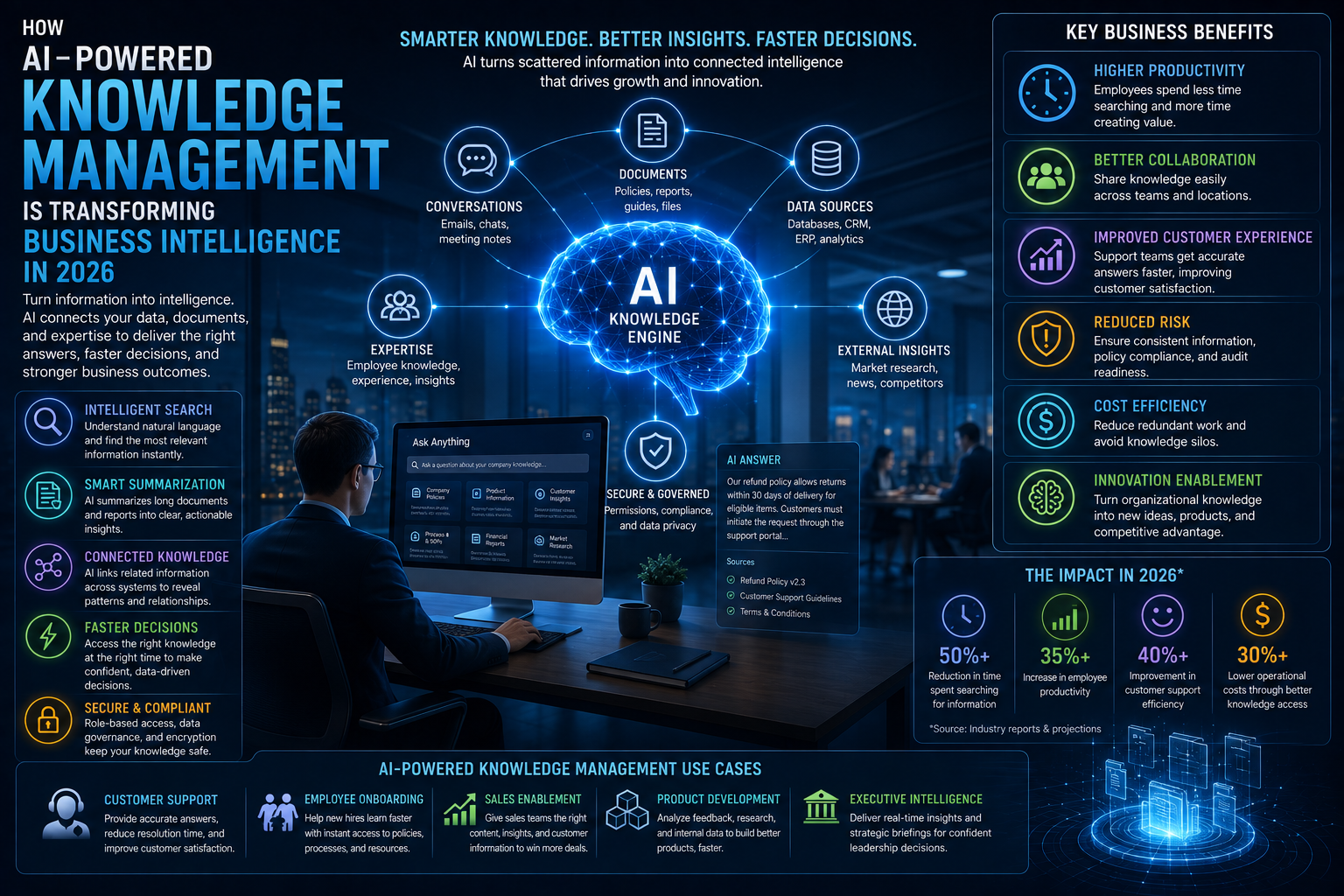
Businesses are generating more information than ever before. Emails, reports, customer conversations, presentations, research documents, internal policies, databases, meeting notes, and operational records all contain valuable knowledge.
The challenge is no longer simply collecting information. The challenge is finding the right information, understanding it, and turning it into useful decisions.
This is where AI-powered knowledge management is becoming increasingly important.
BullNext is already featuring AI-Powered Knowledge Management among its Quick Reads, while its current Tech & AI coverage is heavily focused on practical business applications of artificial intelligence.
In 2026, organizations are moving beyond traditional document repositories and keyword search toward intelligent knowledge systems that can understand context, connect information, summarize complex material, and help employees find answers faster.
What Is AI-Powered Knowledge Management?
Knowledge management refers to the process of collecting, organizing, storing, sharing, and using an organization's knowledge.
Traditional knowledge-management systems often depend on databases, folders, intranets, document libraries, and search tools.
AI adds a more intelligent layer.
An AI-powered knowledge-management platform can analyze documents, understand natural-language questions, identify relationships between information, and provide relevant answers.
Instead of asking employees to search through hundreds of documents, businesses can allow them to ask questions in ordinary language.
For example:
“What is our current customer refund policy?”
An intelligent system could locate the relevant information and provide a concise response based on approved company sources.
Why Business Knowledge Is Becoming More Valuable
Every organization has knowledge.
Some of it is formally documented, while much of it exists in employees' experience.
A sales representative may know why a major customer prefers a particular product.
An engineer may understand how to solve a recurring technical problem.
A finance employee may know why a particular process exists.
When experienced employees leave, some of this knowledge can disappear with them.
AI-powered knowledge management can help organizations capture, organize, and make institutional knowledge easier to access.
The objective is not to replace employees' expertise.
It is to make useful knowledge available to more people.
From Search to Answers
Traditional enterprise search often requires users to enter specific keywords.
If employees do not know the exact wording used in a document, finding the right information can be difficult.
AI changes the interaction.
Employees can ask questions naturally.
For example:
“Which customers experienced delivery delays last quarter, and what were the main causes?”
An AI system can potentially search approved sources, identify relevant information, and produce a structured response.
This makes enterprise knowledge more accessible to employees who may not know where the information is stored.
AI Connects Disconnected Information
Businesses often store information across many systems.
Customer information may exist in a CRM.
Financial data may exist in accounting software.
Project information may be stored in collaboration tools.
Company policies may exist in document-management platforms.
Research may be stored in separate databases.
This fragmentation can make decision-making difficult.
AI can act as an intelligent layer across approved information sources.
Rather than requiring employees to check each system separately, an enterprise AI platform can potentially retrieve relevant information from multiple sources.
The quality of the result depends heavily on system integration, permissions, and data quality.
Improving Business Intelligence
Business intelligence traditionally focuses heavily on structured data.
Dashboards show revenue, sales, expenses, customer numbers, inventory, and other measurable indicators.
But organizations also need unstructured information to understand why those numbers are changing.
Emails, reports, meeting notes, customer feedback, contracts, and research documents can provide important context.
AI-powered knowledge management can connect structured business intelligence with unstructured organizational knowledge.
This creates a broader decision-making environment.
Instead of seeing only that sales declined, an executive may also be able to explore customer feedback, sales-team reports, market research, and internal analysis related to the decline.
AI-Powered Executive Research
Executives often need to make decisions quickly.
They may need information about markets, customers, competitors, financial performance, operations, or strategic projects.
Traditionally, preparing this information can require multiple employees and significant research time.
AI can help accelerate the process.
An executive could ask:
“Summarize the most important risks affecting our European expansion and identify the evidence behind each risk.”
The system could retrieve approved internal reports and produce an organized briefing.
Human executives can then evaluate the information and make the final decision.
Faster Employee Onboarding
Knowledge management can also improve employee onboarding.
New employees often need to learn company policies, processes, products, systems, and terminology.
This can take weeks or months.
An AI knowledge assistant can provide employees with a conversational way to learn.
A new employee might ask:
How do I submit an expense?
What is our customer escalation process?
Where can I find the latest product documentation?
Who approves this type of request?
The system can guide employees toward relevant information.
This can reduce repetitive questions directed toward managers and experienced colleagues.
Preserving Institutional Knowledge
Employee turnover creates a knowledge challenge.
When experienced employees leave, organizations may lose valuable practical knowledge.
AI-powered systems can help capture information from approved documents, project records, procedures, and other organizational sources.
Over time, this can create a searchable knowledge base.
However, businesses should not assume that AI can automatically capture everything employees know.
Important expertise still needs to be documented deliberately.
Organizations should create processes that encourage employees to record important decisions, procedures, lessons, and insights.
AI and Customer Service
Customer service teams can also benefit significantly.
Support employees often need to search product documentation, policies, previous cases, and technical information while communicating with customers.
An AI knowledge assistant can retrieve relevant information quickly.
This can help support agents answer questions more consistently.
AI can also summarize previous customer interactions and identify relevant troubleshooting steps.
The result can be faster customer service without requiring employees to memorize large amounts of information.
Sales Enablement
Sales teams deal with large amounts of information.
They need product knowledge, pricing information, case studies, competitive intelligence, customer histories, and market research.
AI-powered knowledge management can bring this information closer to the sales workflow.
A salesperson preparing for a customer meeting could ask an AI system to summarize the customer's previous interactions, identify relevant products, and provide approved case studies.
This can reduce preparation time.
More importantly, it can help salespeople make better use of information that already exists inside the organization.
AI and Product Development
Product teams also depend on knowledge.
Customer feedback, support tickets, market research, technical documents, and internal discussions can all contain product insights.
AI can analyze these sources and identify recurring themes.
For example, if customers repeatedly mention a particular problem, an AI system could highlight the trend for product managers.
Teams can then investigate whether the issue should influence future development priorities.
This creates a stronger connection between customer knowledge and product strategy.
Knowledge Management and AI Agents
The development of AI agents could take knowledge management further.
An AI agent could retrieve information, analyze it, compare documents, prepare summaries, and complete approved knowledge-related tasks.
For example, an employee could ask an AI agent to prepare a quarterly business briefing using approved internal reports.
The agent could gather the information, organize it, identify important changes, and produce a draft for human review.
This turns knowledge management from a passive information system into an active business capability.
The Importance of Permissions
AI knowledge systems must respect access controls.
Not every employee should be able to access every document.
Financial information, employee records, customer data, strategic plans, and confidential contracts may require restricted access.
An AI assistant should therefore understand user permissions before retrieving information.
The system should not accidentally reveal confidential information simply because it can access it.
Strong identity management and permission controls are therefore essential.
Data Quality Determines AI Quality
AI cannot produce reliable knowledge from unreliable information.
If a company has outdated policies, duplicate documents, contradictory reports, or inaccurate databases, an AI system may produce confusing results.
Organizations should establish clear processes for managing their knowledge.
Important documents should have owners.
Outdated information should be removed or clearly marked.
Policies should have appropriate version control.
This creates a stronger foundation for AI.
Avoiding AI Hallucinations
Generative AI can sometimes produce information that sounds convincing but is not supported by the underlying data.
This is particularly dangerous in business environments.
An AI knowledge system should therefore be designed to ground answers in approved organizational sources.
Where possible, employees should be able to see the documents or evidence supporting an answer.
This allows users to verify important information.
AI should help employees find knowledge faster, not create false confidence.
Measuring the Business Impact
Organizations should measure whether AI-powered knowledge management is actually producing value.
Useful metrics can include:
Time spent searching for information
Employee onboarding time
Customer-service response time
Repeated internal questions
Knowledge-base usage
Search success rates
Employee productivity
Decision-making speed
The goal is not simply to deploy an AI assistant.
The goal is to improve how the organization creates and uses knowledge.
AI-Powered Knowledge Management and Security
Knowledge-management systems contain valuable corporate information.
They can therefore become attractive targets for cyberattacks.
Organizations need strong authentication, encryption, access controls, monitoring, and data-governance processes.
AI systems should also be carefully configured to prevent unauthorized data access.
Security should be considered during the design of the knowledge architecture rather than added later.
The Future of Business Intelligence
The future of business intelligence may involve a much closer relationship between data and organizational knowledge.
Dashboards will continue to provide quantitative information.
AI knowledge systems can provide context.
AI agents can connect the two.
For example, an executive could ask:
“Why did our operating costs increase this quarter, and what should management investigate next?”
The system could potentially combine financial data with internal reports, supplier information, project records, and operational documentation.
This creates a more complete picture of business performance.
How Companies Can Start
Businesses do not need to deploy AI across every knowledge source immediately.
A focused approach is often more practical.
Companies can begin with a high-value knowledge area such as:
Customer support
Employee onboarding
Product documentation
Sales enablement
Internal policies
Technical support
Executive research
Organizations should then connect trusted information sources and establish appropriate access controls.
After measuring results, they can gradually expand the system.
Conclusion
AI-powered knowledge management is changing how organizations find, understand, and use information.
Traditional knowledge systems largely focused on storing documents.
Modern AI systems can make organizational knowledge more accessible by understanding natural-language questions, connecting information across sources, summarizing complex material, and providing context for business decisions.
The technology can improve employee productivity, customer service, onboarding, sales, product development, and executive decision-making.
But successful implementation requires more than an AI model.
Organizations need high-quality information, strong permissions, security controls, clear governance, and processes for keeping knowledge up to date.
The most valuable organizations of the future may not simply be those that collect the most data.
They may be those that can turn their collective knowledge into useful intelligence quickly and responsibly.
In 2026, AI-powered knowledge management is helping make that possible, transforming organizational information from something employees search through into a strategic resource that can actively support the business.