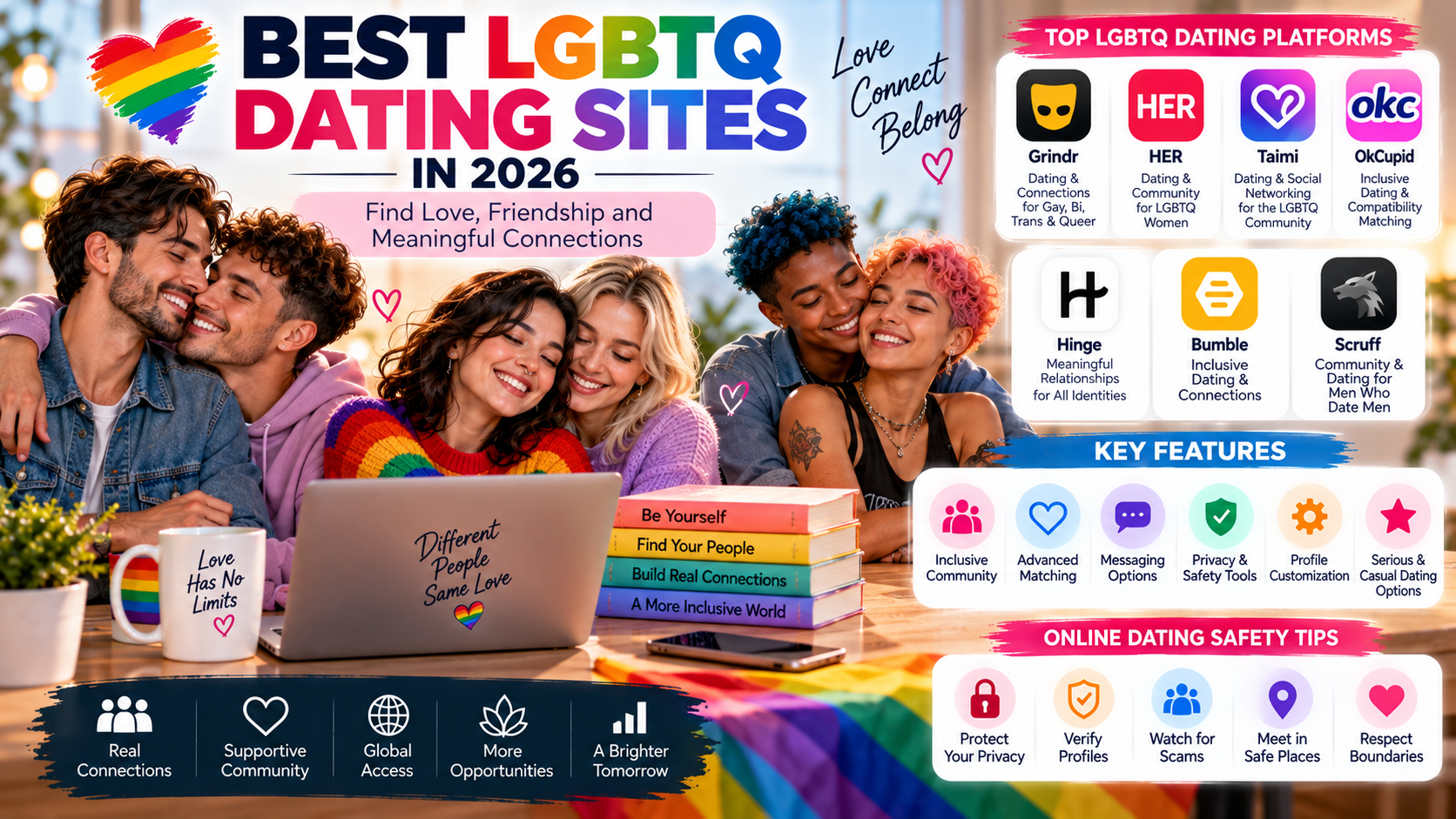
Online dating has created new opportunities for LGBTQ people to meet potential partners, build friendships, and find communities where they feel understood. Whether someone is looking for a serious relationship, casual dating, or meaningful social connections, LGBTQ dating platforms offer different ways to connect with people who share similar interests and relationship goals.
In 2026, LGBTQ dating services range from dedicated platforms for gay, lesbian, bisexual, transgender, and queer users to mainstream dating applications with inclusive profile options. Some focus on long-term relationships, while others emphasize community, local connections, or casual dating.
Choosing the best LGBTQ dating site depends on personal preferences, location, privacy needs, and the type of relationship someone wants. This guide compares popular platforms, explains their key features, and shares practical tips for safer and more comfortable online dating.
What Are LGBTQ Dating Sites?
LGBTQ dating sites are websites and applications designed to help lesbian, gay, bisexual, transgender, queer, and other LGBTQ people connect with potential romantic partners or social communities.
Some services are built specifically for LGBTQ users, while others offer inclusive options within a broader dating platform.
Common features include:
Profiles with photographs and personal interests.
Matching based on location and preferences.
Messaging and communication tools.
Relationship goal settings.
Gender identity and orientation options.
Community features and social discovery.
Privacy, blocking, and reporting controls.
The availability of these features varies by platform and country. Users should review each service's privacy policies and local availability before registering.
Best LGBTQ Dating Sites in 2026
The following platforms offer different experiences for LGBTQ dating and community connections. Features, prices, and availability can change, so check each service's current details before creating an account.
1. Grindr — Dating and Connections for Gay, Bi, Trans, and Queer People
Grindr is a location-based social and dating application widely used by gay, bisexual, transgender, and queer people, particularly men who date men.
Key features:
Location-based profile discovery.
Messaging and chat features.
Profile preferences and filters.
Community and social connection options.
Paid subscriptions with additional features.
Best for: People looking to meet nearby LGBTQ users and explore dating or social connections.
Things to consider: Location-based features may reveal information about proximity. Review location permissions and avoid sharing identifying details too early.
Website: https://www.grindr.com/
2. HER — Dating and Community for LGBTQ Women
HER is a dating and social platform designed primarily for lesbian, bisexual, queer, and other LGBTQ women and nonbinary people.
Key features:
Dating profiles and matching.
Community-oriented features.
Interest-based discovery.
Social events and group interactions in supported areas.
Free and paid options.
Best for: LGBTQ women and nonbinary people seeking dating opportunities or community connections.
Things to consider: Features and community activity vary by location. Check whether the platform's current membership options fit your preferences.
Website: https://weareher.com/
3. Taimi — LGBTQ Dating and Social Networking
Taimi combines dating features with social networking tools and offers options for a broad LGBTQ audience.
Key features:
Dating and matching tools.
Profile customization.
Messaging and social discovery.
Inclusive identity and preference options.
Paid plans with additional features.
Best for: LGBTQ users interested in both dating and broader social connections.
Things to consider: Review the available privacy controls and subscription terms. Not every feature may be available in every country.
Website: https://taimi.com/
4. OkCupid — Inclusive Dating and Compatibility Matching
OkCupid is a general dating platform with profile questions and options intended to support different orientations, gender identities, and relationship preferences.
Key features:
Detailed personal profiles.
Compatibility questions.
Gender and orientation options.
Search and matching features.
Free and paid membership options.
Best for: LGBTQ users who value detailed profiles, shared interests, and compatibility-based discovery.
Things to consider: Available identity options, matching features, and membership benefits may differ by market.
Website: https://www.okcupid.com/
5. Hinge — Dating Focused on Meaningful Relationships
Hinge emphasizes detailed profiles and conversation prompts to help users learn more about potential matches.
Key features:
Profile prompts and personal interests.
Likes and comments on profile details.
Relationship preference settings.
Matching and messaging tools.
Optional paid features.
Best for: LGBTQ users who want to explore meaningful conversations and potentially long-term relationships.
Things to consider: Hinge is not exclusively an LGBTQ dating platform. Local membership and available preferences influence the number of suitable matches.
Website: https://hinge.co/
6. Bumble — Inclusive Dating and Connections
Bumble is a mainstream dating application that offers profile-based matching and communication tools.
Key features:
Dating profiles and matching.
Preference filters.
Profile verification tools in supported markets.
Messaging features that depend on the connection type and current platform rules.
Optional paid subscriptions.
Best for: LGBTQ users who prefer a mainstream dating app with profile and preference controls.
Things to consider: Bumble is not exclusively LGBTQ-focused. Review current communication rules, available identity options, and privacy settings.
Website: https://bumble.com/
7. Scruff — Community and Dating for Men Who Date Men
Scruff is an LGBTQ social and dating application commonly used by gay, bisexual, transgender, and queer men.
Key features:
Profile discovery and messaging.
Community and social features.
Travel-related discovery tools.
Filters and profile preferences.
Optional paid membership features.
Best for: Men who date men and want dating, friendship, and community connections.
Things to consider: User activity and available features vary by location. Check the app's privacy controls before sharing location or travel details.
Website: https://www.scruff.com/
LGBTQ Dating Sites Comparison Table
Platform | Main focus | Best suited for |
|---|---|---|
Grindr | Location-based dating and social discovery | Gay, bi, trans, and queer users, particularly men who date men |
HER | Dating and community | LGBTQ women and nonbinary people |
Taimi | Dating and social networking | A broad LGBTQ audience |
OkCupid | Compatibility-based dating | LGBTQ users who prefer detailed profiles |
Hinge | Meaningful relationships | People seeking more intentional dating |
Bumble | Mainstream dating | LGBTQ users seeking broader dating options |
Scruff | Dating and community | Gay, bi, trans, and queer men |
No single platform is best for every LGBTQ user. Consider your relationship goals, local availability, preferred features, and comfort with the platform's privacy settings.
How to Choose the Best LGBTQ Dating Site
Choosing a suitable platform involves more than downloading the most popular application.
1. Identify Your Dating Goals
Some people want a long-term relationship, while others prefer casual dating, friendship, or community connections.
Choose a platform that supports your goals and allows you to communicate your expectations clearly.
2. Check Local Availability
The number of active users can vary considerably by country and city. A platform with a large international membership may have fewer active users in your area.
Confirm that the service operates where you live and offers the features you need.
3. Review Gender and Orientation Options
Look for profile settings that allow you to describe your identity and preferences comfortably and accurately.
Inclusive options can make it easier to find compatible people, but features differ between platforms.
4. Compare Free and Paid Features
Many dating applications offer free accounts alongside paid subscriptions. Additional features may include advanced filters, more profile visibility, or extra communication tools.
Review the total cost, automatic renewal terms, cancellation process, and refund policy before paying.
5. Consider Privacy and Safety
Privacy can be especially important for LGBTQ people who are not publicly open about their identity or who live in places where LGBTQ people face discrimination.
Check whether the platform allows you to control profile visibility, hide or limit location information, block users, and report harassment.
6. Look for Compatible Communication Styles
Some users prefer quick messaging, while others want detailed profiles and thoughtful conversations.
Choose a platform that suits your communication style and gives you enough control over how you connect with others.
LGBTQ Dating Safety and Privacy Tips
Online dating can help people build connections, but users should take reasonable precautions to protect their safety and personal information.
Protect Your Identity
Avoid sharing your home address, workplace, financial details, identity documents, or other identifying information with people you do not know well.
If revealing your LGBTQ identity could put you at risk, carefully consider what appears on your profile and who can view it.
Review Location Permissions
Some dating applications use location information to recommend nearby profiles. Consider limiting location access through your device settings and reviewing whether the application offers additional privacy controls.
Do not assume that hiding your profile or using a particular setting guarantees complete anonymity.
Watch for Scams and Blackmail
Be cautious if someone asks for money, cryptocurrency, gift cards, intimate images, or sensitive personal information.
Some scammers may threaten to expose private conversations or images. Avoid sending material that could put you at risk, and use the platform's reporting tools if someone threatens or harasses you.
Verify Profiles Carefully
Look for consistent profile information and be cautious if someone refuses reasonable verification while pressuring you to trust them.
Profile verification features can help, but they do not guarantee that every user is genuine.
Arrange First Meetings Safely
If you decide to meet someone in person, choose a public location, arrange your own transportation, and tell a trusted person about your plans.
Consider the local social and legal environment before sharing personal information or arranging a meeting.
Respect Boundaries and Consent
Healthy connections depend on mutual respect. You can stop a conversation, decline a meeting, or block someone if you feel uncomfortable.
Respect other people's identities, privacy, and boundaries as well.
LGBTQ Dating and Long-Term Relationships
LGBTQ dating platforms can support a variety of relationship goals, from casual dating to committed partnerships.
Communicate Expectations
Be honest about whether you are looking for a serious relationship, casual dating, or friendship. Clear communication can reduce misunderstandings.
Build Trust Gradually
Take time to learn about another person's interests, values, and expectations before making important decisions.
Discuss Compatibility
Shared values, communication styles, lifestyle preferences, and mutual respect can all influence relationship compatibility.
Avoid Rushing
There is no need to move quickly from online messaging to an in-person meeting or relationship commitment. Move at a pace that feels comfortable for both people.
Value Respect and Emotional Safety
A healthy relationship should allow both people to express themselves without coercion, threats, or discrimination.
LGBTQ Dating in 2026: Trends to Know
Dating platforms continue to develop features that shape how LGBTQ users connect.
More Inclusive Profiles
Some platforms provide expanded options for gender identity, orientation, and relationship preferences. The available choices vary by service.
Greater Attention to Privacy
Privacy controls and safety tools remain important, especially for people who need to manage who can discover their profiles.
More Compatibility Features
Detailed profiles, prompts, and matching preferences can help users identify shared interests and relationship goals.
Online and Offline Community Connections
Some platforms combine dating with social groups, events, or community features, giving users additional ways to connect.
Improved Digital Safety Tools
Dating services may introduce new profile checks, reporting systems, and account protections. Users should still exercise caution because no platform can eliminate every risk.
Conclusion
The best LGBTQ dating sites in 2026 offer different ways to meet potential partners, build friendships, and connect with a broader community.
Grindr and Scruff focus on connections among men who date men, HER provides dating and community features for LGBTQ women and nonbinary people, and Taimi serves a broad LGBTQ audience. OkCupid, Hinge, and Bumble offer additional options through more general dating platforms.
The right service depends on your relationship goals, location, preferred features, and privacy needs. Before registering, compare platform features, review subscription terms, and understand how your personal information is handled.
Most importantly, prioritize respect, consent, privacy, and personal safety. Online dating can create valuable opportunities for connection, but a positive experience depends on choosing a platform that suits your needs and maintaining healthy boundaries.
Frequently Asked Questions
1. What are the best LGBTQ dating sites in 2026?
Grindr, HER, Taimi, OkCupid, Hinge, Bumble, and Scruff are popular options to compare. The best choice depends on your identity, dating goals, location, and preferred features.
2. Which LGBTQ dating site is best for serious relationships?
Hinge and OkCupid may appeal to people who prefer detailed profiles and compatibility features. Other platforms may also support serious relationships, depending on local users and individual preferences.
3. Are there free LGBTQ dating apps?
Many platforms offer free registration and basic features, although messaging, advanced filters, or other tools may require payment.
4. Which dating apps are designed specifically for LGBTQ users?
Grindr, HER, Taimi, and Scruff are examples of LGBTQ-focused platforms, although their target audiences and features differ.
5. Are LGBTQ dating sites safe?
They can offer useful safety features, but risks remain. Protect personal information, review location settings, watch for scams, and report harassment or threats.
6. Can I use mainstream dating apps for LGBTQ dating?
Yes. Platforms such as OkCupid, Hinge, and Bumble offer options for LGBTQ users, although available settings and features may vary.
7. How much do LGBTQ dating sites cost?
Many offer free accounts with optional paid subscriptions. Prices depend on the platform, country, subscription duration, and features included.
8. Can I use LGBTQ dating sites privately?
Many platforms offer privacy settings, but complete anonymity cannot be guaranteed. Review profile visibility, location permissions, data policies, and account controls before using a service.
9. Are LGBTQ dating apps available internationally?
Some operate in many countries, but availability, features, and local user activity vary. Check the platform's current availability before registering.
10. How can I recognize an LGBTQ dating scam?
Warning signs include requests for money, cryptocurrency, intimate images, or sensitive information, as well as threats to expose private conversations. Stop communication and report suspicious accounts.