
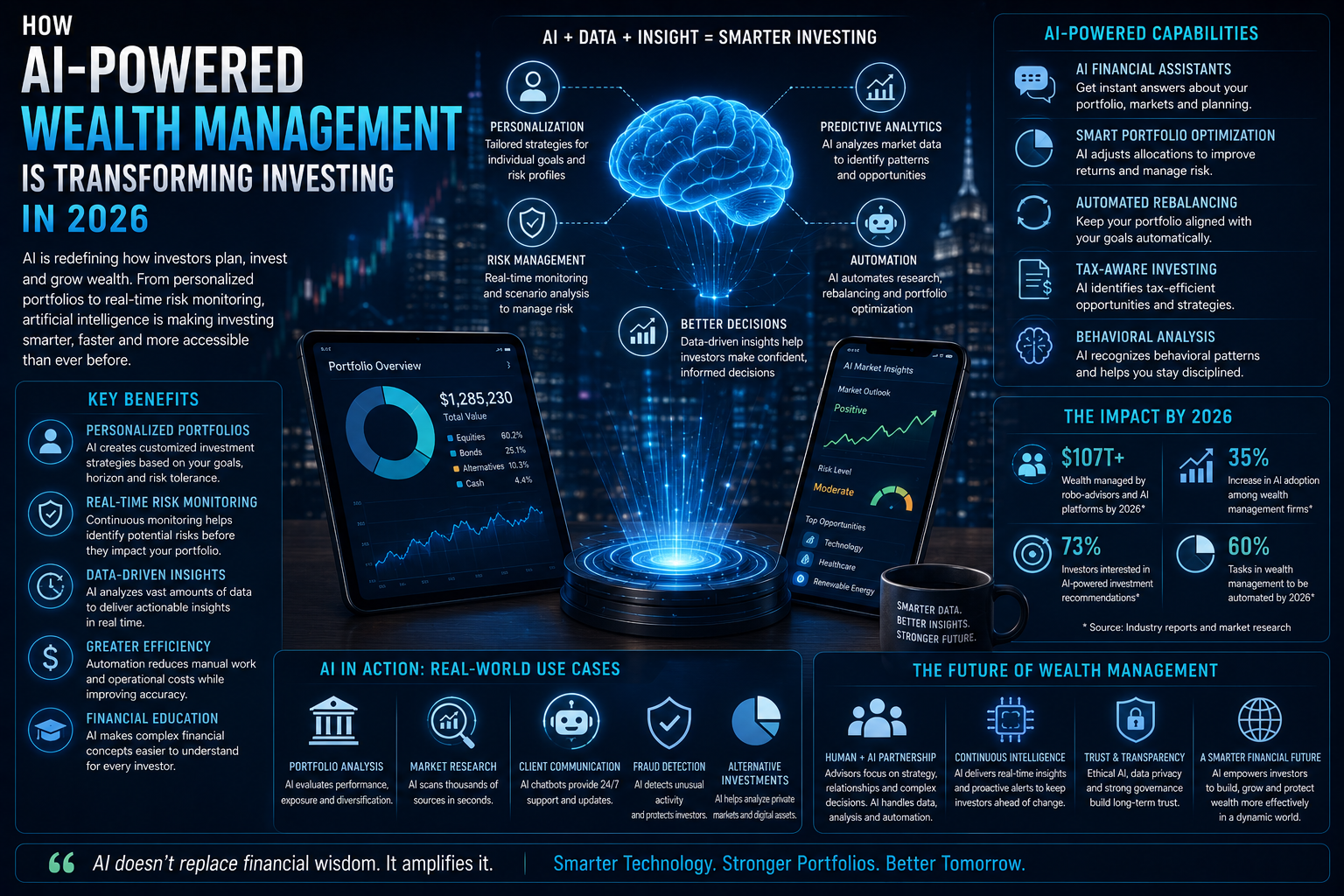
The wealth-management industry is entering a new phase of digital transformation. Investors today have access to more financial information, more investment products, and more markets than ever before. At the same time, managing a portfolio has become increasingly complex.
Artificial intelligence is changing how financial institutions, wealth managers, and investors approach that complexity.
AI-powered wealth management combines machine learning, predictive analytics, natural-language interfaces, portfolio optimization, behavioral analysis, and automated financial workflows to help investors make more informed decisions.
The technology is moving beyond traditional robo-advisors. Modern AI systems can analyze large volumes of market information, identify patterns, summarize financial research, monitor portfolio risk, and provide personalized insights.
In 2026, the biggest opportunity may not be replacing financial advisors with machines. Instead, it may be creating a hybrid model where AI handles information-heavy analysis while human professionals provide judgment, strategy, and relationship management.
What Is AI-Powered Wealth Management?
AI-powered wealth management uses artificial intelligence to support investment and financial-planning activities.
Applications can include:
Portfolio analysis
Risk assessment
Asset allocation
Market research
Tax-aware planning
Financial forecasting
Client communication
Fraud detection
Investment monitoring
Personalized financial education
Traditional wealth-management platforms often rely on predefined rules.
AI can analyze more complex relationships and adapt its analysis to changing information.
This can potentially create more personalized investment experiences.
Why AI Is Becoming Important for Investors
Financial markets generate enormous quantities of information every day.
Investors may need to evaluate:
Economic data
Corporate earnings
Interest rates
Inflation
Market trends
Geopolitical developments
Industry reports
Company filings
Alternative assets
Human professionals cannot process all of this information continuously.
AI can help organize and analyze large datasets quickly.
This does not mean AI can predict markets perfectly.
Financial markets remain uncertain.
Instead, AI can help investors understand information and identify potential risks or opportunities more efficiently.
Personalized Portfolio Management
One of the strongest applications of AI is personalization.
Traditional investment models often group investors into broad categories based on age, income, risk tolerance, and financial goals.
AI can potentially consider a much wider range of information.
A system could analyze an investor's:
Financial objectives
Investment horizon
Risk preferences
Cash-flow requirements
Existing assets
Tax considerations
Market exposure
It can then help create a portfolio strategy aligned with those requirements.
Human advisors can review and adjust the recommendations.
AI-Powered Risk Management
Risk management is one of the most important responsibilities in wealth management.
AI can continuously monitor portfolios and identify changes in risk exposure.
For example, a portfolio may gradually become overly concentrated in a particular industry because several investments have increased in value.
An AI system can identify the concentration and alert the investor or advisor.
AI can also simulate potential scenarios involving interest rates, market volatility, inflation, or economic downturns.
This helps investors understand how a portfolio might behave under different conditions.
Predictive Analytics
Predictive analytics is another major application.
AI models can examine historical information and identify patterns that may help estimate future scenarios.
For example, financial institutions can use models to analyze market behavior, customer activity, or portfolio characteristics.
However, predictions should not be confused with certainty.
Financial markets are influenced by unexpected events, human behavior, policy decisions, and global developments.
AI should therefore be used as an analytical tool rather than a guaranteed market-prediction engine.
AI Financial Assistants
The rise of generative AI is changing how investors interact with financial information.
Instead of navigating multiple dashboards, investors can ask questions in natural language.
For example:
“Why did my portfolio decline this month?”
An AI assistant could analyze the portfolio and summarize the major contributors.
Another investor might ask:
“How exposed am I to technology stocks?”
The system could identify direct and indirect exposure across the portfolio.
This makes financial information easier to understand.
AI and Financial Research
Investment research can require significant time.
Analysts may review earnings reports, company filings, industry research, economic indicators, and market news.
AI can summarize large documents and identify important changes.
It can compare companies, organize financial information, and generate research drafts.
Human analysts can then verify the information and focus on higher-level interpretation.
This can increase research productivity without removing the need for professional judgment.
Wealth Management and Digital Assets
AI-powered wealth management is also expanding into alternative and digital assets.
Investors increasingly have exposure to:
Cryptocurrencies
Tokenized assets
Private markets
Commodities
Alternative investments
These assets can introduce additional complexity.
AI can help investors understand portfolio exposure across traditional and digital markets.
For example, a wealth-management platform could analyze how a client's cryptocurrency holdings affect overall portfolio volatility.
This can provide a broader view of risk.
AI and Tax-Aware Investing
Tax considerations can significantly affect investment outcomes.
AI can help financial professionals identify opportunities for tax-efficient portfolio management.
For example, systems can analyze potential gains and losses, portfolio positions, and transaction history.
They can then identify situations that may deserve professional review.
Tax rules vary by jurisdiction and individual circumstances, so AI-generated suggestions should not replace qualified tax advice.
Automated Rebalancing
Investment portfolios can drift away from their intended allocation.
Suppose an investor originally targets:
60% equities
30% fixed income
10% alternatives
If equities rise significantly, the portfolio may become more heavily concentrated in stocks.
AI-powered systems can monitor these changes and identify when rebalancing may be appropriate.
Depending on the platform, the system may recommend or execute predefined adjustments.
Human approval can remain part of the process.
AI and Behavioral Finance
Investors are not always rational.
Fear, excitement, overconfidence, and short-term reactions can influence financial decisions.
AI can potentially identify behavioral patterns.
For example, a platform may notice that an investor frequently changes positions after short-term market movements.
The system could alert the investor or advisor to the pattern.
This can help encourage more disciplined decision-making.
Democratizing Wealth Management
Historically, sophisticated wealth-management services have often been associated with high-net-worth clients.
AI can potentially lower the cost of delivering certain analytical services.
Automated portfolio analysis, financial education, research summaries, and basic planning tools can be offered digitally.
This could allow more people to access sophisticated financial information.
However, democratization also creates a responsibility to ensure that AI systems are transparent and appropriate for users with different levels of financial knowledge.
AI and Institutional Wealth Management
AI is not limited to retail investors.
Institutional asset managers can use AI for:
Portfolio monitoring
Risk analysis
Research
Scenario modeling
Client reporting
Operational automation
Market intelligence
Large institutions manage portfolios containing thousands of securities and complex exposures.
AI can help analysts process information at scale.
This can improve efficiency while allowing investment professionals to focus on strategy.
Human Advisors Are Not Disappearing
The growth of AI does not necessarily mean the end of financial advisors.
Many investors value human guidance.
Financial decisions often involve emotions, family circumstances, retirement goals, business considerations, and long-term planning.
These areas require context and judgment.
AI can support advisors by handling research and administrative work.
The advisor can then spend more time communicating with clients and helping them make difficult decisions.
This creates a human-plus-AI wealth-management model.
AI Agents in Wealth Management
The next development could involve autonomous AI agents.
An AI agent could monitor a portfolio, review predefined investment objectives, identify changes in risk, prepare recommendations, and communicate with the investor or advisor.
For example, an agent could notify an advisor that a client's portfolio has moved significantly away from its target allocation.
The advisor could review the recommendation before taking action.
This combines automation with human control.
Security and Fraud Prevention
Wealth-management platforms contain highly sensitive financial information.
AI can also support security.
Systems can monitor account activity and identify unusual behavior.
For example, a sudden login from an unfamiliar device followed by an unusual transfer could trigger additional verification.
AI can therefore become part of both investment management and financial security.
Privacy Challenges
AI-powered wealth management requires access to significant amounts of financial information.
This creates privacy concerns.
Companies need to understand:
What data is collected
How it is stored
Who can access it
How AI models use it
Whether third parties receive it
Strong data governance is essential.
Investors should also understand how their information is being used.
AI Bias and Model Risk
AI systems can produce biased or inaccurate recommendations.
If training data contains historical biases, models may reproduce them.
Financial institutions therefore need processes for testing and monitoring AI systems.
They should evaluate model performance across different customer groups and scenarios.
Human oversight remains particularly important when AI recommendations could have significant financial consequences.
Regulatory Considerations
Financial services are heavily regulated.
AI-powered investment systems must operate within applicable requirements involving suitability, disclosure, consumer protection, data privacy, and investment advice.
Regulators are increasingly examining how financial institutions use artificial intelligence.
The challenge is balancing innovation with investor protection.
The most successful financial AI platforms will likely be those that build compliance and transparency into their systems from the beginning.
How Investors Should Use AI
Investors should view AI as a powerful research and decision-support tool rather than a guaranteed source of returns.
AI can help with:
Understanding portfolios
Comparing investments
Summarizing research
Identifying risk
Organizing financial information
But investors should verify important claims and understand that predictions can be wrong.
Investment decisions should reflect individual financial circumstances and appropriate professional guidance when necessary.
The Future of Wealth Management
The future of wealth management may involve highly personalized financial platforms.
An investor could have an AI assistant continuously monitoring their financial situation.
The system could analyze market developments, portfolio risk, financial goals, and changing circumstances.
It could prepare recommendations and explain them in simple language.
A human advisor could remain responsible for major decisions and complex planning.
This creates a new model in which technology provides continuous intelligence while humans provide trust and judgment.
Conclusion
AI-powered wealth management is transforming investing by making financial analysis more personalized, continuous, and accessible.
Artificial intelligence can analyze large quantities of market information, monitor portfolio risk, summarize research, identify behavioral patterns, support rebalancing, and provide investors with easier access to financial insights.
However, AI is not a crystal ball.
Markets remain unpredictable, models can make mistakes, and financial decisions involve personal circumstances that technology cannot fully understand.
The strongest future model is therefore likely to combine AI efficiency with human expertise.
Financial advisors can use AI to reduce administrative work and improve analysis.
Investors can use intelligent tools to understand their portfolios and financial decisions more clearly.
Institutions can use AI to manage increasingly complex investment environments.
As AI becomes more deeply integrated into financial services, wealth management could evolve from periodic advice toward continuous, intelligent financial guidance.
In 2026, that transformation is already underway—and the firms that combine technological innovation with transparency, security, and responsible human oversight will be best positioned to shape the future of investing.