Businesses are entering an era where physical operations and digital intelligence are becoming increasingly connected. Manufacturers, logistics companies, retailers, energy providers, real estate organizations, and other industries are using advanced technologies to understand their operations in greater detail and make better decisions.
One technology gaining attention in this transformation is the digital twin.
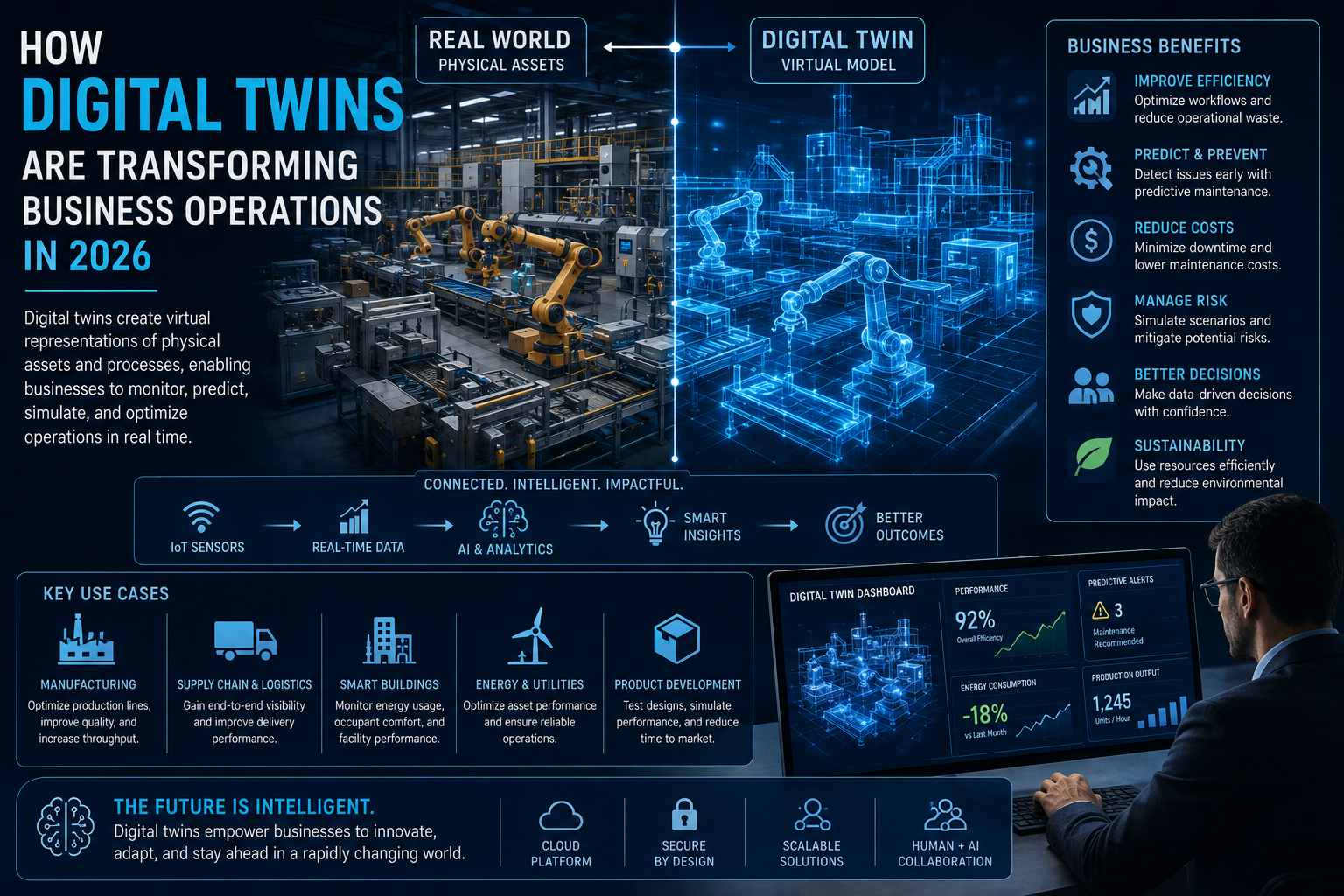
A digital twin is a virtual representation of a physical object, system, process, or environment. It can use data from sensors, software systems, connected devices, and other sources to represent how a real-world asset or operation behaves.
In 2026, digital twins are moving beyond specialized industrial applications and becoming an important part of broader business transformation. Combined with artificial intelligence, cloud computing, Internet of Things technology, and real-time analytics, digital twins can help organizations monitor operations, test scenarios, identify potential problems, and improve performance.
What Is a Digital Twin?
A digital twin is more than a traditional computer model.
A conventional model may represent how something is expected to work under specific conditions. A digital twin can continuously incorporate information from its real-world counterpart, allowing the digital representation to change as the physical system changes.
For example, a manufacturer could create a digital twin of a production line. Data from machines, sensors, inventory systems, and maintenance records could help create a continuously updated picture of the facility.
Managers could then use that information to understand equipment performance, identify unusual patterns, and evaluate possible operational changes.
This creates a connection between the physical world and the digital environment.
Digital Twins and Artificial Intelligence
The combination of digital twins and AI is particularly powerful.
A digital twin can provide a detailed stream of operational information, while AI can analyze that information to identify patterns and generate insights.
For example, an AI system could analyze equipment data and identify signs that a machine may require maintenance. Instead of waiting until the equipment fails, the organization could investigate the issue earlier.
AI can also help evaluate different scenarios.
A business might want to know what could happen if production capacity increases, a machine is taken offline, demand suddenly rises, or a new process is introduced.
A digital twin can provide a virtual environment for analyzing these possibilities before making changes in the physical world.
Predictive Maintenance
Predictive maintenance is one of the most practical applications of digital twins.
Unexpected equipment failures can create significant operational costs. A machine breakdown may stop production, delay deliveries, increase repair expenses, and affect customers.
Traditional maintenance strategies often involve repairing equipment after failure or servicing it according to a fixed schedule.
Digital twins can support a more data-driven approach.
By combining information about equipment usage, operating conditions, temperature, vibration, maintenance history, and other relevant signals, businesses can develop a better understanding of equipment health.
AI can analyze these patterns and help identify potential problems.
The objective is not to predict every failure perfectly. Instead, organizations can use earlier warning signals to make maintenance decisions more intelligently.
Improving Manufacturing
Manufacturing is one of the industries where digital twins can have a major impact.
A digital twin can represent machines, production lines, factories, or entire manufacturing processes.
Managers can use the virtual environment to examine production performance and identify potential bottlenecks.
For example, if one stage of production consistently limits overall output, the digital model can help teams investigate alternative configurations.
Businesses can also use digital twins when planning new facilities or modifying existing operations.
Testing changes digitally can reduce the need for expensive physical experimentation.
This can make innovation faster while reducing operational risk.
Transforming Supply Chains
Digital twins can also improve supply chain visibility.
Modern supply chains involve multiple suppliers, warehouses, transportation networks, production facilities, and customers. Changes in one part of the system can affect many other areas.
A supply chain digital twin can bring information from these different components into a connected digital environment.
Businesses can use this model to understand inventory movement, transportation capacity, production schedules, and potential bottlenecks.
AI can then analyze the information and identify potential risks.
For example, if demand increases while transportation capacity decreases, the digital twin could help management evaluate the potential impact and consider alternative strategies.
This supports a more proactive approach to supply chain management.
Smarter Buildings and Real Estate
Digital twins are also changing the way buildings and real estate assets are managed.
A digital representation of a building can incorporate information about energy consumption, equipment, occupancy, environmental conditions, and maintenance.
Property managers can use this information to understand how buildings operate.
AI can identify patterns that may indicate inefficient energy usage or equipment problems.
Digital twins can also support planning for renovations, space utilization, and building management.
In larger commercial developments, this can create opportunities to improve operational efficiency while providing better experiences for occupants.
Energy and Infrastructure
Energy companies and infrastructure operators face another important challenge: managing complex physical systems.
Power facilities, transportation infrastructure, utilities, and industrial assets can contain thousands of interconnected components.
Digital twins can help organizations visualize these systems and understand how changes in one area may affect others.
For example, an infrastructure operator could simulate different operating conditions before implementing changes.
This can support better planning and risk management.
As renewable energy and distributed energy systems become more important, digital models may also help organizations understand increasingly complex energy environments.
Product Development Is Becoming More Intelligent
Digital twins are not limited to existing operations.
Companies can use digital representations during product development.
Engineers can create a virtual representation of a product and test how it might perform under different conditions.
This can help identify design problems before physical production begins.
The approach can potentially reduce development time and the cost associated with repeated physical prototypes.
Once a product enters the real world, information from actual usage can also be used to improve future designs.
This creates a continuous feedback loop between product development and real-world performance.
Digital Twins Support Better Decision-Making
One of the most important benefits of digital twins is the ability to make complex systems easier to understand.
Business leaders often make decisions based on reports and historical information.
Digital twins can provide a more dynamic view.
Instead of asking only what happened, organizations can explore what could happen under different conditions.
This makes scenario planning an important application.
A company could evaluate the potential impact of expanding production, changing suppliers, modifying a facility, or introducing new technology.
The ability to experiment virtually can give decision-makers additional information before committing significant resources.
Data Quality Is Essential
Digital twins depend heavily on data.
If the underlying information is inaccurate, incomplete, or outdated, the digital representation may not accurately reflect the physical environment.
Organizations therefore need reliable data collection and management systems.
Sensors need to provide useful information. Business software must be properly integrated. Data should be maintained and protected.
This can make digital twin projects more complex than simply purchasing software.
Businesses need to consider the entire information infrastructure supporting the model.
Cybersecurity Becomes More Important
As digital twins become connected to physical operations, cybersecurity becomes a critical consideration.
A digital twin may contain detailed information about factories, buildings, infrastructure, machines, supply chains, or other valuable assets.
Unauthorized access could expose sensitive operational information.
In some environments, digital systems may also be connected to physical equipment. This means cybersecurity failures could potentially have consequences beyond data loss.
Organizations implementing digital twins therefore need strong access controls, network security, monitoring, authentication, and governance.
Security should be designed into the system from the beginning.
Human Expertise Remains Critical
Digital twins can provide sophisticated analysis, but they do not eliminate the need for experienced professionals.
Engineers, managers, technicians, planners, and other specialists understand operational realities that may not be fully represented in digital models.
AI-generated recommendations also require appropriate evaluation.
A digital twin should therefore be viewed as a decision-support system rather than an automatic replacement for human expertise.
The strongest implementations combine detailed digital information with human knowledge.
How Businesses Can Start
Organizations interested in digital twins do not necessarily need to create a model of their entire business.
A better approach is often to begin with one specific asset, process, or operational problem.
A manufacturer might start with a production line. A logistics company could model a warehouse or transportation route. A property manager might create a digital twin of a building.
The organization can then measure whether the technology improves important outcomes such as maintenance costs, downtime, energy consumption, production efficiency, or planning accuracy.
Successful applications can gradually expand.
The Future of Digital Twins
Digital twins are likely to become increasingly connected to AI agents, predictive analytics, IoT devices, cloud platforms, and automated decision systems.
Future systems may continuously monitor physical environments, identify potential problems, simulate possible solutions, and recommend actions to employees.
In some cases, approved automated systems may eventually execute certain responses without requiring manual intervention.
This could create highly adaptive business environments in which digital models continuously interact with real-world operations.
However, responsible implementation will remain essential.
Organizations need reliable data, cybersecurity, clear governance, and human oversight to ensure that digital twin systems provide genuine value.
Conclusion
Digital twins are changing how businesses understand and manage complex operations.
By creating dynamic digital representations of physical assets and processes, organizations can monitor performance, test scenarios, predict potential problems, improve maintenance, optimize supply chains, and support better decision-making.
The combination of digital twins with artificial intelligence makes the technology even more powerful. AI can analyze the information generated by connected systems and help organizations turn operational data into actionable insights.
In 2026, the opportunity is moving beyond simply creating digital models. The real value comes from connecting those models to the way businesses operate and make decisions.
Companies that successfully combine digital twins, AI, reliable data, and human expertise can build operations that are more efficient, adaptable, and prepared for an increasingly complex future.