
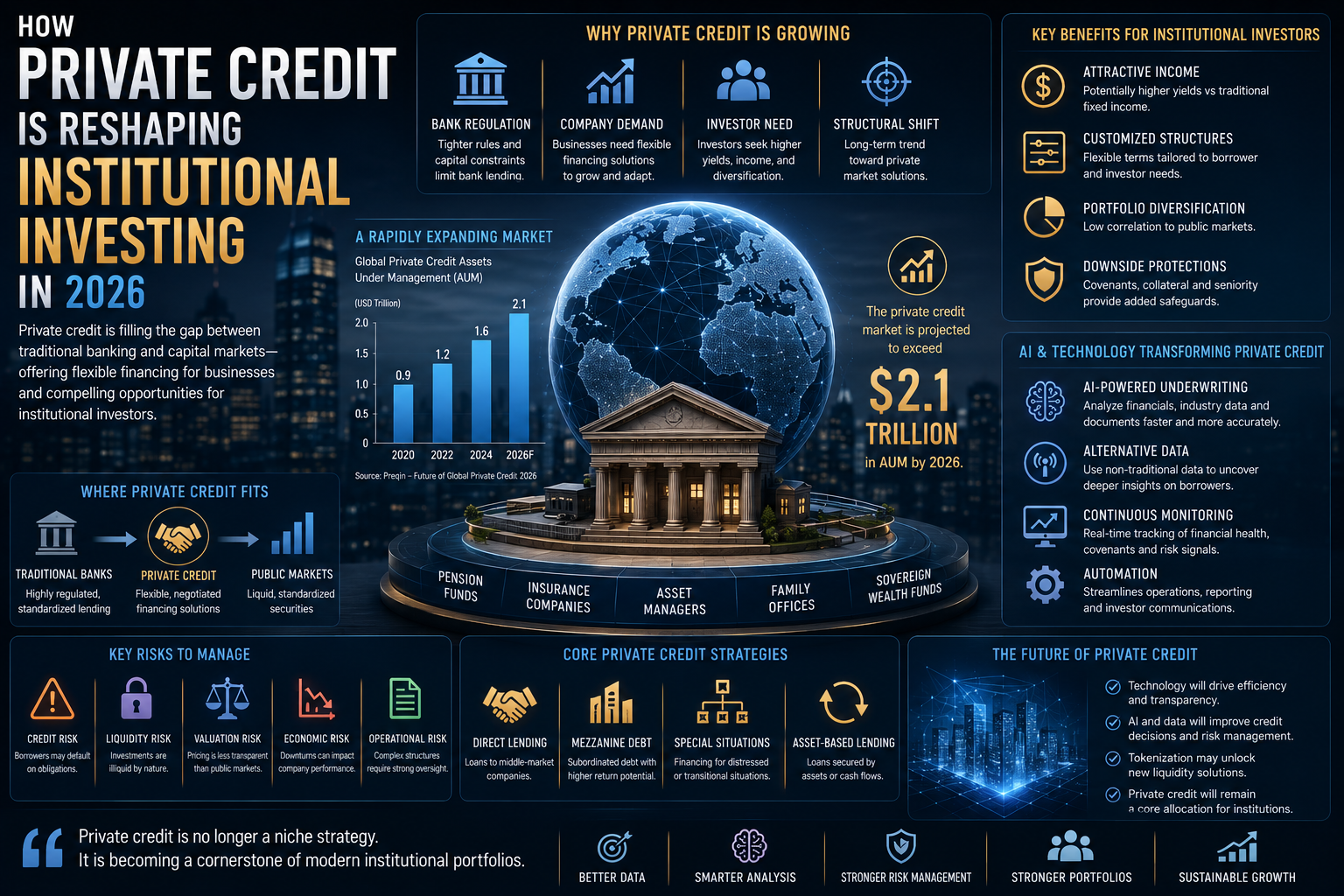
Private credit has moved from a specialized corner of finance into an increasingly important part of institutional investment strategies. As companies seek financing outside traditional bank lending and investors search for income-producing assets, private credit has attracted growing attention from asset managers, pension funds, insurance companies, family offices, and other institutional investors.
Unlike publicly traded bonds, private credit generally involves loans and other debt arrangements negotiated directly between lenders and borrowers. These investments can offer attractive yields and customized structures, but they also come with important challenges involving liquidity, credit risk, transparency, and valuation.
In 2026, technology is adding another dimension to the market. Artificial intelligence, alternative data, automated underwriting, and digital infrastructure are changing how private-credit managers evaluate borrowers and monitor portfolios.
The result is a market increasingly positioned between traditional banking and modern alternative investment management.
What Is Private Credit?
Private credit refers broadly to debt financing provided by non-bank lenders.
Instead of borrowing entirely from a traditional commercial bank, a company may obtain financing from:
Private-credit funds
Asset managers
Insurance companies
Direct-lending firms
Family offices
Institutional investment vehicles
Private lenders can negotiate customized financing arrangements based on the borrower's circumstances.
These arrangements can include different interest rates, repayment schedules, collateral requirements, covenants, and other contractual terms.
For investors, private credit provides exposure to contractual income streams that differ from traditional publicly traded bonds.
Why Private Credit Is Growing
Several structural changes have contributed to private-credit growth.
Banks face capital requirements, regulatory constraints, and changing risk preferences.
At the same time, companies often need financing that does not fit neatly into traditional bank lending models.
Private lenders can sometimes provide more flexible structures.
For institutional investors, private credit can offer potential income and diversification.
This combination has helped turn private credit into a significant component of alternative investment strategies.
The Institutional Investor Opportunity
Institutional investors are constantly searching for ways to balance income, diversification, risk, and long-term returns.
Private credit can offer an alternative to traditional fixed-income markets.
Potential advantages include:
Higher contractual yields
Customized lending structures
Diversification
Floating-rate exposure
Direct relationships with borrowers
Potential downside protections through covenants and collateral
However, these advantages come with trade-offs.
Private credit is generally less liquid than publicly traded securities.
Investors need to understand the risks before allocating capital.
Private Credit vs. Traditional Bonds
Public bonds are typically easier to trade.
Their prices can change continuously based on market conditions.
Private loans are different.
They are generally negotiated privately and may not have an active secondary market.
This means investors may hold positions for extended periods.
The lower liquidity can be attractive when investors are seeking long-term income, but it also makes portfolio valuation more complex.
The Rise of Direct Lending
Direct lending has become one of the most important areas of private credit.
Direct lenders provide loans directly to companies, often to support:
Acquisitions
Expansion
Refinancing
Management buyouts
Capital expenditures
Business restructuring
Instead of relying entirely on syndicated bank financing, companies can negotiate directly with private lenders.
This can provide borrowers with greater flexibility.
Private Credit and Middle-Market Companies
Middle-market companies are particularly important to private credit.
These businesses may require substantial financing but may not have the same access to public debt markets as large corporations.
Private lenders can evaluate these businesses individually.
They can structure loans around company-specific cash flows, assets, and growth plans.
This creates opportunities for lenders willing to conduct detailed credit analysis.
The Role of AI in Private Credit
Artificial intelligence is becoming an important technology for private-credit managers.
Traditional underwriting can require extensive analysis of:
Financial statements
Management reports
Industry data
Company contracts
Customer information
Market conditions
Historical performance
AI can help process this information faster.
A private-credit platform can use machine learning and natural-language systems to organize documents, identify important variables, and highlight potential risks.
The goal is not to eliminate human underwriting.
Instead, AI can help analysts spend more time evaluating complex credit decisions.
AI-Powered Credit Underwriting
Credit underwriting involves determining whether a borrower is likely to repay a loan.
AI can analyze multiple variables simultaneously.
For example, an AI model could examine:
Revenue trends
Debt levels
Cash flow
Customer concentration
Industry conditions
Payment behavior
Operating margins
The system can identify patterns that deserve further investigation.
A human credit committee can then evaluate the findings before approving financing.
This creates a hybrid underwriting model.
Alternative Data
Private-credit managers are increasingly interested in alternative data.
Traditional financial statements may provide only periodic snapshots of a company.
Alternative data can offer more frequent signals.
Potential sources include:
Web traffic
Hiring activity
Supply-chain data
Customer reviews
Transaction patterns
Pricing information
Industry trends
These signals can help investors understand how a borrower's business is evolving between formal financial reporting periods.
Continuous Credit Monitoring
Underwriting is only the beginning.
Private-credit investors need to monitor borrowers after loans are issued.
AI can continuously analyze financial and operational information.
If revenue declines unexpectedly or a company's debt burden increases, the system can flag the change.
This can help lenders identify potential problems earlier.
Continuous monitoring can therefore become an important advantage of technology-enabled private credit.
Risk Management
Private credit involves credit risk.
A borrower may fail to meet its obligations.
Economic conditions can also affect companies across an entire industry.
Private-credit managers therefore need strong risk-management systems.
AI can support:
Early-warning detection
Portfolio stress testing
Scenario analysis
Concentration monitoring
Default-risk assessment
Covenant monitoring
This can help managers understand how individual loans affect the overall portfolio.
The Importance of Covenants
Covenants are contractual requirements designed to protect lenders.
They can place limits on borrower behavior or require certain financial conditions to be maintained.
Examples include restrictions related to:
Additional debt
Asset sales
Dividend payments
Financial ratios
Acquisitions
Technology can help private-credit managers monitor covenant compliance more efficiently.
AI systems can analyze borrower reports and flag potential covenant breaches.
Private Credit and Interest Rates
Interest rates are an important factor in private credit.
Many private loans have floating-rate structures.
This means interest payments can change as benchmark rates change.
When rates are higher, floating-rate loans can provide larger interest payments.
But higher rates can also increase borrowing costs for companies.
That creates a balance.
Lenders may benefit from higher income while borrowers may face greater financial pressure.
Liquidity Risk
One of the most important risks in private credit is liquidity.
Unlike publicly traded bonds, private loans may not be easy to sell quickly.
Investors therefore need to understand their investment horizon.
Institutional investors with long-term liabilities may be better positioned to hold illiquid assets.
But private-credit managers still need liquidity planning for fund-level commitments, redemptions, and portfolio changes.
Valuation Challenges
Private-credit assets do not always have continuously observable market prices.
This makes valuation more complicated than pricing publicly traded securities.
Managers may rely on models, borrower information, market comparisons, and other inputs.
AI can potentially help analyze valuation data.
However, model assumptions can introduce errors.
Strong governance and independent review remain important.
Private Credit and Insurance Companies
Insurance companies are increasingly relevant participants in private markets.
Insurers manage long-term liabilities and therefore may have investment horizons compatible with private credit.
Private-credit assets can potentially provide income streams that align with these long-term obligations.
However, regulatory capital requirements remain an important consideration.
The structure and risk characteristics of each investment must be carefully evaluated.
Technology Is Changing Private-Credit Operations
Private credit has historically involved significant manual processes.
These can include:
Document review
Borrower reporting
Covenant monitoring
Portfolio reporting
Data reconciliation
Investor communications
Technology can automate many of these activities.
Cloud platforms, AI, APIs, and data analytics can create more efficient workflows.
This could reduce operational costs and improve visibility across large portfolios.
Tokenization and Private Credit
Blockchain technology could eventually introduce another layer of innovation.
Private-credit interests could potentially be represented through tokenized financial structures.
Tokenization could support digital ownership records and potentially create new methods of transfer and settlement.
However, tokenization does not eliminate the underlying credit risk.
The borrower still needs to repay the debt.
Legal enforceability, investor eligibility, custody, and regulatory compliance remain essential.
Private Credit and Institutional Transparency
As the private-credit market grows, investors may demand greater transparency.
Institutional investors need reliable information about:
Borrower quality
Portfolio concentration
Default rates
Valuation
Liquidity
Leverage
Fees
Risk exposure
Technology can make this information easier to collect and analyze.
AI-powered dashboards may allow investment committees to monitor portfolios continuously.
The Role of Human Judgment
Despite technological improvements, private credit remains highly dependent on judgment.
A company can look financially healthy while facing hidden operational problems.
An experienced credit professional may identify risks that a model misses.
Human teams can evaluate management quality, competitive positioning, business strategy, and unusual circumstances.
AI should therefore complement experienced investment professionals rather than replace them.
Regulatory Considerations
The growth of private credit is attracting increasing attention from regulators and policymakers.
As private markets become more systemically important, authorities may focus more closely on:
Leverage
Liquidity
Valuation
Investor protection
Disclosure
Interconnectedness
Institutional managers need robust governance frameworks.
Compliance and risk management should be integrated into private-credit operations from the beginning.
How Investors Can Evaluate Private Credit
Investors considering private credit should evaluate several factors.
Credit Quality
Who is the borrower and how strong is its financial position?
Structure
What protections exist for lenders?
Yield
Is the expected return sufficient for the risks?
Liquidity
How long might capital remain invested?
Diversification
Is the portfolio exposed too heavily to one industry or borrower type?
Manager Experience
Does the investment manager have a strong credit-underwriting process?
Transparency
Can investors understand how the portfolio is performing?
These questions are more important than simply looking at headline yields.
The Future of Private Credit
Private credit is likely to become increasingly technology-driven.
AI can improve underwriting.
Alternative data can provide additional borrower signals.
Automation can improve portfolio monitoring.
Blockchain could potentially support new settlement and ownership models.
Data platforms can improve transparency.
Together, these technologies could make private-credit operations faster and more sophisticated.
But technology cannot remove the fundamental risks of lending.
Credit analysis, borrower quality, economic conditions, and liquidity will continue to determine investment outcomes.
Conclusion
Private credit is becoming an increasingly important part of institutional investing in 2026.
The market provides companies with alternative sources of financing while giving institutional investors access to potentially attractive income and diversification.
At the same time, private credit involves meaningful risks, particularly around borrower defaults, liquidity, valuation, leverage, and transparency.
Artificial intelligence and alternative data are changing how managers evaluate these risks.
AI can accelerate underwriting, monitor borrowers continuously, analyze large amounts of information, and identify potential warning signals.
The next stage of private credit may therefore be defined by a combination of human expertise and intelligent technology.
Rather than replacing credit professionals, AI can help them make faster, more informed decisions.
As institutional investors continue searching for differentiated sources of income and companies seek flexible financing, private credit is likely to remain an important part of the evolving global financial system.
The firms that combine disciplined underwriting, strong risk management, transparent operations, and advanced technology will be best positioned to compete in the next generation of private markets.