The next phase of digital transformation may not happen entirely on traditional computer screens. As businesses adopt artificial intelligence, augmented reality, virtual reality, 3D visualization, and advanced sensors, computing is increasingly becoming connected to the physical environment.
This evolution is often described as spatial computing.
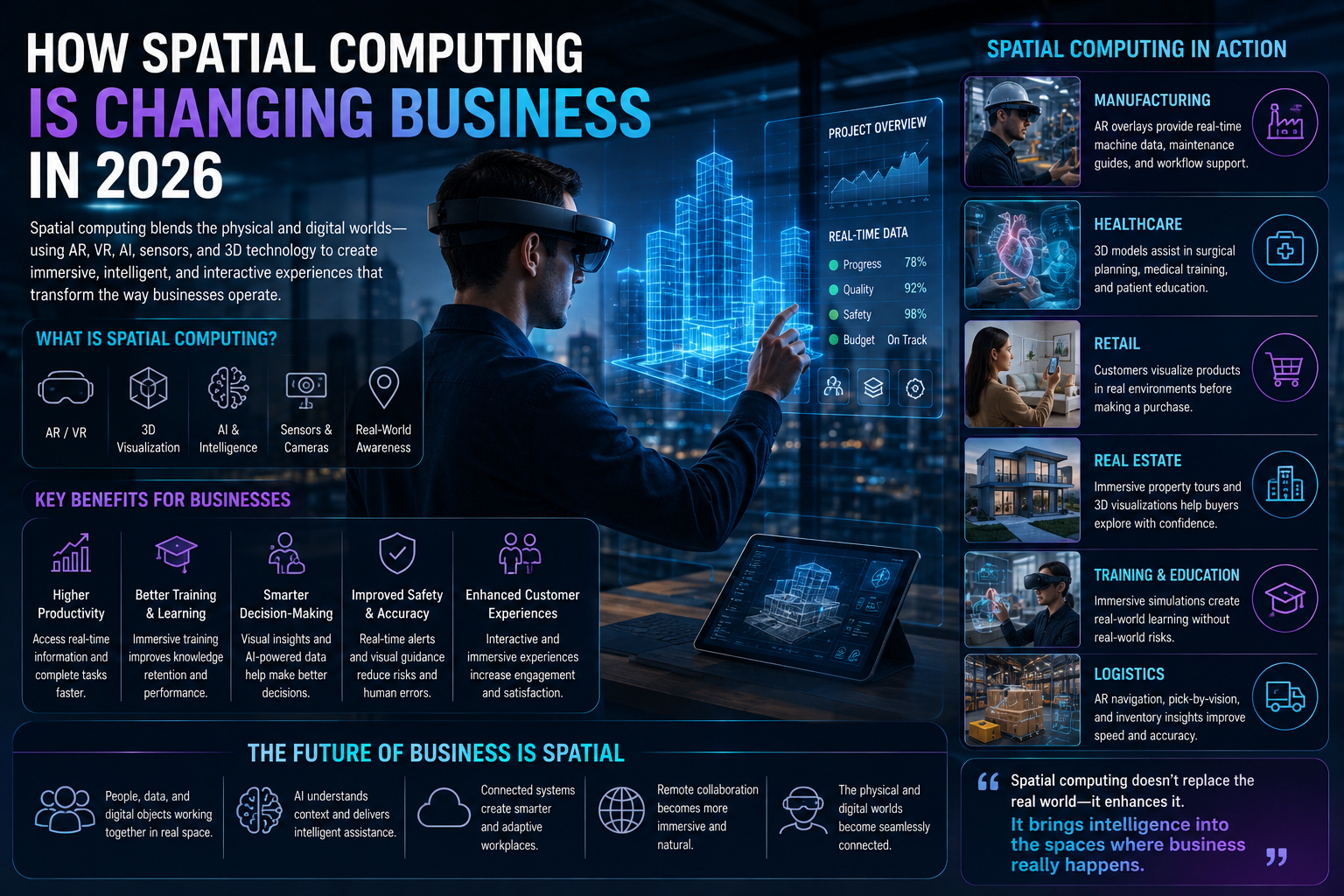
Spatial computing combines digital information with the physical world, allowing people and machines to interact with three-dimensional environments in more natural ways. Instead of simply viewing information on a flat screen, users can visualize digital objects around them, interact with virtual environments, and access information based on their physical location.
In 2026, spatial computing is becoming increasingly relevant to industries such as manufacturing, healthcare, retail, real estate, education, engineering, logistics, and professional services.
The technology is still developing, but its potential business impact is significant.
What Is Spatial Computing?
Spatial computing refers to technologies that allow computers to understand and interact with physical spaces.
It can involve augmented reality, virtual reality, mixed reality, 3D environments, computer vision, sensors, artificial intelligence, and specialized hardware.
For example, an engineer wearing spatial-computing equipment could view a digital representation of a machine while standing next to the physical equipment.
A retail customer could visualize how furniture might look inside a room before purchasing it.
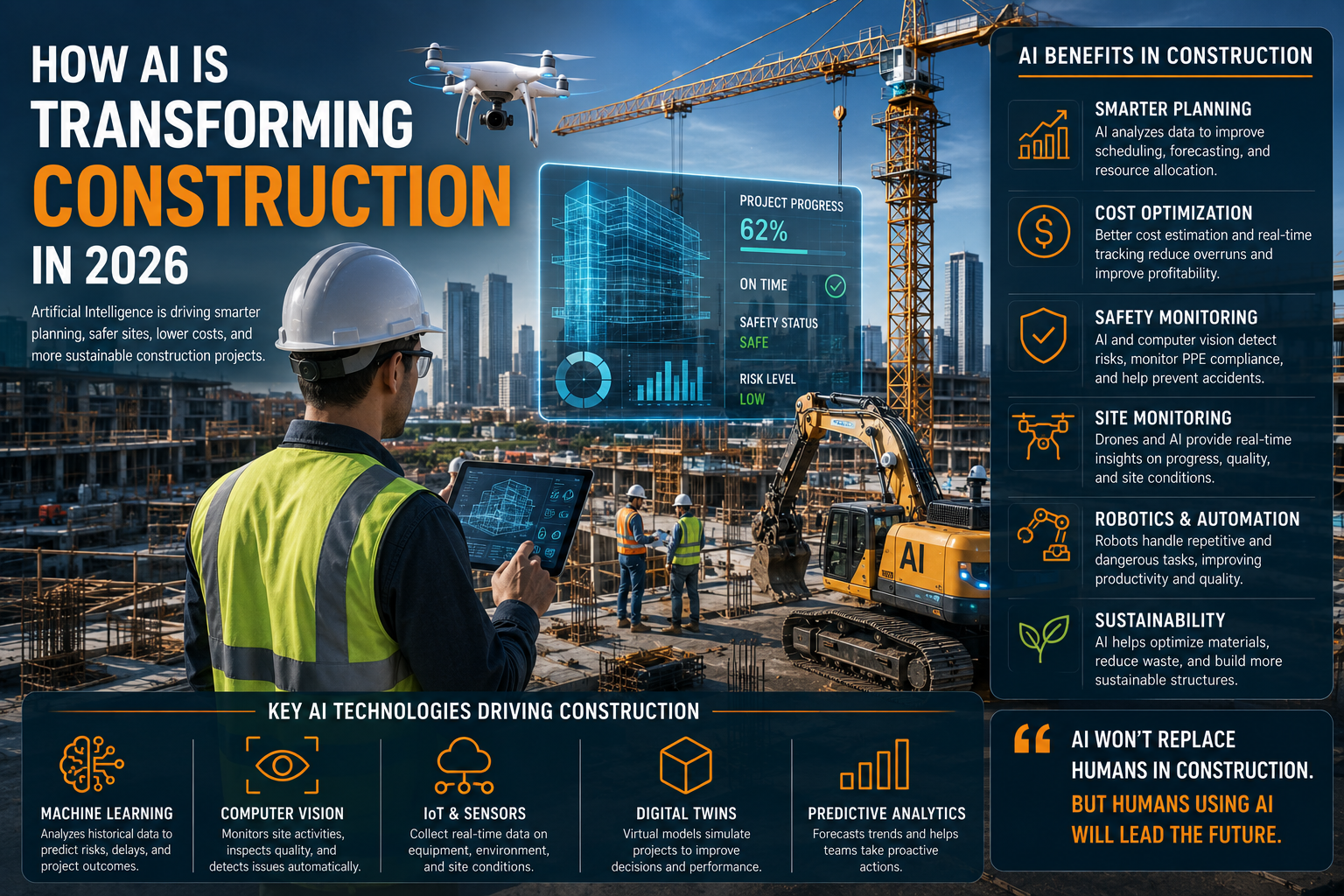
A construction team could view a 3D representation of a building directly on a construction site.
The key difference is that digital information becomes connected to physical space.
Why Businesses Are Paying Attention
Businesses are constantly looking for better ways to visualize information, train employees, communicate ideas, and improve decision-making.
Traditional documents and two-dimensional screens can be effective, but they are not always ideal for complex physical environments.
A three-dimensional representation can sometimes make complicated information easier to understand.
For industries dealing with buildings, machinery, products, medical environments, or logistics facilities, spatial computing can provide a more intuitive way to interact with digital information.
The technology may therefore become an important complement to AI and other enterprise technologies.
Spatial Computing in Manufacturing
Manufacturing is one of the industries where spatial computing could provide significant value.
Factories contain complex machines, production lines, equipment, and safety systems.
Workers and engineers can use augmented reality to access digital information while looking at physical equipment.
For example, an employee performing maintenance could see instructions or diagrams positioned directly over the machine.
Instead of stopping work to search through a manual or computer system, the relevant information could appear within the worker's field of view.
This can potentially reduce training time and make maintenance procedures easier to follow.
Improving Employee Training
Training is another major opportunity.
Traditional training programs often require employees to read documents, watch videos, or attend classroom sessions.
Spatial computing can create immersive learning environments.
Employees can practice procedures inside simulated environments without exposing themselves to real-world risks.
A manufacturing employee could learn how to operate machinery in a virtual factory.
A healthcare professional could practice procedures using simulated environments.
A logistics worker could learn warehouse processes before working on the actual floor.
Immersive training can provide employees with practical experience while reducing the risks associated with learning new procedures in live environments.
Healthcare Applications
Healthcare is another field where spatial computing could have a major impact.
Medical professionals often need to understand complex three-dimensional structures.
Three-dimensional visualization can help doctors, surgeons, and students explore anatomy and medical information from different perspectives.
Medical education could become more interactive as students examine virtual models rather than relying entirely on two-dimensional diagrams.
Spatial computing may also support surgical planning by allowing professionals to visualize relevant information in three dimensions.
However, healthcare applications require rigorous validation, privacy protections, and professional oversight.
Spatial technology should enhance clinical expertise rather than replace medical judgment.
Transforming Retail Experiences
Retail businesses are exploring ways to make digital shopping more immersive.
One of the biggest challenges of online shopping is that customers cannot physically interact with products before purchasing them.
Spatial computing can help bridge this gap.
Customers could potentially visualize furniture inside their homes, preview products in a physical environment, or interact with three-dimensional versions of products.
Fashion retailers may also use virtual environments to allow customers to explore clothing and accessories.
These experiences can help customers make more informed purchasing decisions.
The technology could also reduce uncertainty associated with buying products online.
Real Estate and Property Visualization
Real estate is another natural application.
Buying or renting property often requires customers to visit multiple locations before making a decision.
Spatial computing can make property exploration more immersive.
Potential buyers could use virtual environments to explore buildings remotely.
Developers could allow customers to walk through a property before construction is completed.
Architects and investors could also visualize proposed developments in three dimensions.
This can make complex projects easier to understand and communicate.
For international investors, virtual property experiences may be particularly valuable because they can explore potential investments without immediately traveling to the location.
Construction and Engineering
Spatial computing can also improve collaboration between architects, engineers, and construction teams.
Three-dimensional building models can be displayed within the physical construction environment.
Workers can compare the planned structure with the actual site.
Engineers can visualize components and identify potential conflicts before installation.
This can help reduce misunderstandings between teams.
When combined with building information modeling, sensors, AI, and digital twins, spatial computing could become part of a broader digital construction ecosystem.
Logistics and Warehouse Operations
Warehouses are highly physical environments, making them suitable for spatial technologies.
Workers need to locate products, navigate storage areas, and complete orders efficiently.
Augmented reality devices can provide visual instructions while employees move through a facility.
For example, a worker could receive directions showing where a product is located and which route to take.
The system could also display information about inventory or order priorities.
This can reduce the amount of time employees spend checking separate screens or paperwork.
Spatial Computing and Collaboration
Remote collaboration has become a standard part of modern business.
Video conferencing allows employees to communicate, but traditional video calls remain largely two-dimensional.
Spatial computing could create more immersive collaboration environments.
Teams could work around shared virtual models, examine three-dimensional designs, and interact with digital objects together.
An engineering team in different countries could potentially review the same virtual machine.
A global leadership team could explore a virtual representation of a new facility.
This creates new possibilities for distributed teams.
AI Makes Spatial Computing More Intelligent
Artificial intelligence can significantly enhance spatial computing.
AI can help systems understand objects, recognize environments, interpret gestures, and respond to natural-language instructions.
Computer vision can identify physical objects and determine their position.
AI assistants can provide contextual information based on what a user is looking at.
For example, an engineer could look at a machine and ask an AI assistant for its maintenance history.
The system could identify the equipment and retrieve relevant information.
This combination of spatial awareness and AI could create highly interactive workplace assistants.
The Importance of Spatial Data
Spatial computing depends heavily on accurate spatial information.
Systems need to understand where objects are located and how they relate to one another.
This requires sensors, cameras, mapping technologies, computer vision, and other forms of data collection.
Businesses therefore need strong data infrastructure to support spatial applications.
Poor spatial information can result in inaccurate digital overlays or confusing user experiences.
Data quality will remain just as important in spatial computing as it is in other digital technologies.
Privacy and Security Concerns
Spatial computing introduces new privacy considerations.
Devices may collect information about physical environments, workplaces, customers, employees, and surroundings.
Cameras and sensors can potentially capture sensitive information.
Businesses therefore need clear policies governing how spatial data is collected, stored, processed, and shared.
Security is also important.
Connected spatial devices can become potential targets for cyberattacks.
Organizations need appropriate authentication, encryption, access controls, and device-management policies.
Responsible deployment will be essential for building trust.
Hardware Challenges
Spatial computing still faces hardware limitations.
Headsets and wearable devices can be expensive, uncomfortable, or difficult to use for long periods.
Battery life, processing power, display quality, weight, and connectivity can all affect user experience.
Businesses therefore need to evaluate whether a spatial application solves a meaningful problem before investing heavily in hardware.
Technology adoption will depend not only on technical capabilities but also on whether employees and customers find these systems convenient.
The Human Factor
Technology adoption is ultimately about people.
Employees may resist spatial systems if they make workflows more complicated.
Businesses should therefore design applications around actual user needs.
Training and support are important.
Organizations should also avoid introducing immersive technology simply because it is innovative.
The best applications will be those that clearly improve productivity, safety, communication, learning, or customer experience.
The Future of Spatial Business
Spatial computing is likely to become increasingly connected with AI, cloud computing, digital twins, robotics, and the Internet of Things.
Future workers may interact with digital information through spatial interfaces rather than traditional screens.
AI assistants could understand both language and physical surroundings.
Factories could combine spatial interfaces with robots and connected machinery.
Retail environments could blend physical stores with digital experiences.
Real estate companies could provide immersive property experiences before buildings are constructed.
These developments could gradually make spatial computing a normal part of business technology.
How Businesses Can Prepare
Businesses interested in spatial computing should begin with a practical use case.
Employee training, equipment maintenance, product visualization, warehouse navigation, property tours, and design collaboration are potential starting points.
Companies should measure results such as training time, productivity, error rates, customer engagement, or operational efficiency.
Small pilot projects can help organizations determine whether the technology provides measurable value.
Businesses should also evaluate hardware requirements, data security, employee training, and integration with existing systems.
Conclusion
Spatial computing is bringing digital information closer to the physical world.
By combining augmented reality, virtual reality, computer vision, sensors, AI, and three-dimensional environments, businesses can create new ways to train employees, visualize products, manage facilities, collaborate remotely, and interact with customers.
The technology is not likely to replace traditional computing. Instead, it will expand the ways people interact with digital systems.
The biggest opportunity lies in combining spatial computing with technologies businesses are already adopting.
AI can provide intelligence, sensors can provide awareness, cloud platforms can provide computing power, and spatial interfaces can provide a more natural way for people to interact with digital information.
As these technologies mature, businesses that experiment with practical spatial applications today may be better prepared for a future where the boundary between the physical and digital worlds becomes increasingly blurred.