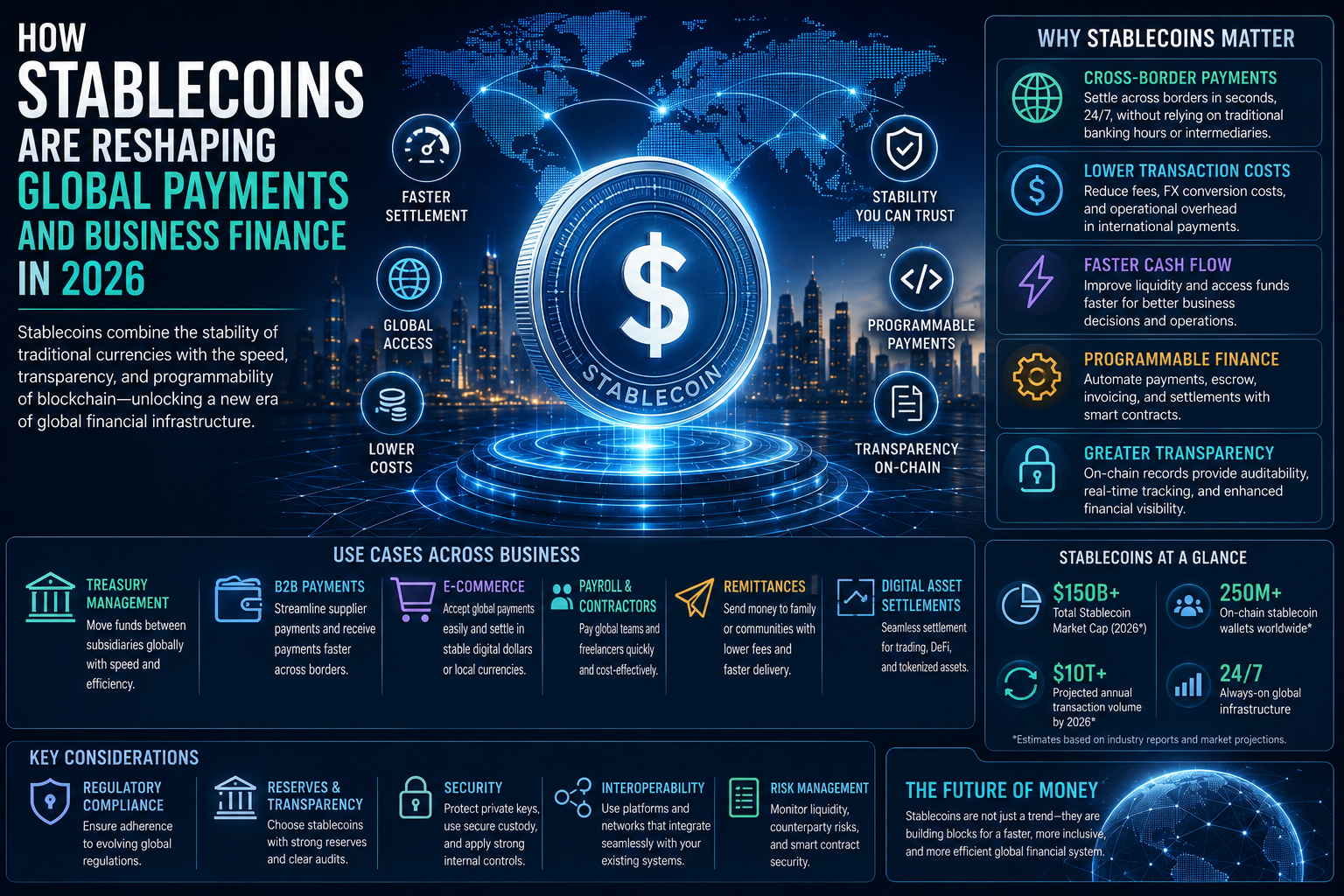
The global payments industry is entering a new phase of digital transformation. Businesses increasingly expect financial transactions to be faster, more transparent, and available across borders, while traditional payment systems can still involve multiple intermediaries, settlement delays, currency conversions, and operational costs.
At the same time, blockchain-based financial infrastructure is moving beyond speculative cryptocurrency trading toward practical payment and settlement applications. BullNext’s recent coverage reflects this broader shift, including developments in digital trading infrastructure and blockchain-native payment settlement.
One technology receiving significant attention is stablecoins.
Stablecoins are digital assets designed to maintain a relatively stable value, typically by referencing an asset such as a national currency. Their combination of blockchain-based transferability and price stability makes them particularly interesting for payments, treasury operations, cross-border commerce, and digital financial infrastructure.
In 2026, stablecoins are increasingly being considered not simply as cryptocurrency products, but as potential components of a new generation of global payment systems.
What Are Stablecoins?
A stablecoin is a digital asset designed to maintain a stable value relative to another asset or reference.
Many stablecoins are designed to track the value of a major fiat currency, such as the U.S. dollar.
Unlike highly volatile cryptocurrencies, stablecoins aim to reduce price fluctuations, making them potentially more practical for transactions.
Their blockchain-based nature means they can be transferred digitally between compatible wallets and systems without necessarily following the same infrastructure used by traditional bank transfers.
This creates an important combination:
digital programmability + blockchain settlement + relatively stable value.
Why Stablecoins Matter for Global Payments
Traditional international payments can involve banks, payment processors, correspondent banking relationships, currency exchanges, and settlement systems.
The process can become particularly complicated when businesses operate across multiple jurisdictions.
Stablecoins offer another model.
A company could potentially send a digital dollar-denominated asset to an approved recipient on a compatible blockchain network.
The transaction can be recorded on-chain and potentially settled much faster than some traditional cross-border processes.
This does not mean stablecoins automatically eliminate banks or payment providers.
Instead, they can become another layer within the evolving global payments ecosystem.
Faster Cross-Border Transactions
Speed is one of the strongest potential advantages.
Traditional international transfers can sometimes take significant time, depending on the countries, institutions, currencies, and settlement processes involved.
Blockchain-based transfers can potentially operate continuously rather than being limited to traditional banking schedules.
For businesses, this could improve cash-flow management.
A company making international payments may be able to move funds more quickly between approved counterparties.
Faster settlement can be particularly valuable for businesses operating across multiple markets.
Lower Payment Friction
International payments can generate costs through currency conversion, intermediary fees, reconciliation, and administrative processes.
Stablecoins may reduce some of these layers in certain payment structures.
For example, a business could potentially use a digital dollar-denominated asset to settle with an international partner without converting between multiple local currencies at every stage.
The actual savings will depend on the network, service provider, compliance requirements, liquidity, and local financial infrastructure.
Stablecoins should therefore be evaluated based on the complete transaction cost rather than assuming they are automatically cheaper.
Stablecoins and Business Treasury
Corporate treasury departments manage cash, liquidity, foreign-exchange exposure, payments, and short-term financial requirements.
Stablecoins could eventually become another tool within treasury operations.
Businesses with international operations may use digital assets for certain approved transfers between subsidiaries, suppliers, or partners.
Blockchain-based settlement can also provide transaction records that may simplify certain reconciliation processes.
However, treasury departments need strong controls around custody, accounting, liquidity, compliance, and counterparty risk.
Programmable Payments
One of the most interesting characteristics of blockchain-based payments is programmability.
Stablecoins can potentially interact with smart contracts.
This means payments can be connected to predefined conditions.
For example, a business transaction could theoretically release payment after an agreed milestone has been verified.
A supplier could receive payment automatically when a particular condition is satisfied.
A digital marketplace could distribute funds according to predefined rules.
This creates opportunities for programmable commerce, where payment becomes integrated into the business workflow rather than being a separate administrative step.
Stablecoins and Global E-Commerce
E-commerce businesses increasingly operate internationally.
A company can have customers in one country, suppliers in another, and employees or contractors distributed across several regions.
Managing payments across these markets can be complicated.
Stablecoins could provide another method for transferring value between compatible parties.
For digital businesses, especially those already operating with blockchain infrastructure, this could create a more unified payment environment.
However, customer-facing use requires careful consideration of local regulations, consumer protection, taxation, and payment licensing.
Supporting Businesses in Emerging Markets
Stablecoins can also be relevant in markets where access to international financial infrastructure may be limited or expensive.
Businesses and individuals in some regions already use dollar-linked digital assets as a way to access digital dollar exposure.
For companies conducting international commerce, stablecoins may offer another mechanism for receiving or sending value.
But adoption must be considered within each country's legal and financial framework.
A payment method that is acceptable in one jurisdiction may be restricted or regulated differently elsewhere.
Stablecoins and Remittances
International remittances are another potential application.
Workers sending money across borders often face fees, exchange-rate differences, and delays.
Stablecoin infrastructure could potentially shorten some parts of the transfer process.
A digital asset could move across a blockchain network before being converted into local currency through an appropriate regulated provider.
The technology can therefore potentially improve the infrastructure behind remittances.
The final customer experience, however, still depends on local banking access, cash-out options, compliance requirements, and service providers.
The Role of Banks
Stablecoins are sometimes presented as competitors to traditional banking.
The future may be more complicated.
Banks can play important roles in stablecoin ecosystems, including custody, compliance, settlement, liquidity, payment integration, and issuance.
Financial institutions may therefore incorporate stablecoins into their existing infrastructure rather than being replaced by them.
This could lead to a hybrid financial system.
Traditional banking networks can continue supporting regulated financial services while blockchain-based infrastructure handles selected digital settlement functions.
Stablecoins and Digital Asset Markets
Stablecoins already have an important role in digital-asset markets.
They can provide a digital unit of account for trading and settlement.
Instead of converting every transaction into traditional currency, market participants can use stablecoin infrastructure to move value within blockchain ecosystems.
This creates a bridge between traditional money and digital assets.
As institutional digital-asset markets develop, stablecoins may become increasingly important as settlement instruments.
Regulatory Compliance Is Essential
Stablecoin adoption depends heavily on regulation.
A stablecoin is not simply a piece of software.
Its structure can involve reserves, custody, redemption mechanisms, financial institutions, issuers, and regulated intermediaries.
Businesses need to understand the rules that apply to the stablecoin and payment service they use.
Compliance requirements may include customer identification, anti-money-laundering controls, transaction monitoring, reporting, and consumer protections.
Regulatory clarity will therefore be one of the major factors influencing institutional adoption.
The Importance of Reserves and Transparency
A stablecoin's credibility depends partly on how its value is supported.
Users and businesses need confidence that they can redeem the asset according to the issuer's stated arrangements.
This makes reserve management and transparency important.
Businesses evaluating stablecoins should examine the issuer's structure, redemption process, reserve approach, disclosures, custody arrangements, and regulatory status.
The goal should be to understand the actual financial infrastructure behind the digital token.
Stablecoin Security
Digital payments create cybersecurity considerations.
Businesses using stablecoins need to protect wallets, private keys, accounts, smart contracts, and transaction systems.
A compromised wallet can create immediate financial consequences.
Organizations therefore need strong security procedures.
These can include:
Multi-factor authentication
Secure custody
Transaction limits
Wallet segregation
Approval workflows
Monitoring systems
Address verification
Smart-contract security reviews
Security should be treated as part of payment infrastructure rather than an optional feature.
Stablecoins and AI
Stablecoins and artificial intelligence could eventually work together.
AI systems can monitor transactions, identify unusual payment patterns, automate reconciliation, and help manage treasury workflows.
For example, an AI-powered treasury platform could monitor approved stablecoin transactions and identify unusual activity.
AI agents could potentially prepare payment instructions based on predefined business rules, with human approval for higher-risk transactions.
This creates a potential combination of programmable money and intelligent automation.
Stablecoins and Business-to-Business Payments
Business-to-business payments are particularly interesting because they often involve repetitive processes.
Invoices need to be issued.
Payments need to be approved.
Funds need to be transferred.
Transactions need to be reconciled.
Stablecoins combined with smart contracts and enterprise software could potentially automate portions of this workflow.
A future B2B payment system could connect invoices, contractual conditions, identity verification, payment authorization, and settlement within one digital process.
That could reduce administrative friction.
Challenges to Adoption
Stablecoins still face important challenges.
These include:
Regulatory uncertainty in some jurisdictions
Blockchain network fees
Liquidity considerations
Wallet security
Custody requirements
Accounting treatment
Tax implications
Interoperability
Consumer protection
Local conversion infrastructure
Businesses need to evaluate these issues before adopting stablecoin payments at scale.
The technology may be useful for some payment flows but unnecessary for others.
Interoperability Will Matter
Global payments operate across many systems.
A business may use a bank account, payment processor, accounting platform, blockchain wallet, and treasury application.
For stablecoins to become mainstream business infrastructure, these systems need to communicate effectively.
APIs, payment gateways, custody providers, compliance platforms, and blockchain networks will all play roles.
Interoperability could therefore become one of the most important areas of development.
The Future of Global Payments
The long-term impact of stablecoins may be larger than simply creating another payment method.
They could contribute to a financial environment where money becomes more programmable, continuously transferable, and integrated directly into digital applications.
Imagine a business application that can automatically calculate an invoice, verify the transaction, obtain approval, and initiate a digital payment.
The payment would become part of the software workflow.
This could fundamentally change how businesses think about financial operations.
How Businesses Can Prepare
Companies interested in stablecoins should begin with carefully selected use cases.
Potential areas include:
Cross-border B2B payments
Treasury transfers
International contractor payments
Digital commerce
Remittances
Blockchain-based settlements
Digital-asset transactions
Businesses should first evaluate the regulatory and accounting implications in the relevant jurisdictions.
They should also select secure infrastructure providers and establish clear transaction controls.
A small pilot can help organizations measure cost, speed, operational complexity, and customer experience before expanding.
Conclusion
Stablecoins are becoming an increasingly important part of the conversation around the future of global payments.
Their combination of blockchain infrastructure and relatively stable value creates opportunities for faster settlement, programmable payments, international transfers, digital commerce, and new approaches to business treasury management.
However, widespread adoption will depend on much more than technology.
Regulation, security, transparency, interoperability, liquidity, and institutional trust will determine how stablecoins fit into the global financial system.
The most likely future is not one where stablecoins completely replace traditional money or banking.
Instead, businesses may operate within a hybrid financial environment where banks, payment processors, blockchain networks, stablecoins, and AI-powered financial software work together.
As digital commerce becomes increasingly global, the ability to move value quickly and securely will become an important competitive advantage.
In 2026, stablecoins are moving closer to that role—not simply as digital assets, but as potential building blocks for the next generation of global payment infrastructure, and settlement risks at scale.