
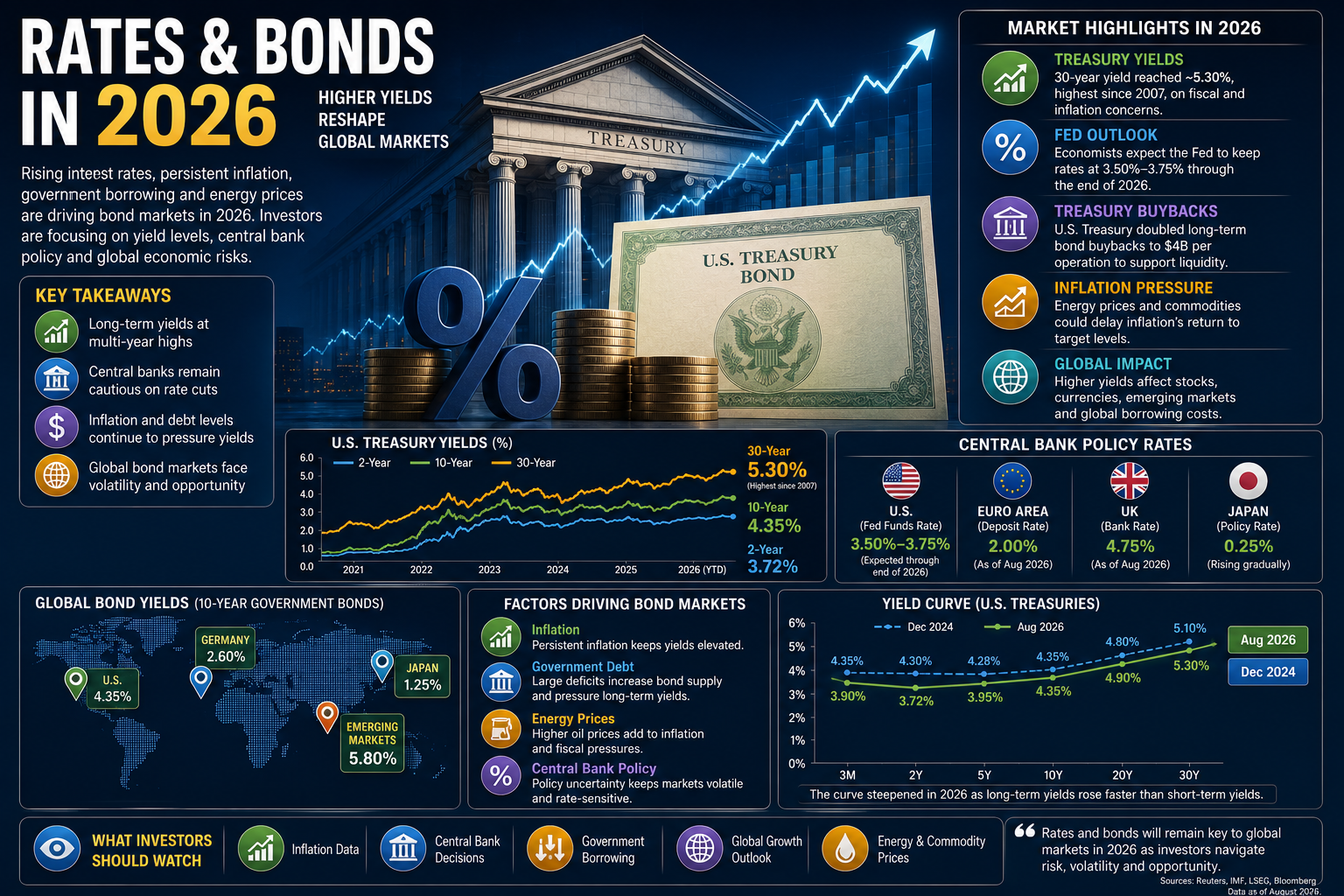
Interest rates and bond markets have become some of the most important areas to watch in 2026. Investors are balancing inflation, government borrowing, energy prices, central-bank policy and economic growth as long-term bond yields remain elevated across several major markets.
The U.S. bond market has faced particularly strong pressure. Recent selling pushed long-term Treasury yields to their highest levels in nearly two decades, with concerns about government borrowing, inflation and future interest-rate policy weighing on investors.
Interest Rates Remain a Major Market Driver
Interest rates influence almost every part of the financial system.
When central banks raise rates, borrowing becomes more expensive for households and businesses. When rates fall, financing generally becomes cheaper, potentially encouraging investment and spending.
In 2026, central banks are facing a difficult balance between controlling inflation and supporting economic activity.
A Reuters survey in August found that a strong majority of economists expected the U.S. Federal Reserve to keep its policy rate at 3.50%–3.75% through the end of 2026, although inflation and labor-market data could change that outlook.
U.S. Treasury Yields Remain Elevated
U.S. Treasury bonds are closely watched because they influence borrowing costs around the world.
The recent rise in long-term Treasury yields has reflected several concerns, including increased government borrowing, inflation expectations and uncertainty over future Federal Reserve policy.
Higher Treasury yields can affect:
Mortgage rates
Corporate borrowing
Government financing
Stock valuations
Currency markets
Emerging-market debt
This makes the Treasury market a key indicator for global financial conditions.
The 30-Year Treasury Draws Attention
Long-term U.S. government bonds have experienced particularly strong selling pressure.
Reuters reported that the 30-year Treasury yield reached levels not seen since 2007 during the recent market sell-off.
Long-term yields are influenced by expectations for inflation and interest rates, but also by government debt supply and investor demand.
For investors, higher yields can make bonds more attractive as a source of income, but existing bonds can lose market value when yields rise.
Treasury Buybacks Enter the Spotlight
The U.S. Treasury has also taken steps aimed at supporting liquidity in the long-term bond market.
In August, the Treasury announced that it would double some long-term bond buybacks from $2 billion to $4 billion per operation, with the program targeting securities with maturities of 10 to 30 years.
The announcement briefly pushed long-term yields lower.
However, analysts noted that the underlying pressures—including fiscal deficits and inflation expectations—remain significant.
Inflation Remains Important
Inflation is one of the biggest risks facing bond investors.
When inflation rises, investors may demand higher yields to compensate for the declining purchasing power of future interest payments.
The IMF has warned that higher energy prices and commodity costs could delay the return of inflation to central-bank targets.
This is particularly important for long-duration bonds because their prices are more sensitive to changes in interest rates.
Energy Prices Add Pressure
Energy markets have become increasingly important for bond investors in 2026.
Higher oil and gas prices can push inflation higher, potentially making central banks more cautious about cutting rates.
The IMF's 2026 outlook highlighted rising energy prices and geopolitical disruptions as important sources of inflation uncertainty.
For bond markets, this creates a difficult combination: investors want lower rates to support economic growth, but persistent inflation can prevent central banks from easing policy quickly.
Government Debt Is a Growing Concern
Government borrowing has become another major factor influencing bond markets.
Large fiscal deficits require governments to issue more debt.
When the supply of government bonds increases, investors may demand higher yields to absorb that additional debt.
The IMF has highlighted rising debt and fiscal imbalances as important sources of pressure on long-term yields.
This issue is not limited to the United States.
Japan and several European economies are also experiencing increased sensitivity to government borrowing and long-term yields.
European Bond Markets
European government bonds are also facing changing conditions.
Germany's long-term yields have been affected by inflation expectations, energy prices and expectations for European Central Bank policy.
The ECB faces its own challenge because higher energy costs can increase inflation while simultaneously weakening economic growth.
This can make decisions about interest rates more complicated.
Japan's Bond Market
Japan is another important bond market to watch.
After years of extremely low interest rates, Japan is moving toward a more normal interest-rate environment.
The IMF's April outlook projected that Japan's policy rate would gradually rise toward a neutral level of around 1.5%.
Higher Japanese rates can have global implications because Japanese investors hold substantial amounts of overseas assets.
Emerging-Market Bonds
Emerging-market bonds can offer higher yields than many developed-market government bonds.
However, they also carry additional risks.
Investors need to consider:
Currency movements
Government debt
Inflation
Political stability
Credit quality
Refinancing costs
When global interest rates rise, emerging-market borrowers can face higher financing costs.
The IMF has warned that higher yields and rollover risks can create additional pressure on emerging-market economies.
Corporate Bonds
Corporate bonds are also being affected by the changing interest-rate environment.
Companies issue bonds to finance expansion, acquisitions, refinancing and everyday operations.
When government yields rise, corporate borrowing costs generally rise as well.
Companies with strong balance sheets may be able to handle higher rates, while highly leveraged businesses can face greater pressure.
Bond Funds and ETFs
Bond funds and bond ETFs provide investors with diversified exposure to fixed-income markets.
They can invest in:
Government bonds
Corporate bonds
Municipal bonds
Emerging-market debt
Short-term securities
Long-term bonds
However, investors should understand that bond funds can lose value when interest rates rise.
The amount of interest-rate sensitivity depends partly on the fund's duration.
Short-Term vs. Long-Term Bonds
The choice between short- and long-term bonds has become particularly important.
Short-Term Bonds
Short-duration bonds generally have less sensitivity to interest-rate changes and mature sooner.
Long-Term Bonds
Long-duration bonds can provide higher yields but are more sensitive to changes in interest rates and inflation expectations.
Investors may therefore use a combination of maturities depending on their objectives.
The Yield Curve
The yield curve shows interest rates across different bond maturities.
Investors closely watch the difference between short- and long-term yields because it can provide information about expectations for inflation, economic growth and monetary policy.
A significant change in the yield curve can influence banks, corporate borrowing and investment strategies.
Why Higher Yields Matter for Stocks
Bond yields also affect equity markets.
When government bonds offer higher yields, investors may require greater potential returns from stocks.
Higher discount rates can particularly affect high-growth companies because much of their expected value comes from future earnings.
This is one reason technology and growth stocks can become more sensitive when long-term yields rise.
Bonds Can Offer Better Income
Higher yields are not entirely negative for bond investors.
Newly issued bonds can provide more attractive income than securities issued when interest rates were much lower.
Investors who hold bonds to maturity may receive the scheduled principal and interest payments, assuming the issuer does not default.
The challenge is that market prices can fluctuate before maturity.
What Investors Are Watching
Several factors will remain important for rates and bonds during the rest of 2026.
Federal Reserve Policy
Markets will closely follow inflation, employment and economic-growth data.
Inflation
Persistent inflation could keep rates higher for longer.
Government Borrowing
Large deficits could increase bond supply and pressure long-term yields.
Energy Prices
Higher oil and gas prices could increase inflation expectations.
Central Banks Globally
Different monetary policies across the U.S., Europe and Japan can create major currency and bond-market movements.
Treasury Demand
Foreign and domestic demand for U.S. government debt remains important for long-term yields.
The Outlook for Rates and Bonds
The bond market is entering a period where investors may need to focus more closely on fiscal policy and inflation rather than relying solely on central-bank decisions.
The IMF has noted that higher debt, inflation uncertainty and changing investor demand can increase sensitivity in sovereign bond markets.
At the same time, elevated yields can create opportunities for investors seeking income.
The key question is whether inflation eventually cools enough for central banks to lower rates, or whether persistent energy and fiscal pressures keep long-term yields elevated.
Final Thoughts
Rates and bonds are playing a central role in global markets in 2026.
U.S. Treasury yields have climbed sharply, European and Japanese bond markets are also facing pressure, and investors are paying greater attention to government debt and inflation risks.
For investors, higher yields create both challenges and opportunities.
Bond prices can decline when yields rise, but newly issued debt can offer more attractive income.
As central banks respond to inflation and economic conditions, interest rates and bond yields will remain among the most important indicators for global investors throughout 2026.
FAQs
What are interest rates?
Interest rates represent the cost of borrowing money and the return earned by lenders.
Why do bond prices fall when yields rise?
Existing bonds become less attractive when newly issued bonds offer higher yields, so their market prices generally decline.
Why are Treasury yields important?
U.S. Treasury yields influence borrowing costs, stock valuations, currencies and financial conditions worldwide.
What is the yield curve?
The yield curve shows interest rates across different bond maturities.
Are higher bond yields good for investors?
They can provide better income on newly purchased bonds, although rising yields can reduce the market value of existing bonds.
Why does inflation affect bonds?
Higher inflation reduces the purchasing power of future bond payments and can lead investors to demand higher yields.
What are emerging-market bonds?
They are debt securities issued by governments or companies in developing and emerging economies, often offering higher yields but also carrying greater risk.